WWI Today

Pritzker Military Museum & Library On War Military History Symposium March 31 – April 1, 2022 


31efbdcf 42d2 44e5 9d46 1eb3d6f398c1 

Pritzker Military Museum & Library On War Military History Symposium March 31 – April 1, 2022 

Special to the Doughboy Foundation web site 

The Pritzker Military Museum & Library present their 2022 On War Military History Symposium featuring Dr. Margaret MacMillan, recipient of the 2021 Pritzker Military Museum & Library’s Literature Award for Lifetime Achievement in Military Writing. The symposium will consider the current state of military history under the theme of “What is Military History Today?”. Individual panel sessions will explore and identify today’s challenges in researching, writing, and presenting military history, and how they are impacted by the needs and interests of diverse audiences. Perspectives from the academic community, military professionals, and the general public will be considered.

This year’s Symposium will take on a hybrid format with an option to join in person or virtually online. Sessions include: What is Military History Today?, Museums and Memorialization; Violence, Atrocity, and Restraint in War and Military History of the Post-Cold War. Pricing for member and non-member, in-person and virtual attendance is available on our website.

Behind the Epic WWI Memorial Being Sculpted in an Englewood Warehouse


Sabin Howard Departing Dad 5 Triad Guys 6 and 7 1Sabin Howard is working tirelessly on A Soldier’s Journey, the 60-foot-long bronze relief bound for the nation’s capital. In the completed section shown, the soldier heads into battle with two comrades.  

Behind the Epic WWI Memorial Being Sculpted in an Englewood Warehouse 

By Leslie Garisto Pfaff
via the New Jersey Monthly magazine web site

Behind the soaped window of a former warehouse in downtown Englewood, an epic journey is taking shape. Under a skylight that catches the day’s waning glow, Sabin Howard is carefully applying small swipes of clay to the figure of a soldier in a World War I doughboy’s uniform. Howard’s gaze moves from the sculpture to actor Mark Puchinsky, a live model who looks every inch the young warrior, down to the authentic olive drabs that Howard purchased from World War I reenactors.

The figure, about 10 percent larger than life, is one of 38 that will eventually comprise an intricate, 60-foot-long bronze relief titled A Soldier’s Journey. It will form the centerpiece of the country’s first national World War I memorial, commemorating the 4 million Americans who served in what was once known as the Great War. Chosen out of a field of 360 entries in an international competition, Howard’s piece will be installed in Pershing Park, just steps from the White House, in the fall of 2023 or the following spring.

The uncertain timing reflects the arduousness of Howard’s process. Each figure requires some 600 hours of work, meaning Howard can complete only nine or 10 figures in a year, even with two assistant sculptors and a team of models. Considered a master of modern classicism, Howard, 57, creates sculpture that is startlingly realistic. He is, says project manager Traci Stratton—the novelist/documentarian who is also Howard’s wife—a perfectionist: “If he had 800 hours to complete a work, he’d want 1,600,” she says. “If he had 1,000, he’d want 2,000.”

In fact, the project would literally have taken a lifetime to complete if Howard had followed his traditional routine: creating a drawing of the proposed sculpture, producing a small-scale 3-D maquette (or preliminary model), building foam-covered steel armatures (or frameworks) of each figure, applying clay to the armatures, and then casting the work in bronze. He was able to skip the labor-intensive third step in favor of a digital process in which the armatures are 3-D printed.

The work is a departure for Howard in another significant way. “I had to change from being a strict classicist”—sculpting idealized, largely static forms—“to being an expressive humanist. You can’t have a visceral impact on the viewer with art that’s purely cerebral.”

Inspired by Teaching History in England, I Explored the Unconventional Memorials Created by the Forgotten Female Veterans of World War I


Inspired by Teaching History in England, I Explored the Unconventional Memorials Created by the Forgotten Female Veterans of World War I

By Allison S. Finkelstein
Special to The Doughboy Foudation web site 

For any American who has been in Great Britain during the month of November, the enduring relevance of the memory of World War I in British culture is hard to miss. From the tradition of wearing a poppy to the nationwide two minutes of silence observed on Remembrance Sunday, many Britons remain deeply preoccupied with the Great War. After living among these rituals while teaching in the history department of an English boarding school, I started to wonder: why does the memory of World War I remain so much stronger in Great Britain than in the United States? This question led me on a long path to the publication of my first book: Forgotten Veterans, Invisible Memorials: How American Women Commemorated the Great War, 1917-1945. By investigating the groundbreaking role American women played in the memorialization of the war, the process of writing this book uncovered new ways to answer this question and revealed significant but too often overlooked aspects of World War I’s history that have renewed relevance today.QUEENS CEMETERY PUISIEUX France CWGC May 2009 by ASF 100 4413Queen’s Cemetery in Puisieux, France, a British World War I cemetery run by the Commonwealth War Graves Commission. Photograph by Allison S. Finkelstein 

Book Cover Jkt Finkelstein MKTGThe seeds for Forgotten Veterans, Invisible Memorials were planted during my time in England. After participating in British remembrance rituals and taking our students on a trip to the sites of the Western Front, I entered graduate school upon my return home. At the University of Maryland, College Park, I focused my studies on military commemoration. Two summers spent interning at the American Battle Monuments Commission (ABMC)—where I would later work—steered me firmly toward the First World War as my area of focus. I dove into this question about the American memory of the war through archival research as well as fieldwork at the Meuse-Argonne American Cemetery and Memorial in France.

By the time I selected my dissertation topic, I knew enough to realize that answering this question was far too big for just one project. Instead, I decided to approach the question by specifically examining how American women commemorated the war. Doing so, I hoped, might provide some explanation of America’s waning memory of World War I. Little did I know that my research would do more than just shed light on answers to this question, but it would also help to resurrect a forgotten group of American women from the recesses of history. The more time I spent researching these women as I transformed my dissertation into a book, the more passionate I became about sharing their stories.

In its final form, Forgotten Veterans, Invisible Memorials investigates how American women who somehow served or sacrificed in World War I commemorated that conflict. I argue that these female activists considered their community service and veterans advocacy projects to be forms of commemoration just as significant and effective as traditional memorialization methods such as monuments and statues. In other words, these women sometimes preferred projects that helped a broadly defined group of male and female ‘veterans’ as an alternative to physical monuments and memorials. These are the invisible memorials mentioned in the book’s title.

Arlington National Cemetery’s Tomb of the Unknown Soldier Centennial Commemoration


 Soldiers dressed as Doughboys in processiont Nov 11 21 U.S. Army photo by Sgt Charlotte CarulliSoldiers dressed as Doughboys in procession on Nov 11 2021. U.S. Army photo by Sgt Charlotte Carulli

Arlington National Cemetery’s Tomb of the Unknown Soldier Centennial Commemoration

By Allison S. Finkelstein, Ph.D., Senior Historian, Arlington National Cemetery
Special to the  Doughboy Foundation web site

In 2021, Arlington National Cemetery (ANC) served as the designated government leader of the congressionally mandated Tomb of the Unknown Soldier Centennial Commemoration. This centennial recognized the 100th anniversary of the Tomb’s creation at ANC on November 11, 1921.

As the culmination of years of work by the entire ANC team, this yearlong commemoration produced a wealth of content for the public about the history and meanings of the Tomb of the Unknown Soldier, much of which focused on World War I (WWI). We are excited to share these resources with readers of the Doughboy Foundation Dispatch Newsletter so we can continue to raise awareness about the Tomb’s significance.

Over the next several months, we will be contributing a series of articles that highlight the different projects we created for the Tomb Centennial. Just as the 1921 ceremonies for the burial of the WWI Unknown Soldier involved mass public participation, the Tomb Centennial engaged the public through a variety of means: exhibits, publications, webinars, videos, digital media, an education program, and participatory ceremonies. For more information on the Tomb Centennial, please visit the following websites:

This month, we are sharing our Commemorative Guide to the Tomb of the Unknown Soldier. In the years leading up to the Centennial, the ANC History Office undertook in-depth research into the history of the Tomb and its legacy. This research will eventually yield two publications.

Orange County Historian to host trip to Europe to pay tribute to the Harlem’s Rattlers (the 369th New York Infantry Regiment) in World War I

Goshen, N.Y. – Orange County Historian Johanna Yaun will host [...]

Mrs. Dawson’s Wartime Memories


Mrs. Dawson’s  book was a thoughtful gift.

Mrs. Dawson’s Wartime Memories 

By Thomas Emme
Special to the Doughboy Foundation web site 

It all started with a gift.

It was a thoughtful gift; the giver knew that I had an interest in the history of the Great War and it was a book full of World War 1 photography. It was over a hundred years old but in bad shape. The binding was broken and unravelling, and the cover almost fell off when I opened it. I took the book home and set it aside for a more careful look.  In the back of my mind, I thought if it wasn’t salvageable, I might be able to turn it into an art project.

Collier’s Photographic History of the European War

Collier’s Photographic History of the European War

Collier’s Magazine was a general interest magazine, founded in 1888 and published weekly until 1957. This “photographic history” was one in a series of five books published by Colliers between 1916 and 1919 to document the war. Before television or the internet, books like this defined what war looked like to the average person. This image is of the cover page from the first volume published in 1916 and the title refers to the “European War”. This was because the United States had not yet joined the war. Future editions included pictures of soldiers from the United States and the series was renamed to the photographic history of the “World War”.

From World War I to now: Helping Veterans One Action at a Time


From World War I to now: Helping Veterans One Action at a Time 

By Rhonda Underhill
Special to the Doughboy Foubdation web site 

WWI DisabledToday’s veterans have many benefits that their predecessors didn’t. When you look, especially, at World War I veterans, who bore the brunt of a society concerned over what they deemed excessive benefits given to Civil War veterans, today’s vets are doing much better. But, it’s not enough.

Let's look at a few different ways that you can help the veterans in your community 100 years after World War I.

Veteran Benefits

Unlike the millions of drafted veterans of World War I, many new military enlistees today go into service with benefits in mind. The most coveted may be the military’s education programs, including the G.I. Bill. Veterans may also qualify for low-cost medical care, job training, counseling, and loans earmarked for former service members. And, in 2022, the majority of disabled veterans will see a disability cost-of-living adjustment of 5.9%, according to Benefits.com.

However, many veterans struggle with a lack of access to these benefits, along with PTSD, sexual trauma, and higher than average unemployment. Homelessness and suicide are also common. But, with help from a community that cares, the veterans in your life can receive the assistance they need and the respect they deserve.

How To Help

There are many ways to help veterans, from offering a simple token of appreciation to launching full-scale fundraising campaigns that provide financial assistance to low-income vets. Other ideas include:

Learn about their needs. Often, we don’t help because we don’t know what’s needed. Consider learning what you can about World War I, Vietnam, Korea, Desert Storm, and other veterans in your community. This could include looking at the history of the wars, what they’ve been through, and how they were treated upon return home.

New musical honors military exploits of women in WWI


Rosemarie Chandler as Grace Banker in the Phoenix Theatre Companys production of The Hello GirlsRosemarie Chandler as Grace Banker in the Phoenix Theatre Companys production of The Hello Girls 

New musical honors military exploits of women in WWI 

By Bridgette M. Redman
via The Glendale Star newspaper (AZ) web site

After spending her childhood on Luke Air Force Base, Rosemarie Chandler finds it fitting that she’s playing one of the first women in combat during World War I in “The Hello Girls” by the Phoenix Theatre Company.

“The Hello Girls,” which runs through Jan. 30, stars Chandler as Grace Banker, a switchboard operator in charge of a corps of women who went overseas during World War I.

The daughter of two military parents, Chandler lived on Luke AFB in the mid-1990s at the age of 4.

She recalled her parents attending a charity ball and leaving her older brother in charge. Instead of listening to him, she locked herself and her best friend’s neighbor in her dad’s military closet filled with freshly pressed and dry-cleaned suits.

“I started doing makeup and got makeup all over his flight suits and dress suits,” Chandler said. “My mom came home, and she was furious.”

Her younger brother is now stationed at Luke Air Force Base. During visits, she hears stories from female lieutenants.

“It’s definitely been hugely impactful to understand that part of my mom and also what it is like to be a woman in general in the military today,” Chandler said. “They’ve come so far and made great strides, but I think there are still ways we can become even more inclusive.”

Her mother was a protocol officer in the Navy for Adm. William Crowe and traveled around the world with him. It was also how her parents met.

“They held the same rank,” Chandler said. “I love that part of their story. The first time he walked into the office, my mom was doing paperwork. She didn’t even look up. She just handed him his paperwork and said, ‘Here you go, Mr. Chandler.’ My dad was smitten right away and went about pursuing her.”

Uncharted waters

The women in “The Hello Girls” had a more challenging route, as there were no women in the military. The musical is a modern retelling of a critical part of history in the struggle for women’s rights.

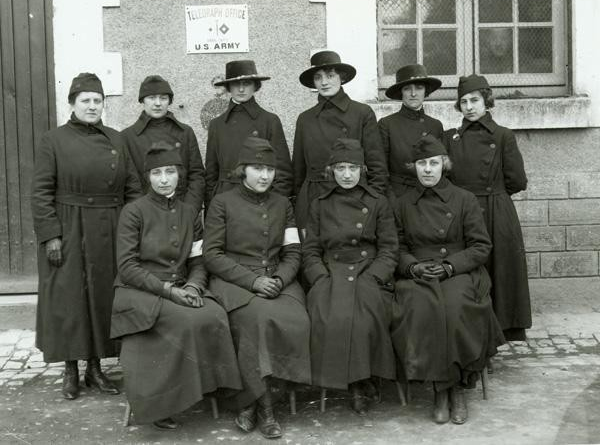
The women were part of the Signal Corps Female Telephone Operators Unit, typically known as “The Hello Girls.” They were bilingual telephone operators who helped turn the tide in World War I and fought to make their way to the front lines. After the war, they spent decades fighting for equality and recognition.

The story jumped out at Cara Reichel, the show’s director and co-writer.

“As someone who makes musicals, I’m always on the lookout for stories and ideas,” Reichel said. “I kind of have a mental Rolodex of things. I remember clearly when I first encountered their story — a very brief mention of them in a larger documentary on the history of women in the military. The name was ‘Unsung Heroes,’ and I thought maybe someone should sing about these women.” 

Go to Top