Lest We Forget the Great War
Published: 6 November 2026
By Brian T. Allen
via the National Review magazine website
National Review header image. edited framed
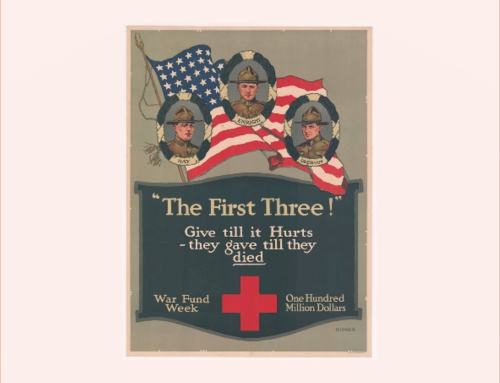
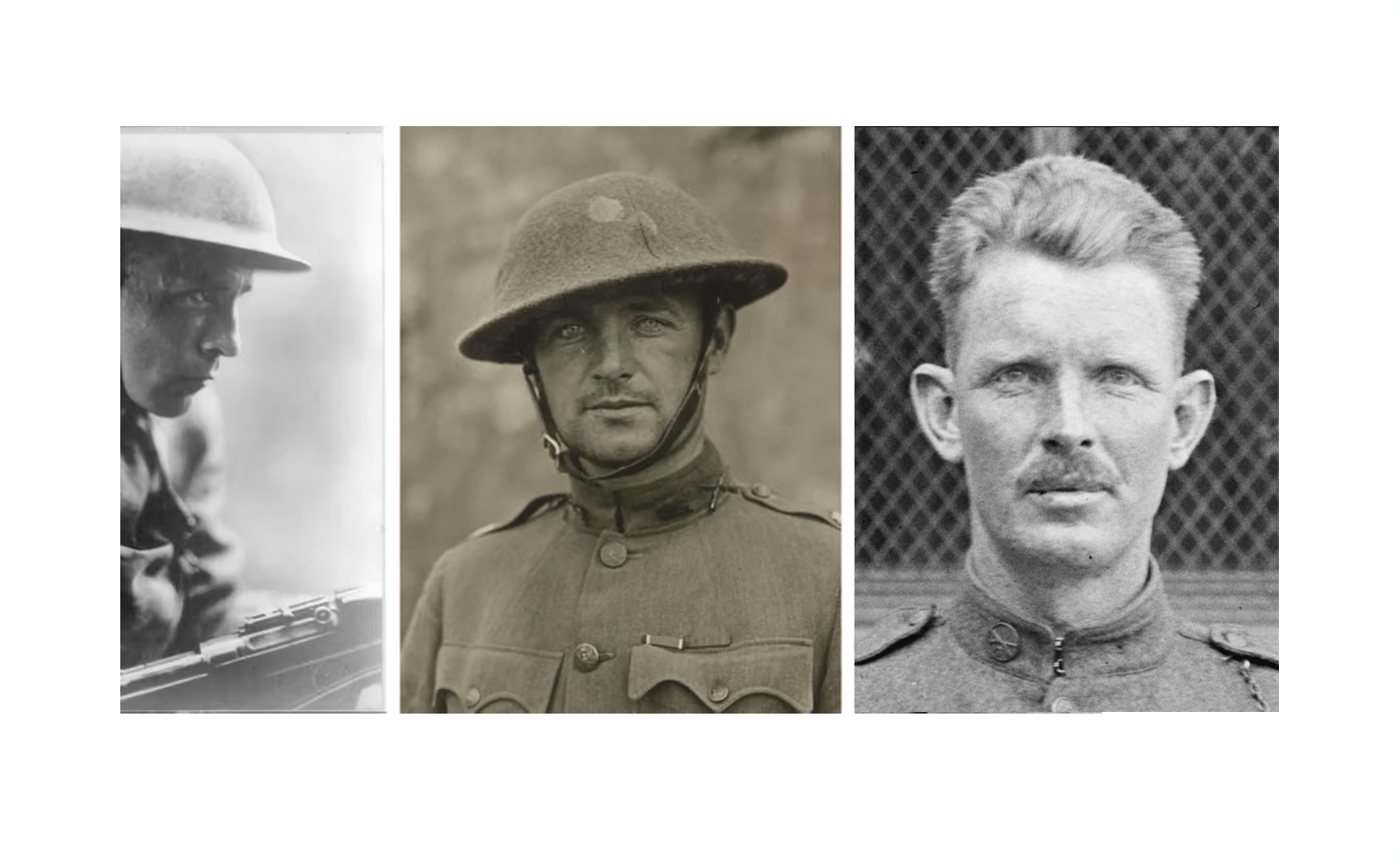
As Veterans Day approaches, time to remember the Doughboys. Anonymous soldier on the left, Wild Bill Donovan in the center, and Alvin York on the right.
Kansas City’s World War I Museum tells the intense, poignant story of the war Americans often overlook.
With Veterans Day nigh, I made a special point, when in Kansas City recently, to visit our National World War I Museum. It’s the official museum — so sayeth Congress — for the interpretation of our place as a combatant from April 6, 1917, the day of the war declaration, to the armistice on November 11, 1918, and the Treaty of Versailles. We came late to the labyrinth of slaughter, delusion, and intransigence but helped to end it, for a while.
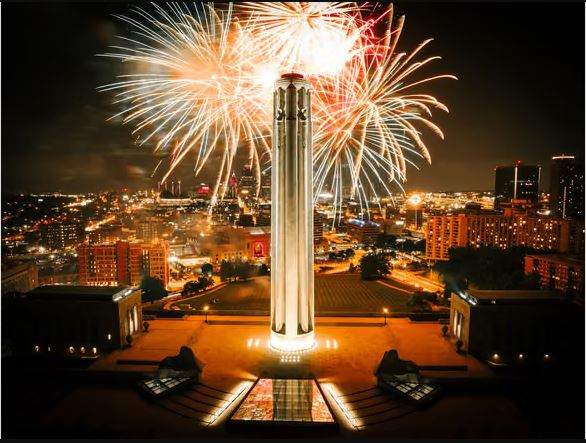
Fireworks illuminate the Liberty Memorial Tower. (National WWI Museum and Memorial)
The museum lies beneath the grounds surrounding the memorial obelisk, the Liberty Memorial Tower, built in the 1920s to honor those who served in the war, especially the 411 Kansas Cityans who died. The entrance signage and doors are inauspicious in that they give the impression of entering via a loading dock, but, once inside, you see that the museum nicely radiates in three efficient directions, one to the left for visitor amenities and one to the right for special exhibitions spaces. Straight ahead there’s a glass bridge under which is a field of 9,000 silk poppies, one for every 1,000 of the 9 million combatants killed in the war, and that’s just fatalities. I had to stand still for a moment and breathe deeply to contemplate so many dead and so many horribly wounded and how the war turned the world upside down.
It’s a difficult, dense history museum, but there’s no making a long story short. It starts in Europe, with an introductory gallery called Grand Illusions about Old World ambitions, schemes, insecurities, and missteps. A web of alliances, competition for colonies, blank checks, a martial but gullible public, and incompetent, not satanic, kings, generals, and pols: All were sticks of dynamite. The lit fuses exploded in August 1914, and so the world of the Congress of Vienna collapsed. Our betters had never failed so horribly.
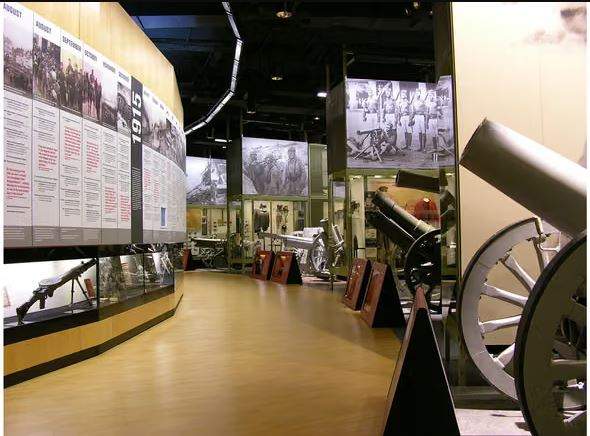
A World War I timeline and artillery exhibit. (National WWI Museum and Memorial)
A superb month-by-month, multilayered timeline for 1914 and 1915 starts with Franz Ferdinand, the tubby heir to the Austrian throne, shot to death on June 28, 1914. This triggered pledges of unconditional support and ultimatums, Russian mobilization, the activation of Britain’s pledge from 1838 to protect Belgium’s neutrality, and war. Liège, Leuven, Ypres, the Rape of Belgium, and the Marne, sieges and battles, soon filled the headlines, as did trench warfare, the Wire of Death, and, by New Year’s Day, 4 million young men wounded or dead. Paris nearly fell. It might have been quick, like the Franco-Prussian War, but it wasn’t. By war’s end, more than one of three French men between 18 and 30 were dead. No wonder so many of the French have lost faith in God. Millions dead in such a war would make a nihilist of anyone.
The text of the timeline is very rich, with good photography, blow-by-blow events, and a juicy quote for every month. There’s “the lamps are going out all over Europe,” famous enough, as is “the world must be made safe for democracy,” that from the psycho, liar, and warmonger Woodrow Wilson. One wag admired “the majestic spectacle” of warships headed to battle, as if the war was an aesthetic experience, as it indeed was for many. “I hope he roasted all the way down,” a British fighting ace said when he heard that the Red Baron, Manfred von Richthofen, had been shot from the skies. My kinda guy. Definitely not turn-the-other-cheek. “Life is one hell, death is a mere trifle. . . . We are all screws in a machine that wallows forward,” a German soldier said.
Below the timeline is a row of low glass cases. The first object is a model of the pistol that 19-year-old Gavrilo Princip, a Serbian student, used to shoot Ferdinand and his wife. It looks like a toy gun. Two bullets that plunged the world into a living hell.
Speaking of guns, opposite the timeline is an array of munitions. A catastrophic failure of leadership is one of the museum’s themes. Trench warfare is another — and gruesome one — but a third is war technology. That’s the deployment of what were, at the time, the most lethal weapons in the history of war. A French 75mm field gun, heavy howitzers, a Renault FT-17 field tank, a trench mortar, and much else are blood-curdling. Techno war wasn’t just fought on the ground. The museum does exhibits on the U-Boat and the air war, with a special focus on the top pilots and their kills. There’s a torpedo and a German thermite bomb.
⇒ Read the entire article on the National Review website here:
External Web Site Notice: This page contains information directly presented from an external source. The terms and conditions of this page may not be the same as those of this website. Click here to read the full disclaimer notice for external web sites. Thank you.