The Music That Endured: Honoring America’s Musicians of World War I
Published: 13 November 2026
By Dan Dayton
Special to the Doughboy Foundation website
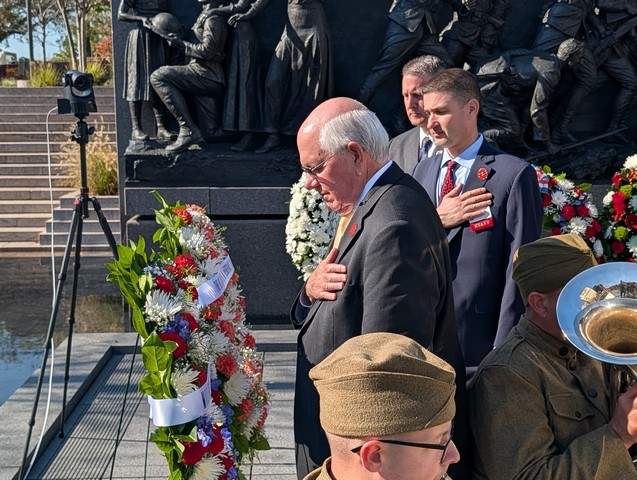
Wreath for Musicians
"It was a profound honor to recognize those who sacrificed their lives to bring music to a War that Changed the World." — Dan Dayton
When America entered World War I in 1917, thousands of musicians answered the call to serve. They left behind concert halls, theaters, orchestras, and promising careers to join the American Expeditionary Forces in France. They carried with them something as powerful as it was essential: music.
Throughout the Great War, music lifted spirits, strengthened resolve, comforted the wounded, and reminded soldiers of the homes and families they had left behind. The American Expeditionary Forces included hundreds of military bands, whose musicians helped sustain morale while introducing Europe to the distinctive sounds of American ragtime and early jazz.
Among these remarkable Americans were three whose stories deserve special remembrance.
David Hochstein (1892–1918) was one of America’s most promising young violinists. Having performed at Carnegie Hall and studied with distinguished European masters, he set aside a brilliant musical career to serve his country. He lost his life in France in October 1918, just weeks before the Armistice. His legacy lives on through the Hochstein School of Music in Rochester, New York.
Morris Wilbur Bennett (died 1918) served as a clarinetist with the 115th Infantry Regiment. Like so many military musicians, he brought encouragement and moments of humanity to men enduring the extraordinary hardships of war. He died of pneumonia in France in October 1918, leaving behind a story emblematic of the thousands of musicians whose service deserves recognition.
James Reese Europe (1881–1919), the legendary bandleader of the 369th Infantry Regiment, the Harlem Hellfighters, helped change the course of American musical history. His performances across France introduced European audiences to the rhythms of American jazz. Although he survived the war, his untimely death in 1919 deprived America of one of its most influential musical pioneers.
These men represent a generation of American musicians who understood that music was not a luxury in wartime. It was a necessity. Their artistry brought comfort amid suffering, hope amid uncertainty, and a shared humanity to a world torn apart by conflict.
As Founder of the Doughboy Foundation and Producer of The Story of a Rose: A Musical Reverie on the Great War, I believe that remembering these musicians is an essential part of honoring the American experience of World War I.
Their legacy reminds us that the history of the Great War cannot be told through battles and military achievements alone. It must also be told through the music, poetry, courage, and humanity of those who served.
More than a century later, their music still speaks to us. Our responsibility is to ensure that their stories are never forgotten.
We shall remember them.
 Dan Dayton is the Founder of the Doughboy Foundation, and Producer of The Story of a Rose: A Musical Reverie on the Great War.