U.S. Naval Aviation vs. the U-boats in WWI
Published: 17 September 2026
By Kimball Worcester
via the Roads to the Great War website
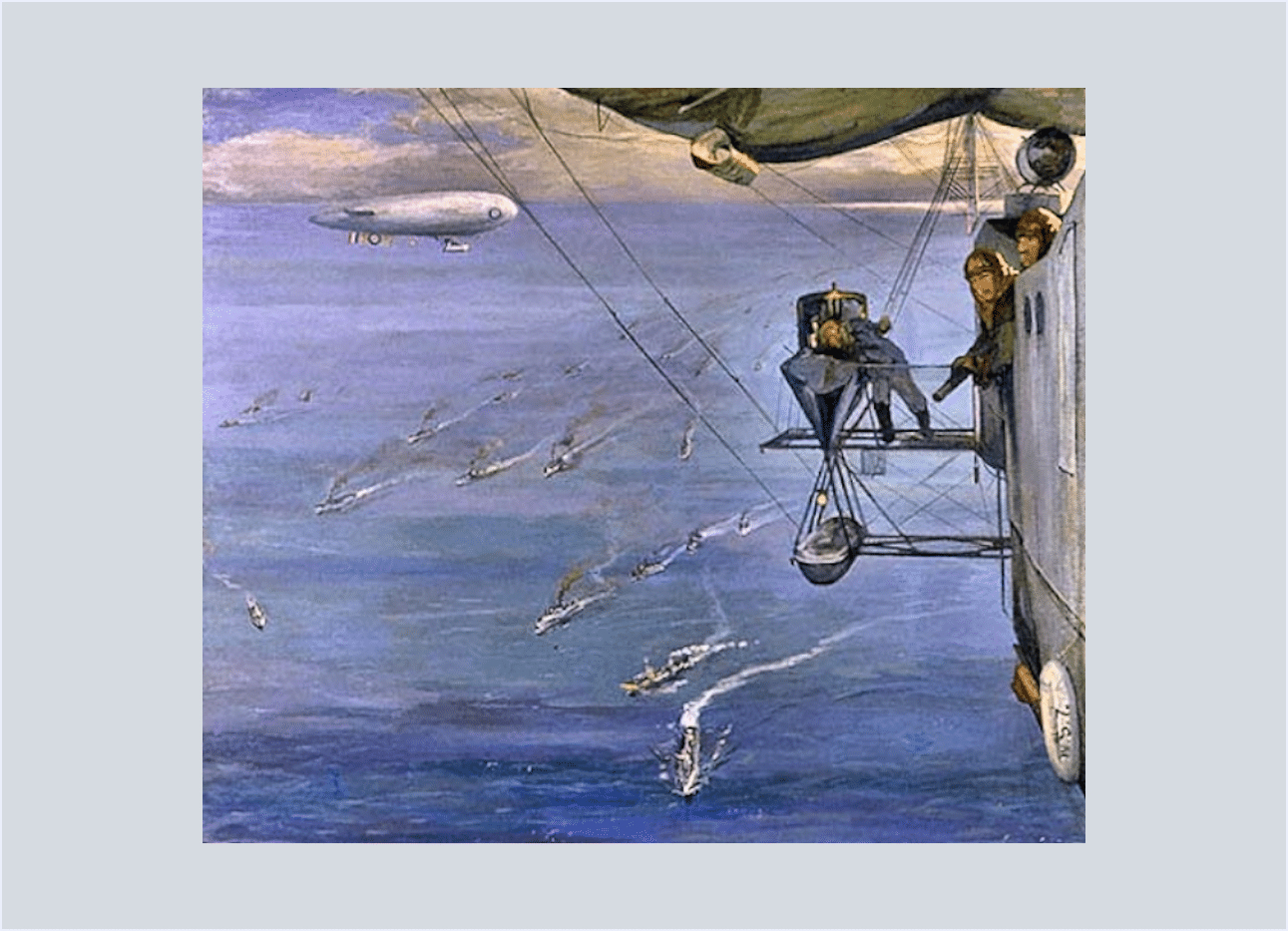
Navy Blimps Escorting a Convoy
U.S. Navy blimps escorting a convoy during World War I.
Introduction:
The U.S. Navy aviation entered World War I as a tiny force of just 54 obsolete aircraft and 48 pilots, but expanded rapidly into a major anti-submarine patrol network operating 44 stations globally by the 1918 Armistice. Naval aviators flew seaplanes, dirigibles, and kite balloons on more than 22,000 patrols across 3 million nautical miles, targeting German U-boats threatening Allied supply shipping. By the Armistice, the U.S. Navy was operating over 2,100 aircraft, 15 airships, and 215 kite balloons.
_________________________________________
The primary role of naval aviation in WWI was anti-submarine warfare. The first recorded attack on an enemy submarine by a U.S. naval aviator was made by Ens. John F. McNamara on 25 March 1918, while serving at the Royal Navy Air Station, Portland, England. Although his attack was successful enough to warrant special commendations from the Secretary of the Navy and Adm. Sims, the later evaluation was “possibly damaged.” This was typical of the 30 recorded attacks on enemy U-boats during the war. On the score sheet U.S. naval aircraft did not receive credit for a single sinking. There was, however, considerable interference with U-boat operations, especially in the last year of the Great War.
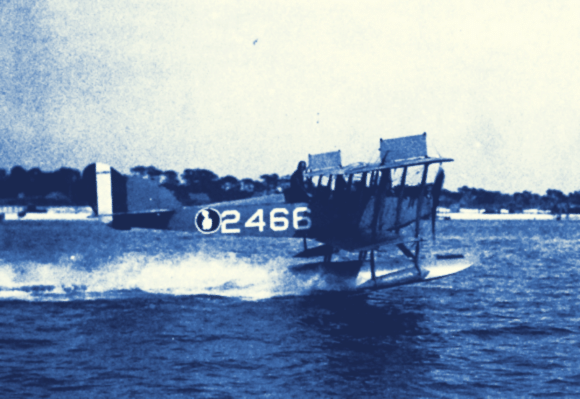
Curtiss N-9 Seaplane (Primarily Used for Training)
The first attack from a U.S. Naval Air Station was from Ile Tudy, France, which, perhaps because of its location, had more anti-submarine action than any of our overseas stations. Two coastal convoys passed through its sector daily, one bound north, the other south. Around Penmarch Point, the water was deep near shore, free of reefs and sandbars and ideally suited to submarine operations. A majority of the “allos” received at Ile Tudy were from this area. The operating routine was described by the station historian. “The sector was marked off into 25-mile squares, subdivided into squares of five miles. By this means planes were able to report position every half hour and be quickly and accurately located. Communication was maintained with shore bases by radio and pigeons, and with vessels by message buoys, phosphorous buoys, Very pistols and the blinker system. . . .
“A section of two planes escorted each convoy. As the sector was too long to be covered entirely by two planes, it was necessary to send out another section to relieve the first, when the convoy was approximately halfway through the area. This necessitated using at least eight planes per day for convoy work alone. In addition, there was always a section known as the ‘Alert’ ready to take the air from daybreak to dark in response to any ‘allos’ received. When the convoy was picked up, the planes would first circle over it. Then while one plane would remain around the convoy the other would fly as far as 10 to 15 miles ahead, zigzagging broadly on both sides. This plane would return, again circle the convoy, repeating the same maneuver again and again. Before leaving a convoy, the planes circled a last time in its neighborhood. In this way the convoy was well protected from surprise.”
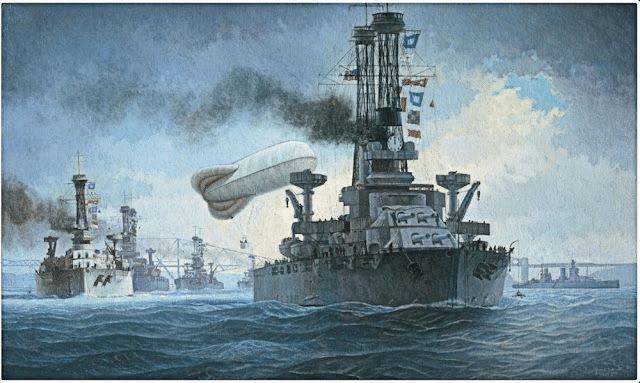
U.S. Battleships Departing the Firth of Forth with Observation Kite Balloons Aloft
On 23 April 1918, a convoy escort of two Donnet-Denhaut seaplanes, piloted by Ens. K. R. Smith and R. H. Harrell, QM1c, saw the first action. They joined the southbound convoy of about 20 ships, approximately six miles north of Penmarch Point. As the weather was very foggy, they first flew to the rear of the convoy to look for stragglers, then flew a wide circle toward the main body. Shortly after, they sighted a suspicious wake, apparently being made by a submarine moving at good speed, and went in to attack. Smith dropped two bombs, the first landing on the fore part of the wake and the second ten feet ahead. The explosions created a heavy disturbance in the water followed by many air bubbles and appeared so successful that Harrell did not drop his bombs. Instead, he marked the spot with a phosphorous buoy and circled. Smith then flew to a destroyer, USS Stewart, and dropped a message buoy. Stewart arrived in the target area, followed soon after by the French gunboat Ardente, and dropped three depth charges. The pilots circling overhead saw small pieces of wreckage, particles of sea growth and large quantities of oil coming to the surface, and shortly after returned to their base. The oil was still visible from the air as late as the sixth of May. Ens. Smith and his observer, Chief O. E. Williams, were officially credited by the French naval authorities with a submarine, were cited in the Order of the Day and awarded Croix de Guerre with Palm.
⇒ Read the entire article on the Roads to the Great War website here:
External Web Site Notice: This page contains information directly presented from an external source. The terms and conditions of this page may not be the same as those of this website. Click here to read the full disclaimer notice for external web sites. Thank you.