The U.S. Has Seen Labor Shortages Before: Working Women During World War I
Published: 30 August 2026
By Tae H. Kim
via the Barrow Group website
World-War-I-Women
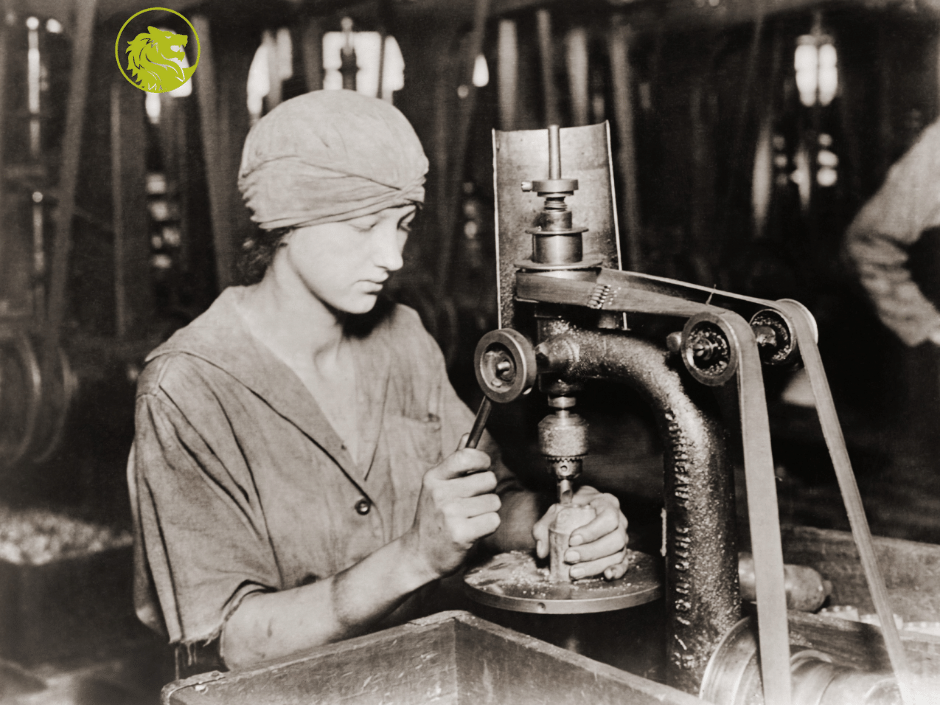
As men left their jobs to serve their country in war overseas, women replaced their jobs. Women filled many jobs that were brought into existence by wartime needs. As a result, the number of women employed greatly increased in many industries. In the U.S. there were, before the war, over eight million women in paid occupations. After the war began, not only did their numbers increased in common lines of work, but as one newspaper stated, “There has been a sudden influx of women into such unusual occupations as bank clerks, ticket sellers, elevator operator, chauffeur, street car conductor, railroad trackwalker, section hand, locomotive wiper and oiler, locomotive dispatcher, block operator, draw bridge attendant, and employment in machine shops, steel mills, powder and ammunition factories, airplane works, boot blacking and farming.” Many of these women were married, and some were mothers whose husbands or older sons had gone to front. Women were also seen as vital resources for wartime aids, and various wartime slogans such as “You should aid nation in the war” and “Everyone has to be a helper” emphasized patriotism and created the environment for women’s active involvement in many industries. By looking through various newspapers including the Seattle Post-Intelligencer and the Seattle Times, dated from 1917 to 1918 as my main primary sources for the research, I began to understand the role that women played during World War I.
A. General feminine jobs
Even though many women were in high demand for industries where previously men were dominant, long-established feminine jobs were still common during the war. The Seattle Post-Intelligencer and Seattle Times had a full listing of open positions for general housework and other general domestic jobs. The war actually created more domestic jobs because many women who worked in factories and outside their homes were not able to care well enough for their children. Help wanted ads and situation wanted ads looking for general housework were very easy to find in newspaper “help wanted” sections. Ads such as: “Widow: 40; very good appearance, whose only support has gone to war would like some light work to help out” and “Wanted – Reliable neat school girl to assist general housework. Nice home” were evidence for the fact that there were many women, regardless of age and status, who were willing to work, either to help nation to win the war or to sustain the life of their family in absence of their husband and father.
B. Increase in war emergency jobs
As more and more men were drafted and had to leave their jobs, the U.S. government and various industries were seriously looking for female workers who could replace their men’s jobs. Especially during 1917 and 1918, there were a vast number of demands for female stenographers, telegraphers, and phone operators. The Women’s Defense League was also placing a lot of effort to fill the gap. Potential telegraphers had to learn the code through memorization or by familiarizing themselves to carry out their work efficiently. One newspaper wrote, “Women are more apt than men in this line of work.” The various railroad companies of the country employed hundred of capable women operators, because they were known to be not only skillful, but also dependable. In many newspapers, ads looking for stenographers and other clerical works were increasing over time. In “situation wanted” sections of the newspapers, two thirds of the total ads were looking for female stenographers, an example being, “Thoroughly competent bookkeeper, cashier, and stenographer, six years with last firm in charge of books and collections, desire position of responsibility.” Evident in this ad, women were willing to take more responsible jobs and were becoming not just a substitute labor force, but skillful workers. The government was also in need of thousands of wartime positions open to women to work as government clerks, stenographers, and telegraphers.
C. Red Cross, Patriotic League, and YWCA
Organizations such as the Red Cross, Patriotic League, and YWCA also made efforts in supporting wartime hardships that the nation might face. The Red Cross organized non-professional women to aid in relief work. To help the war effort, many women joined the Red Cross as nurses. While they were in the Red Cross, they rolled bandages, knitted socks, and worked in military hospitals. Most of the women were wives and mothers of soldiers of all classes. The Red Cross war council also created a women’s bureau, which appointed a national advisory committee of women that made an effort to recruit every available woman in the campaign to make adequate funds and supplies. Women in the Red Cross were also helpful in recruiting men who had not joined the war. One method was by showing a man in civilian clothes with white feathers as a mark of cowardice. Another method was by making women speak at public meetings, encouraging others to have nothing to do with men who had not joined the war. Women also went over seas as members of the Voluntary Aid Detachment of the Red Cross. Volunteering brought them out of the house and into the public. Women had no trouble filling the gaps left by men who went to war. The Red Cross continued to encourage many women to join the Red Cross by saying “It’s the patriotic duty of every man, woman, and child to join the Red Cross. Why wait to be asked? Be a volunteer.”
The Patriotic League also organized girls for wartime activities. A branch of the Patriotic League, the National Organization for Girls, which was active in social service work and war services. It was organized in Seattle in 1918 to organize the city’s patriotic girls for real war activities. An editorial piece in the Seattle Argus newspaper covered the story of young girls who had donated bed shirts to the Red Cross with the money that they had made at work. One article pointed out that, “Hundreds – Probably thousands are doing their utmost to help win the war. They are the private soldiers.”Girls and women were soldiers armed with patriotism and hard work.
The Young Women Christian Association’s northwestern field committee was also concerned with the needs of the war. The committee occasionally discussed the great increase in the duties of employment agencies of the YWCA because of the war. In those discussions they came to the conclusion that training girls to take the place of the men was necessary. One newspaper wrote, “The necessity of training girls to take the place of men, and also work in connection with the hostess houses at Camp Lewis, Vancouver barracks and Bremerton, has made as many demands upon the Northwest.” Further advancement in the development of women’s work was strengthened by the withdrawal of millions of men from the American industry.
⇒ Read the entire article on the Barrow Group website here:
External Web Site Notice: This page contains information directly presented from an external source. The terms and conditions of this page may not be the same as those of this website. Click here to read the full disclaimer notice for external web sites. Thank you.