Navy-Merchant Marine Memorial
Published: 22 September 2026
By David Coleman
via the Have Camera Will Travel website
Navy-Merchant Marine Memorial
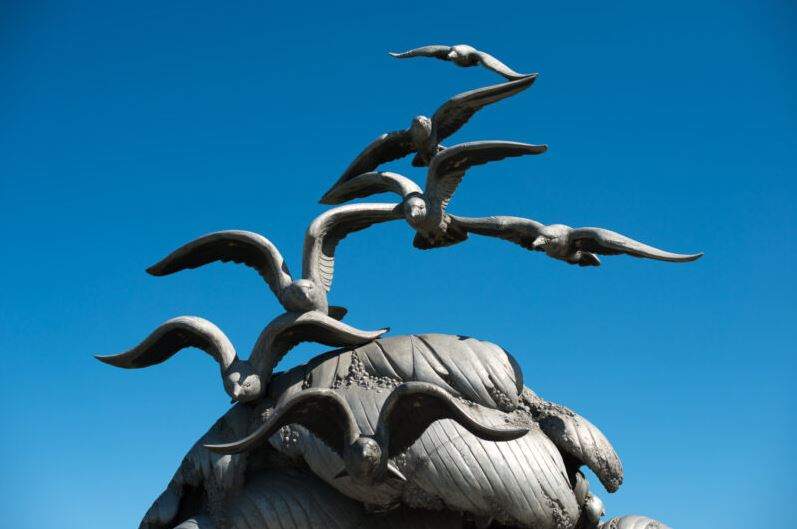
The Navy-Merchant Marine Memorial, featuring a large, evocative aluminum sculpture of a cresting wave and seagulls in flight, sits on Columbia Island on the Arlington side of the Potomac. (Photo by David Coleman / Have Camera Will Travel)
The Navy-Merchant Marine Memorial, featuring a large, evocative aluminum sculpture of a cresting wave and seagulls in flight, sits on Columbia Island on the Arlington side of the Potomac.
The Navy-Merchant Marine Memorial honors the Americans of the U.S. Navy and U.S. Merchant Marine who lost their lives at sea during World War I.
You might see it referred to as the Navy Marine Memorial in nearby signs, but it’s referring to the same thing. There is also a Navy Memorial in downtown Washington, D.C.
Notably, the memorial is cast in aluminum, which is what gives it that distinctive patina that looks different from most other monuments in the area.
It was a bold innovation for monumental sculpture in the 1930s, but it fits with the Art Deco style. And it has practical benefits stemming from the material’s lightness and resistance to weathering. It means that the sculpture rises to an impressive 35 feet and can have those seagulls safely towering up there.

Weeping willow branches frame the Navy-Merchant Marine Memorial, an aluminum sculpture of seven gulls rising above a breaking wave in Lady Bird Johnson Park. Dedicated in 1934 and created by Ernesto Begni del Piatta, the Art Deco monument honors Navy sailors and merchant mariners lost at sea during World War I. Locals know it simply as “Waves and Gulls.” (Photo by David Coleman / Have Camera Will Travel)
Dedicated in 1934, it was the work of Italian sculptor Ernesto Begni del Piatta, who sought to evoke both the serenity and the peril of the sea.1
The centerpiece of the memorial features seven streamlined seagulls soaring above stylized ocean waves, symbolizing the spirits of those lost at sea.
Initially, it was intended to rest atop an imposing base of polished green granite. However, limited funds during the Great Depression resulted in its placement on a plain concrete base, later replaced by a more modest green granite pedestal.
Encircling the monument is a wide flower bed that bursts into a vivid sea of red tulips each spring. In the summer, they’re replaced with a bed of other flowers.
⇒ Read the entire article and see more great pictures on the Have Camera Will Travel website here:
External Web Site Notice: This page contains information directly presented from an external source. The terms and conditions of this page may not be the same as those of this website. Click here to read the full disclaimer notice for external web sites. Thank you.