In 1920, Washington planted 507 Norway maples along 16th Street to honor its war dead; the invasive species later spread into Rock Creek Park
Published: 13 August 2026
via The Economic Times | US website
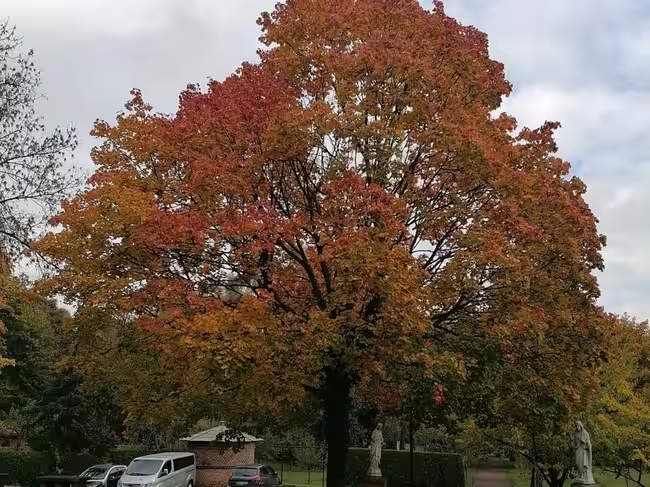
norway-maple
An image of a Norway maple tree. (Credits: Wikimedia Commons)
In 1920, Washington, DC, created a unique living memorial to residents who had died during World War I: 507 Norway maple trees planted along 16th Street NW. This was dedicated on Memorial Day, May 30, 1920, along the stretch between Alaska Avenue and Allison Street. The memorial’s legacy goes beyond the commemoration, as the Norway maple species (Acer platanoides) has the capacity to reproduce and establish itself beyond cultivated lands and was widely planted during that time as an urban shade tree. Over the following decades, it became one of the non-native trees found in Washington’s Rock Creek Park, with the National Park Service now classifying it as an aggressively invasive species.
A memorial consisting of living trees
The original idea of the memorial was conceived by the District’s American Legion as a way to commemorate the dead through a landscape instead of a conventional monument. A 1986 Washington Post article reported that one tree and one plaque were dedicated for each of the 507 District servicemen who had died in World War I. The memorial created a long tree-lined memorial corridor along 16th Street NW. The species chosen for the memorial was Norway maple, which had become popular in American cities because of its hardiness, rapid establishment, and ability to tolerate urban conditions. According to the University of Connecticut Extension, Norway maple was introduced into the United States in the mid-1700s and became widely planted as a street tree during the 19th century.
The memorial did not remain at exactly 507 trees: historical reports say another 23 trees and markers were added in early 1922 for people omitted from the original memorial, bringing the total to 530. For years, the trees and markers were decorated during Memorial Day, but over time the maintenance gradually declined. According to the Washington Post, by the beginning of World War II, most of the trees had died, and many plaques had been damaged or stolen.
When an urban tree moved into the forest
The ecological story of the species, however, continued long after the original 16th Street plantings died. Planted directly along the eastern boundary of Rock Creek Park, the 16th Street corridor shared an immediate physical border with the forest edge. Because Norway maples can begin producing seeds in just ten years, the mature memorial trees had a nine-year active seeding window to cast their winged seeds, known as samaras, directly into the park via autumn winds before the roadside population collapsed. This initial wave of wind-dispersed seeds established a self-sustaining beachhead within the park’s interior. Crucially, while urban stress and neglect wiped out the parent roadside trees by 1939, the wild offspring thriving inside the protected park escaped this collapse. Having reached their own reproductive maturity, this wild generation continued to multiply independently from the original planting site. Additionally, the species’ ability to tolerate relatively low light allows these seedlings to establish beneath forest canopies. The NPS identifies Norway maple as a non-native, aggressively invasive species in Rock Creek Park and notes that it can outcompete native plants for resources.
⇒ Read the entire article on The Econonic Times|US website.
External Web Site Notice: This page contains information directly presented from an external source. The terms and conditions of this page may not be the same as those of this website. Click here to read the full disclaimer notice for external web sites. Thank you.