“If now we forget…”
Published: 3 September 2026
By Courtland Jindra
Special to the Doughboy Foundation website
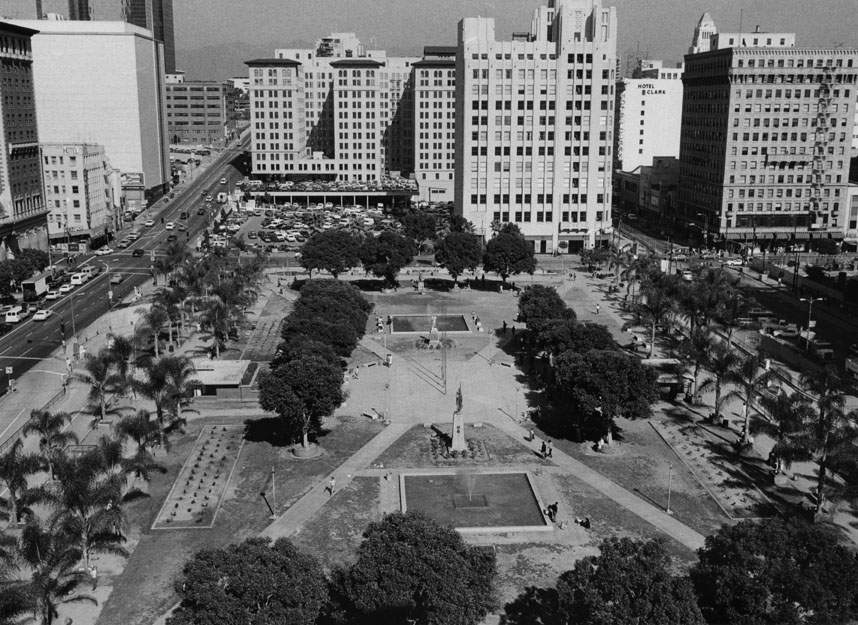
Pershing_Square_in_Los_Angeles_in_1988
Pershing Square in Los Angeles in 1988.
“If now we allow places and things that were named to honor veterans from over a century ago to be retooled as memorials to others, how can we expect today’s soldiers to hope their service and sacrifices will be remembered in the future?”
In 1866, Los Angeles was a small outpost of about 4500 people. However, it had high hopes for the future when local authorities founded Plaza Abaja, the city’s first public park. Almost immediately it became a beloved icon of the community. Something which wasn’t an instant fixture was its name, which was changed numerous times as the sleepy community exploded in growth over the following decades.
By the end of the First World War, the population had increased to around half a million people. Los Angeles had been heavily involved in the struggle, with over twenty thousand serving in uniform, as well as tens of thousands of citizens participating in all of the various bond rallies, scrap drives, etc. that kept the public engaged. When the Armistice was announced, Los Angeles, like cities and towns all over the country, was ecstatic. City Archives record that the day after, a motion to rename Central Square (the then name for the original La Plaza Abaja) in honor of the “Army and Navy of America in bringing about this world-liberating peace” and to the “Commander-in-Chief of the American Expeditionary Force, is the man to whom was entrusted the duty of leading America’s Army on the battlefield.” Hence on November 15th, 1918 the City Council of Los Angeles formally renamed the parcel Pershing Square.
This piece of history, like many others regarding the park, has been largely forgotten. For many years, before and after the new name, Pershing Square was a place of reflection – especially for the military. A memorial to those lost in the 7th California Infantry, today’s 160th Infantry Regiment headquartered in nearby Inglewood, in the Spanish American War, what is widely considered to be the first piece of public art in the city, was erected there in 1900. This monument is widely considered to be the first piece of public art in the city.
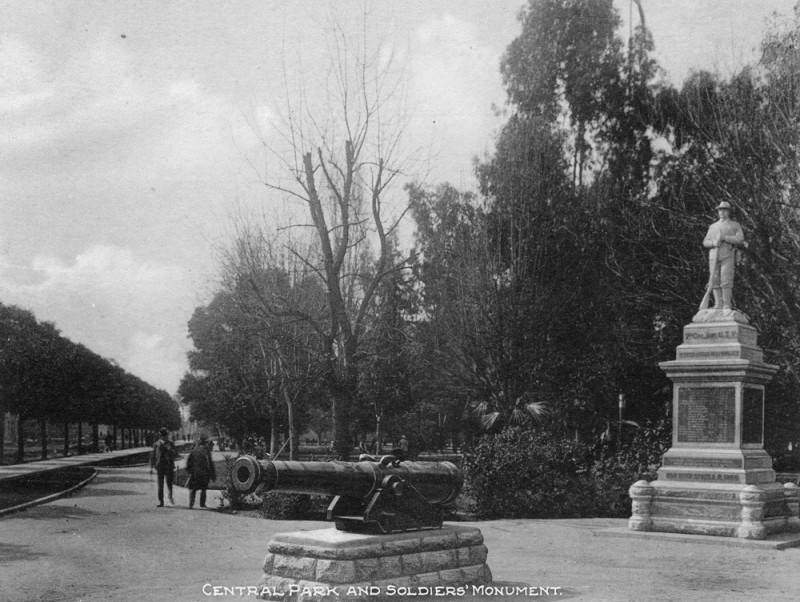
The 7th Infantry/Spanish American War monument paired with cannon in early 1900s.
The previous Thanksgiving, a captured cannon from the same conflict was set in the park (today it resides in the Maritime Museum of San Pedro). Another cannon that had briefly been on the USS Constitution was brought to the city in the 1930s and also resides in Pershing Square.
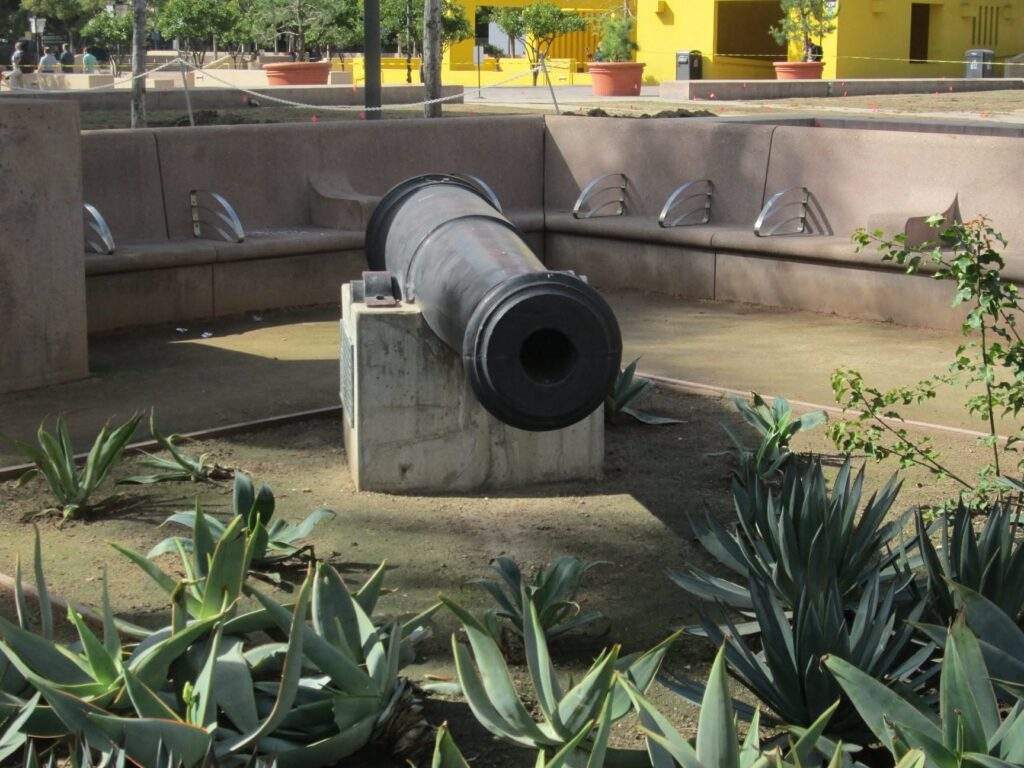
USS Constitution Cannon in Pershing Square, Los Angeles, CA.
The park also served as places for two large outdoor funeral services for fallen soldiers from the war. Morris Lynchick’s 1921 funeral rites stopped the city in its tracks. He was the first soldier from war brought home for burial in LA, and all the stops were pulled out as Lynchick seemed to symbolize all the men from the city who died in Europe. It was very much like a local version of the ceremonies around the Unknown Soldier being laid to rest in Arlington National Cemetery. Thousands of Angelenos came to bow their heads and pay their respects. A couple of years later, the son of the former Mayor was likewise venerated. Captain Ross Snyder was a decorated officer who gave his life in July of 1918 near the Marne River. Again, the city honored him with a huge martial display in Pershing Square.
Not satisfied with just the name Pershing Square, a World War monument was eventually added as well. Humberto Pedretti’s DOUGHBOY, which was dedicated on the 4th of July in 1924, pays tribute to local servicemen. It is still, arguably, the most impressive element in the park as it towers roughly 25 feet from its base to the top of the flag that he strides carries battle. It’s a heroic depiction that seeks to evoke respect. The sides of the pedestal all have inscriptions that add to the effect. Though it has fallen into some disrepair, when one stands in front of it, it is hard not to be moved.
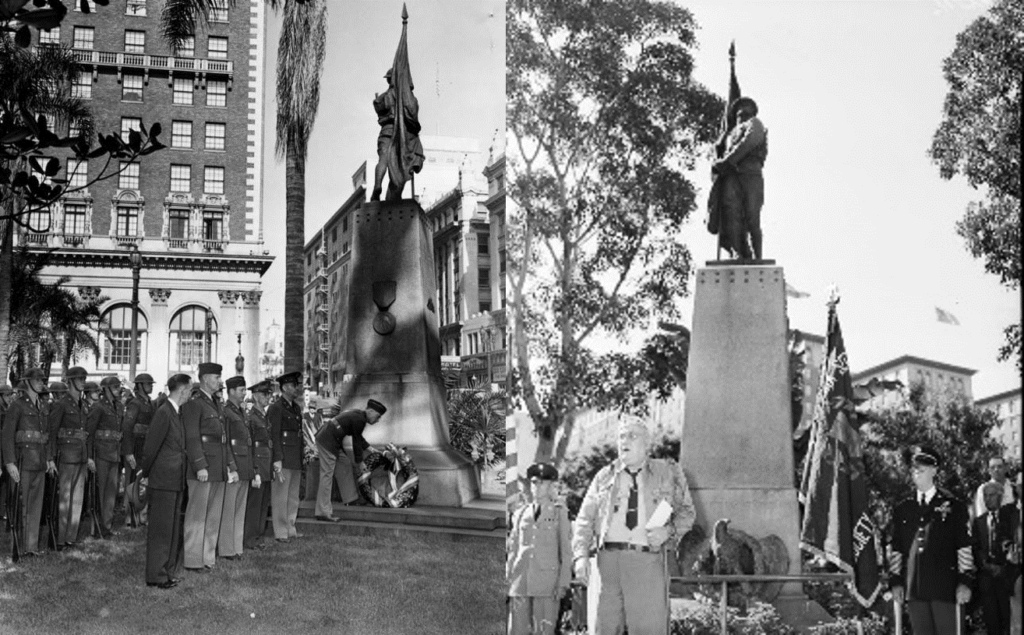
Military ceremonies in different eras taking place next to Humberto Pedretti’s Doughboy sculpture in Pershing Park, LA.
It’s no surprise that given the large number of military tributes at Pershing Square, that during WWII, it was the city mecca for rallies, recruitment, and Liberty Bond drives. There were even large-scale Memorial Day services at the 7th California Infantry monument for decades at the Square, and annual events at DOUGHBOY on the 4th of July.
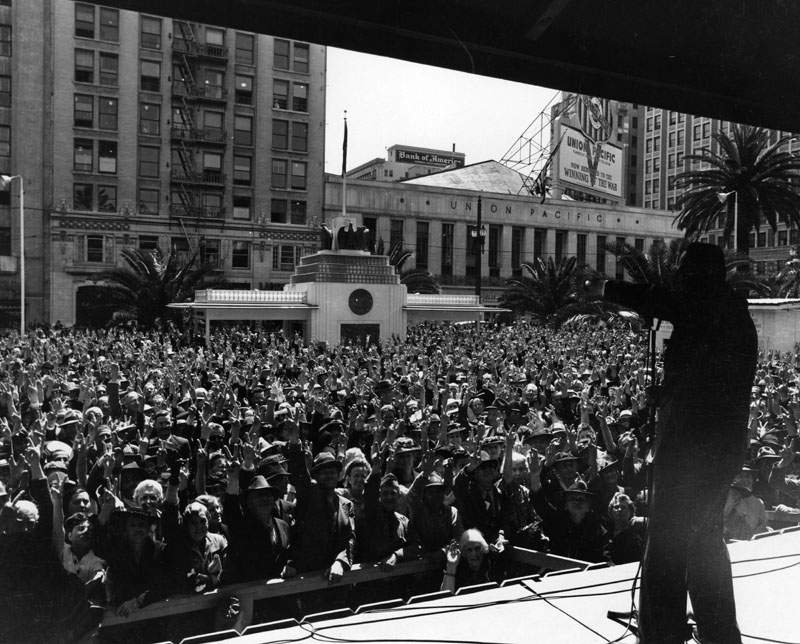
WWII war bond rally at Pershing Square in Los Angeles.
Then on Thanksgiving Day in 1970, Pershing Square again took center stage to bring attention to the military. The park’s central location was specifically chosen to highlight Prisoners of War from the conflict in Vietnam. Thousands gathered around a bamboo cage in the center of the park. Inside, sat a bearded, ragged man, his ankles were shackled to the floor. He used chopsticks to slurp a sad holiday supper of pig fat, soupy rice and pumpkin. The ‘stunt’ garnered nationwide press at the time.
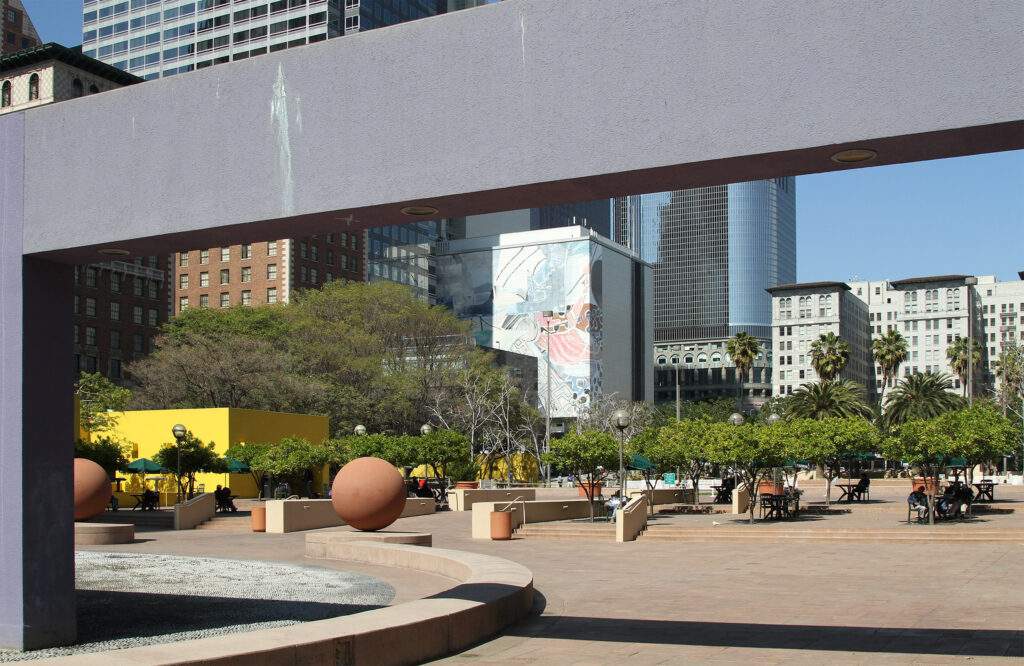
The redesigned Pershing Square in Los Angeles in 2012.
What is most interesting and depressing is how all of this has been forgotten. Now the monuments and plaques are all ignored and largely hidden with low visibility. One, giving a rundown of Pershing’s career, was even stolen in 2024!
That same year of ’24, embattled City Councilman Kevin de Leon made a motion to rename Pershing Square from the general to a local African American pioneer, Biddy Mason. Mason lived a heroic life, being brought to the area as a slave in the 1850s. Then she successfully sued for her freedom and would go on to become a nurse, midwife, philanthropist, who then bought real estate that helped the early African American community to thrive. She certainly deserves to be remembered with a park.
In fact, she already has. Less than a mile away, Biddy Mason Memorial Park sits nestled in the heart of downtown. It includes an 80-foot-long poured concrete wall which sits on her original homestead and chronicles her life story. It’s a beautiful little spot to those who stop there.
De Leon lost his re-election bid and the drive to rename Pershing Square seemed to have evaporated. However, it recently returned with a vengeance and is currently moving through the city’s channels with rapidity. Again, Mason is fully deserving of tributes, but if now we forget, if now we allow places and things that were named to honor veterans from over a century ago to be retooled as memorials to others, how can we expect today’s soldiers to hope their service and sacrifices will be remembered in the future?
I’m hoping to bombard local officials with messages asking to table and/or defeat this motion.
One can do so here.
https://cityclerk.lacity.org/publiccomment/?cfnumber=24-0751
Courtland Jindra served as a Managing Board Co-Director of the California WW1 Centennial Task Force.
External Web Site Notice: This page contains information directly presented from an external source. The terms and conditions of this page may not be the same as those of this website. Click here to read the full disclaimer notice for external web sites. Thank you.