Hard Aground: The Wreck of the USS Tennessee and the Rise of the US Navy
Published: 20 October 2026
By Jim Gallen
via the Roads to the Great War website
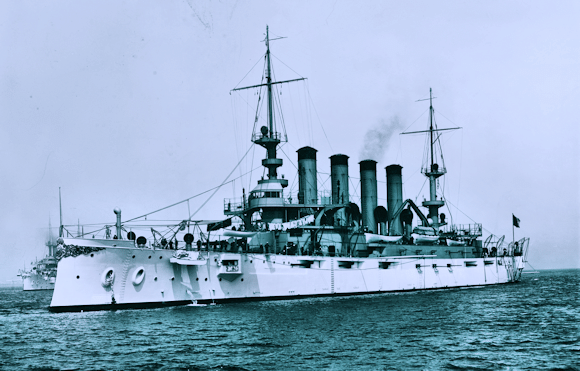
When the Tennessee Was New and Beautiful
When the Tennessee Was New and Beautiful.
When I began this read, I was expecting to find an exposition on how the grounding of the USS Tennessee was a turning point in the modernization of the United States Navy. I actually found that the theme of the book is the second clause of the subtitle: “The Rise of the U.S. Navy” of which the grounding of the Tennessee is merely one, though a recurring, story.
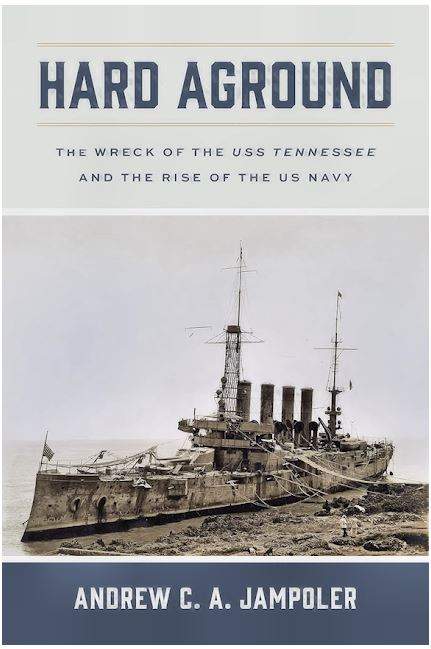 Tennessee’s operational career as an armored cruiser spanned just over 11 years, from 1906 to 1917. In 1916, she was renamed the Memphis to free the Tennessee name for a new battleship. During her career, she transported Presidents Theodore Roosevelt and William Howard Taft to Panama for inspections of canal construction. In 1907 she participated in the naval review associated with the Jamestown Exposition, held from 7 to 11 June 1907, to commemorate the tricentennial of the founding of the first English settlement in America. The outbreak of World War I disrupted commercial sailings and financial transactions, leaving Americans scrambling for transportation home. On 6 August 1914 the Tennessee sailed out of anchorage at Tompkinsville, Staten Island, for Falmouth, England, with only a Navigation Complement, barely enough crew to sail safely but not a “fighting crew.” Its ammunition holds were loaded with $50,000 in U. S. double eagle gold pieces as part of a shipment of $1.5 million in U. S. government money and $3 million in private money to satisfy expenses and secure transportation for expatriate Americans. She spent about a year in the eastern Mediterranean protecting American interests until her return trip in August 1915, carrying “seven carloads of English gold” to safekeeping in the United States and Canada. By then renamed Memphis, the vessel was participating in American intervention in the Dominican Republic when it was wrecked by a hurricane that left her aground and unsalvageable on 29 August 1916.
That is the story of Tennessee’s service and wreckage, but an even bigger part of the story is the second part of the subtitle, “The Rise of the U.S. Navy,” beginning in 1881. The Civil War Navy was obsolete and retired. In the words of Navy Secretary, William Hunt: “The condition of the Navy imperatively demands the prompt and earnest attention of Congress. Unless some action be had…it must soon dwindle into insignificance…We have been unable to make such an appropriate display of our naval power abroad as will cause is to be respected…It is a source of mortification to our officers and fellow countrymen generally, that our vessels of war should stand in such mean contrast alongside those of other and inferior powers.”
The Navy’s rise began with the 1884 appropriation. Dolphin, Atlanta, Boston and Chicago introduced steel hulls to the fleet. By 1898, the rise was sufficient to decimate the Spanish fleets in Manila and of Santiago de Cuba during the Spanish-American War that put an end to Spanish Empire. Lessons from the Spanish-American war that a heavily-armed cruiser like Tennessee could outrun anything it could not outfight lasted until the Royal Navy’s Dreadnought made them obsolete in 1906. The acquisition of an American island empire gave rise to the Anti-Imperialist League whose leaders, including industrialist Andrew Carnegie, labor leader Samuel Gompers, Harvard Professor William James, and Mark Twain became the conscience of America and questioned its need for a navy. President Theodore Roosevelt made a statement as he sent the Great White Fleet around the world in 1908.
Though still neutral, Great War belligerents reached American shores when Kapitänleutnant Hans Rose of U-53 made a surprise three-hour visit on October 7, 1916 when he docked his boat at Newport, Rhode Island, ostensibly to mail a letter to the German Ambassador in Washington. During courtesy calls on naval district commander Rear Admiral Austin Knight, USN, and commander of Atlantic Fleet’s destroyer force, Rear Admiral Albert Gleave, USA, his boat’s deck guns and torpedoes delivered a show of the Kaiserliche Marine’s force and range to the still neutral United States. Back again in international waters, U-53 reinforced its message by quickly sinking six foreign-flagged steamers.
⇒ Read the entire article on the Roads to the Great War website here:
External Web Site Notice: This page contains information directly presented from an external source. The terms and conditions of this page may not be the same as those of this website. Click here to read the full disclaimer notice for external web sites. Thank you.