Did Woodrow Wilson Have the Flu in Paris?
Published: 5 June 2026
By James Patton
via the Roads to the Great War website
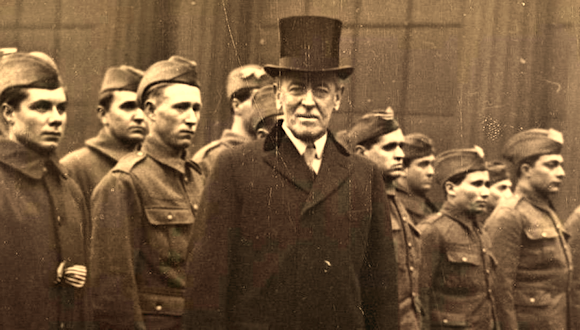
A Determined Looking Woodrow Wilson in London En Route to Paris 1919
A Determined Looking Woodrow Wilson in London En Route to Paris in1918.
On the night of 3 April 1919, President Woodrow Wilson began to cough. His condition quickly worsened to the point that his personal doctor, Rear Admiral Cary Grayson NC (1878–1938), thought that Wilson might have been poisoned. Grayson later described the long night spent at Wilson’s bedside as “one of the worst through which I have ever passed. I was able to control the spasms of coughing but his condition looked very serious.”
However, Wilson wasn’t poisoned; it is widely speculated that he was laid low with the “Spanish Flu” that killed about 20 million people worldwide, although the third wave of the pandemic had peaked in France two months previously. Whether influenza or not, Wilson was left bedridden in the middle of the most important negotiations of his life, the Paris Peace Conference to end World War I.
In January 1919 Wilson came to the Paris negotiations determined to accomplish his visionary Fourteen Points initiative, including open and transparent diplomacy, freedom of the seas, free economic exchange, disarmament, fair adjustment of colonial claims, recognition of self-determination for all Europeans and, above all, his Point XIV, the creation of a “general association of nations”—later called the League of Nations—to obviate future wars.
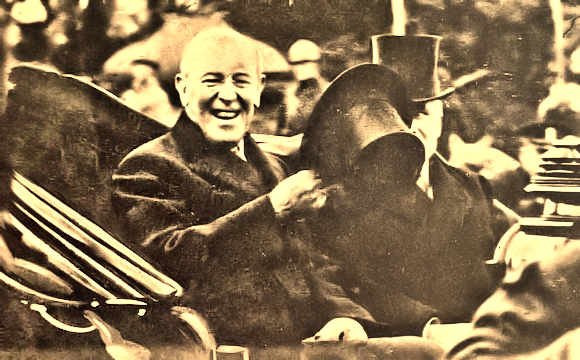
An Enthusiastic Wilson Is Greeted in Paris, 13 December 1918
Parts of Wilson’s vision were quashed by France and the UK, who controlled the agenda. The German colonies and vast portions of Ottoman territory were divvied up without any regard for the interests of their residents. Parts of Germany and much of the Austro- Hungarian dual monarchy were given away, even though some of these lands contained significant German or Hungarian-speaking populations. Wilson’s only success at “self-determination” was the creation of two new Slavic confederations, Yugoslavia and Czechoslovakia, both of which turned out to be bad ideas.
The French prime minister, Georges Clemenceau (1841–1929), openly clashed with Wilson over the economic punishment of the Germans. Clemenceau demanded billions in reparations for the loss of French lives and the massive destruction of French property, but Wilson wanted to spare the German people further suffering. He refused to assert any reparation claim on behalf of the U.S. Rather than making Germany too weak to be a threat, he wanted to focus on preventing future war by disarmament and the empowerment of his League.
At the time that Wilson fell ill, the Paris negotiations were deadlocked. No progress was made while he was bedridden for five days at the Hôtel du Prince Murat. He reportedly had a 103-degree fever and racking coughs, but Dr. Grayson told the world that it was nothing more than a bad cold.
The 1918 Spanish flu was notorious for aggressively attacking the respiratory system, often progressing to pneumonia, causing the lungs to fill with fluid, thus killing the patient quickly. Clearly, Wilson’s case didn’t progress that far. But some of those who seemed to survive the infection experienced resultant neurological symptoms.
These flu victims displayed “post-influenzal manifestations”—psychotic delusions and visions that may have resulted from damage to the nervous system, says John Barry, author of The Great Influenza: The Story of the Deadliest Pandemic in History.
“The most comprehensive study of the 1918 pandemic noted how common neurological disorders were,” says Barry. “They were second only to the lung. This included psychosis, which was usually temporary.”
Read the entire article on the Roads to the Great War website here:
External Web Site Notice: This page contains information directly presented from an external source. The terms and conditions of this page may not be the same as those of this website. Click here to read the full disclaimer notice for external web sites. Thank you.