The Hello Girls Speak to Every Generation
Published: 25 July 2026
By Catherine Bourgin, with Diane Boettcher and Briana Gervat
Special to the Doughboy Foundation website
NDA article header
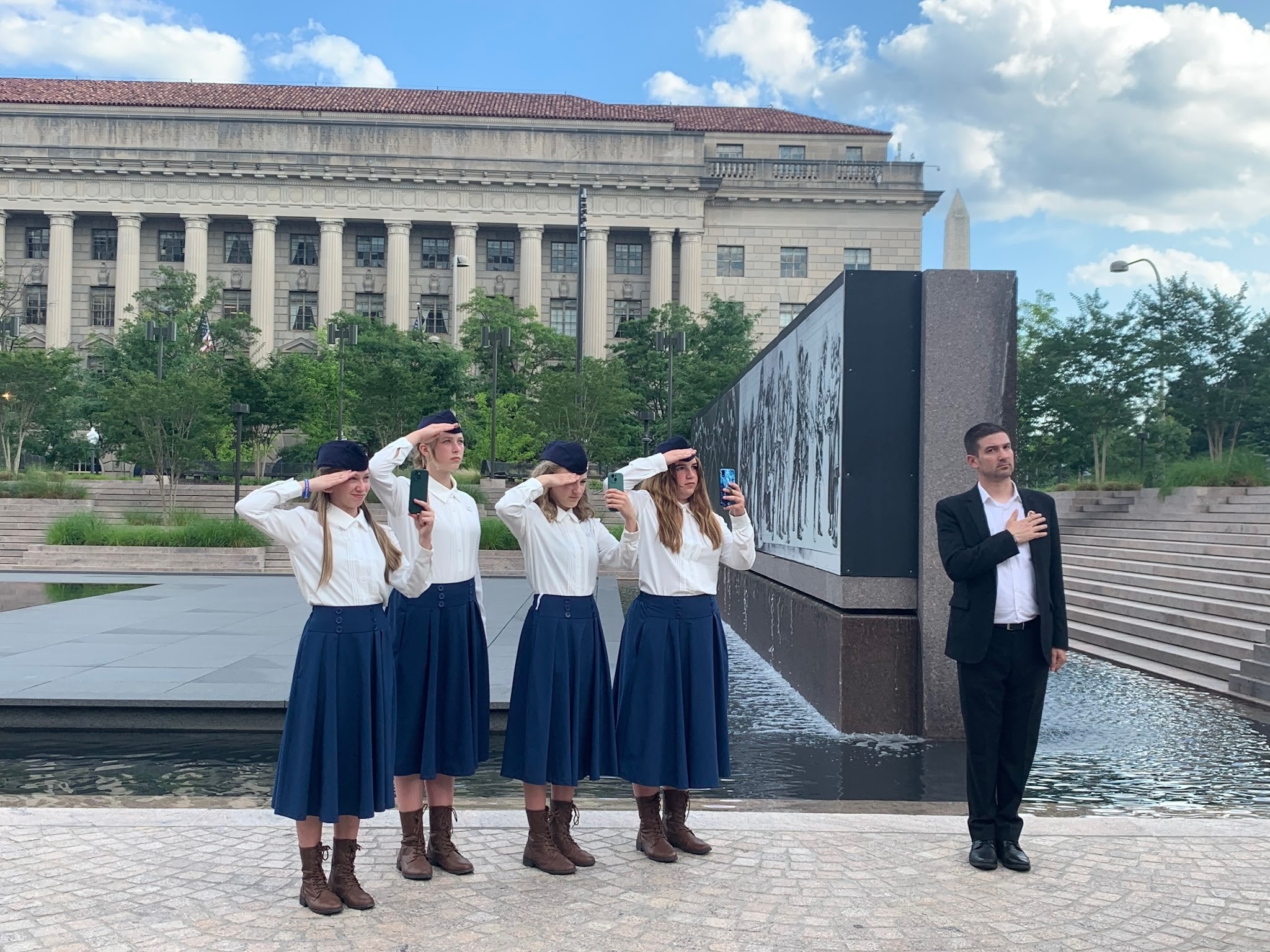
(left) The four Alaska students who placed second in the nation at the 2024 National History Day competition in their WWI Hello Girls costume render a salute during Daily Taps at the National World War I Memorial in Washington, DC. Taps is sounded 5 p.m. ET every day at the Memorial by Doughboy Foundation buglers. (Right) Doughboy Foundation operations manager Kevin Paul,
Part One: A Table, A Story, and Three Thousand Students
This was not my first encounter with National History Day (NHD). Two years ago, in 2024, I attended for the first time, unsure of what this event was all about but I was excited to discover. Two student groups had chosen the Hello Girls as their topic that year. One group, four junior high girls from Alaska, had written their own song about the Hello Girls set to the tune of George M. Cohan’s famous WWI anthem, Over There. Their performance was so spirited and creative that they were later invited to perform again at the National WWI Memorial in Washington DC, hosted by the WWI Centennial Commission and the Doughboy Foundation. They came in second in the nation. Watching those young girls bring the Hello Girls’ story to life through music was something I never forgot.
So when Lynne O’Hara, Deputy Director of National History Day (The National History Day 2026 theme was Revolution, Reaction, Reform in History, culminating in the national contest held in June 2026 at the University of Maryland, College Park), mentioned at the In Flanders Fields Memorial event on 18 May 2026 in Washington DC that three student groups had chosen the Hello Girls for this year’s national competition, I did not hesitate. Her warm and inviting personality made the invitation feel less like a formal event and more like being welcomed into a community. I said yes immediately. Diane Boettcher, Ret. CAPT USN and Hello Girls researcher, was also invited to attend.
This time I arrived prepared. I brought photographs, a copy of the December 1918 issue of the AT&T Telephone Review featuring my grandmother Edmée’s interview and hand drawn portrait, Elizabeth Cobbs’s book The Hello Girls, and Claudia Friddell’s children’s book Grace Banker and the Hello Girls. I also brought my grandmother’s story and the full arc of where the Hello Girls’ mission stands today to share with the current contestants I was hoping to meet in person. Diane brought the personal papers and mementos of Operator Josephine Gray Davis. Surprisingly, we had found her collection on an online auction site.
What I did not bring, and did not expect, was a display table of our own. But that is exactly what happened. After finding Lynne and connecting with Diane, Lynne spotted an empty table in the vast check-in hall and suggested we set up. Within minutes we had an impromptu Hello Girls display table in the midst of a very busy and bustling check-in reception area for all the contestants.
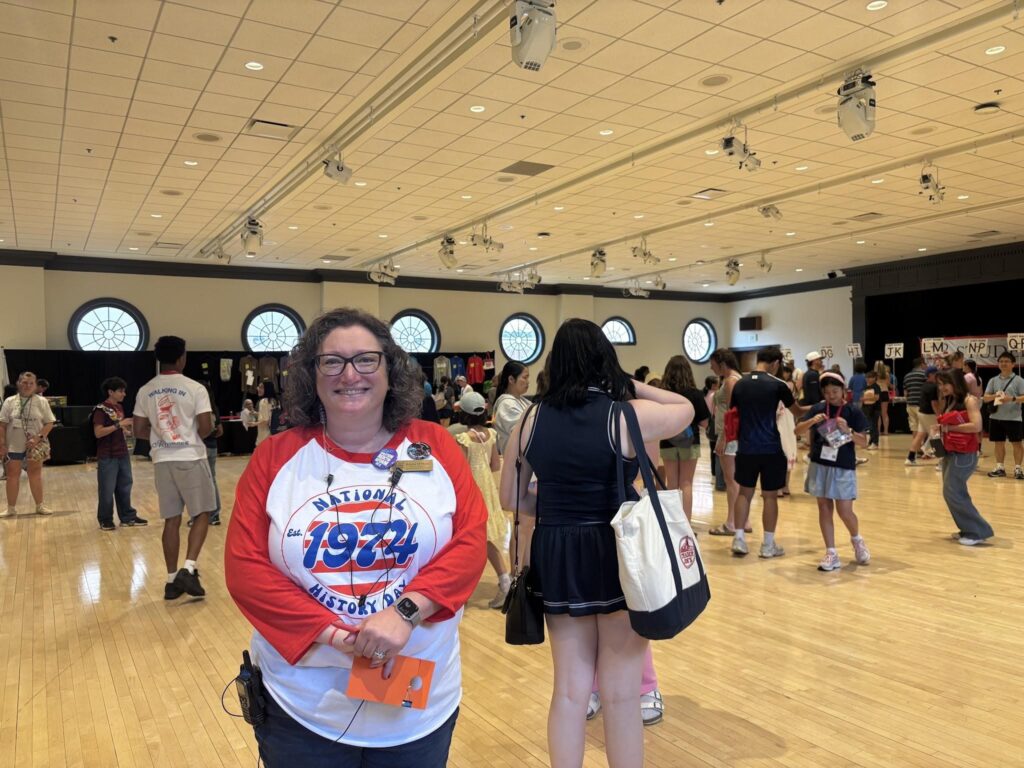
Lynne O’Hara, Deputy Director of National History Day, in the 2026 event registration hall.
Three thousand students from across the country, U.S. territories, Department of Defense schools and international schools from China and Korea were checking in with their parents and teachers, projects in hand, lanyards already collecting the NHD trading buttons that are a beloved tradition of the competition. The room had the feeling of a busy airport, passengers arriving in waves, suitcases and projects rolling in every direction, people fanning out to their designated areas. It was organized excitement on a grand scale.
And right in the middle of it all, Diane and I were at our newly set up display table telling the Hello Girls’ story to anyone who stopped to listen.
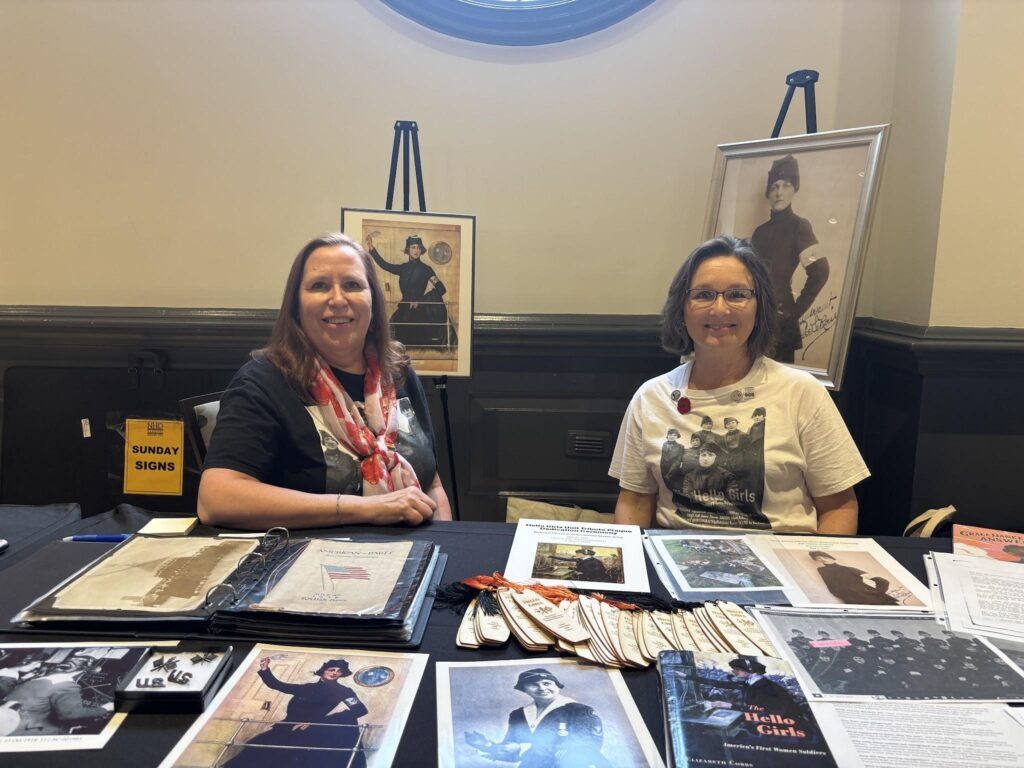
Diane Boettcher and Catherine Bourgin at the 2026 National History Day registration area at University of Maryland campus.
They did stop, students and their grown-ups alike. Curiosity brought them over first, drawn by the photographs staring up from the table. Then came the surprise, because almost no one had ever heard of the Hello Girls. And then, inevitably, came the disbelief, when they learned that these women served under combat conditions, connected over 26 million calls during the war, two died while in service due to the Spanish Flu epidemic, and after the war they were denied veterans’ status for sixty years. That progression, from curiosity to surprise to disbelief, happened over and over again for the two hours we stood at that table.
Meeting Ana
It was Sunday, 14 June 2026, registration day for the National History Day national competition at College Park, Maryland. We had come to meet Ana Spiride, a composed and talented young woman from Plano, Texas, whose Senior Individual Exhibit had earned her a place among the top 10 best student historians in the country. Her topic? The Hello Girls.
What I was not prepared for was what I found on her display table. Among the carefully arranged artifacts and research materials, Ana had placed documents she had aged by hand, their edges ragged and yellowed to evoke the passage of time. I leaned in to read them. There among them was a letter my grandmother Edmée LeRoux had written to the U.S. Army Signal Corps after the war, from Paris, requesting her own copy of her service recommendation letter. The letter had been sent to a distant relative through her mother’s second marriage stateside to acknowledge her work and her service, but Edmée herself had never received her own copy. She was writing to ask for what was rightfully hers.
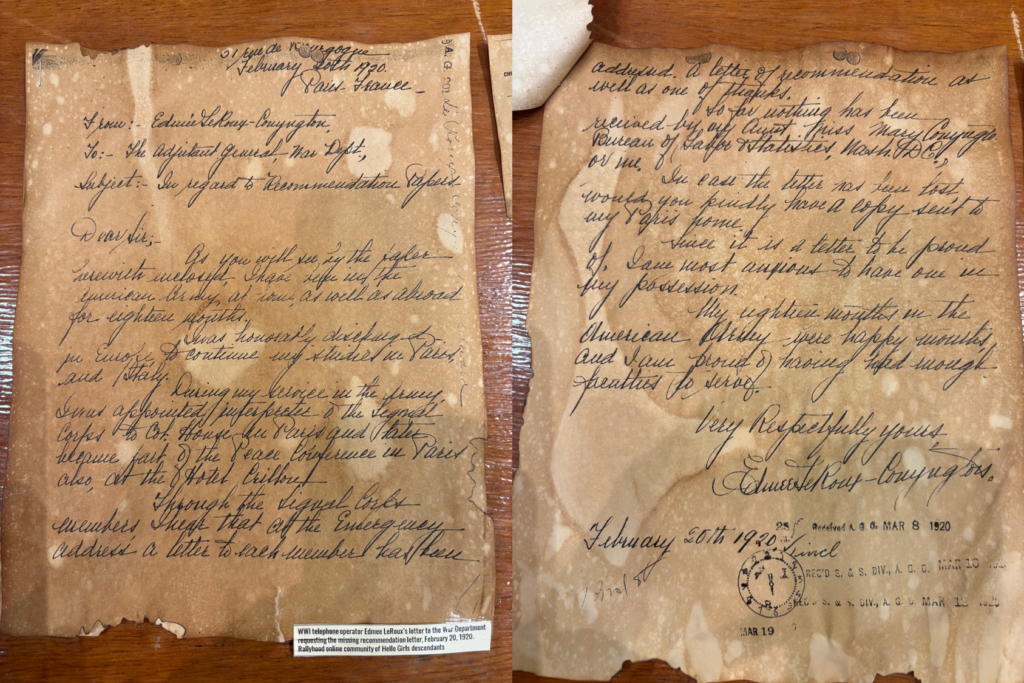
Replica of Edmée LeRoux’s letter written to the U.S. Army Signal Corps after the war, from Paris, requesting her own copy of her service recommendation letter.
Ana had chosen that letter, out of all the available Hello Girls material, to include in her display. And she chose a document that quietly captures everything that was both remarkable and heartbreaking about these women’s story, the service that was given fully, and the recognition that was so slow to arrive. I stood there, in the middle of that busy competition hall, surprised and deeply touched. I tried not to let it show. Diane tells me that I wasn’t entirely successful.
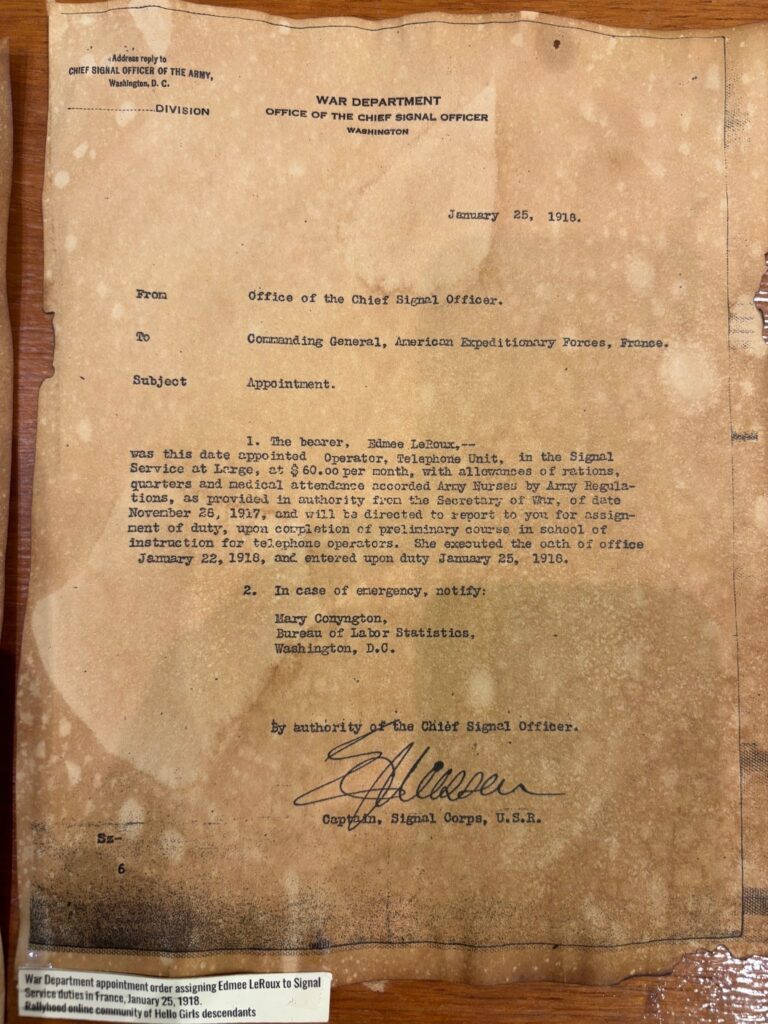
Replica of Edmee Leroux U.S. Army Signal Corps appointment letter from 1918.
Diane recognized that some of Ana’s documentation came from a file-sharing site of the Hello Girls Military Honors and Remembrance Project, a program of the Doughboy Foundation (MHARP) team. As a researcher, Diane had invested time in digitizing the Hello Girls records held at the National Archives. She had then uploaded many of those files to the site. To learn that the files were serving their intended purpose – to assist others in Hello Girls research – was incredibly validating.
For a high school student, her level of research, attention to detail, and creative presentation was extraordinary. Every panel, every photograph, every carefully aged document spoke to months of dedicated work and genuine passion for this story. Her display board, titled Hello Girls: Answering the Call, Revolution, Reaction, and Reform in Service, traced the Hello Girls’ story from their recruitment and rigorous training, through their service in France, to their sixty year fight for veterans’ recognition and the Congressional Gold Medal bill finally passed in December 2024.
Standing beside her display that day were Diane, wearing a red poppy scarf that felt entirely fitting for the occasion, Ana herself, poised and gracious. And me, in my Hello Girls t-shirt.
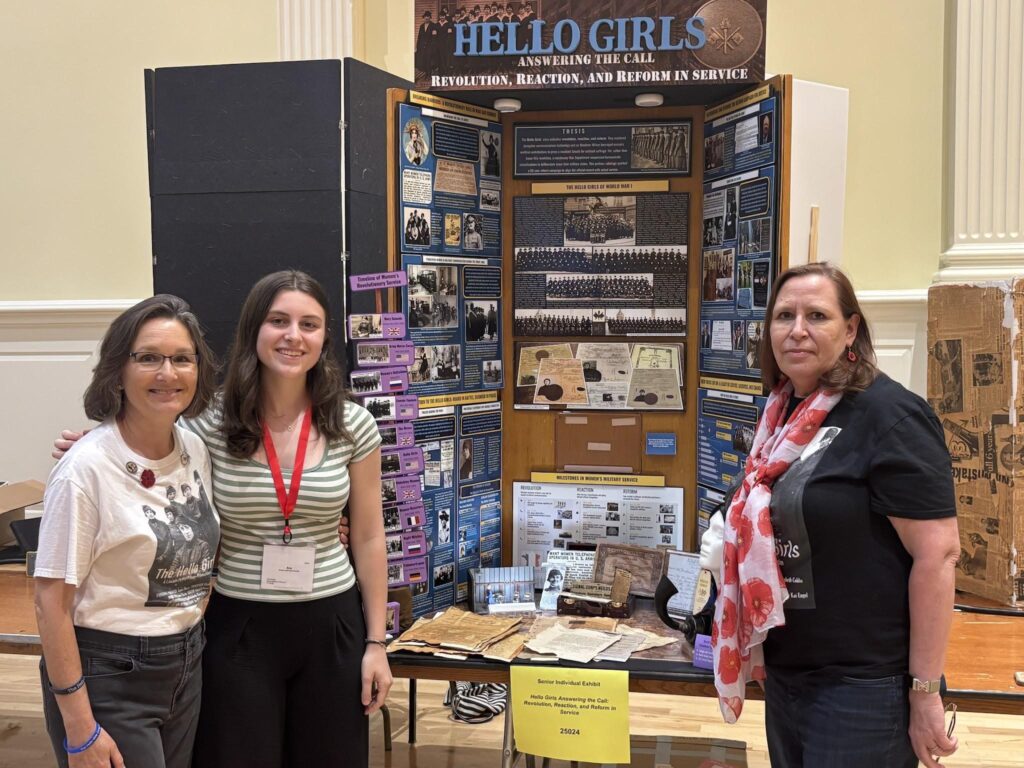
(L-R) Catherine, Bourgin, Ana Spirde from Plano, TX, and Diane Boettcher at Ana’s Hello Girls display for National History Day at the University of Maryland, 14 June 2026.
From Montana to McKeldin Mall
Monday, 15 June 2026, brought a different kind of meeting entirely.
Harper Vezina and Alexis Hines, two junior high students from Potomac 7-8 School in Montana, had created a website titled The Hello Girls: Women Warriors of WWI for the Junior Division competition. Their session that morning was closed to visitors, so I waited. When it ended we met outside on the balcony of the McKeldin Library, overlooking the verdant expanse of McKeldin Mall, its trees and campus buildings stretching out in every direction. After a long day indoors, I thought the fresh air and the view might be a welcome change for two young students from Montana.
They arrived with one of the girl’s grandmother, who was chaperoning them for the competition. Harper and Alexis were quiet and a little shy, as junior high students often are when meeting an adult they don’t know. Their grandmother was warm and engaged, asking questions to encourage the conversation and speaking on their behalf when the girls needed a moment to find their words. What none of us knew at the time was that lunch was also very much on their minds!
Despite their shyness and their growing appetite, we spent a good hour together on that balcony. I shared photographs and articles about my grandmother Edmée, giving them a glimpse into one Hello Girl’s personal story behind the history they had researched so carefully. I told them about the Congressional Gold Medal campaign, its long journey through Congress and its successful conclusion in December 2024. And I told them about where the mission stands today, the research to locate every Hello Girl’s burial site, the grave marker dedication ceremonies, the biographies being written, and the dream of a searchable database that will one day make these women’s stories accessible to anyone who wants to find them.
It was a lot to take in over an hour on a library balcony. But the grandmother’s curiosity and warmth kept the conversation flowing, and I left hoping that Harper and Alexis carried something of it home with them to Montana.
What they had already accomplished was remarkable. In their process paper, Harper and Alexis described how they almost moved on from the Hello Girls entirely at first, knowing them only as switchboard operators. It was the rarity of women in the army that made them look closer. And the deeper they researched, the more they found. Their historical argument said it best: “They proved they belonged, stood up for their rights, and made history along the way.” For two junior high students from Montana, that is a profound and accurate conclusion.
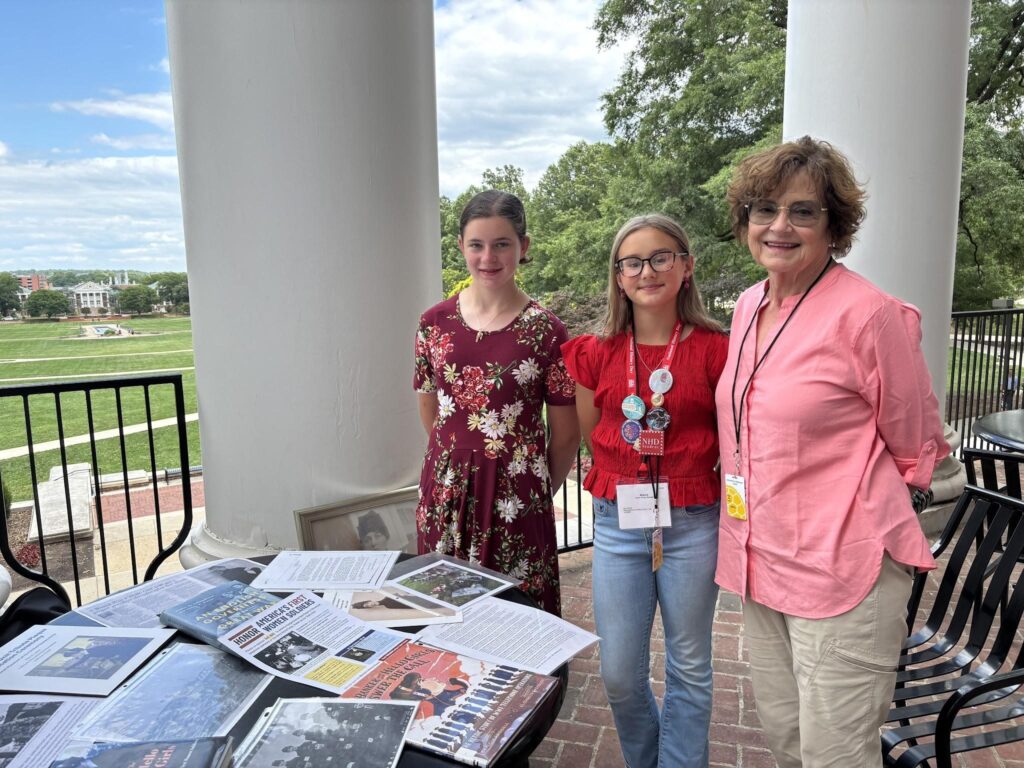
From Montana: Harper Vezina (at left) and Alexis Hines and her grandmother on McKeldin Library balcony at the University of Maryland campus.
Letters Across Time at Cab Calloway
Tuesday, 16 June 2026 brought my final student encounter of the week, and perhaps the most theatrical.
I arrived just in time, found parking near the Plant and Sciences building and made my way through the crowded hallways to Room 0301 in the School of Public Health building. It was a perfectly ordinary classroom. No stage, no lighting, no special setting of any kind. But what Ginny Green and Sami Martinez of the Cab Calloway School of the Arts in Delaware proceeded to do in that ordinary room was anything but ordinary.
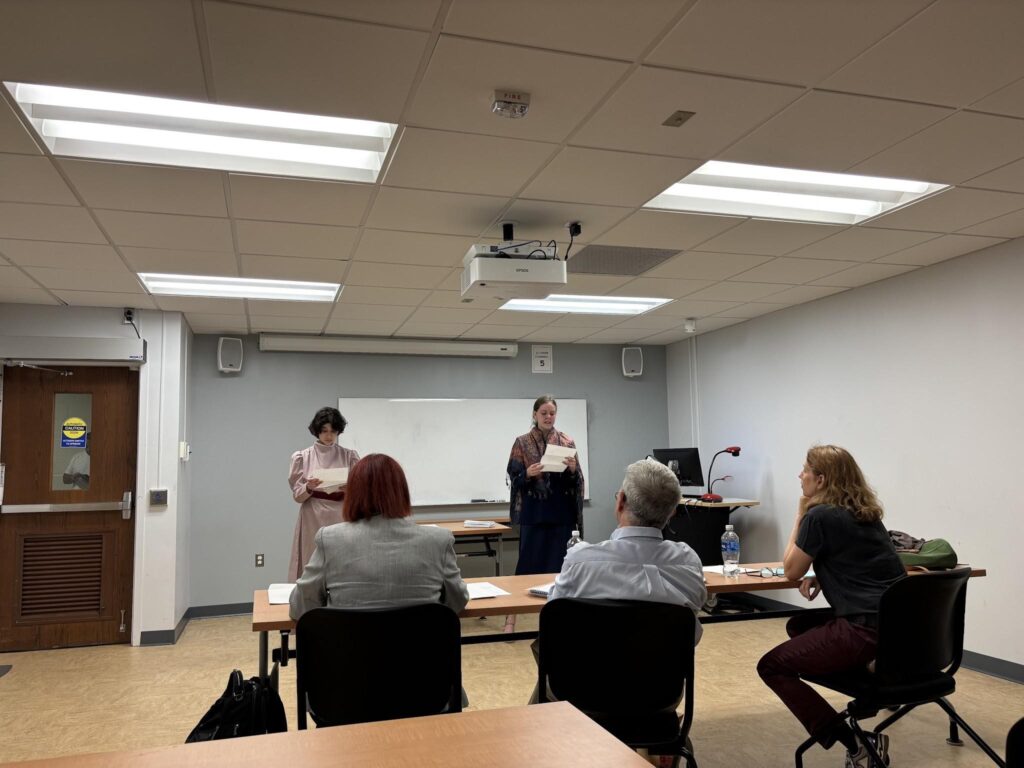
Sami Martinez (left) and Ginny Green performing in front of the three judge panel at National History Day.
Their Senior Group Performance was titled The First Hello Girl: Merle Egan Anderson’s Revolutionary Life as a Hello Girl. They had written their own letters, an exchange between Merle Egan and her (fictional) friend Ethel, one stateside and one in France, sharing their fears, their hopes, their friendship and their experiences as the war unfolded around them. It was history told through the most personal of formats, two friends writing to each other across an ocean, across a war, across time.
What made the performance particularly compelling was the transformation happening before our eyes. The student portraying Merle slowly changed her costume as the letters progressed, moving from civilian clothing into her U.S. Army uniform and then back to civilian clothes again after the war. It was a simple but powerful theatrical device that told the entire arc of the Hello Girls’ story without a single explanatory caption or timeline. You watched Merle become a soldier. And then you watched her come home.
The room was intimate. Three judges, their teacher Erin Sullivan, one parent, a couple of other visitors and me. But these two young women from a performing arts school filled that small classroom with presence, clarity and genuine emotion. Their voices were strong and clear. Their timing was assured. They understood not just the words they were reading but the weight behind them. The performance lasted about fifteen minutes, followed by a thoughtful round of questions from the judges about their topic, their research and their motivation for choosing it. At one point the judges asked who else was in the room. Ginny and Sami introduced one by one the audience members to the judges as my mother, my teacher….and a granddaughter of a Hello Girl. Afterward, we escaped the crowded hallways and drove across the sprawling University of Maryland campus, which totals 1,335 acres, to the dining hall in the Stamp Student Union Center. We found a quieter spot upstairs, away from the lunchtime rush, and ate together while the conversation wandered naturally from their performance to their school, to the Hello Girls Musical making its way toward Broadway, to my own trip to New York in May for the concert reading. Ginny’s mother joined us, warm and engaged, and entirely at ease in a performing arts conversation. She had worked in the film industry in Los Angeles, so the world of performance and storytelling was very much her native language.
Then we went downstairs for ice cream. The University of Maryland used to have its own dairy herd on campus which has been relocated to the Central Maryland University Research and Education Center – Clarksville Facility in Howard County (www.ansc.umd.edu), but it still has its own campus ice cream shop ( https://dining.umd.edu/catering/maryland-dairy) in the Stamp Student Union Center, and we indulged in celebration of the girls performance. It was a perfect and lighthearted ending to a meaningful morning.
We drove back to where I had parked, said our goodbyes, wished them well and congratulated them on making it to nationals. I never did find out how they placed in the competition. But I left knowing that Merle Egan Anderson would have been proud to hear her story told so beautifully by two young women who had never met her and yet were drawn to her powerful story of recognition earned but ignored for a century.
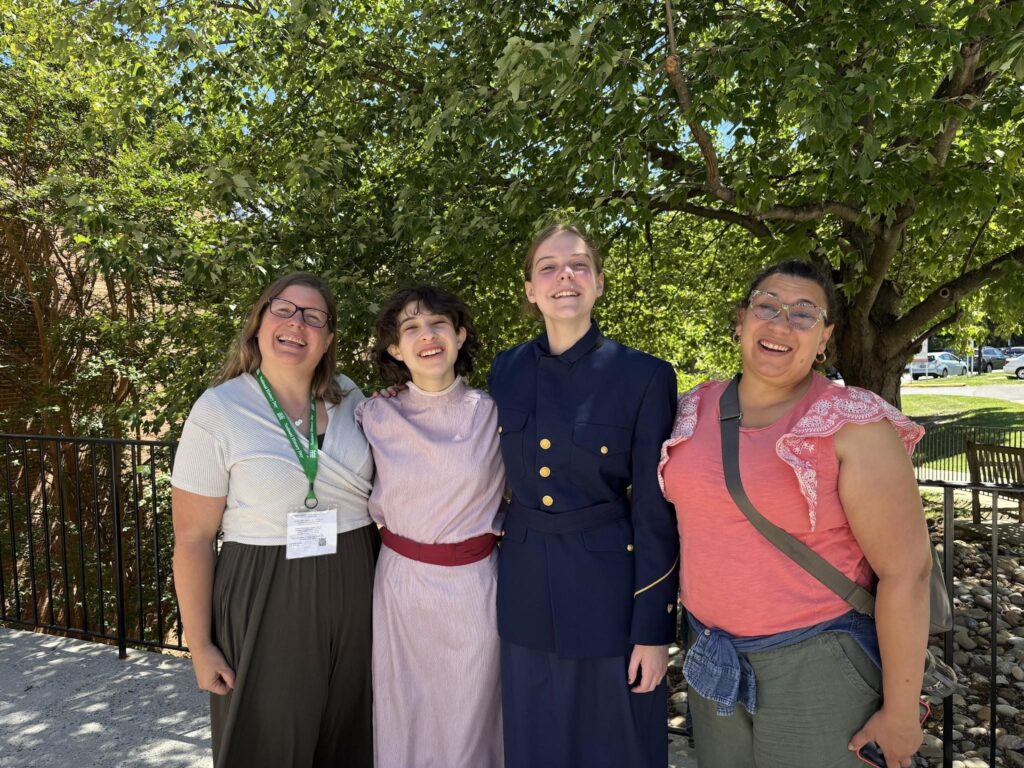
(L to R) Social Studies teacher Erin Sullivan of Cab Calloway School of The Arts in Wilmington, DE; Sami Martinez; Ginny Green; Sami’s mother.
A Stone Dropped in Still Water
Three student groups. Three completely different approaches. One story is still being reclaimed.
A display board packed with primary sources and personal letters, carefully aged to look like the artifacts they honored. A website built by two junior high students from Montana who almost passed the Hello Girls by, thinking them merely switchboard operators, until they looked closer. A dramatic reading performed in an ordinary classroom by two young women from a performing arts school in Delaware who understood instinctively that the most powerful way to tell this story was through the voices of the women themselves.
How did they find it? That question stayed with me long after I left College Park, MD. Was it the momentum of the Congressional Gold Medal campaign and the media coverage that followed? Was it a growing movement among young women to seek out the lost stories of women’s contributions to history? Perhaps it is all of these things at once.
What I do know is this. Like a stone dropped in still water, the Hello Girls’ story is sending rings outward in every direction, reaching audiences no one planned for and inspiring people no one expected. From a teenager in Texas who chose my grandmother’s correspondence to include in her national competition display, to two junior high girls in Montana who built a website, to two performing arts students in Delaware who gave Merle Egan Anderson her voice back. The story is moving. And it is moving on its own.
Part Two: The Western Front Association East Coast Symposium
A Day filled with Stories from Long Ago…
On Saturday, 20 June 2026, I drove to Maryland’s Veterans Museum (www.mdvets.cc) in Newburg, Maryland for the Eastern Coast Branch Symposium of the Western Front Association, organized by Dianne Smith and welcomed by Greg Goodell, Chair of the WFA East Coast Branch. It was a full day program with five presenters covering a remarkable range of WWI topics, from overlooked AEF generals to brutal urban combat to a walk searching for peace to the revolutionary medical advances that continue to shape military medicine today. And the final presentation of that day was about the Hello Girls and my grandmother’s story. I was the last presenter of the day.
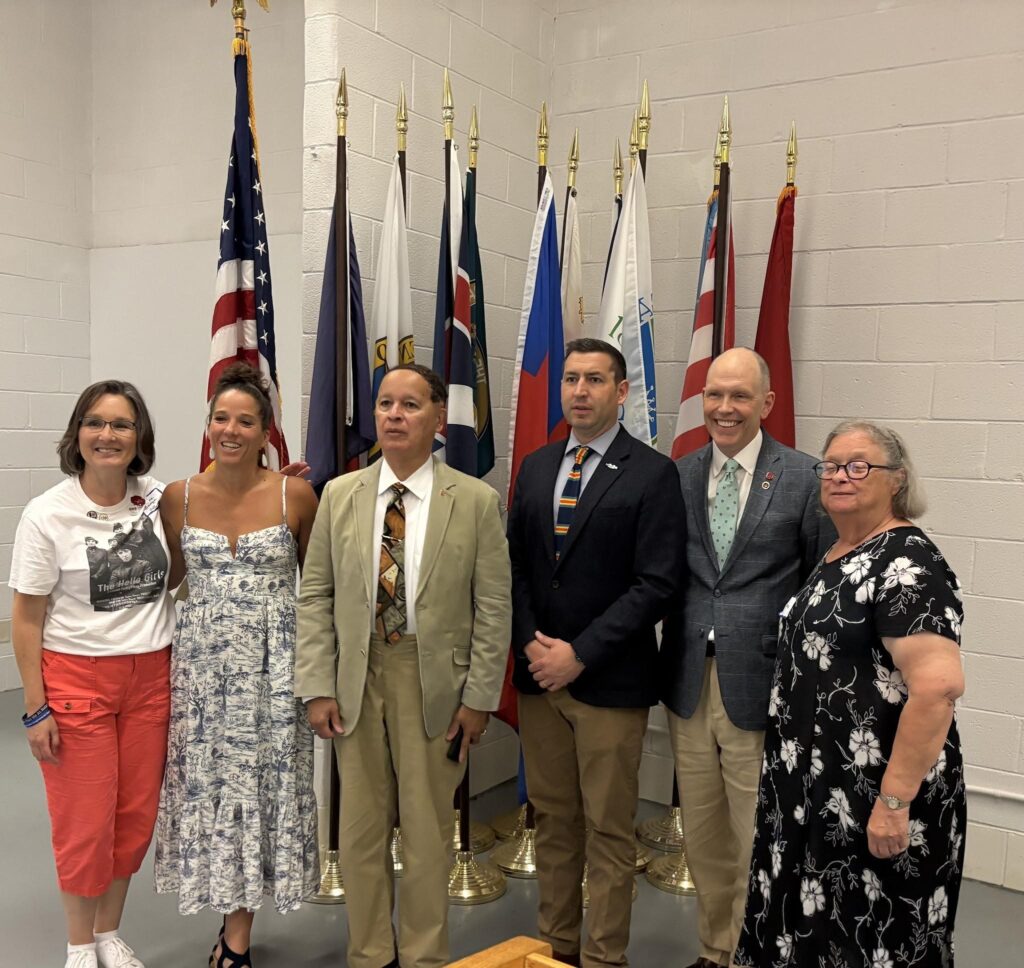
(L to R) Catherine Bourgin, Briana Gervat, Gen. George Alexander, Ret., Aaron Heft, Greg Goodall and Dianne Smith. (Missing Frank Nuno.)
The audience of approximately 25 people was largely what you might expect at a Western Front symposium, former military, academic historians and serious history enthusiasts, mostly men, with about six women in the room. These were people who knew their WWI history. They had spent the day listening to presentations by Assistant Professor Geronimo “Frank” Nuno of the National Defense University, who compared the largely overlooked AEF commanders General Hunter Liggett and General Robert Lee Bullard; Aaron Heft of the U.S. Army Center of Military History, who brought to life the brutal month-long urban combat of the 28th Division at Fismes and Fismette in France; and Major General George Alexander, USA Medical Corps, Ret., whose 25 years as Deputy Surgeon General and his championship of medical readiness for 350,000 Army National Guard soldiers made for a presentation that was as thorough and detailed as his distinguished career. He spoke deliberately and carefully, as a man of his experience and knowledge rightly should. He simply had a great deal to say. By the time he finished, the afternoon was well advanced and I had been waiting since morning for my turn.
Two Outliers and a Shared Alma Mater
Before I took the podium, there was another outlier in the room. Briana Gervat, poet, photographer and art historian, author of There Will Come Soft Rains, had presented earlier in the day. Like me, she was not a military historian or a former officer. Like me, she had come to WWI through a deeply personal and unconventional door. In 2022, she had walked the entire length of the Western Front alone, sleeping under the same stars the soldiers had slept under, moving through the forests of Verdun, the mountains of Alsace, and the Gothic cathedrals that survived the war, searching for peace and finding something she could only express through words and photographs. Her book is the record of that journey.
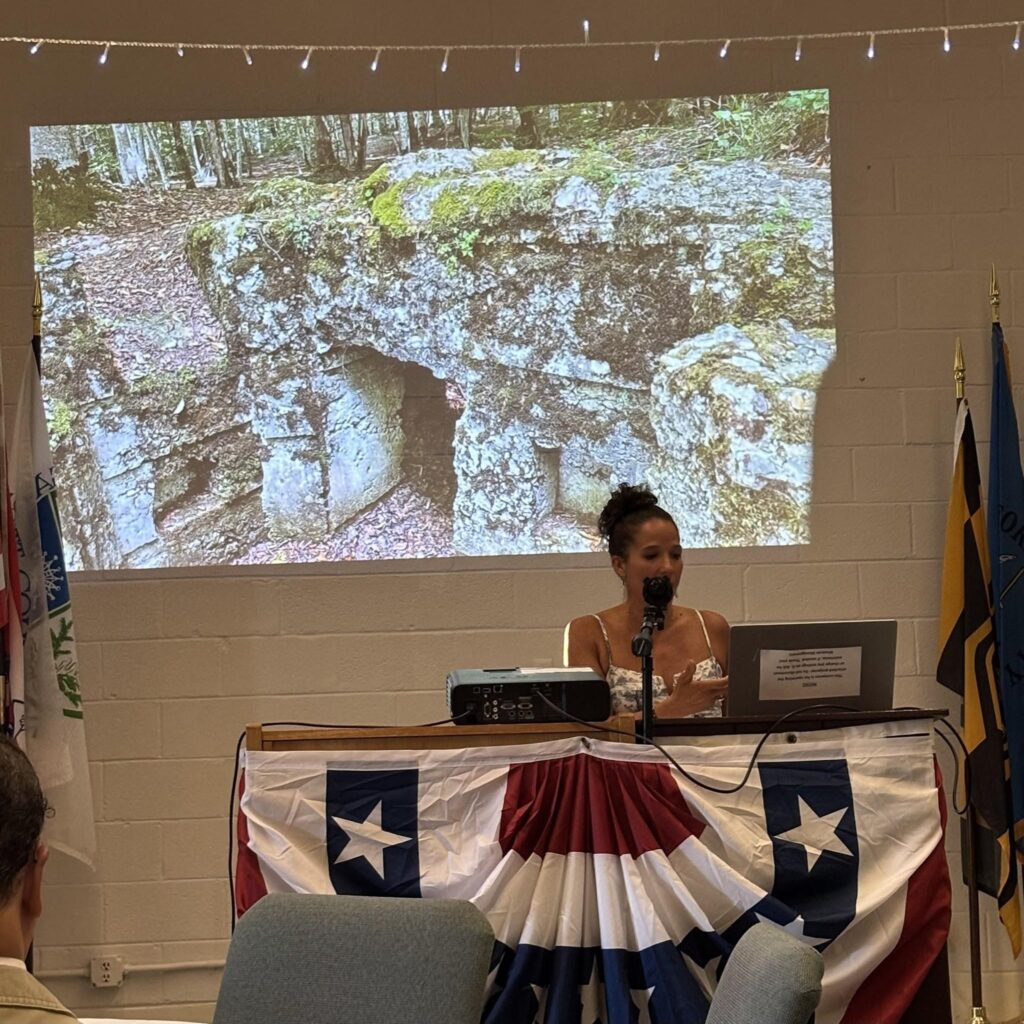
Briana Gervat, author and University of Mary Washington alumna.
When the room full of military historians and former officers heard her speak, something unexpected happened. They were enthralled. These were men who had spent careers studying the same battlefields she had walked, but they had never considered looking at them through her eyes. They had never followed that particular thread of feeling, loss, beauty and quiet grief through the same landscape they knew through maps and strategy. When she finished, they flocked around her. Several bought her book. I watched from across the room, quietly relieved and genuinely thrilled for her.
When my biography was read before my presentation, it mentioned that I had attended Mary Washington College in Fredericksburg, Virginia. From across the room, Briana Gervat applauded loudly. I looked up from the podium, found her face in the audience, smiled and gave her a small wave of acknowledgment. The emcee made the connection himself, we were both alumnae of the same institution, now known as the University of Mary Washington. It was a small moment but a warm one, a reminder that the threads connecting people around this history run in unexpected directions.
Briana Gervat brought something to that symposium that no military rank or academic title could provide. In her own words:
“I am not a Veteran or a military historian. I have no personal ties to the Great War. My great grandparents arrived in America from a recently unified Italy and a not yet independent Poland to create a new life in a new country years before the old world destroyed itself. Not after.
I can name only a handful of generals, and even among those, I still stumble upon the German pronunciations. What is the sense of knowing any of these names when there are still soldiers known only unto God?
I may not be a Veteran or a military historian, but I am an art historian who focuses not on war, but its aftermath. And as such I have long held the belief that there was the world before the Great War, and everything after.
And yet, despite studying the Rwandan Genocide and the Great War, I still choose to see the world through the eyes of artists who seek to create despite our ongoing collective and inherent intent to destroy. For it is through art that we remember our humanity when it is so easily forgotten through war.
It was in the later years of the pandemic that I first came across the Western Front Way: a path of peace that wove through the fields and farms of France and Belgium, which crossed over the great battlefields of the Great War: Verdun, the Marne, the Somme, Ypres.
It was a moment after midnight when I knew that I was meant to walk this way.
But my journey along the Western Front began long before August 2022. I had caught glimpses of the front from further east: the Middle East, the Dardanelles, Sarajevo. It was only a matter of time before I found myself in France.
When I set out that August, it was the poetry of the soldiers who fought, and died, there that both mended and broke my heart every step of the way. Because I, too, am a poet at heart and there is no point in poetry other than to show the world itself: all its beauty, and its sorrow.
When the opportunity to present the story of my 500-mile journey across the Western Front at the WFA symposium came around, I could not say no. How I love to be surrounded by my fellow historians and enthusiasts to learn from them; especially when one of them is my fellow Mary Washington alumna, Catherine Bourgin, who always makes the day more meaningful. At first, I was nervous to take the podium. Who was I, a self-published art historian, to contribute my opinion on such a meaningful, yet meaningless war?
It was a question that I asked myself often as I walked the Western Front.
But looking out upon the faces of those present, I was reassured that they were here to learn something too, because that is what history is: a sharing of stories. It was an incredibly humbling experience, when I finished my presentation, to be asked questions of genuine curiosity by professors, generals, and historians. They revealed that I am not alone in this passion for this part of history; and that there are always more stories to tell.
But then again, this was the hopeful intention behind writing There Will Come Soft Rains. To reveal both what the world is, and what it could be. And offer hope to an all too often hopeless world.
Lest we forget.”
The Last Presenter
I will be honest. By the time my turn came, the day had been a full day. I had been anxiously waiting for my turn which was a tiring process. And the weight of following a Major General with 70 published medical and scientific papers and a career spanning three decades was not lost on me.
But I had a story they had not heard yet. And I intended to tell it in my own way, in my best effort.
I began with a little joke. I told the audience that I was the only presenter of the day who was going to give them homework. A few murmurs. A chuckle. The homework, I explained, was to read Elizabeth Cobbs’ book The Hello Girls, to watch Jim Theres’ documentary of the same name, bothof which can be found on Amazon and Amazon Prime, and to keep an ear out for the Hello Girls Musical, which is currently making its way toward Broadway. Three works. All called The Hello Girls. I told them that was not a coincidence. It was a movement.
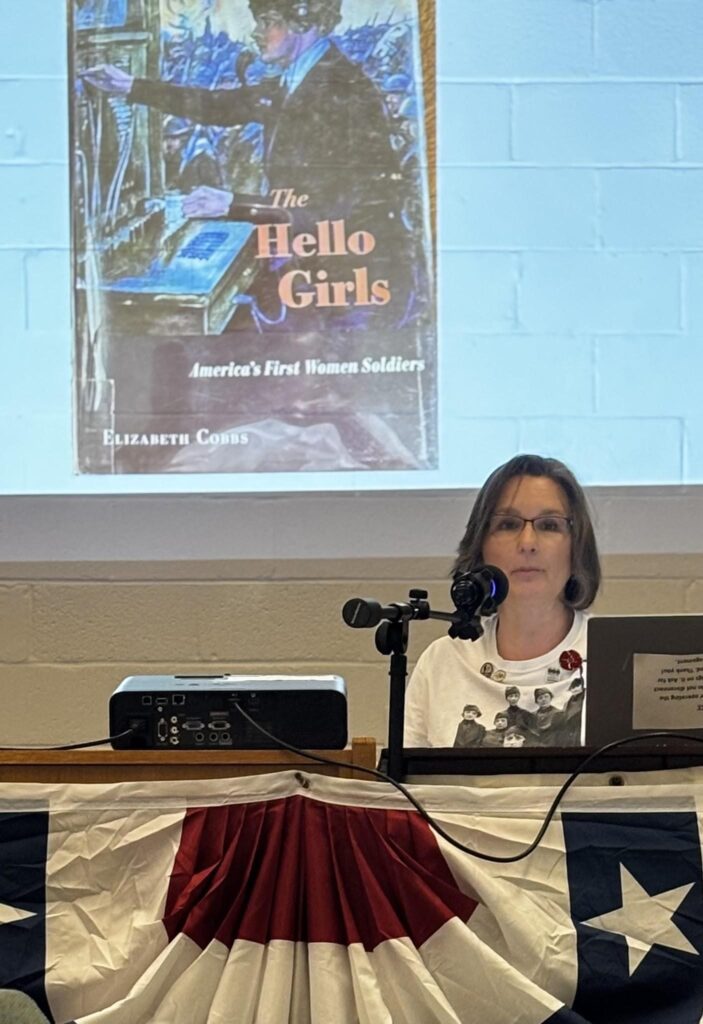
Catherine Bourgin, granddaughter of WWI Hello Girl Edmée LeRoux.
Then I told them about the Hello Girls, who they were, what they did, and why it mattered. Women whose bilingual skills and patriotism overtook every restriction society had placed upon them, including the right to vote. Women who served in 75 different locations in France, some under combat conditions, connected over 26 million calls, moved with the front lines, and were told by the U.S. government when they came home that none of it counted. Women who spent sixty years fighting, some until their dying days, for their veterans recognition they had earned in a matter of months. Women who, 106 years later, finally received the Congressional Gold Medal in December 2024.
I told them about the Congressional Gold Medal campaign, and how that campaign team evolved into the Hello Girls M-HARP, a program of the Doughboy Foundation, dedicated to finding every Hello Girl’s burial site and ensuring she is honored as the veteran she was. I told them about the grave marker dedication ceremonies already completed and those being planned. I told them about the research, the biographies, the hope to create a database so that these women’s stories will never again be lost.
And I paused to ask the room to recognize Dianne Smith, who had initiated the effort to install a Hello Girls Unit plaque at the National U.S. Army Museum (www.themusa.org) at Ft. Belvoir, VA, and whose work, supported by a generous anonymous donor covering 75% of the $5,000 fee, ensured that the Hello Girls are now permanently represented on the entrance wall of Army unit plaques at that museum. The room applauded and Dianne smiled broadly.
I did not rush. But I did not linger. When I finished, I thanked the audience for their time and attention throughout what had been a full and enriching day, and wished them safe travels home.
Lest we forget.
Those three words felt like the right ones to leave with a Western Front audience. They are the motto of the Western Front Association. They are the reason everyone in that room had given up their Saturday. And they are the reason the Hello Girls’ story needed to be told, on that day, among those people.
I had no military rank. No academic title. No published papers. I was there because of my grandmother, Marie Edmée LeRoux, Hello Girl, Group 4, stationed in Paris and Tours, who crossed the Atlantic in 1918 to answer her country’s call and came home to a silence that lasted decades.
I am honored to have the opportunities like this one to continue to share the Hello Girls story.
Lest We Forget: in closing
Another remarkable week in June 2026, the Hello Girls’ story was told in a competition hall at the University of Maryland, on a library balcony overlooking McKeldin Mall, in an ordinary classroom that became a stage, and at a symposium table in Maryland’s Veterans Museum. It was told through research and creativity, through a website and a dramatic reading, through a grandmother’s correspondence aged to look like history and through words spoken quietly from a podium to an attentive audience of military historians and former officers in Newburg, Maryland.
Each telling was different. Each audience was different. And yet the essential truth of the story remained the same in every room, in every format, in every voice. These women served. They were skilled, courageous, bilingual and professional. They answered a call that their country was not yet willing to recognize. They came home to silence. They fought for sixty years for recognition. And 106 years later, we are still finding them, still honoring them, still making sure their names are not lost to time.
Ana Spiride found them in Texas. Harper Vezina and Alexis Hines found them in Montana. Ginny Green and Sami Martinez found them in Delaware. And I found one of them in an unmarked grave at Fort Lincoln Cemetery in Brentwood, Maryland, five miles from the Capitol, where my grandmother Marie Edmée LeRoux lay unrecognized for decades until we placed a Veterans Administration grave marker on her grave in May 2024.
The Hello Girls are still being found. The rings are still moving outward.
Lest we forget.
Please consider donating to the Hello Girls Military Honors and Remembrance Project: https://secure.qgiv.com/for/hellogirls/
Please consider donating to the Wreaths Across America at Ft Lincoln Cemetery, Brentwood, MD where two Hello Girls Edmee LeRoux and Miriam de Jersey Glenum are buried: https://go.wreathsacrossamerica.org/HelloGirls (for every wreath sponsored for a veteran, $5 goes to MHARP).
External Web Site Notice: This page contains information directly presented from an external source. The terms and conditions of this page may not be the same as those of this website. Click here to read the full disclaimer notice for external web sites. Thank you.