“C’est la guerre” – It’s war.
Published: 16 November 2026
By Michael Santoro
Special to the Doughboy Foundation website
Portrait of Lieutenant Louis Rockwell framed header
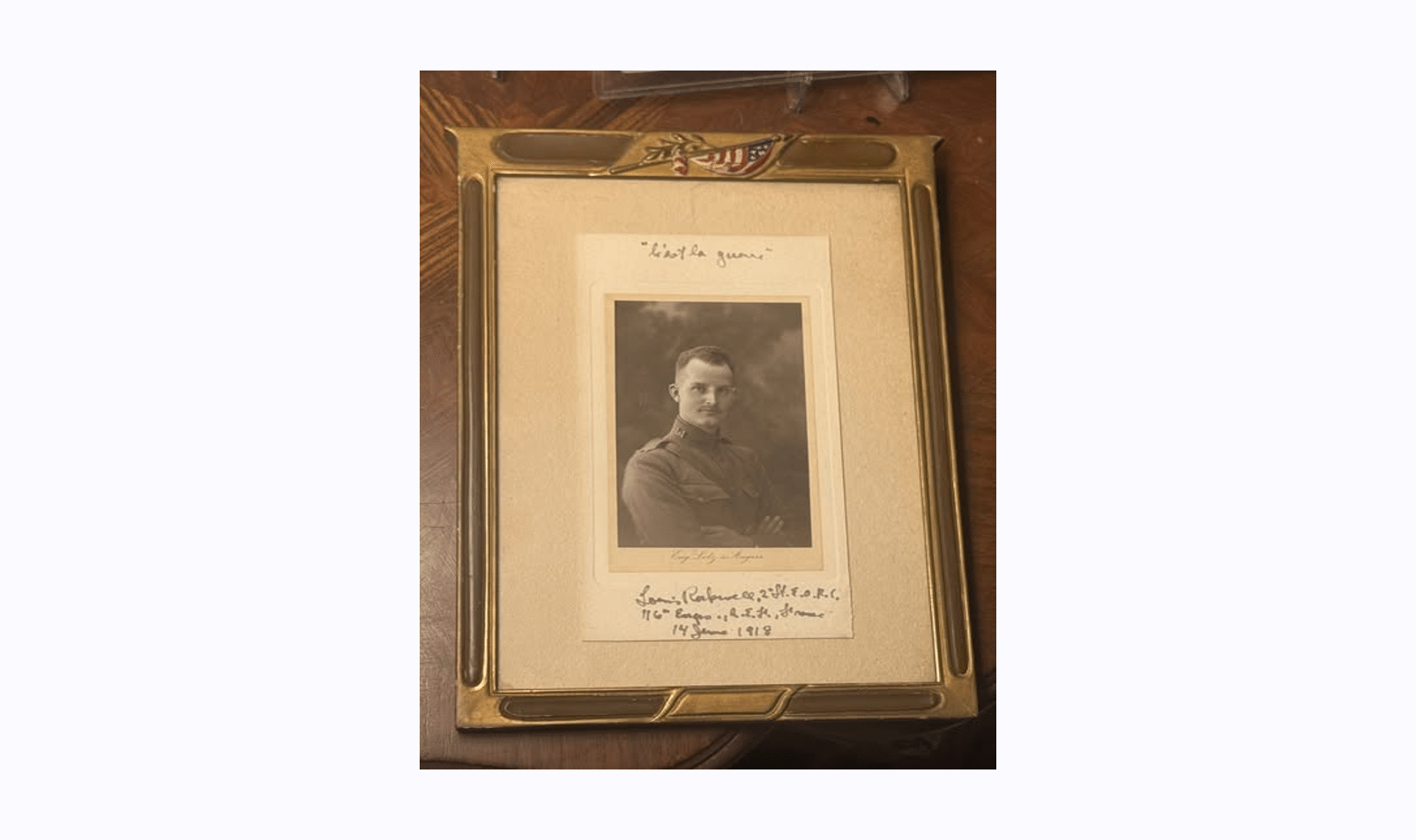
Framed portrait of Lieutenant Louis Rockwell of the 2nd Engineers, 2nd Division in World War I.
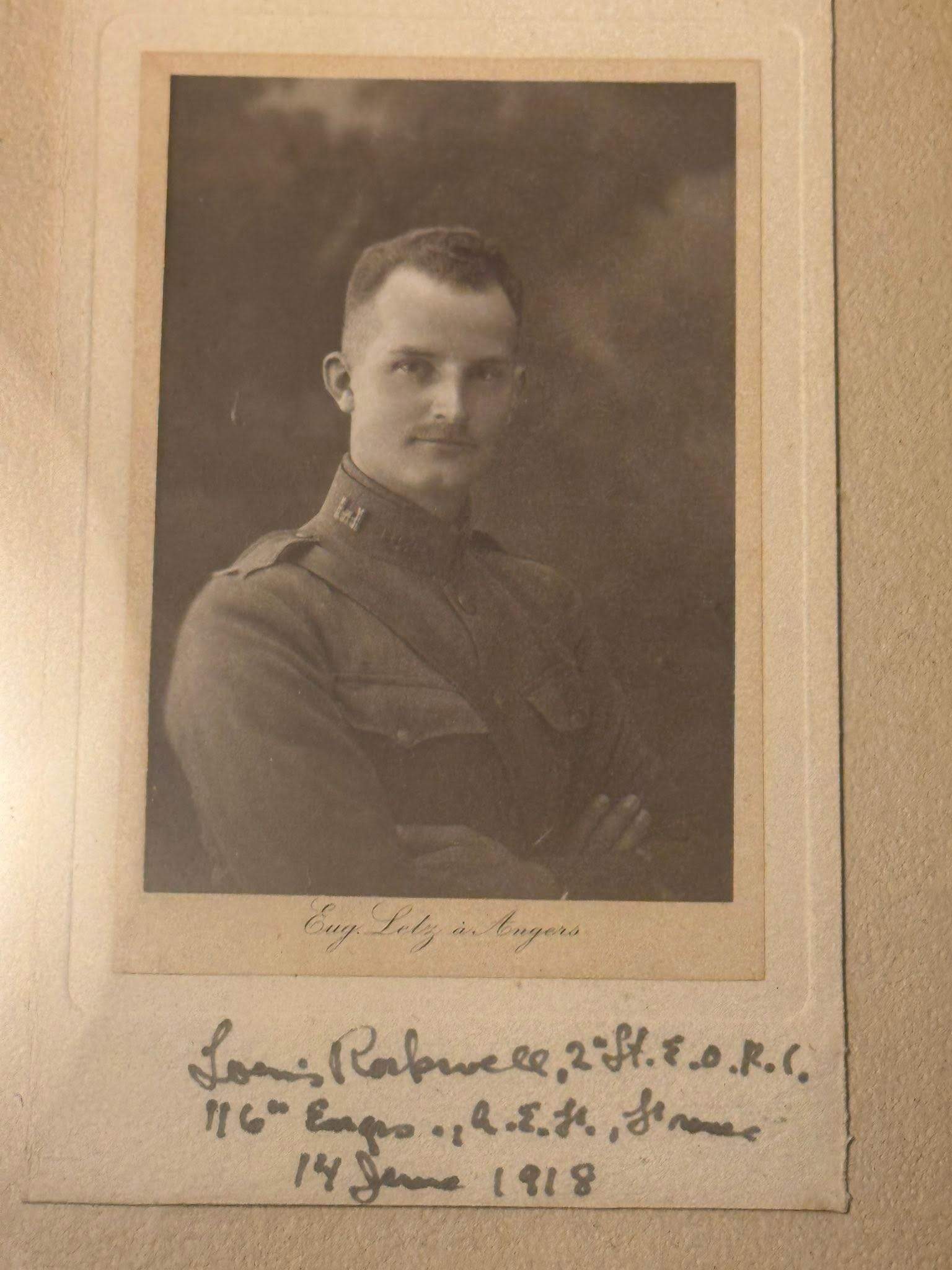
This is a portrait of Lieutenant Louis Rockwell of the 2nd Engineers, 2nd Division, who arrived overseas with Company E on September 12th, 1917. He would be singled out by his company commander to attend the First Corps School, and was commissioned as an officer. He was briefly attached to the 116th Engineers in June 1918, which is when he had this portrait taken.
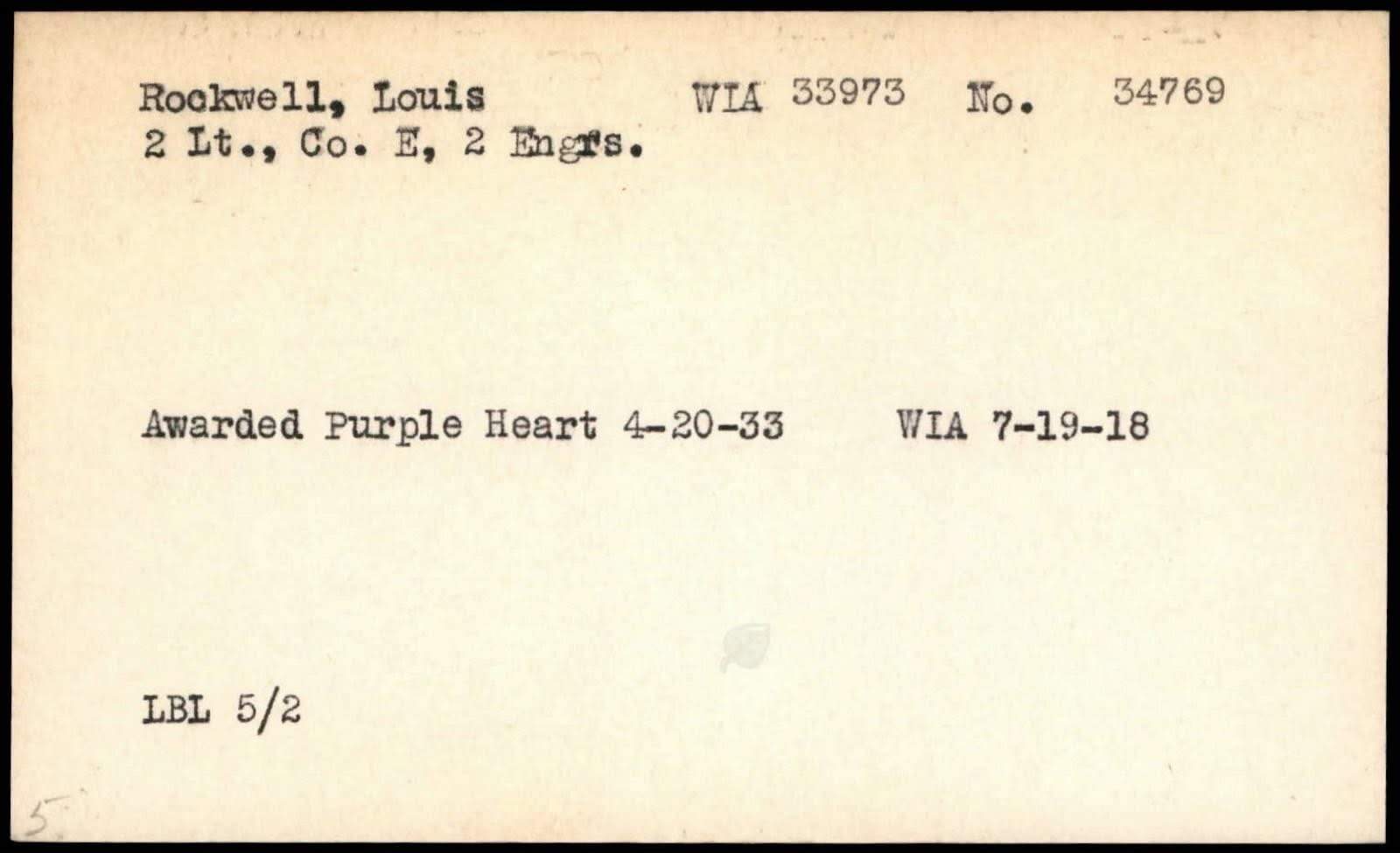
Just a month after this photograph was taken, during the Battle of Soissons on July 19th, 1918, Rockwell was wounded by a gas shell, and was awarded a Purple Heart on April 20th, 1933.
Interestingly, Rockwell also experienced the death of his cousin, Pilot Thomas Farnsworth of the 96th Aero Squadron, entirely by chance after he crash-landed on the edge of Bois Du Fay on September 13th, 1918. Farnsworth was being pursued by three German aircraft, was badly wounded, and made a perfect landing near where his cousin was stationed.
The following transcript is taken from an article written for the St. Charles History Museum in 2013, found here https://www.stcmuseum.org/history-news/2015/3/28/friday-september-13-1918-a-chance-meeting-of-two-cousins-in-france-during-world-war-i
From Rockwell’s account of that day:
“I was lying in reserve with a platoon on the edge of Bois Du Fay about twilight Friday afternoon, September 13, when the whir of four aeroplanes overhead attracted our attention. After some maneuvering the American plane climbed above the three German planes, and then, when directly overhead dived straight down and the purr of the machine gun could be heard mingled with the buzz of the motor. One of the German planes (word obscured by a tear in the newspaper) and then fell to the earth… (the next two lines of the letter are missing due to a tear in the newspaper)…German lines. Suddenly our American plane careened, and the observer – or one of them – fell out. Who the poor fellow was I never found out.
The plane was seemingly about to drop out of control when it was righted again and guided in an unsteady spiral groundward. It was quite evident that the machine was in distress and the pilot could not keep it upright. However, he succeeded in bringing it to a safe landing, but in the woods.
I was so impressed with the man’s gameness and afraid that aid would not reach him quickly that I broke army rules and left my platoon to search for him.
I found him not far back. Was the first to reach his side, and as I stooped to pick him up I recognized Thomas. He was very badly wounded, but the noble spirit in him would not give up. ‘They haven’t get me yet’, were his only words – but ‘they’ had. It was Tom’s last flight. He died two hours later in the hospital.
Have left a personal request that his grave, which will be in the vicinity of Jaulny, be especially marked, and that you folks be notified of its exact location. He had no personal effects, not even his watch upon him, and his organization will send these things to you.
If you knew the value of such sacrifices as this one to the men of America over here you would feel that your loss was as highly recompensed as such losses can be.
Tom lived efficiently and died gamely in a crisis.
Sincerely,
Louis Rockwell
Second Lieut. Co. B, 2d Engrs.”
This transcript taken from an article written for the St. Charles History Museum in 2013.
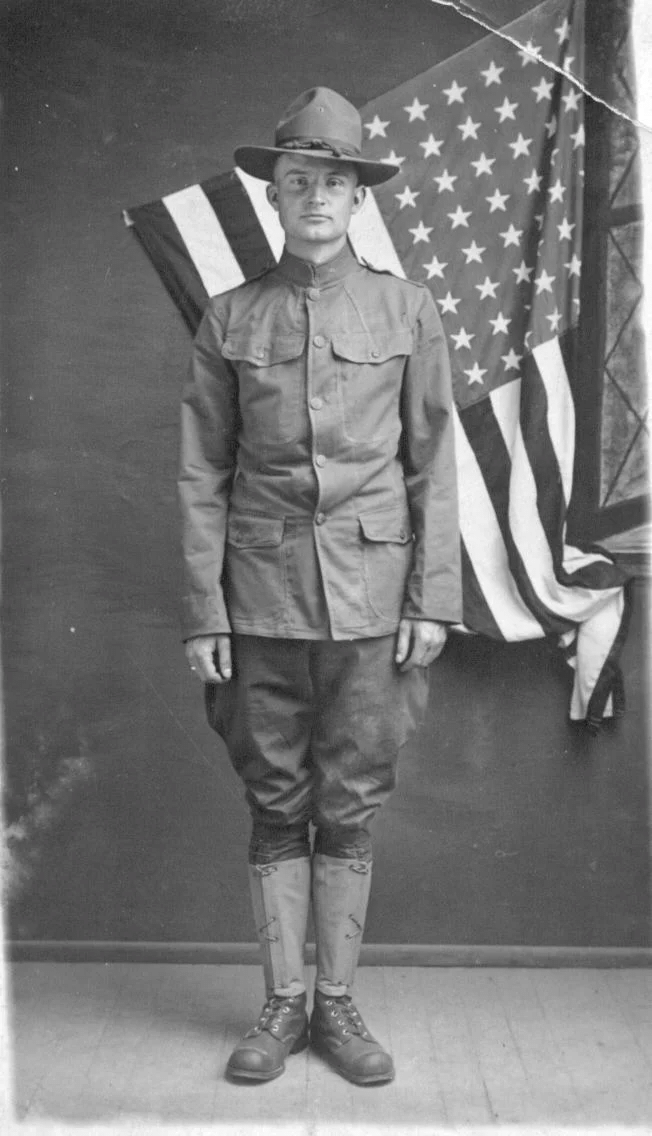
Louis Rockwell on his first day in “Uncle Sam’s uniform”, image provided by St. Charles History Museum.
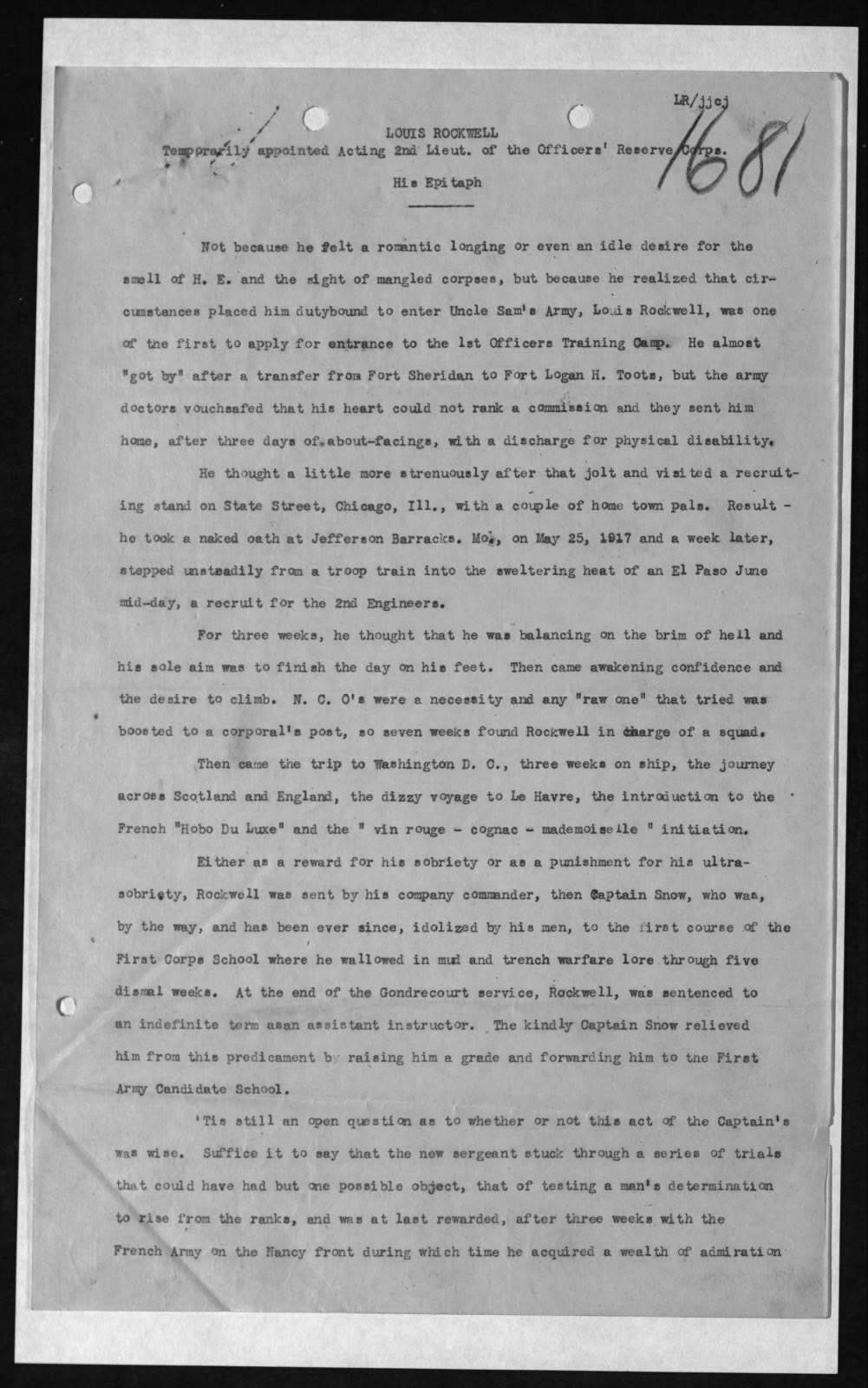
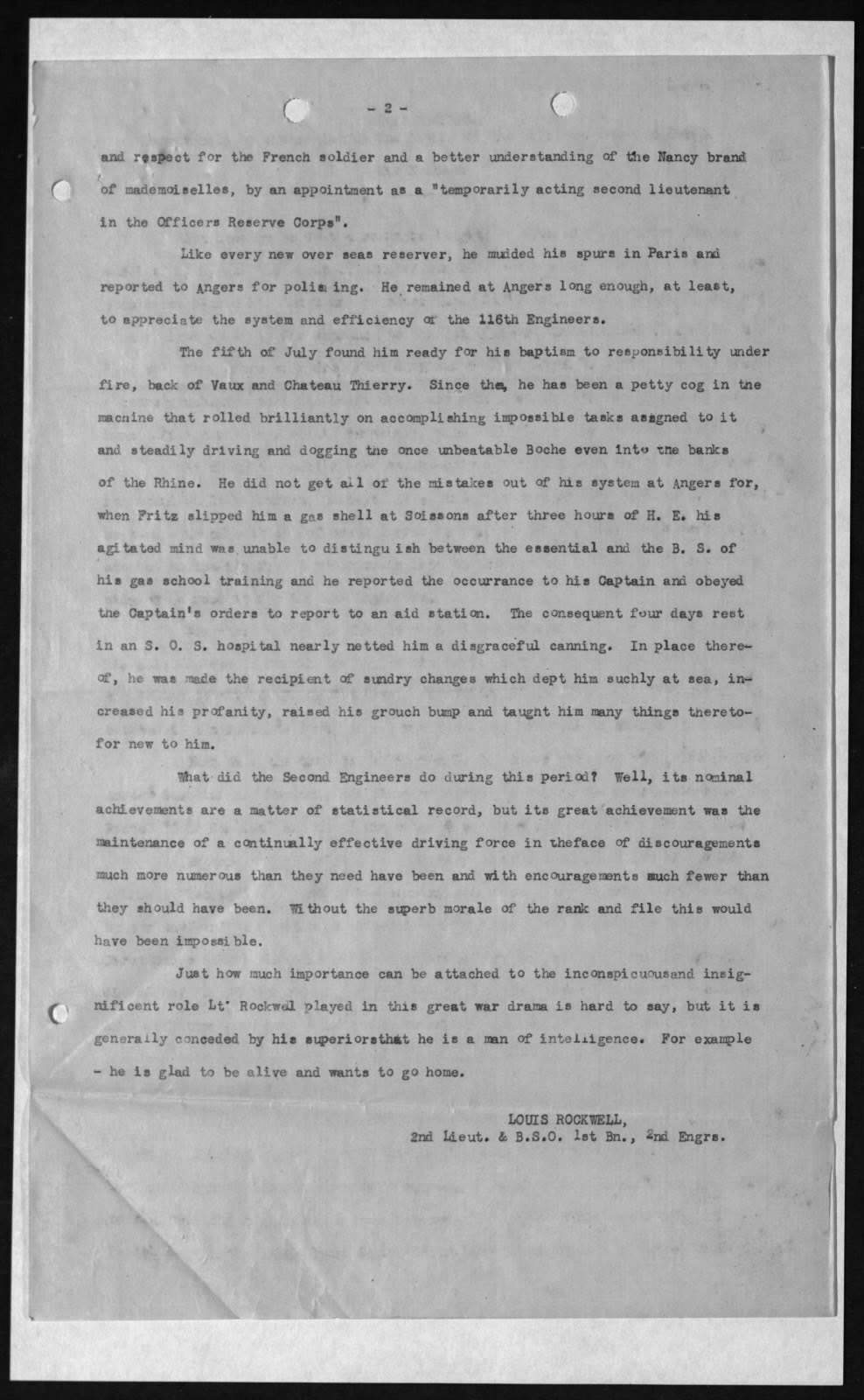
The following is from Rockwell’s AEF Officer’s Experience Report:
“Not because he felt a romantic longing or even an idle desire for the smell of H. E. and the sight of mangled corpses, but because he realized that circumstances placed him dutybound to enter Uncle Sam’s Army, Louis Rockwell, was one of the first to apply for entrance to the 1st Officers Training Camp.
…
Either as a reward for his sobriety or as a punishment for his ultra-sobriety, Rockwell was sent by his company commander, then Captain Snow, who was, by the way, and has been ever since, idolized by his men, to the first course of the First Corps School where he wallowed in mud and trench warfare lore through five dismal weeks. At the end of the Gondrecourt service, Rockwell, was sentenced to an indefinite term as an assistant instructor. The kindly Captain Snow relieved him from this predicament by raising him a grade and forwarding him to the First Army Candidate School.
…
Like every new overseas reserver, he muddied his spurs in Paris and reported to Angers for polishing. He remained at Angers long enough, at least, to appreciate the system and efficiency of the 116th Engineers.
The fifth of July found him ready for his baptism to responsibility under fire, back of Vaux and Chateau Thierry. Since the, he has been a petty cog in the machine that rolled brilliantly on accomplishing impossible tasks assigned to it and steadily driving and dogging the once unbeatable Boche even into the banks of the Rhine. He did not get all of the mistakes out of his system at Angers for, when Fritz slipped him a gas shell at Solssons after three hours of H.E. his agitated mind was unable to distinguish between the essential and the B. S. of his gas school training and he reported the occurrence to his Captain and obeyed the Captain’s orders to report to an aid station. The consequent four days rest in an S.O.S. hospital nearly netted him a disgraceful canning. In place there-of, he was made the recipient of sundry changes which dept him suchly at sea, increased his profanity, raised his grouch bump and taught him many things thereto-for new to him.
What did the Second Engineers do during this period? Well, its nominal achievements are a matter of statistical record, but its great achievement was the maintenance of a continually effective driving force in the face of discouragements much more numerous than they need have been and with encouragements much fewer than they should have been. Without the superb morale of the rank and file this would have been impossible.
Just how much importance can be attached to the inconspicuous and insignificant role Lt. Rockwell played in this great war drama is hard to say, but it is generally conceded by his superiors that he is a man of intelligence. For example – he is glad to be alive and wants to go home.”
Louis Rockwell was born in St. Charles, Illinois on May 9th, 1887. He attended the University of Illinois from 1907-1910, having studied law. He was a member of the American BAR Association, and later became the Kane County Treasurer. He returned home as Lieutenant of Company D, 2nd Engineer Regiment, 2nd Division, and resumed his law work, becoming an attorney and in 1921 working to stop pollution of the Fox River in Elgin. Rockwell passed away on July 20th, 1953 at the age of 66.
Thank you to the Doughboy Foundation for the opportunity to preserve Rockwell’s story.
 Michael R. Santoro is a historic researcher & antiquarian of the First World War. After finishing his Bachelor’s and Master’s degrees in Architecture & Historic Preservation at the University at Buffalo, New York, he spent a year developing a museum in Gettysburg, Pennsylvania, and another year freelancing research in order to preserve the stories of soldiers long forgotten.
He now works full time at International Military Antiques in Gillette, New Jersey as a Historical Research Specialist & Authenticator, preserving countless items & stories across all nations and eras.
External Web Site Notice: This page contains information directly presented from an external source. The terms and conditions of this page may not be the same as those of this website. Click here to read the full disclaimer notice for external web sites. Thank you.