Remembering the U.S.S. Cyclops (1910-1918)
Published: 16 November 2026
By Marvin W. Barrash
Great nephew of Lawrence Merkel, Fireman, Second Class, U.S.S. Cyclops
via the Steamship Historical Society of America’s PowerShips magazine
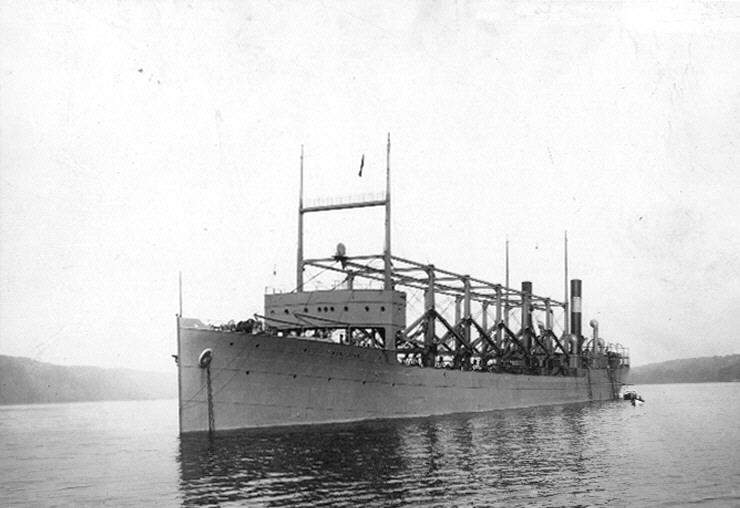
USS_Cyclops_in_Hudson_River_19111003
U.S.S. Cyclops anchored in the Hudson RIver off New York City on October 3, 1911. (Naval History & Heritage Command)
“If ammunition is lacking you can run; if food is lacking you can subsist on half rations and
still fight, but if fuel is lacking, you can neither fight nor run.” –
Rear Admiral Alfred Thayer Mahan, U.S.N.[1]
A collier is a ship that is designed to supply coal fuel to another ship. Prior to the transition to diesel oil-powered vessels, the ships of the U.S. Navy, to a great extent, depended on coal for their energy needs. The significance of the collier was its ability to travel with, and to provide fuel to the fleet while at sea. With a reduced need for its ships to return to shore for fuel, the navy’s level of readiness and security of the fleet was greatly increased.
Article originally published in the PowerShips magazine of the Steamship Historical Society of America. Tolearn more about SSHSA, visit their website at https://shiphistory.org/.
In 1908, there were eighteen colliers in the U.S. Navy. They were mostly incapable of meeting the needs of the fleet. Most were unable to keep up with the ships that they were to fuel. Only four of the eighteen colliers were considered to be capable of supporting the fleet during an extended cruise due to their limited coal carrying capacity[2]: Ajax, Alexander, Brutus, and Nero.[3] Much of the coal required by the navy, was actually transported at that time, by chartered foreign vessels. Many U.S. firms would not accept the government’s highest pay out of $9.00 per ton.[4]
To bring some relief to that situation, the 60th Congress, during its first session on May 13, 1908, appropriated funds for the navy for fiscal year 1909[5] for, “Two fleet colliers, of fourteen knots trial speed, when carrying not less than twelve thousand five hundred tons of cargo and bunker coal.”[6] President Theodore Roosevelt approved the names Jupiter, and Cyclops for the two fleet colliers authorized under the act.[7] It was a United States Navy tradition that auxiliaries, including fuel ships, were assigned names from classical mythology.[8]
The Navy Department advertised for prospective bidders on October 9, 1908, “for the construction of a steel steam collier of about 12,500 tons cargo and bunker capacity”.[9] The “circular defining chief characteristics” was provided to prospective bidders on October 15, 1908.[10] Four companies submitted bids for the construction of the collier Cyclops. The offeror which submitted the lowest bid, $775,000 was William Cramp & Sons Ship and Engine Building Company, Philadelphia, Pennsylvania. The navy authorized an increased expenditure of $47,500 for a coal handling apparatus with greater performance specifications than the one proposed by the builder, which increased the cost to build to $822,500.[11]
The colossal collier Cyclops was designed to assist the navy transition from coal to fuel oil. She was an immense vessel; 542’ in length. Her molded beam was 65’, and her draft, was 27’- 6”.[12] Her general appearance was unlike most other naval vessels. This ship did not have a towering superstructure above her main deck, nor was she equipped with massive armaments. What would not have been evident to a casual observer was that this ship was actually a floating coal mine. The Cyclops had the capacity to fuel a fleet of warships. She was the largest vessel of her kind at completion. Her dominant features were an elevated bridge housing in the forward area, from which she was steered, and two large stacks, astern, which would spew out black smoke from the coal consumed in her boilers. Amidships was her coal handling mechanism; an impressive array of steel posts and booms that straddled her cargo holds.
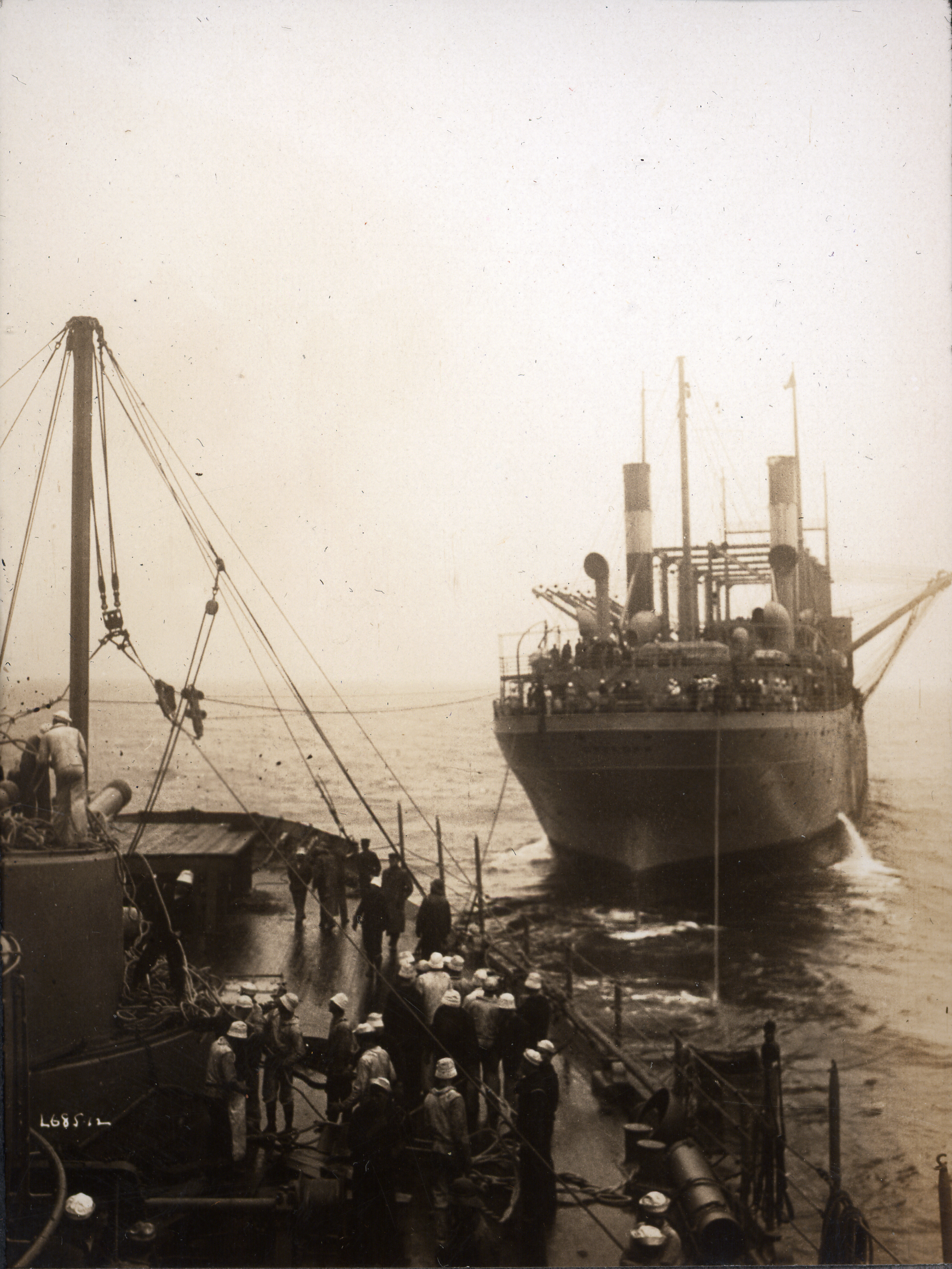
U.S. Collier CYCLOPS coaling the U.S.S. South CAROLINA in a seaway, April 12, 1913. An operational demonstration of the Lidgerwood-Miller marine cableway. (Courtesy, U.S. Naval History and Heritage Command, Washington Navy Yard, Washington, DC)
The majority of the Cyclops’ volume consisted of her cargo holds[13] for the transport of fuel. The Cyclops’ total coal capacity was based upon how much fuel oil that she carried. Four of her smaller holds could be used for either coal or fuel oil, according to the needs of the fleet. If she carried the maximum coal possible, 499,450 ft3, it would limit the amount of oil that could be transported. Conversely, if she carried the maximum fuel oil possible, 874,700 gallons, it would limit the amount of coal that could be transported. In addition to the cargo coal, she could carry 97,590 ft3 of bunker coal; the fuel that would be stored separately for use in her own boilers. The contractual requirement to carry 12,500 tons of cargo coal, and the specified capacity of bunker coal had been met. It was not only important for the Cyclops to transport this vital cargo; she had to be capable of delivering it to the ships whether they were in port or at sea.
The collier’s innovative design permitted the simultaneous transfer of coal from her port and starboard sides in coal bags and clamshell buckets while stationary. The “Coal Handling Cableway”[14] designed by the Mead-Morrison Manufacturing Company in 1909, specifically for use on the Cyclops, was the principal mechanism by which the coal was transferred, via clamshell buckets or coal bags, from her cargo holds to other ships. A few years later, the Lidgerwood-Miller marine cableway was installed on the Cyclops. That important addition was permitted stern-to-bow coaling, with coal bags, while underway.[15] A battleship would typically take on several hundred to 1,500 tons during a coaling operation, but some had taken as much as 2,600 tons at a time.[16]
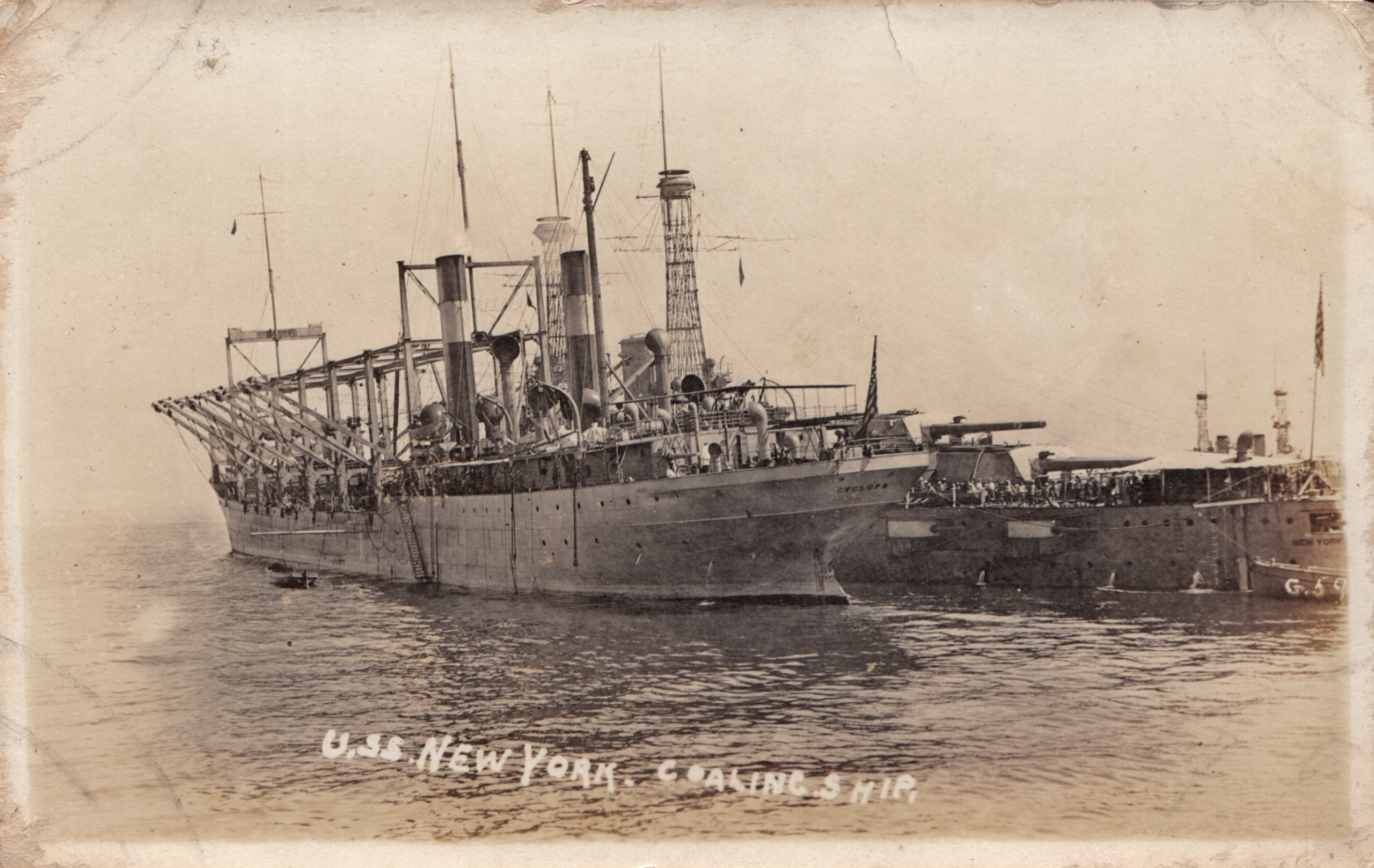
U.S.S. Cyclops coaling Battleship U.S.S. New York at Port Jefferson, Long Island, NY, September 7, 1917. (Collection of the Author)
Some of the newer ships consumed fuel-oil. (Several ships actually consumed coal, and fuel-oil.) The Cyclops delivered that fuel via a hose to the receiving ship. The oiling process was faster and cleaner as compared with coaling. Fuel oil-fired vessels did not spew thick black smoke from their stacks as the ships that burned coal. That was significant in time of war as smoke from coal-fueled ships could be seen for miles, by enemy vessels, thereby revealing their positions. A typical fuel-oiling, of a destroyer, involved the transfer of 20,000 to 50,000 gallons.
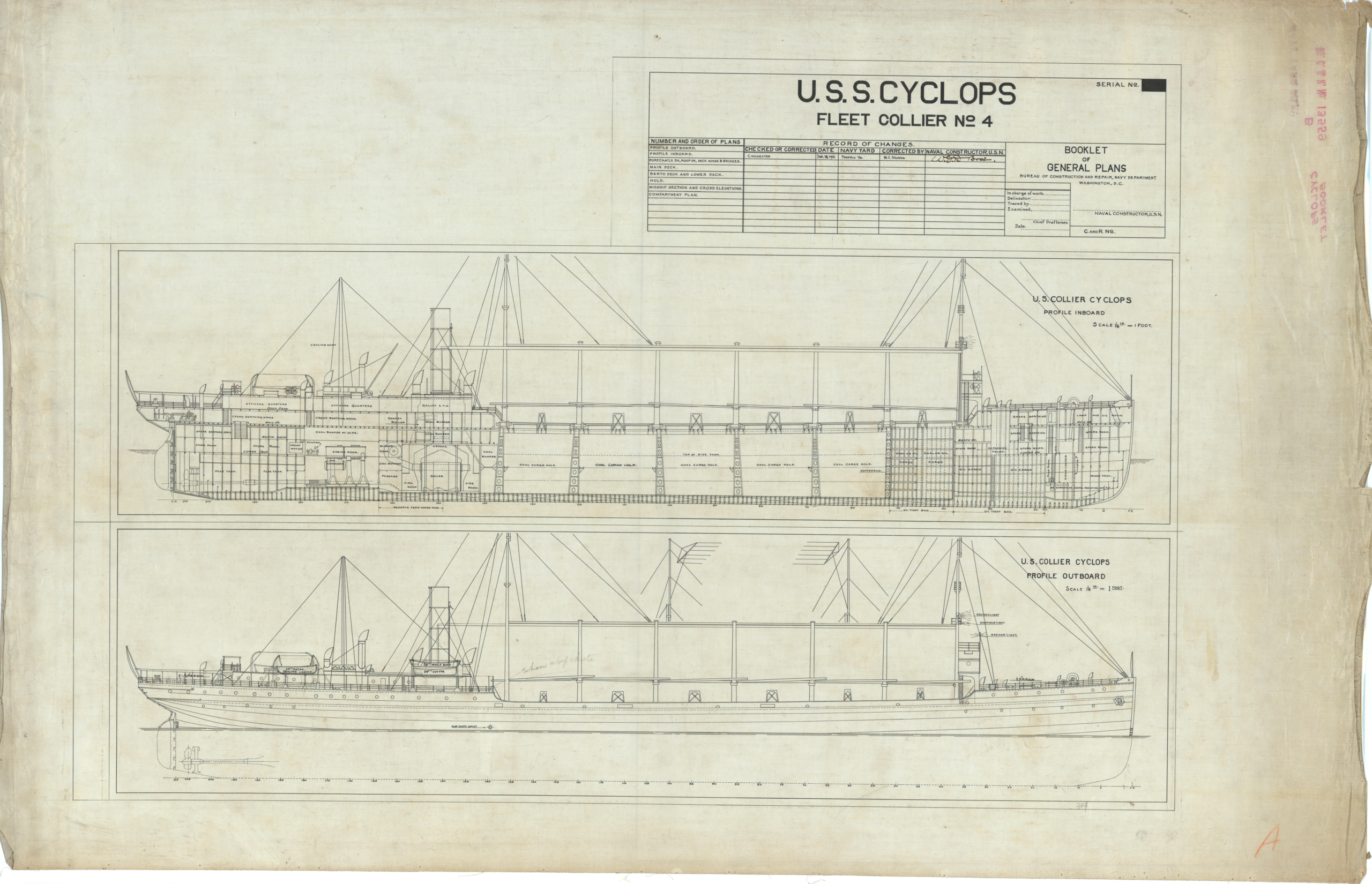
Starboard profile of U.S.S. Cyclops From Booklet of Plans, Fleet Collier No. 4, National Archives and Records Administration, Record Group 19
The U.S. Naval Auxiliary Cyclops was placed in service, on November 7, 1910, under the command of Master[17] George W. Worley. The first log book entries occurred on November 8, 1910. The ship’s home port was Norfolk, Virginia. Her officers and men were employed by the Naval Auxiliary Service which was a component of the navy’s Bureau of Navigation. The ranks of officers and positions of the enlisted personnel, paralleled those on merchant vessels of that era.
No matter where on the ship, her crewmen were assigned, duty on board the Cyclops was far from attractive or safe. The coal-handling equipment was very dangerous to operate. Ventilation was poor, and coal dust was in the air that the crew breathed. The engine and boiler areas, were the hottest, down in the bowels of the ship. Hazardous materials such as the primer, red lead, were in common use, throughout the vessel. With the benefit of electric lighting, operations were possible 24 hours a day, 7 days a week.[18]
For nearly six and one half years, the civilian crew provided coal and fuel oil to the fleet. Coal was also provided to shore facilities. The mail and supplies were routinely transported on the collier Cyclops. U.S. Navy personnel were transported to other ships and shore stations via the collier. Many times, U.S. Marine Corps personnel were transported on the ship to or from Guantanamo, Cuba, or to operational areas in Tampico, Mexico, and Port au Prince, Haiti.[19]
Following her support to U.S. warships during the Mexican Campaign at Vera Cruz, and Tampico in 1914, the collier Cyclops took aboard hundreds of Americans, at Tampico, Mexico, who sought refuge. Master Worley undertook two such evacuations: Tampico to Galveston, Texas (April 23 – 26, 1914), and Tampico to New Orleans, Louisiana (May 2 – 11, 1914).[20]
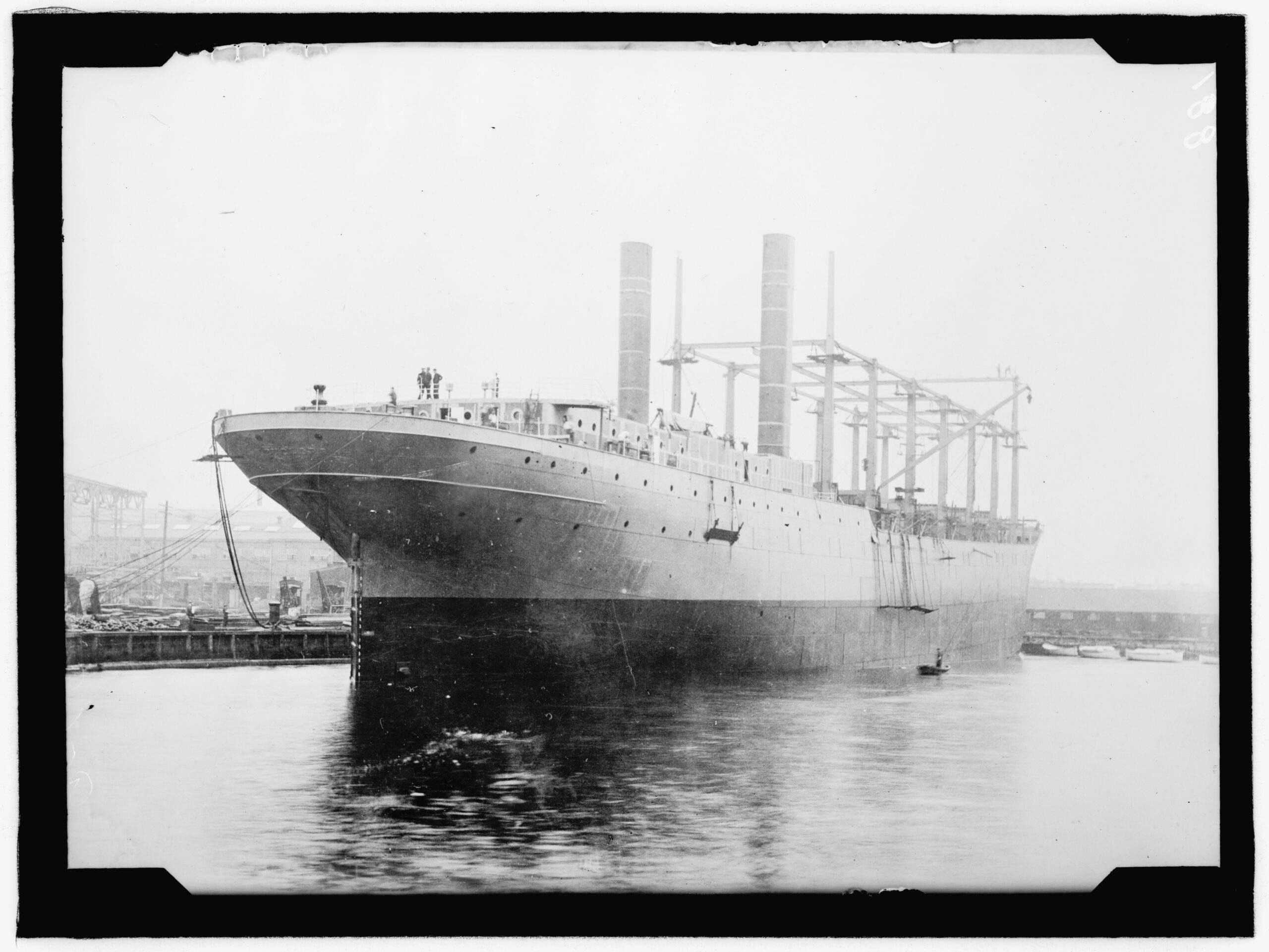
U.S.S. Cyclops under construction, 1910. (Library of Congress photo.)
No medical personnel were assigned to the Cyclops from November 1910 to June 1917,.[21] During that period an injured sailor could be treated at a navy hospital or aboard a hospital ship. In 1916, the U.S. Navy Bureau of Medicine and Surgery published the “Medical Compend for Masters of the Naval Auxiliary Service.” The intent of the book was to provide basic care for, “The frequent occurrence of medical and surgical emergencies aboard auxiliaries where only the medicine box is available under the lay direction of the master, made it advisable that a practical compend be evolved explaining the uses and abuses of the supplies furnished by the bureau, as well as pointing out in a simple, easily comprehended way the principles of first-aid, diagnosis and treatment of the commoner diseases, the routine to follow in using hospital facilities, procedure in case of death on board, and a lucid chapter on the primal principles of quarantine and disinfection.”[22]
April 6, 1917, “That the state of war between the United States and the Imperial German Government which has been thrust upon the United States is hereby formally declared.”[23] Four rapid-fire guns were installed on the decks of the Cyclops, on April 16, 1917,[24] at the Norfolk Navy Yard. Two guns were mounted forward, on the forecastle deck, to the aft of the breakwater, at the port, and starboard sides of the ship. The other two were mounted astern, on the poop deck, aft of the deckhouse, at the port, and starboard sides of the ship.[25] The rapid-fire guns were breech-loaded and rifled. That type of gun utilized a quick-acting breech, operated by a lever that opened the breech in one movement of the arm. They use fixed ammunition; meaning, “ammunition where the entire charge of the gun projectile, powder, and primer was contained in a single, metal (usually brass) cartridge case.”[26]
On May 1, 1917, the U.S.S. Cyclops was placed in commission. Her enlisted manning began to change from a civilian complement to U.S. Navy personnel. The collier’s officers received commissions in the U.S. Naval Reserve Force.
Now, armed with four rapid fire guns and fast enough to accompany, and fuel the fleet, the U.S.S. Cyclops was assigned to convoy-escort duty, in Group 3, of the first U.S. Expeditionary Force to Saint Nazaire, France, under the Command of Rear Admiral Albert Gleaves. [27] The convoy to France got underway on June 14, 1917. The changeover in Cyclops personnel was not complete. Her crew consisted of officers and men of the Naval Auxiliary Service, Naval Auxiliary Reserve, U.S. Navy, U.S. Naval Reserve Force, and National Naval Volunteers. Many of the men were inexperienced as they only had recently enlisted. In addition to her cargo of fuel and supplies, the Cyclops transported members of the staff of what would become Army Base Hospital No. 18[28] ay St. Nazaire. The collier remained at St. Nazaire for 17 days. During that time, she provided coal and fuel oil to numerous vessels. Following her return to Norfolk, the U.S.S. Cyclops returned routine fueling operations.
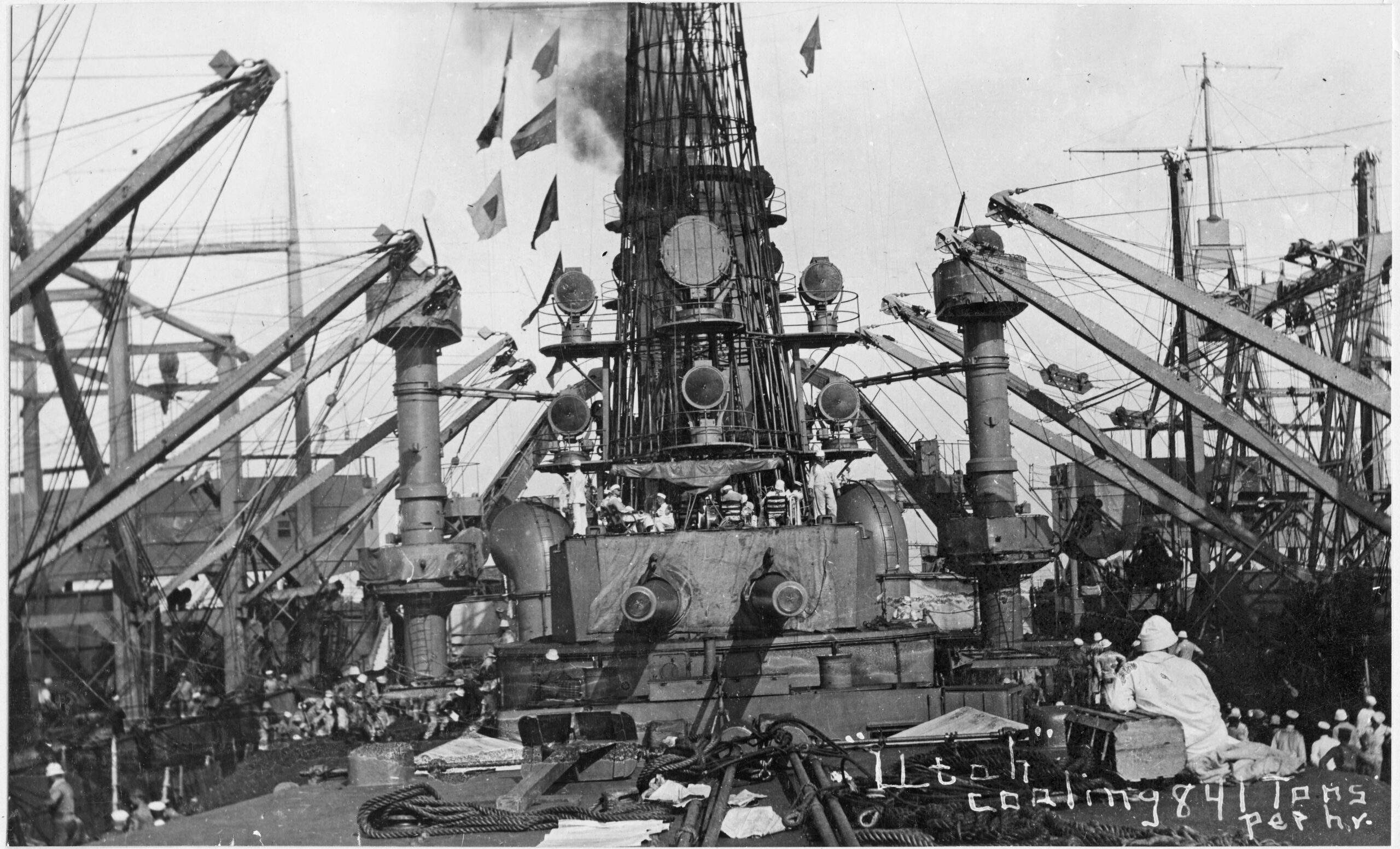
View looking forward from atop # 4 12 gun turret of the U.S.S. Utah while coaling simultaneously from two colliers at the rate of 841 tons per hour, prior to World War I. The ship’s band is stationed on top of # 3 12 gun turret. The two colliers are Cyclops (Fuel Ship # 4) on the left and either Orion (Fuel Ship # 11) or Jason (Fuel Ship # 12) on the right. Note the differences between the collier’s coal handling arrangements: Cyclops‘s was of the Mead-Morrison type, while Orion‘s and Jason‘s were of the Lidgerwood type. Note Utah‘s searchlights and the boat cranes flanking her cage mainmast. — U.S. Naval History and Heritage Command Photograph.
On December 6th 1917, two ships collided in the harbor of Halifax, Nova Scotia. One was a munitions ship, loaded with explosives, bound for the battlefields of the World War. The north end of Halifax was demolished by the blast. Two thousand people were killed; many more were injured. Two days later, the U.S.S. Cyclops received orders to head toward Halifax for coaling operations in support of the massive relief effort that took place there.
On January 8, 1918, the Cyclops departed icy Norfolk for South America. She performed coaling operations at Bahia, Brazil. She then headed to Rio de Janeiro, Brazil to receive a massive cargo of manganese ore. The 10,500 tons of the war materiel was to be transported to Baltimore, Maryland.
The Cyclops’ starboard engine was damaged off the coast of Brazil, possibly as a result of improper maintenance, or defective parts. A Board of Investigation examined the incident. Plans were in place make repairs once the ship was back in the United States. On February 22, 1918, the U.S.S. Cyclops departed Brazil, en route to Baltimore, Maryland. Only her port engine was operational. She laid over at Barbados on March 3rd 1918, where took on bunker coal and stores. On the following evening, the U.S.S. Cyclops, with 309 men (237 crew, 72 official passengers) on board, departed for the U.S. She never arrived at her destination.
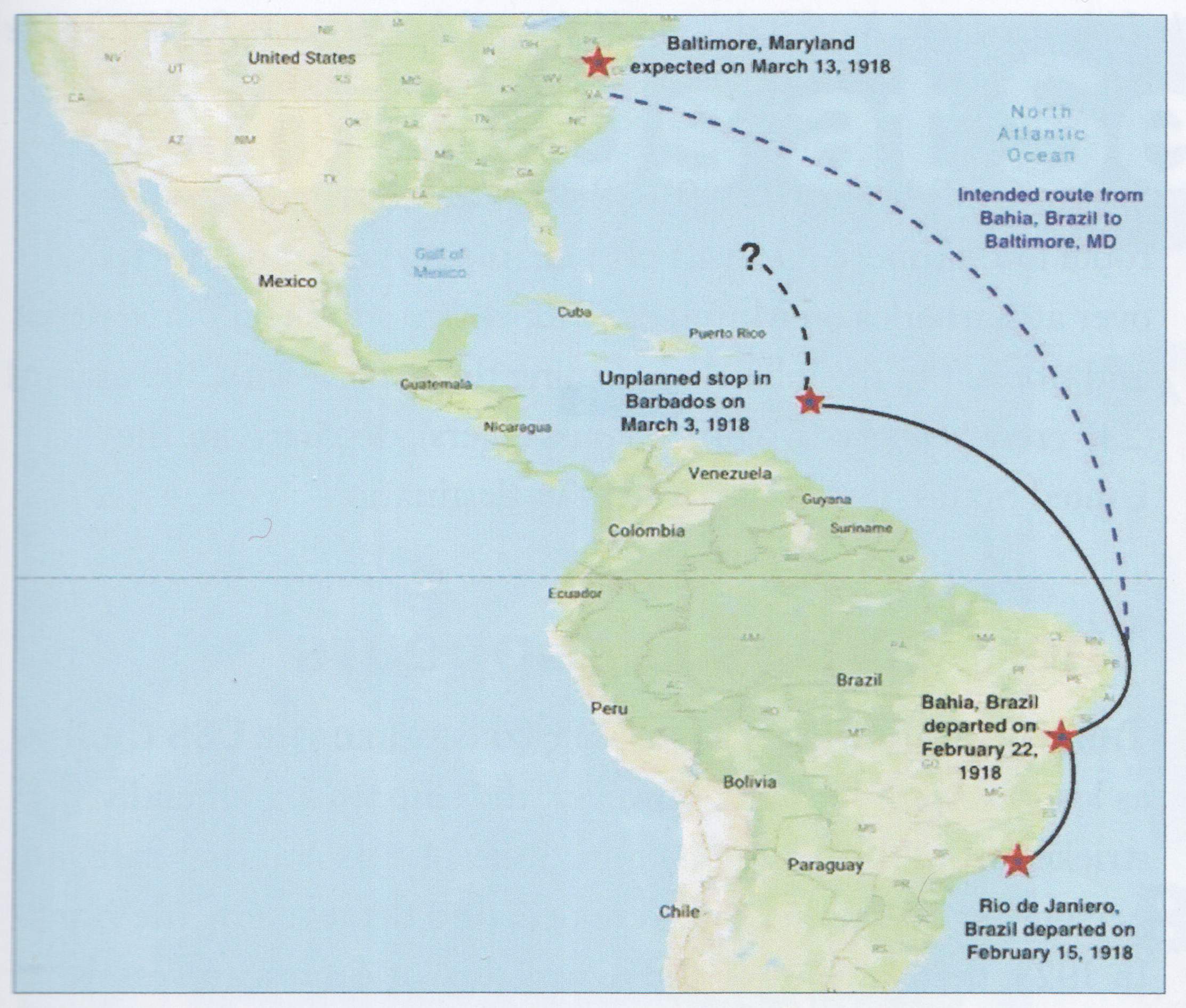
The Cylops’s final mission was to transport 9,960 tons of coal from its homeport in Norfolk, Virginia, to Rio de Janeiro, Brazil, and bring back 11,000 tons of manganese ore. It departed on January 9, 1918, and arrived in Rio on January 28, where it stayed for two weeks unloading and loading cargo. On February 15, 309 souls departed for Bahia, Brazil, the only scheduled stop before Baltimore, Maryland. Two days later, at 1800 on February 22, the ship embarked for Maryland; it was expected to arrive on March 13. The last known location of the Cyclops was an unplanned stop at Barbados on March 3, with 1,800 nautical miles (nm) to go on a 4,844-nm journey. — US Naval Institute illustration.
The Navy Department officially considered the U.S.S. Cyclops, as lost, on April 13, 1918; however, the ship was not officially stricken from the Navy List until June 14, 1918. Also on that date, all persons on board the ship were declared deceased by the navy. In 1923, the Navy published a directory of American vessels lost during the World War. The U.S.S. Cyclops was listed with the remark, “mysteriously disappeared.” That designation was not applied to the loss of any other ship during the war.
Since then, much has been speculated regarding what may have been the circumstances of the Cyclops’ final voyage. The ship’s logs well-documented that she had undergone several instances of severe rolling in the past. In what may have been the only postmortem, by the navy, concerning the ship, Rear Admiral David W. Taylor, Chief, Bureau of Construction and Repair stated, “From all accounts it would appear that there was no standalone cause for the loss of the collier Cyclops. It was likely a combination of unfavorable weather and sea conditions combined with a cargo of manganese that may have been prone to shifting…”[29] The manganese ore that filled her holds was unlike her normal cargo. Manganese ore has a far-greater density than coal and a very abrasive surface. That was the only time that such a cargo was transported by the U.S.S. Cyclops.
It was well documented that the Cyclops had sustained significant rolling, on several occasions in different waters, as early as in 1911. The worst such situation occurred during fleet maneuvers in 1916. On August 20, 1916, the U.S. Naval Auxiliary Cyclops was approximately 175 miles southeast of Nantucket Island, Massachusetts. August 21, 1916, from 4:00 a.m. on, the ship experienced rough seas and a strong SW (force-5 to 7) breeze. These conditions caused the ship to roll 30° to starboard, and 32° to port at 5:30 p.m. The “ship rolling badly” caused a quantity of dishes in the Ward Room to break. The Cyclops was also described as “rolling deeply” during that time.” August 22, 1916, the fleet continued through various courses as the strong SW breeze persisted. At 4:50 a.m., the fleet began to gradually change course to NNE as the Cyclops steamed at 1/3 speed. The fleet proceeded NNE, per standard compass, at 5:30 a.m.; the Cyclops steamed at standard speed, 10 knots, standard distance 2,500 yards. As the crew turned to their regular sea duties, the strong SW breeze (force-5) and heavy swell caused the ship to roll deeply. At 8:00 a.m., the Cyclops was approximately 200 miles northeast of Bermuda. At noon, the winds increased to force-6; the fleet proceeded NNE at the standard speed of 10 knots. The Cyclops’ maximum roll at that time was 41° to port; 42° to starboard. The winds were force 8 at 6:00 p.m. when the ship rolled 46° to port; 50° to starboard.[30] That was the maximum documented roll that the ship had sustained.
Eleven years after the Armistice, the 70th Congress enacted legislation, which President Calvin Coolidge signed into law, on March 2, 1929, “To enable the mothers and widows of the deceased soldiers, sailors, and marines of the American forces now interred in the cemeteries of Europe to make a pilgrimage to these cemeteries.” The pilgrimages would be made between May 1, 1930 and October 31, 1933.[31] The law was amended three times in 1930, and included a key provision regarding the interment of the deceased, “wherein death and burial of the member occurred at sea or overseas but whose place of interment is unknown” thereby permitted surviving mothers and widows of the men of the Cyclops to participate in the pilgrimage program.[32] Following the change in the law, 49 of the mothers and widows of the Cyclops’ crew and passengers participated in the pilgrimages. Not all of those participants traveled at the same time. The pilgrimages were conducted under the direction of Major General Frank B. Cheatham who, “would try to arrange for mothers and widows from the same localities to make the pilgrimage together.”[33]
On one of the pilgrimage voyages, “A bouquet of flowers was thrown upon the turbulent waters of the Atlantic Ocean recently by Mrs. Dode Hill… in memory of her son Thornton Winders Hill, who lost his life at sea during the World War. The occasion of the ceremony during which the flowers were tossed upon the waves, was the crossing of 125 Gold Star women of the group who had lost one of her kin at sea. Mrs. Hill’s son was a U.S. Marine Corps Private transported on the U.S.S. Cyclops when the ship was lost.”[34]
“Mrs. Dora B. Hines, Blackfoot, Idaho, aboard the S.S. President Roosevelt, was named as one of the two Gold Star Mothers to drop flowers on the ocean, thus honoring American soldiers who died at sea.”[35] Mrs. Hines’ son, Encel was a navy Machinist’s Mate, 2C, who was transported aboard the U.S.S. Cyclops when the ship was lost.
Mrs. Jessie West participated in one of the pilgrimages. Mrs. West lost two sons; Andrew and James West. Both served as Firemen, Second Class, on board the U.S.S. Cyclops, when the ship was lost. On August 23, 1931, on board S.S. President Roosevelt, United States Lines, she was given the honor to cast a floral anchor wreath to the deep. The wreath bore a ribbon, “In Memory of those Members of the Military and Naval Forces of the United States Who Were Lost or Buried at Sea During the World War.”[36]
Some families opted to erect a cenotaph; a monument erected in memory of a deceased person whose remains lay elsewhere, in cemeteries, and in family burial grounds across the country, in memory of their loved ones who were lost with the Cyclops. The U.S. Department of Veterans Affairs continues to assist in that regard.
Many states and cities erected World War monuments which included the names of the Cyclops dead from their communities. Several Veterans of Foreign Wars posts and American Legion posts were named for sailors who perished with the U.S.S. Cyclops. To date, there does not exist a memorial, large or small, dedicated to the memory of all who perished with the U.S.S. Cyclops.
It is essential, despite the passage of more than a century since her loss, to conduct a search for the wreckage of the U.S.S. Cyclops. Once found, the remains of the ship must be respected as the gravesite of the 309 Americans who gave their all during time of war. The ship’s wreckage, and any artifacts associated with her, must be protected from salvage. The immediate site and its environs need to be studied with the goal to ascertain the cause of her loss.
The word mystery must now be removed from the saga of the U.S.S. Cyclops. It has been 108 years since her loss. She was a fuel ship, manned by personnel, who served her country well. That fuel ship served a vital purpose, in peace and, in war. The time to know the facts concerning the loss of the 309 Americans and their ship is now. Many families today are related to men who perished with the U.S.S. Cyclops. The 309 lost with the ship are not just numbers to us. They have names and must be remembered, and their stories told. These were men who served their country in the United States Navy, United States Naval Reserve Force, United States Marine Corps, National Naval Volunteers, and the U.S. Department of State.
Marvin W. Barrash – Biography
Marvin W. Barrash was introduced to the U.S.S. Cyclops at an early age. His father told him that his great uncle was lost with the “Collier Cyclops” during the First World War. That bit of family history made an impression on him. Years later, he authored three books concerning the U.S.S. Cyclops. Following his initial thirteen years of extensive research of surviving Cyclops documentation, his book, U.S.S. CYCLOPS, the comprehensive history of the ship, was completed.
 His next volume was, Murder on the Abarenda, a pre-history of the Cyclops saga that delved into the prior sea service of the ship’s only commanding officer. His third book, U.S.S. CYCLOPS, Volume Two, focused on the men who perished with the ship and provided information that was not previously available.
Mr. Barrash’s decades of research of the Cyclops’ history never ceased. He continues with the hope that the ship will be located and studied; not salvaged. The cause of the ship’s demise and the terrible loss of life with her must be ascertained.
Marvin Barrash retired after more than four decades of service with the U.S. Department of Defense. His military service was in the Maryland Army National Guard. He resides in Maryland.
Endnotes:
[1] “The Train and Mother Ships”, by Charles H. Hall, p. 24, Sea Power, Sea Power Publishing Co., Inc.,
Washington, D.C., May 1917
[2] Statement of Commander Cleland Davis, U.S.N., attached to Bureau of Equipment, in charge of coaling
and the transportation of coal, Hearing before the Subcommittee on Construction, Repair and Steam
Engineering, Washington, D.C. January 23, 1908, Hearings Before the Committee on Naval Affairs of the
House of Representatives on Estimates Submitted by the Secretary of the Navy, p. 527, Government
Printing Office, Washington, D.C. 1908
[3] “The Problem of Colliers”, The Navy, March-April 1908, p. 39, The Navy Publishing Co., Washington, D.C.
[4] Statement of Rear Admiral William S. Cowles, U.S.N., Chief, Bureau of Equipment, Hearing before the
Committee on Naval Affairs, January 15, 1908, Hearings Before the Committee on Naval Affairs of the
House of Representatives on Estimates Submitted by the Secretary of the Navy, p. 277, Government
Printing Office, Washington, D.C. 1908
[5] Senate Document No. 112, 62nd Congress, 2nd Session, Navy Yearbook – A Compilation of Annual Naval
Appropriation Laws from 1883-1911, p. 721, Government Printing Office, Washington, D.C., 1911
[6] Senate Document No. 112, 62nd Congress, 2nd Session, Navy Yearbook – A Compilation of Annual Naval
Appropriation Laws from 1883-1911, p. 619, Government Printing Office, Washington, D.C., 1911
[7] The Navy, Service Items, Names for the Submarines and Colliers, Vol. II, No. 8, p. 33, The Navy Publishing Co., Washington, D.C. September 1908
[8] This is described as being Navy policy, The United States Navy, A Handbook, by Henry Williams, Naval
Constructor, United States Navy, p. 145, Henry Holt and Co., New York, NY, October 1911
[9] Correspondence from H.L. Satterlee, Acting Secretary of the Navy to William Cramp & Sons Ship and
Engine Building Co., Philadelphia, PA, January 12, 1909, Navy Department, Washington, D.C., Records of
the Bureau of Ships (1896-1912), National Archives and Records Administration, RG19, File 24439
[10] Annual Reports of the Navy Department for the Fiscal Year 1908, p. 483, Government Printing
Office, Washington, D.C.
[11] Correspondence from H.L. Satterlee, Acting Secretary of the Navy to William Cramp & Sons Ship and
Engine Building Co., Philadelphia, PA, January 12, 1909, Navy Department, Washington, D.C., Records of
the Bureau of Ships (1896-1912), National Archives and Records Administration, RG19, File 24439
[12] Fleet Collier No. 4, Cyclops, Ships’ Information, Scientific and Computing Branch, Bureau of
Construction and Repair, Navy Department, Washington, D.C., Naval History & Heritage Command,
Washington Navy Yard, Washington, D.C.
[13] Booklet of General Plans, U.S.S. Cyclops, Fleet Collier No. 4, corrected to January 14, 1916, Records of the Bureau of Ships (1896-1912), National Archives and Records Administration, RG19
[14] Drawing, “General Arrangement of Coal Handling Cableway Proposed for U.S. Collier Cyclops”, April
10, 1909, Mead-Morrison Mfg. Co., Independence Seaport Museum Library, Philadelphia, PA
[15] “Refueling Warships at Sea” by Spencer Miller, Esq., Member, Transactions of the Society of Naval Architects and Marine Engineers, pp. 169-172, Vol. XXII, Presented December 10 and 11, 1914, Corrected January 1, 1915
[16] Log Book, U.S.S. Cyclops, Records of the Bureau of Naval Personnel, National Archives and Records Administration, RG24
[17] Following the May 1, 1917 change in status, of the Cyclops from, in-service to in-commission, George W. Worley continued command of the U.S.S. Cyclops as Lieutenant Commander, U.S.N.R.F.
[18] “The Largest Naval Collier in the World”, by K.G. Martin, pp 495-498, December 1911, International Marine Review, New York, NY
[19] Log Book, U.S.S. Cyclops, Records of the Bureau of Naval Personnel, National Archives and Records Administration, RG24
[20] Log Book, U.S.S. Cyclops, Records of the Bureau of Naval Personnel, National Archives and Records Administration, RG24
[21] Assistant Surgeon, Burt Asper, U.S.N., reported on board the U.S.S. Cyclops June 9, 1917 as the ship’s physician.
[22] Report of the Surgeon General, Department of the Navy, Bureau of Medicine and Surgery, Washington, D.C., October 1, 1916, Annual Reports of the Navy Department for the Fiscal Year 1916, page 702, Government Printing Office, Washington, D.C., 1917
[23] Joint Resolution of Congress, Declaration of war against Germany, April 6, 1917, The Statutes at Large
of the United States of America, Vol. XL, Part 2, Government Printing Office, Washington, D.C., 1919
[24] Gun Record Cards of U.S.S. Cyclops, Records of the Bureau of Ordnance, National Archives and
Records Administration, National Archives and Records Administration, RG74
[25] Drawing, Booklet of General Plans, No. 13559-C, U.S.S. Cyclops, January 14, 1916, Records of the Bureau of Ships (1896-1912), National Archives and Records Administration, RG19
[26] Rapid-Fire Guns, page 2, Elementary Naval Ordnance and Gunnery, by Lieut. H.C. Ramsay, Little, Brown, and Company, Boston, 1918
[27] Correspondence, From: Commanding Officer, U.S.S. Cyclops at Saint Nazaire, France, To: Commander Destroyer Force, Commander U.S. Convoy Operations in the Atlantic, Subject: Report of Passage of First Expeditionary Force from U.S. to France, paragraph (a), July 1 1917. Naval Records Collection of the Office of Naval Records and Library, National Archives and Records Administration, RG45
[28] History of American Red Cross Nursing, by Lavinia L. Dock, Sarah Elizabeth Pickett, Clara D. Noyes,
Fannie F. Clement, Elizabeth G. Fox, Anna R. Van Meter, pages 485-486, 1443, The Macmillian
Company, New York, NY, December 1922.
[29] 2nd Endorsement, from Rear Admiral David W. Taylor, Chief, Bureau of Construction and Repair to Chief of Naval Operations, Subject: CYCLOPS – Stability (Standard Oil Co’s 1st. to Sec. Navy, April 17, 1918), June 7, 1918, No. O-F4-2, Naval Records Collection of the Office of Naval Records and Library, National Archives and Records Administration, RG45
[30] Log Book, U.S.S. Cyclops, Records of the Bureau of Naval Personnel, National Archives and Records Administration, RG24
[31] Public, No. 952, Chap. 526, (S. 5332), The Statutes at Large of the United States of America from December, 1927, to March, 1929, Vol. XLV, Part 1 – Public Acts and Resolutions, pages 1508-1509, United States Government Printing Office, Washington, D.C., 1929
[32] Public Res., No. 38, Chap. 41 (H.J. Res. 242); Public No. 155, Chap. 198 (H.R. 8527); Public No. 227, Chap. 287 (H.R. 4138), The Statutes at Large of the United States of America from April, 1929, to March, 1931, Vol. XLVI, Part 1 – Public Acts and Resolutions, pages 65, 225-226, 334-335, United States Government Printing Office, Washington, D.C., 1931
[33] “War Mothers Bill Passed by Congress”, Moberly Weekly Monitor, page 1, Moberly, Missouri, February 6, 1930
[34] “Lima Woman Throws Flowers into Atlantic in Memory of Lost Son”, The Lima Sunday News, p 24, Lima, Ohio, May 24, 1931
[35] “Idaho Woman Wins Gold Star Honors”, The Ogden Standard-Examiner, p 2, Ogden, Utah, July 16, 1931
[36] National Archives and Records Administration, Record Group 92 Records of the Office of the Quartermaster General
External Web Site Notice: This page contains information directly presented from an external source. The terms and conditions of this page may not be the same as those of this website. Click here to read the full disclaimer notice for external web sites. Thank you.