As War Broke Out in Europe, America Lost a First Lady
Published: 26 April 2026
By Kimball Worcester
via the Roads to the Great War website
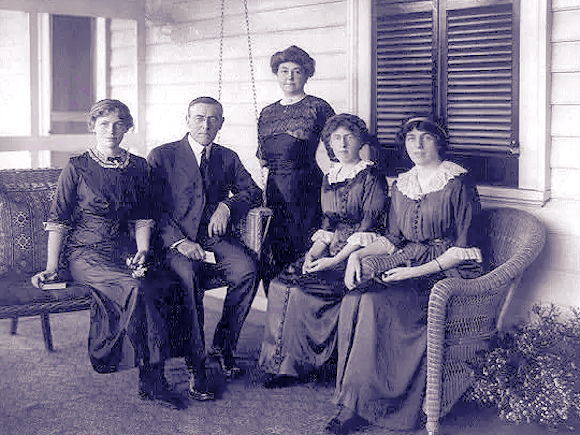
A Soon-to-Be First Family
A Soon-to-Be First Family.; Helen Wilson at center.
U.S. First Lady Ellen Axson Wilson died of Bright’s Disease on 6 August 1914. She had been born on 15 May 1860, in Savannah, Georgia. She was the first of four children born to Presbyterian minister Samuel Axson and Margaret “Janie” Hoyt Axson. Ellen spent most of her childhood in Rome, Georgia, and attended Rome Female College from 1871 to 1876. Although she studied numerous subjects, her favorite was art. Following graduation, Ellen continued to study art and later began selling her portrait drawings.
In April 1883, Ellen attended First Presbyterian Church, where her father preached, and caught the eye of a young lawyer, Woodrow Wilson. Her father, who suffered from severe depression died in 1884 by suicide. After his death, Ellen enrolled at the Art Students League in New York City where she continued her arts education.
Ellen and Woodrow’s engagement lasted nearly two years, and on 23 June 1885 they married in Rome, Georgia. As her husband took teaching positions at various universities, Ellen gave birth to three daughters: Margaret (1886), Jessie (1887), and Eleanor (1889). She also brought her younger brother, Eddie, to live with her family in 1886 and later her sister, Madge, during the summers.
As the wife of a professor and later president of Princeton, Ellen kept a busy social schedule, despite her preference for privacy. Ellen gradually returned to her role as a professional artist and spent several summers at an artists colony in Old Lyme, Connecticut. She exhibited her artwork in several shows, including at the Art Institute of Chicago, the Herron Art Institute, the Pennsylvania Academy of the Fine Arts, and Philadelphia’s Arts and Crafts Guild.
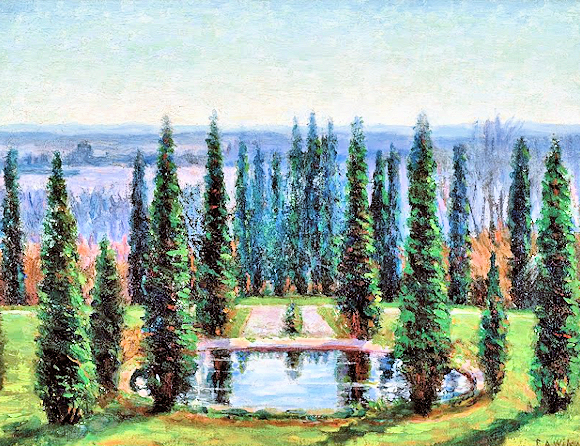
Prospect Garden, Helen Axson Wilson, 1910.
When her husband became the governor of New Jersey in 1911, Ellen supported his political career by hosting events and advising her husband. The following year, Woodrow won the presidential election and Ellen moved into the White House with her family in March 1913.
As first lady, Ellen focused her attention on several projects, including the West Garden, the forerunner to the modern Rose Garden. She worked with landscape architect George Burnap to redesign the space, adding a “President’s Walk” between the West Wing and the White House, and planting an assortment of rosebushes, narcissus, pansies, and boxwood hedges.
She also planned two weddings at the White House. Her daughter Jessie married Francis Bowes Sayre in the East Room on 25 November 1913. Just a few months later, on 7 May 1914, daughter Eleanor married Secretary of the Treasury William Gibbs McAdoo in the Blue Room. Ellen also continued painting and in 1913 installed a skylight at the White House for her art studio on the third floor. Today, one of her paintings, Princeton Landscape, is part of the White House Collection.
In addition to her role hosting White House receptions and dinners, Ellen also advocated for the local community in Washington, DC. As first lady, she began touring the city’s alleyways, where many of the capital’s Black residents lived in slum-like dwellings. She became the honorary chairman of the Women’s Committee of the National Civic Foundation and devoted herself to improving alley life in Washington, advocating for sanitary conditions, visiting residents, and even touring members of Congress through these alleyways. Her efforts eventually resulted in a push for legislation to remove these alleyways in the hopes of replacing them with public parks.
Read the entire article on the Roads to the Great War website here:
External Web Site Notice: This page contains information directly presented from an external source. The terms and conditions of this page may not be the same as those of this website. Click here to read the full disclaimer notice for external web sites. Thank you.