Answering the Call: My National History Day Journey with the Hello Girls
Published: 22 June 2026
By Ana Spiride
Special to the Doughboy Foundation website
Spride header image
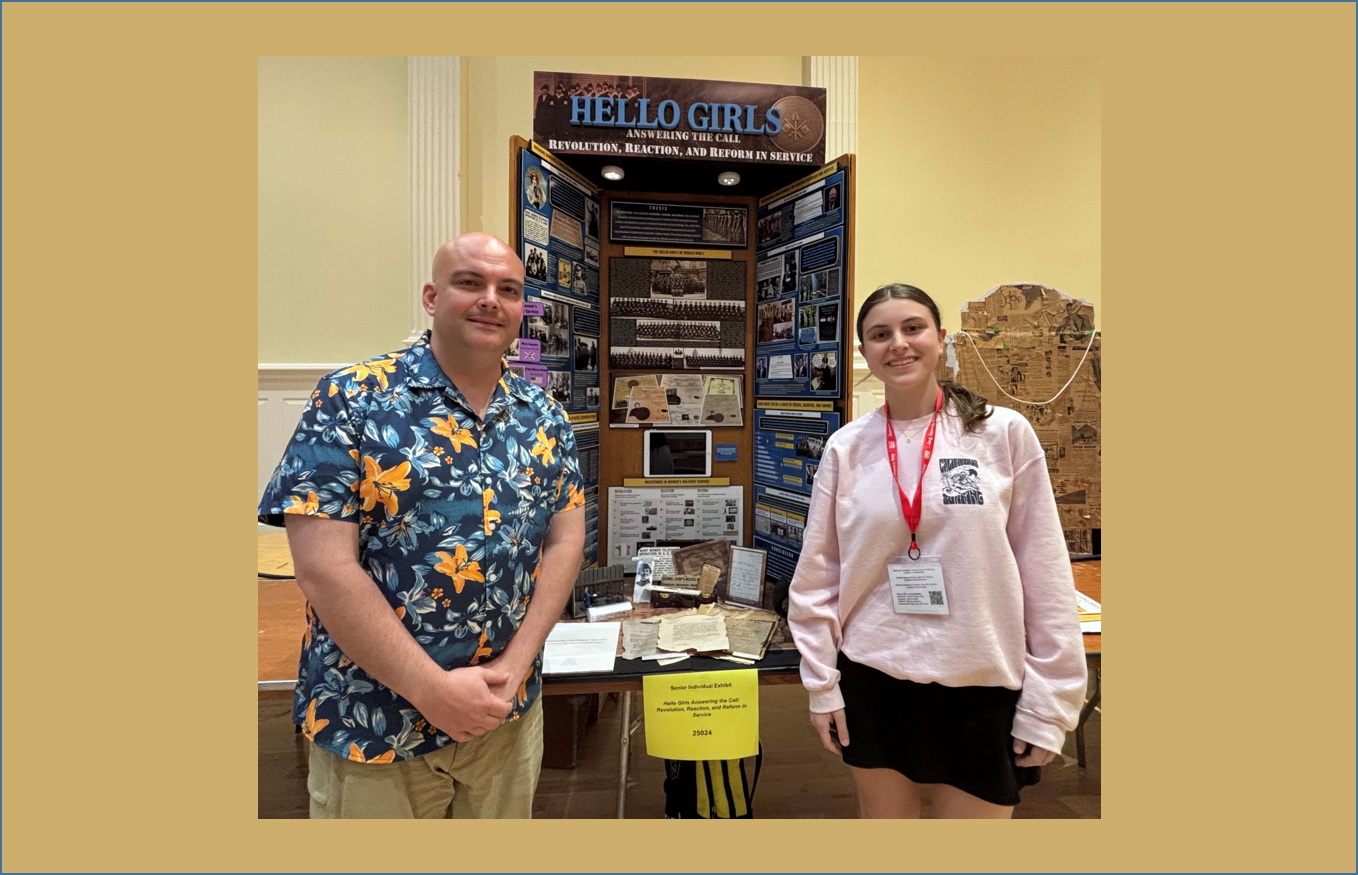
Ana Spiride With Mr. Rhett Carter, history teacher and sponsor of the History Club at Plano East Senior High School.
My National History Day project began with a Doughboy Foundation article about the Hello Girls, a group of bilingual women who served as U.S. Army Signal Corps telephone operators during World War I. I had never heard of them before, even though my passion for history naively led me to believe I knew many of the major stories of American wartime service. Their name sounded friendly and almost casual, but the more I read, the more I realized that the story behind it was serious, complicated, and still present in the lives of their descendants.
The Hello Girls were recruited for the American Expeditionary Forces in France because the Army needed operators who could speak English and French, understand telephone equipment, and work quickly under pressure. In France, they routed calls between headquarters, hospitals, supply stations, and front-line areas, and their speed changed military communications in the final year of the war. My exhibit calls out that women could route a call in about ten seconds, while the men they replaced would often take about sixty seconds. Moreover, some female operators could send and receive Morse code at more than sixty words per minute, which is incredibly impressive considering the average person today types at about the same speed on a full keyboard. After the women arrived in France, telephone service improved from about 13,000 calls a day to about 36,000.
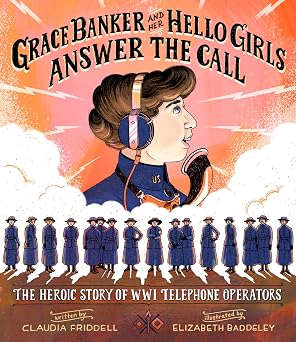 Those numbers helped me understand their contribution, but the personal stories of individual operators made me care deeply about it. Grace Banker became the center of my project because her journey personalized the narrative of the Hello Girls service for me. She was young, educated, fluent in French, technically capable, and quickly emerged as a natural leader for the other women serving during wartime conditions. At first, I knew her mainly through books and photographs, primarily Claudia Friddell’s picture book, “Grace Banker and Her Hello Girls Answer the Call.” After reading it, I found Ms. Friddell’s email online and sent her an email introducing myself and my project. Much to my surprise, she answered right away, offered to talk to me on the phone, and opened the door for me to connect with Carolyn Timbie, Grace Banker’s granddaughter.
That connection changed my project completely, opening doors to perspectives I had not initially considered. When I spoke with Ms. Timbie, she showed me mementos of Grace Banker’s life that made the Hello Girls feel much closer to me than the way they came across on the written page. She showed artifacts like Grace’s hat, letters, food tray, and other family memorabilia that had been preserved across generations. I remember realizing at that moment how history can come alive in very ordinary things, such as a tray, a note, a photograph, or a uniform that has been folded away for years. Those objects no longer felt like decorations for a project. Instead, they came across as evidence that someone had cared enough to keep her memory alive.
Through Ms. Timbie, and later through Catherine Bourgin and Donna Ayres, I began to understand the extent of the network of Hello Girls descendants. What struck me most was that the people helping me carry this story forward were women preserving the stories of their grandmothers and great-aunts. Ms. Bourgin shared the story of her grandmother, Edmée Leroux, whose grave had been unmarked for many years before recent recognition efforts helped restore her rightful place in the public record. Ms. Ayres told me about her great-aunt Olive Shaw, whose preserved uniform became key evidence in the fight for veteran status. Olive had kept the uniform with a note saying it was to be preserved for her funeral and burial, which showed how deeply she identified as someone who had served.
These conversations taught me a larger lesson about history. It is carried by families, communities, documents, graves, photographs, and most importantly, people who keep asking questions. It is how who we are as a community, a people, and a culture gets passed from one generation to the next. I had started with a topic that fit the National History Day theme of Revolution, Reaction, and Reform, but their descendants helped me see that the Hello Girls’ story was actively preserved and continued to be written.
My research moved from discovery to argument as I learned more about what happened after the war. The Hello Girls wore uniforms, took the Army oath, followed Army discipline, and worked under military authority in France. After the armistice, the government classified their service as civilian labor for veteran purposes. That meant they were denied benefits, military burials, and official recognition for decades. Interviewing Mark Hough, the attorney who helped Merle Egan Anderson and other surviving Hello Girls in the 1970s, opened my eyes to how much the legal details mattered. Their eventual recognition came through legislation, especially the 1977 GI Bill Improvement Act, with the Department of Defense later certifying the Signal Corps Female Telephone Operators Unit for veteran status.
I’ve come to realize the importance of Merle Egan Anderson as one of the operators whose persistence kept her fighting for appropriate recognition even when the fight extended through most of her lifetime. She and other survivors had to prove what their own service records, uniforms, oaths, and memories already showed. Their struggle lasted about sixty years, and by the time recognition came, only a small number of Hello Girls were still alive. That part of the story showed me how long justice can take and how easily official records can fail people.
The first version of my exhibit did not fully carry all of that. At the regional competition, the whole day felt rushed from the beginning. It was rainy and cold, and I was hurrying with the exhibit pieces, written materials, and all the usual nerves that come with competition day. I remember fearing that I was not going to make it on time, so when my board was finally set up, I already felt tired before judging had even started.
The regional judges gave me feedback that made me rethink the exhibit. I had strong research but needed to make the argument easier to follow. After regionals, I decided to rebuild part of my project so exhibit viewers could more clearly follow the Hello Girls journey from wartime service to postwar exclusion and eventual reform. I made the legal evidence more visible, strengthened the section on military function and civilian classification, and redoubled my efforts to clearly show how the War Department’s decision affected real women, their benefits, their burials, and the way their families remembered them.
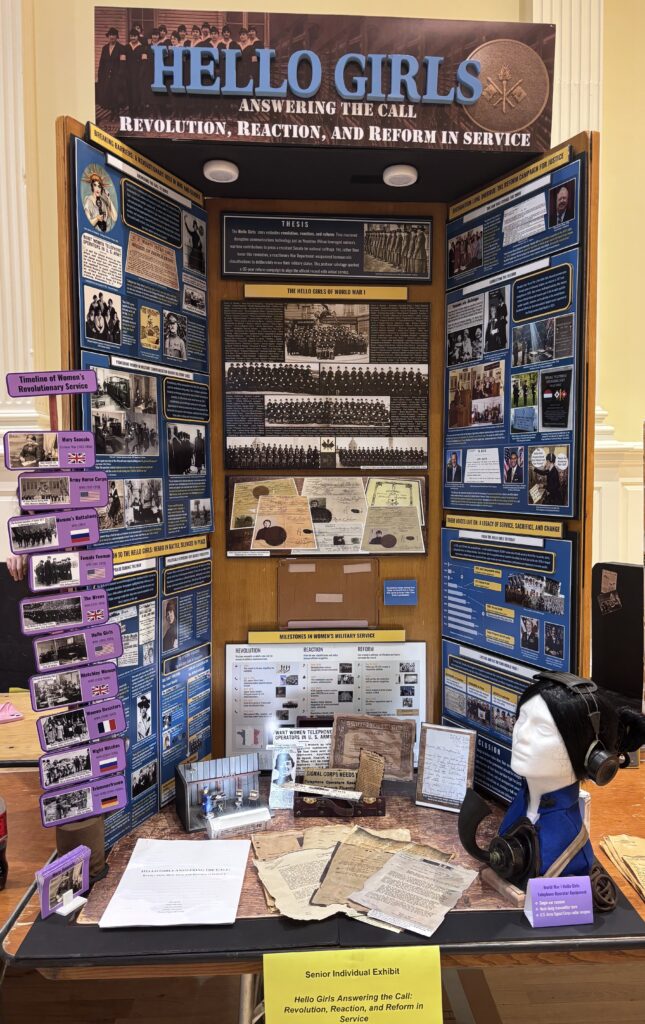
2026 National History Day Senior Individual Exhibit – Hello Girls Answering the Call: Revolution, Reaction, and Reform in Service.
In the final version of my exhibit, I focused more on utilizing visuals to better communicate their story. I picked a deep blue background for the panels to highlight the colors of the Hello Girls’ navy uniforms, especially since most of their surviving black and white service photographs would not show the colors of the service branch that the women identified with. I also decided to enhance the display setup with a life size model of a female operator wearing the actual headset and transmitter horn models that were used in wartime communications in France. The model wore a recreated uniformed adorned with the U.S. Army Signal Corps insignia that was part of the Hello Girls uniform in France.
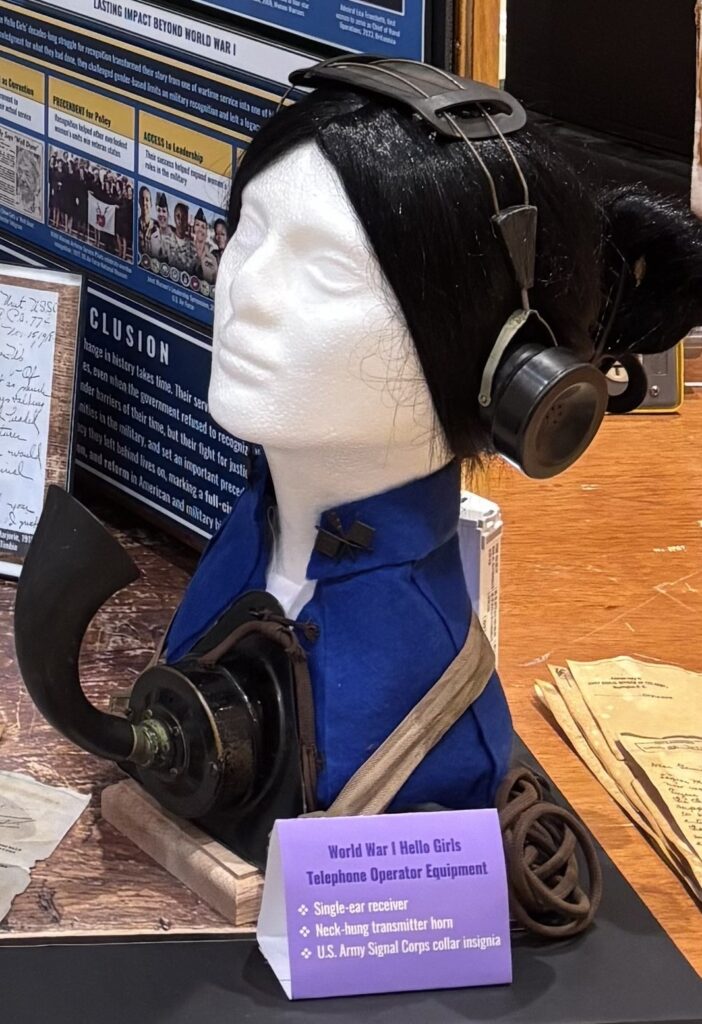
WWI Hello Girls telephone operator head model with equipment, including single-ear receiver, neck-hung transmitter horn, and U.S. Army Signal Corps collar insignia.
I also built a small diorama depicting scale models of switchboards and a recreation of their workspace in the field because I wanted viewers to get a sense of how their use of most advanced technology of that time had a physical, crowded, and demanding dimension. The Hello Girls’ story involved the intersection of rules, laws, and memories, but it also consisted of hands, wires, voices, and long hours operating equipment that had to work even under enemy fire.
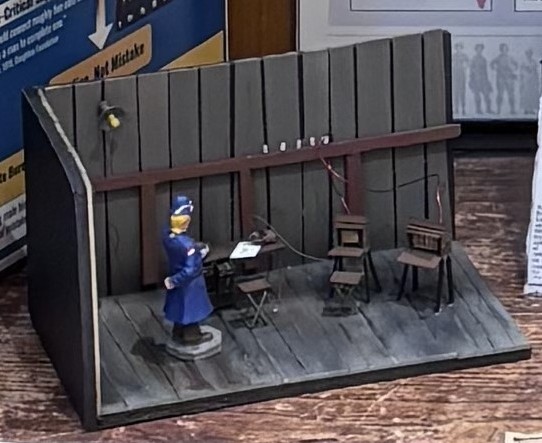
Small diorama depicting the Hello Girls’ workspace.
Even though this was my fourth year participating at the state level in the National History Day Competition, I still felt emotions of competing as if it was the first time. The Bullock Texas History Museum in Austin is by now a familiar place for me, and I recognize many of the organizers and the routine of the day. But somehow that familiarity does very little to calm me. Each year, climbing the stairs to the third floor leaves me slightly winded, so I take a few deep breaths to center myself, and then focus on enjoying the conversation with the judges.
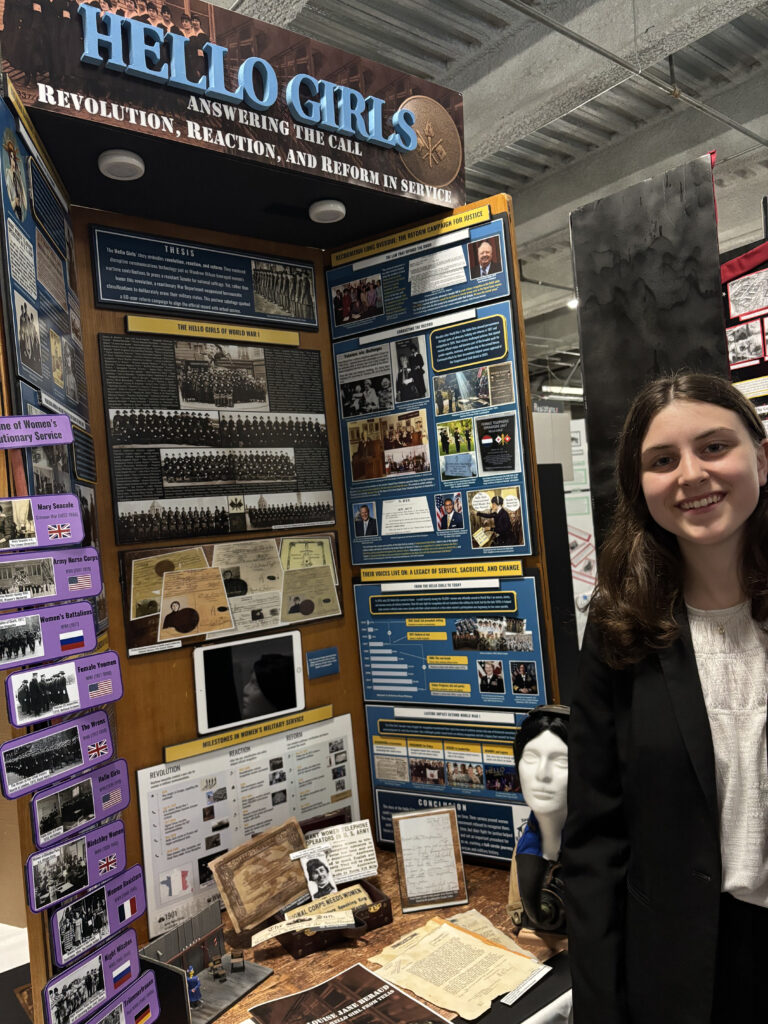
At the Bullock Texas State History Museum in Austin, ready for Texas History Day judging.
Once I begin speaking, the nerves usually settle into focus. I stop thinking about the competition and begin to focus on the people in my project. This year, during one of my state interviews, I got goose bumps while explaining my point of view to a judge, when I realized that many of the Hello Girls in my exhibit were only a few years older than I am. Then I remembered what Ms. Timbie had shared, that a handful of them had lied about their age and were actually about my age when they served. That changed the way I saw the whole narrative. These were young women crossing the Atlantic, entering a military system built around men, handling wartime communications, and then waiting for their country to correctly count their service.
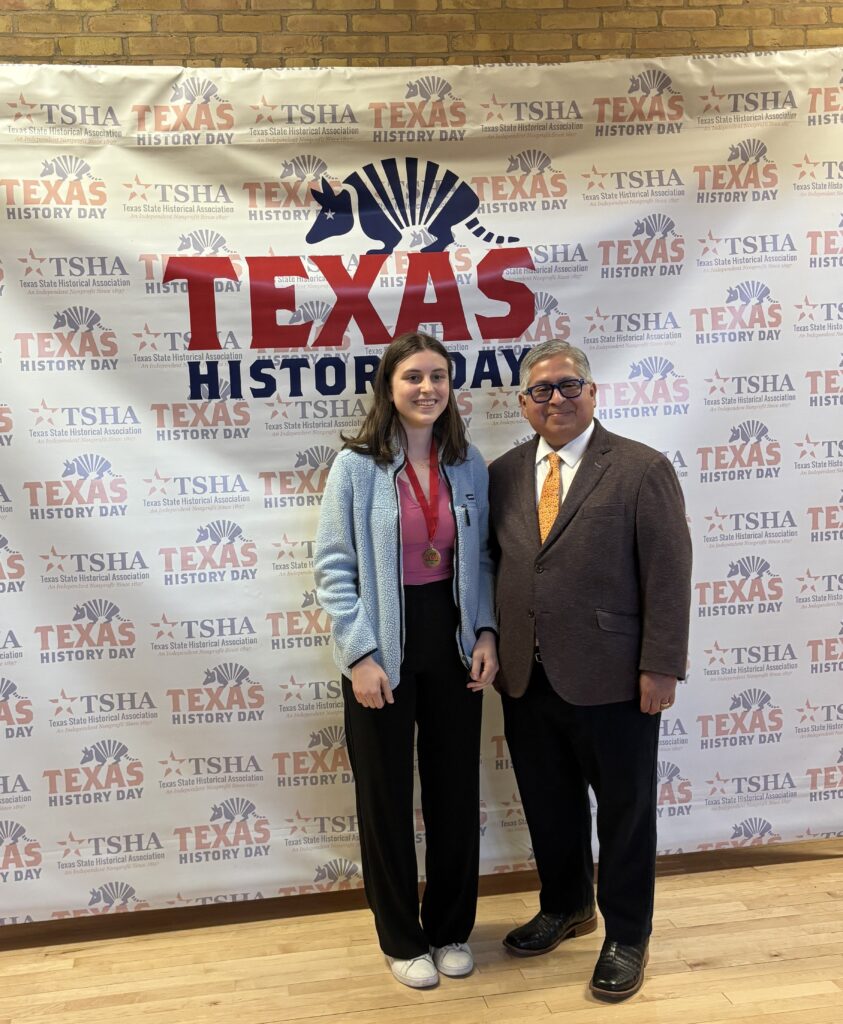
At the awards ceremony at the University of Texas at Austin.
Qualifying for Nationals gave the project another layer. This was my second year participating at NHD Nationals, and I am grateful for Mr. Carter’s guidance, support, and his confidence in my ability to tell difficult stories with evidence and care. As the Plano East Senior High School sponsor of the History Club, his commitment to students who love history gave us opportunities to experience the Washington, D.C. area beyond the competition itself. Visiting places like Monticello, Mount Vernon, the National Mall, the Capitol, and other landmarks helped me understand topics I had learned about in school in a more direct way. They helped to add more depth to the concepts we discussed in class over the years and helped me imagine historical figures not just as names from class, but more as human beings making difficult choices in their own time.
That experience also made the Hello Girls feel more connected to American history as a whole. They served in a war shaped by technology, citizenship, suffrage, military necessity, and gender expectations. Their recognition came through law, advocacy, family memory, and public commemoration. Their story did not stay in one panel of my exhibit. It reached into how women’s military service is remembered, how records are corrected, and how later generations decide what they will carry forward.
Seeing my name on the jumbotron at the Xfinity Center as a Top 10 finalist out of about 100 Senior Individual Exhibit projects made me feel extremely proud. A small voice in my head imagined the Hello Girls in that room, watching their story reach so many people at once. It made the honor feel larger than my own result, because their service was still being remembered, discussed, and carried into another generation.
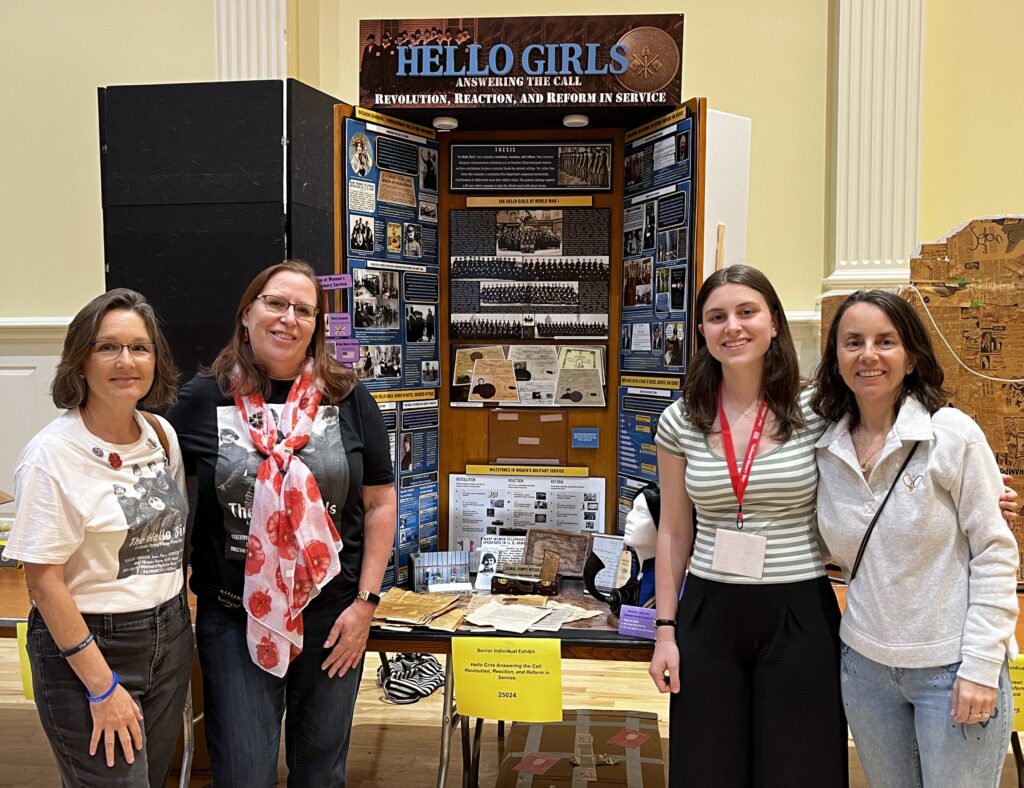
Pictured with Catherine Bourgin, Granddaughter of WWI Hello Girl Edmee LeRoux, Diane Boettcher, Ret. CAPT. USN and Hello Girls Researcher, and my mom.
By the end of the project, I understood that the struggle had changed. Formal recognition for the original Hello Girls finally came after a long delay, through veteran status, memorial efforts, grave markers, and the Congressional Gold Medal authorization. Now the responsibility turns to my generation to keep the story alive with accuracy and care. The past can still guide us, but only if people continue to preserve it, question it, and pass it on.
By the time my exhibit was finished, it had become a record of my own learning as much as a record of the Hello Girls’ service. I began with a topic from an article and ended with a network of people who trusted me with family stories, photographs, documents, and memories. I learned that history is not something that waits quietly in a textbook. It survives because people preserve it, question it, correct it, and pass it on.
The Hello Girls answered the call when the Army needed their skill, and their families and advocates answered another call decades later by protecting the evidence of their service. My project became my own way of answering that call. I wanted to help tell their story, with the proof they preserved and the respect they deserved.
External Web Site Notice: This page contains information directly presented from an external source. The terms and conditions of this page may not be the same as those of this website. Click here to read the full disclaimer notice for external web sites. Thank you.