Captured German cannons stood as WWI memorial until being turned into WWII scrap metal
Published: 17 October 2026
By Sharon Sanders
via the Southeast Missourian website
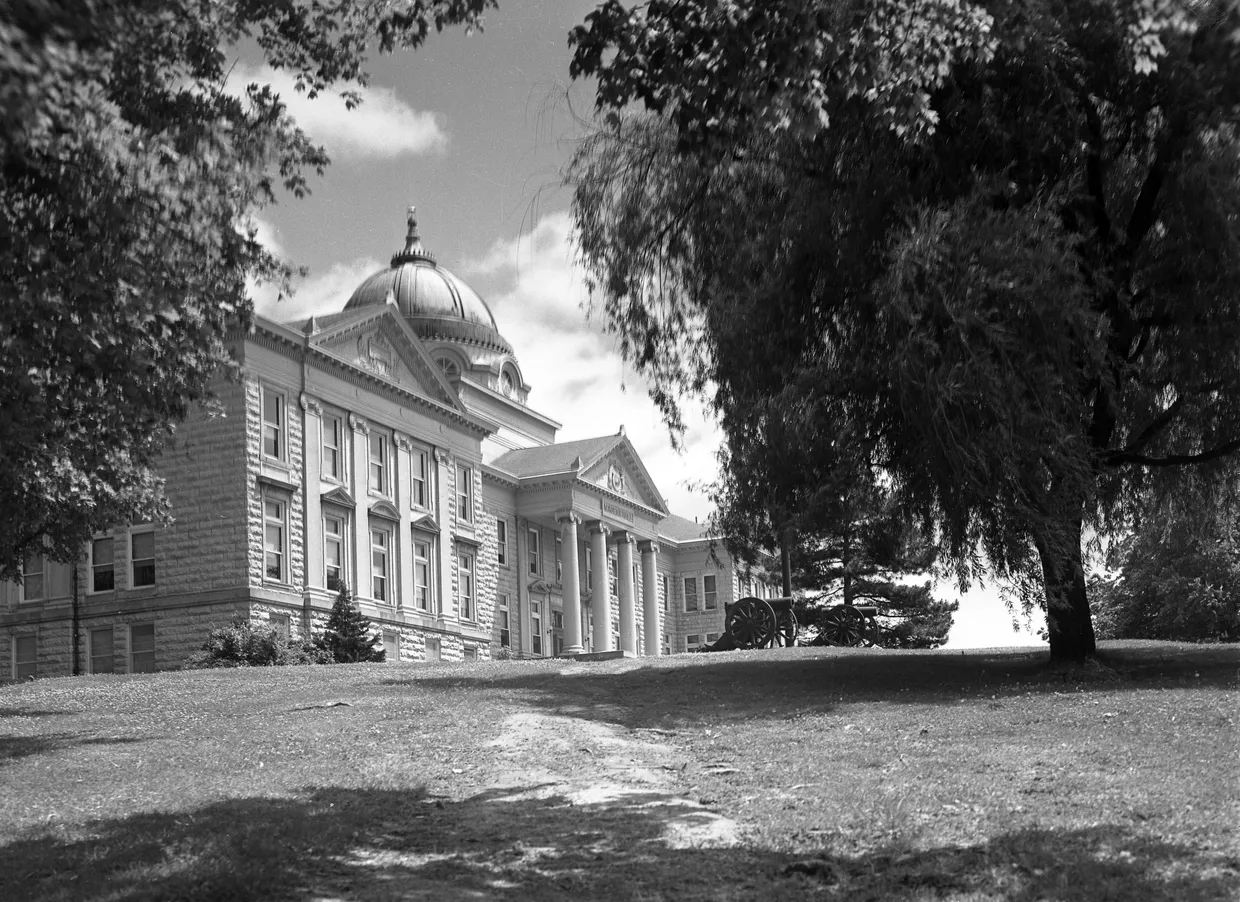
Academic Hall with German cannons from WWI
This pre-1942 photograph of Academic Hall shows the two German cannons and flagpole established as a memorial to the Teachers College students who died during World War I. G.D. Fronabarger ~ Southeast Missourian archive.
Two captured German WWI cannons became a disputed Cape Girardeau Teachers College memorial before being scrapped for World War II in 1942.
In October 1925, Joseph A. Serena, president of the Cape Girardeau Teachers College, announced the school was being given two captured German cannons from World War I. They were to join a small Civil War gun mounted on a boulder in the plaza in front of Academic Hall. (The latter seems fitting, as the campus had been the site of Fort B during the War Between the States.)
Col. H.L. Talbot, president of the Board of Regents, was instrumental in obtaining the artillery pieces, along with Gen. Frank Rumbold of Jefferson City. They were shipped to Cape Girardeau from Rariton Arsenal in New Jersey, arriving here in November 1925.
It wasn’t long, however, before plans to display the cannons on the campus drew opposition.
But not all were happy with the campus additions. A Nov. 25, 1925, front-page article in the Southeast Missourian noted, “A split in the student body of the Teachers College over the question of whether two captured German cannon are to adorn the college campus seemed likely today.”
It explained “one faction” was circulating a petition asking the Board of Regents “not to place the two cannon on the campus, believing it to be ‘a militaristic gesture, not for the best interests of peace.’” Further, those opposed to the weapons’ display “declared that the cannon would be emblematic of the glory of war and that ‘the bringing of these war trophies will breed a spirit diametrically opposed to the altruistic idealism’ for which American soldiers gave their lives, and ‘will be a repudiation of their sacrifice and a breach of faith’ to them.”
A second group of students demanded that the plans go forward and the “guns be installed on the campus as a memorial to the men who gave their lives in the World War.” The local American Legion post supported this opinion and denounced those college students who protested the display.
In the end the controversy seems to have petered out. In fact the petition opposing the cannons was never presented to the school administration. In December it was announced the cannons would be mounted on the campus, along with a 100-foot flagpole that would fly a 10-foot American flag. The site selected was near the southwest corner of Academic Hall. A March 17, 1926, Missourian article described the new flagpole: “The iron mast which has already arrived is in eight sections, the bottom section being more than a foot in diameter. The other sections are graduated so that the top one is only a few inches in diameter. When assembled, the mast will be higher than the dome of Academic Hall.”
In late May 1926 the memorial was dedicated, but the emphasis of the program had shifted from the cannons to the flag and flagpole. Although the Southeast Missourian doesn’t mention it, The Capaha Arrow student newspaper at the college said, “Dedication ceremonies were held for the cannon on May 25, 1926. … The weather was so hot at the time that the (outdoor) speakers’ platform had to be abandoned.”
⇒ Read the entire article on the Southeast Missourian website.
External Web Site Notice: This page contains information directly presented from an external source. The terms and conditions of this page may not be the same as those of this website. Click here to read the full disclaimer notice for external web sites. Thank you.