History Day – World War I: Creel Committee
Published: 13 October 2026
via the Connecticut State Library website
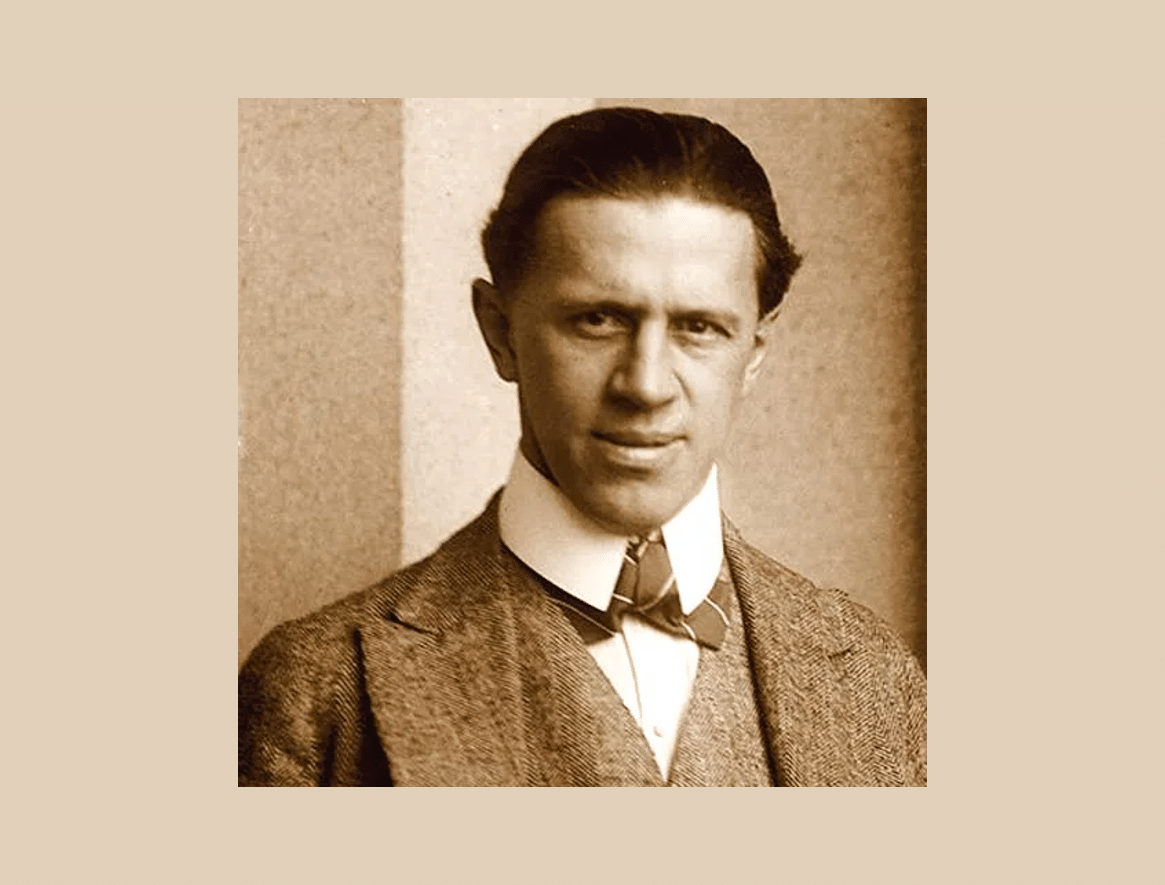
George Creel framed
George Edward Creel (December 1, 1876 – October 2, 1953) was an American investigative journalist and writer, a politician and government official. He served as the head of the United States Committee on Public Information, a propaganda organization created by President Woodrow Wilson during World War I.
Creel Committee – Committee on Public Information (CPI)
The Committee on Public Information (CPI) is often called the Creel Committee, after Chairman George Creel. Sometimes it is called the Public Information Commission. Try searching additional terms as a phrase.
The National Archives site (NARA) states (see link below): “The Committee on Public Information (CPI) was established by Executive Order 2594 as an independent agency in April 1917. The Committee consisted of the Secretary of State, the Secretary of War, and the Secretary of the Navy as ex officio members. Its functions were to release news of the government, issue information to sustain domestic morale, and to publicize America abroad. Domestic activities were discontinued after the Armistice in November 1918 and foreign operations were discontinued in June 1919.”
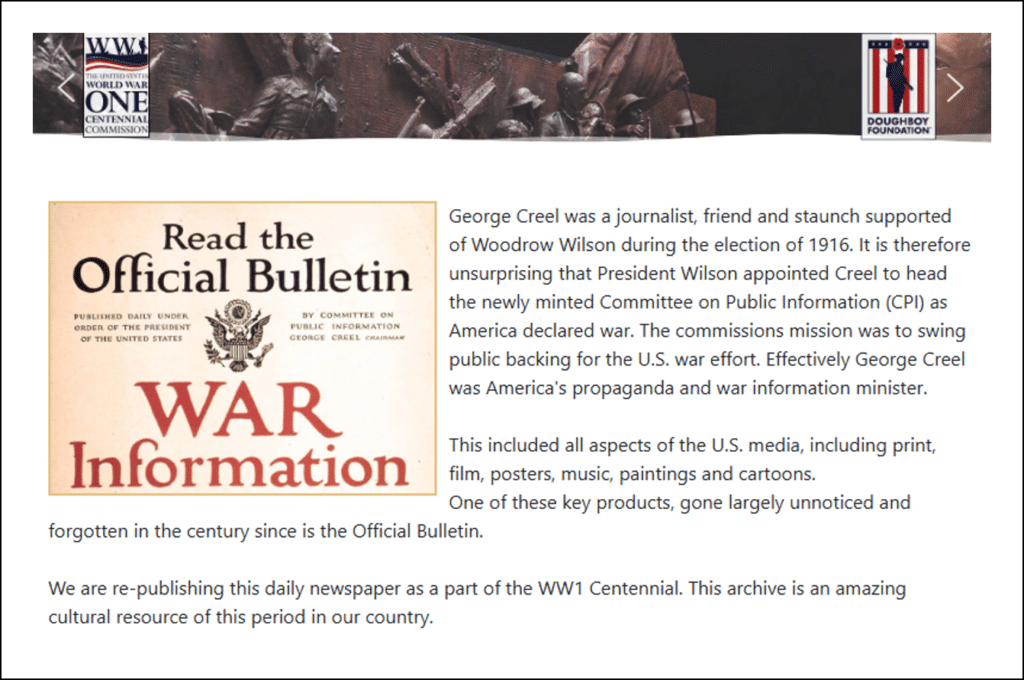
See the complete inventory of the Official Bulletin newspaper from World War I on the U.S. World War I Centennial Commission website, maintained by the Doughboy Foundation. (https://worldwar1centennial.org/index.php/educate/other-resources-image/official-bulletin.html)
Executive Order 3154 obsoletes Executive Order 2594 of April 14, 1917, which created the Committee on Public Information.
According to Words That Won the War (1939, see link below for more details), only about 25 % of the records of the CPI survived to be transferred to NARA (National Archives) in 1937 and “The Committee was so widespread in its ramifications that the collection touches nearly all phases of American and world affairs for the years 1917 to 1919.” (p.viii).
The CPI had a foreign division and a home front division. Chronicling America might be a good resource to see how CPI put its message forth in newspapers.
Related: Woodrow Wilson, Military Intelligence Branch, Four Minute Men.
Note: Before World War II (WWII), World War I (WWI) was called The Great War, The War to End All Wars, The World War , and other such names. It was not called WWI until after there was a second world war. Be sure to use variations in your subject terms when researching.
-
Executive Order 2594—Creating Committee on Public Information
From the American Presidency Project – copy of Pres. Woodrow Wilson’s Executive Order. -
Records of the Committee on Public Information (RG 63) (NARA)
National Archives (NARA): “The Committee on Public Information (CPI) was established by Executive Order 2594 as an independent agency in April 1917. The Committee consisted of the Secretary of State, the Secretary of War, and the Secretary of the Navy as ex officio members. Its functions were to release news of the government, issue information to sustain domestic morale, and to publicize America abroad. Domestic activities were discontinued after the Armistice in November 1918 and foreign operations were discontinued in June 1919.” -
Records of the Committee on Public Information. Record Group 63 (NARA)
National Archives (NARA) finding aid to their collection. Much is not online.
-
Complete Report of the Committee on Public Information: 1917, 1918, 1919 (The Creel Report) by
Call Number: Online at Internet ArchivePublication Date: 1920Online at Internet Archive.
-
Online at Hathi Trust: ” Reprint of the 1920 ed. published under title: Complete report of the Chairman of the Committee on Public Information.”
⇒ Read the entire article on the Connecticut State Library website here:
External Web Site Notice: This page contains information directly presented from an external source. The terms and conditions of this page may not be the same as those of this website. Click here to read the full disclaimer notice for external web sites. Thank you.