The Ribbon of Life: The 1920 Diary of a French War Nurse’s Visit to America
Published: 6 October 2026
By David F. Beer
via the Roads to the Great War website
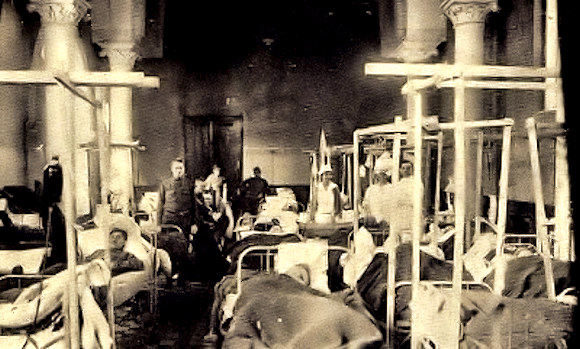
A Ward on the U.S. Army Hospital at Blois, France
A Ward on the U.S. Army Hospital at Blois, France. Nurse Suzanne Raguin Worked Here.
Jane and Ron West have done a marvelous job of putting together and editing the travel diary of a French nurse, Suzanne Raguin, who during WW1 served on the staff of the US Army’s Emory Base Hospital 43 in Blois, France. She was adored by many of her soldier patients and eventually wrote a detailed diary of her visit to America in 1920 to see many of them. The history, editing, and final publication of this diary is an extraordinary accomplishment which is fully described in an introduction plus additional information and photographs provided by the editors.
 Madame Suzanne Henri Raguin was a young married woman when war broke out. She had already experienced crushing tragedy in 1913 when her beautiful 15-year-old daughter Marcelle suddenly died of meningitis. In this book an inscription beneath a photograph of Marcelle written by her mother reads: “In the hope that service to others would ease my aching heart and fill its emptiness, I bent all my energies to alleviating the pain of wounded soldiers far from their own anxious mothers” (p. 15). A sad incentive, but one that she developed meaningfully in nursing wounded American soldiers and in forming a strong link with many of them after the war.
Having trained in advanced nursing, including the Carrel-Dakin treatment of wounds and the Ambrine treatment of burns, she was a valued asset to the hospital and above all to the soldier patients, who called her “Little Mother.” The bond was so strong that in June 1920 she responded to numerous requests and traveled to some of the United States to visit the homes of many returned soldiers, meeting their families and seeing the lasting impact of her work. She also visited families whose son(s) had never returned.
Eventually, in 1938, she put together this detailed memoir of her travels, The Ribbon of Life, in the form of a diary in French and English. In some 400 pages she describes her myriad experiences with her American friends and at one point sums it up by stating: “…no Queen has ever received more royalty than I…I’ve been feted and spoiled everywhere” (p. 300). The detailed accounts of her travels in the U.S. and of the friends she stayed with vividly support this.
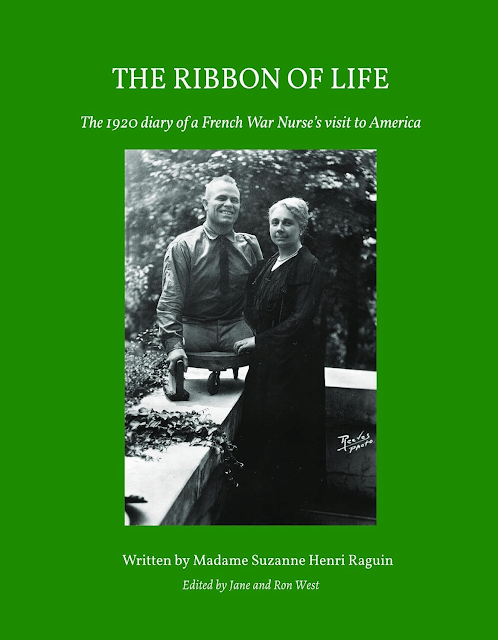
One of her former patients (featured on the cover) was Lt Robert Fletcher, who lost both legs in combat in France and who is perhaps an archetype of the pain, heroism, and gratitude that Nurse Raguin came to know so well. He was also the father of Jane Fletcher West, who helped research and edit this book. Tragedy occurs in peacetime as in war, and Lt Fletcher was killed in a car accident shortly before Jane’s birth. As we learn from this book, he was a significant part of Nurse Raguin’s both war and peace experiences.
⇒ Read the entire article on the Roads to the Great War website here:
External Web Site Notice: This page contains information directly presented from an external source. The terms and conditions of this page may not be the same as those of this website. Click here to read the full disclaimer notice for external web sites. Thank you.