A Survivor of the Lost Battalion: One Swedish Brother’s Journey Home
Published: 22 September 2026
By Jocke Hallberg
via the Swedes in the Great War website
Swedes header image
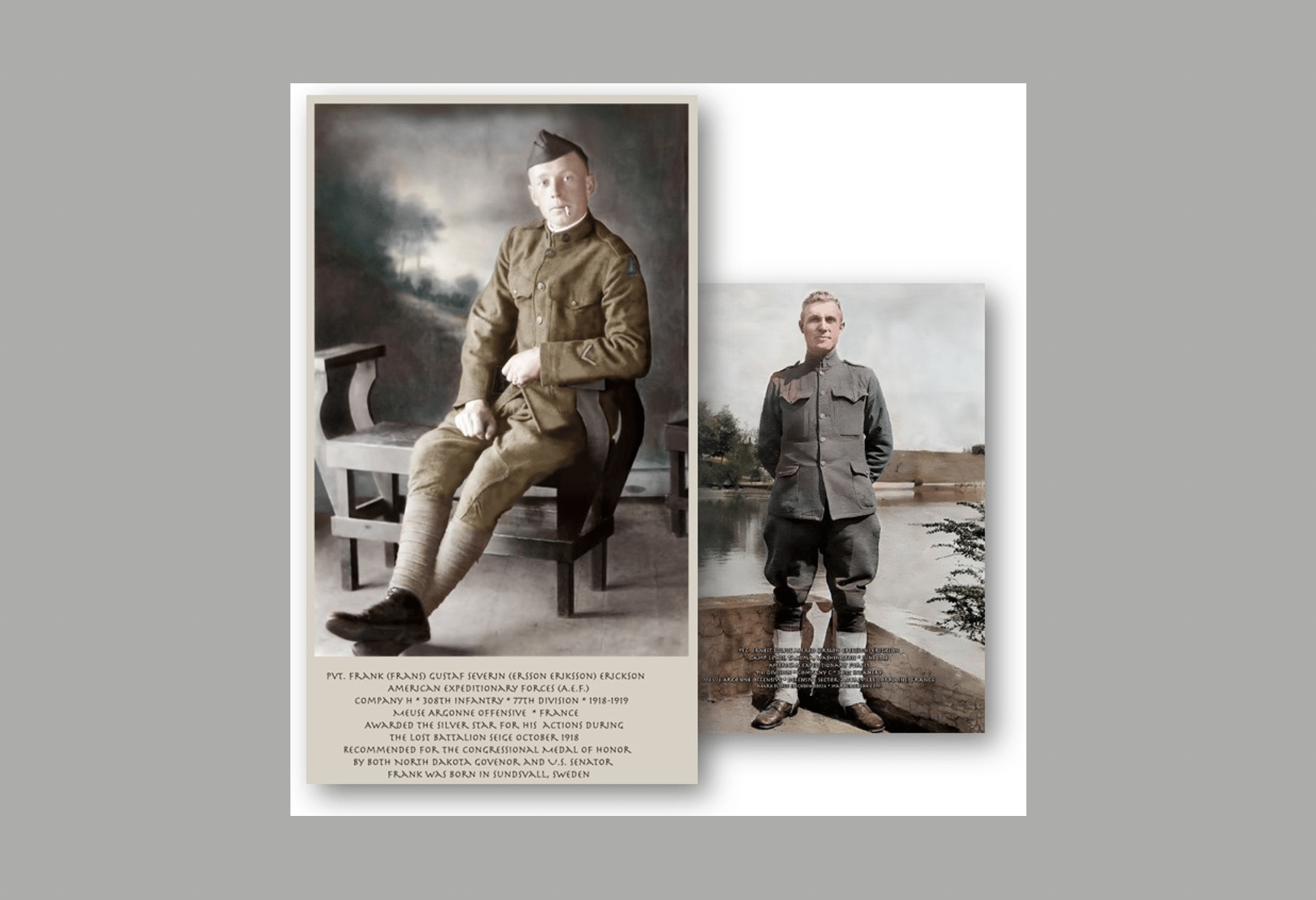
The remarkable story of the Swedish emigrant Frank Gustaf Severin Erickson, the brother of Ernst Julius Erickson.
The remarkable story of the Swedish emigrant Frank Gustaf Severin Erickson, the brother of Ernst Julius Erickson.
You can find my earlier article about Frank’s brother, Ernst Julius Erickson, here on my webpage.
I am writing this second article in the stories about the Swedish born Erickson brothers, in great cooperation with the grandson of Frank, Mark Julius Erickson.
Mark is a fine art painter based in California and also a Digital Graphic Artist. With permission from him I am here using the improved original photographs from the Erickson family. The story is based on Mark’s research and family records, and I am honored to present it in this article to highlight the connection to the Swedish emigrant history, and to bring the memories of the sacrifice many emigrants made in their new homeland, when they served in the American Expeditionary Force in the Great War.
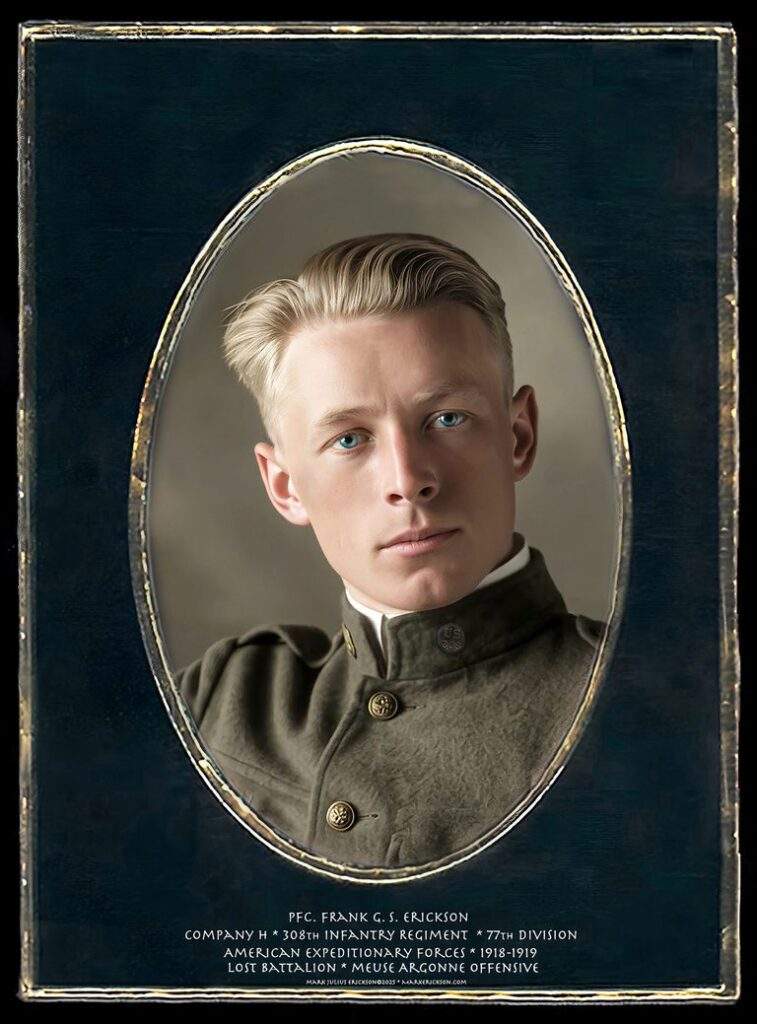
Pfc. Frank G. S. Erickson of the Lost Battalion
Runner Rifleman * Company H * 308th Infantry * 77th Division
September 26th, 1918 * The Meuse Argonne Offensive * Defensive Sector: Foret-d’Argonne
May 6th, 1919 * Victory Parade on Fifth Avenue * Canyon of Heroes * New York City
The Liberty Brigade
On August 8, 1918, Private Frank G. S. Erickson stood by the railing of the SS Nestor, watching the jagged skyline of Brooklyn recede into a haze of coal smoke and summer heat. Beneath his boots, the deck vibrated with the raw, rhythmic pulse of the ship’s engines, steering them out into the perilous, submarine-haunted waters of the North Atlantic. They sailed not alone, but bound to a naval convoy, a gray flock of camouflaged troopships flanked by agile, predatory destroyers.
For Frank and the thousands of Doughboys packed into the claustrophobic belly of the converted liner, the week at sea dissolved into a haze of wartime tension. Days were fractured by the sudden, shrill shriek of sirens triggering submarine drills, sending sailors scrambling through narrow passageways in the dark. On deck, every eye strained against the rolling gray swells, searching for the lethal white line of a torpedo wake. Below decks, the air was thick with the scent of wet wool, tobacco, and salt-sweat, humming with the nervous chatter of men bound for the trenches.
This was Frank’s first time at sea as an adult, but the ocean spoke to him in echoes of a different life. His mind drifted back to 1903. He had been just an eleven-year-old boy then, standing on a similar deck, watching the horizon for a glimpse of America. That crossing had been a journey of hope, emigrating from Sundsvall, Sweden with his parents and five siblings to build a future out of the prairie soil on the Great Northern Plains of Dakota.
Now, fifteen years later, the great Atlantic circle was closing. Clad in the olive drab of his adopted homeland, Frank contemplated what his family would think of him in this present hour. The same boy who had fled the Old World was now being propelled back toward it by the engines of war. He wasn’t arriving as a wide-eyed immigrant seeking peace; he was returning as a soldier, heading straight for the blood-soaked battlefields of Europe.
When the ship finally slipped into Liverpool a week later, the throngs of cheering onlookers lining the docks provided a surreal contrast to the silent anxiety of the voyage. The roaring welcome struck Frank with a poignant irony; he was back in Europe, but the joyous crowds only amplified his unspoken thoughts of the Western Front.
Those looming thoughts became reality in mid-September when he was transferred to the 308th Infantry as a replacement, ultimately placing him in one of the regiment’s most hazardous roles as the personal Runner to Company H’s commander, Lt. William J. ‘Red’ Cullen.
Once settled into a temporary camp, Frank’s training continued through to early September. Orders came suddenly, transferring him into the 308th Infantry as a replacement. He was on his way to France. Due to eventual casualties in the 308th, he was placed in one of the regiment’s most hazardous roles as the personal Runner to Company H’s commander, Lt. William J. ‘Red’ Cullen.
“Next time I write I will be able to tell you what it is like to be in combat.”
⇒ Read the entire article on the Swedes in the Great War website here:
External Web Site Notice: This page contains information directly presented from an external source. The terms and conditions of this page may not be the same as those of this website. Click here to read the full disclaimer notice for external web sites. Thank you.