The Boston Navy Yard in the First World War: The Ships and the Boats
Published: 17 August 2026
via the National Park Service website
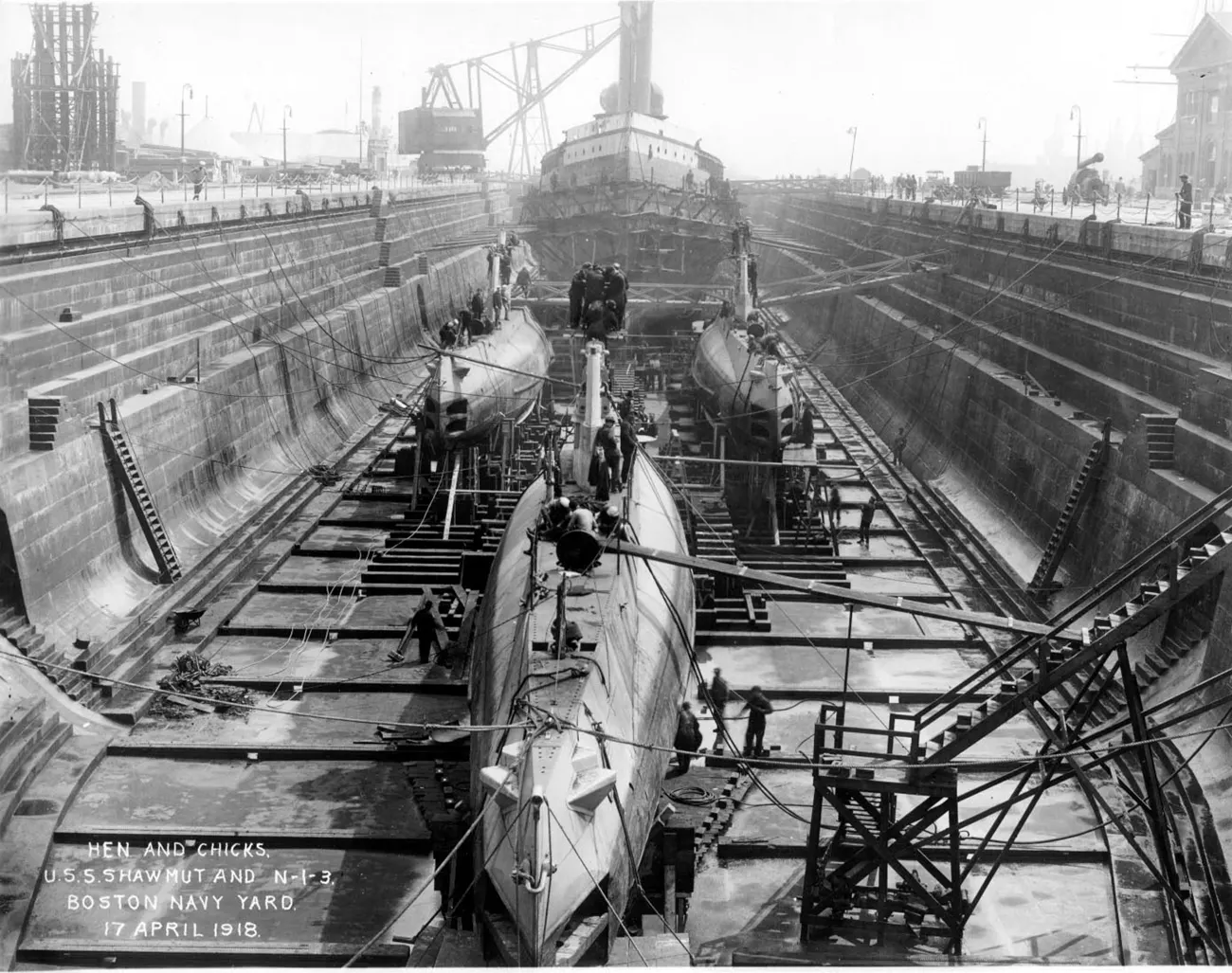
NPS 13838-3734
Over the years, the Boston Navy Yard (also known as the Charlestown Navy Yard) earned the reputation of being a renowned repair yard for the US Navy. At this yard, workers repaired many more ships than they had built. This trend continued during World War I (WWI). Workers at the yard labored over hundreds of existing vessels, yet they only built four. Regardless, their contributions strengthened the US Navy as the ships faced war in Europe.
Setting Sail
The declaration of war in 1917 led to an increase in work in navy yards across the country. From 1917-1918, workers at the Boston Navy Yard (BNY) rapidly constructed ships for the US Navy. The Navy sent many vessels to BNY to be overhauled for two reasons. First, BNY had a reputation for efficiency. Second, Boston was the closest US port to Europe.
In total, civilian and military employees at the yard built, repaired, or converted about 450 vessels in WWI. This number includes ships built at private shipyards and later brought to BNY for finishing or commissioning. All of these vessels equaled about one quarter of the total vessels the Navy deployed during the war. According to historian Frederick Black, workers at BNY had never before completed work at this rate in the history of the yard.
The shipyard workers at BNY worked on all sorts of vessels in WWI. Ships ranged from massive battleships to small patrol boats. A few of these vessels were already being overhauled at BNY when the US entered the war. Upon completion, each set sail from Boston to play their specific role in the war.
Destroyers
Soon after the US declared war on Germany, six destroyers left Boston Navy Yard for Queenstown, Ireland. These destroyers arrived on May 4, 1917. Over the course of this month, another 12 destroyers left BNY for Queenstown. The staff of BNY had prepared these destroyers for overseas duty.
Some commentators nicknamed the arrival of US destroyers in British waters as the “Return of the Mayflower.” The original Mayflower (1620) brought Pilgrims from England to America in search of freedom. In 1917, some viewed US Navy sailors as symbolically representing the descendants of the Pilgrims. Now, they were returning Europe to help the British defend their freedoms. These destroyers helped defend ships bringing aid to Britain and France. Their opponent was the German navy.
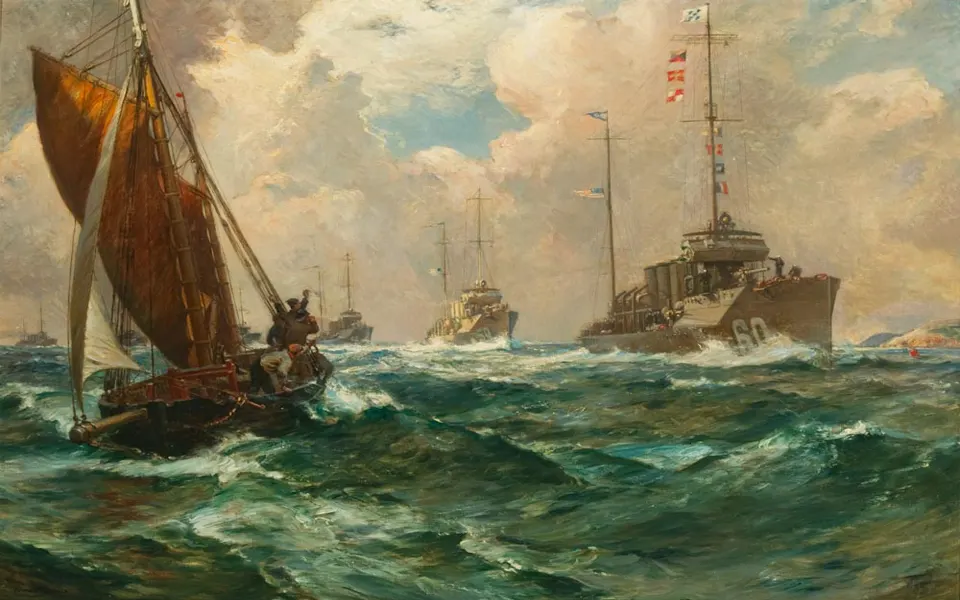
This painting depicts the arrival of the first US destroyers in WW1 off the coast of Britain. These ships came from the Boston Navy Yard. The lead ship is DD-60, the USS WADSWORTH. This fleet helped oppose the German Navy. (“Return of the Mayflower,” by Bernard F. Gribble (British, 1873-1962). Oil on Canvas, painted 1919. (Home of Franklin D. Roosevelt National Historic Site.)
The US Navy sent 36 destroyers to Europe in early 1917. This was almost all the destroyers the Navy had at the time. However, the Naval Act of 1916 had funded the construction of 50 new destroyers. Some of these destroyers were built at the Fore River Shipyard in Quincy, Massachusetts, and its adjacent site, the Victory Destroyer Plant in Squantum. Bethlehem Steel owned both private yards and worked under the direction of BNY staff. When close to completion, these destroyers cruised the short distance up the coast to BNY. Here, workers finished the construction. The yards at Fore River and Squantum together built 71 destroyers for the US Navy in WWI. Most of these destroyers were finished and commissioned after the armistice of November 11, 1918.
Workers at Bath Iron Works in Maine, another private shipyard, worked with BNY officials to build four destroyers for the war. All of these destroyers served in Europe.
⇒ Read the entire article on the NPS website here:
External Web Site Notice: This page contains information directly presented from an external source. The terms and conditions of this page may not be the same as those of this website. Click here to read the full disclaimer notice for external web sites. Thank you.