Carey’s Force in the Somme: The Shrapnel-Dented Helmet of Fred Bachle, 6th Engineer Regiment, 3rd Division
Published: 22 August 2026
By Michael Santoto
Special to the Doughboy Foundation website
Santoro Aug 2026 header image
This is the moderately-dented British Mark I helmet worn by Sergeant (Acting Sergeant 1st Class) Fred Bachle of Company B, 6th Engineer Regiment, 3rd Division, American Expeditionary Forces. Bachle was part of “Carey’s Force”, a small detachment of the 6th Engineers tasked with building bridges in the Somme area in February 1918. The force was made up of Companies B & D along with the Headquarters Company of the 6th Engineers. Long before they were attached to their division, they were thrown onto the front lines with British rifles on the Somme. When the great German offensive broke through the British lines near Peronne on March 21st, 1918, the American 6th Engineers Regiment was engaged in bridge building for the British Fifth Army. Desperate, the British assembled every available man to occupy the old French trenches, known as the Armies Defense Line.
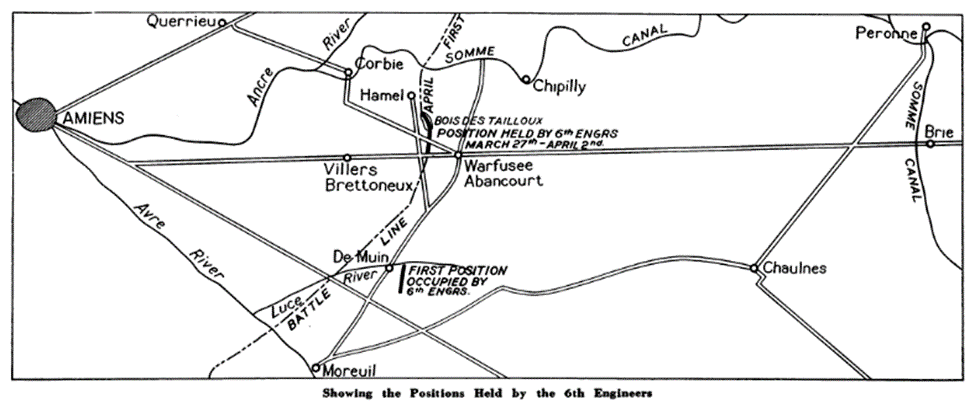
Armies Defense Line map. Image Sourced from Robb, H. L. “The 6th Engineers on the British Front.” The Military Engineer, vol. 19, no. 104, 1927
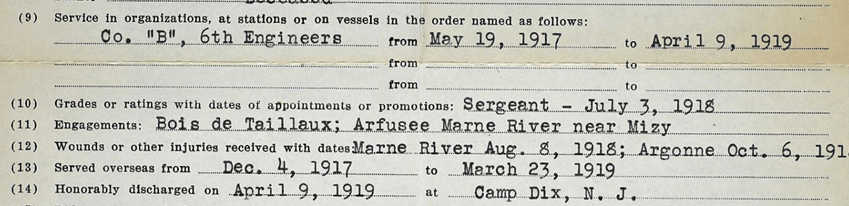
Then-Corporal Bachle, now attached to the BEF, received this British Mark I steel helmet, and was issued a British Lee Enfield rifle. He led his squad as infantry as part of “Carey’s Force” throughout the Somme Defensive, from March 21st to April 6th, 1918. Company B was stationed in the Bois de Taillaux, which is mentioned by name on Bachle’s engagements in his Pennsylvania Veteran Compensation File.
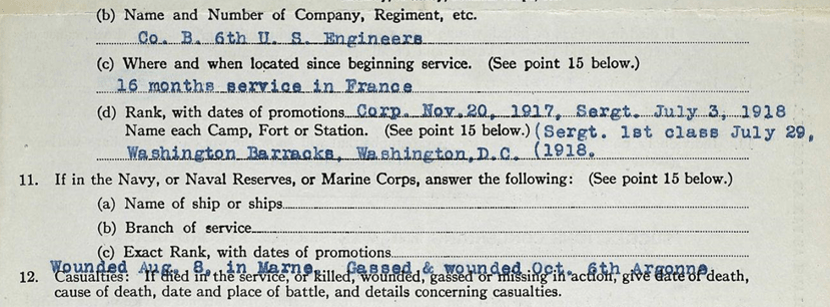
On August 7th, 1918, the 6th Engineers entered the Vesle Sector, and Sergeant Bachle and his platoon were constructing a trestle bridge across the Andre River at Courville under severe enemy shell fire. This bridge furnished the main artery for the French advance from Arcis-le-Ponsart north to Fismes. The next day, August 8th, Sergeant Bachle was severely wounded by shell fire, and Private First Class Edmund J. Crotty was killed instantly. Company B suffered 11 men wounded and 3 men killed this day. It was almost certainly on this day that this helmet received its first impact marks.
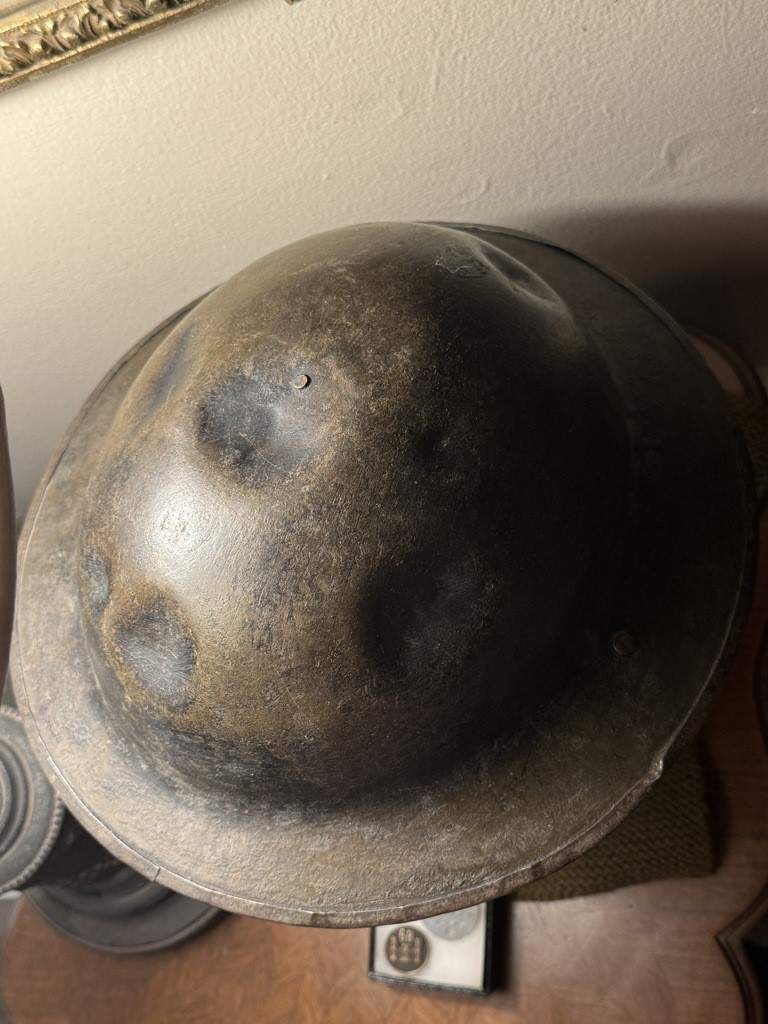
It’s evident that Bachle continued to wear this helmet in the field despite the dents, and that the liner was field-replaced by Bachle before the end of the war. The helmet inscription came first, Sergt. F. Bachle. When he had to replace the liner with an M1917 example, he double-stacked the chinstrap bales as well, though one side’s bale is now gone. The liner chinstrap is inscribed F.B. clearly at a later date, and the interior crown rivet is stamped in the center with a five-pointed star rather than the sunburst normally seen.
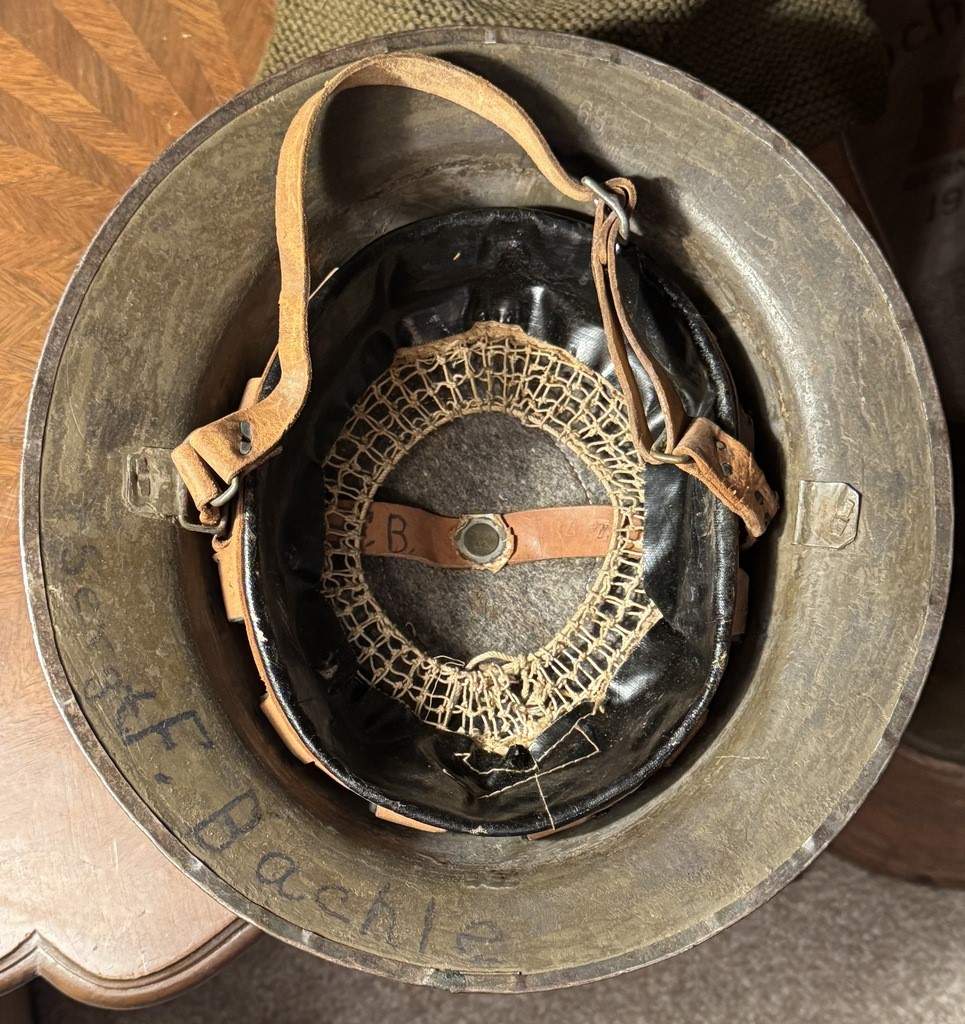
It is observable from the front profile that another impact mark occurred after this liner was added to the helmet.
Following his recovery, Bachle appears to have temporarily joined Company C of the 305th Engineers, 80th Division for a duration. He led a platoon through the St. Mihiel Offensive from September 12-16th. On September 26th, the Meuse Argonne began, and Bachle’s platoon again entered the fray. On October 6th, 1918, Bachle was wounded for the second time, and gassed on the same day. From available muster rolls, it appears he was with the 305th Engineers during this period, though it is mentioned nowhere in his PA application files.
Bachle returned early from France on March 23rd, 1919, likely due to his wounds. He was discharged on April 9th, 1919, and returned to home life.
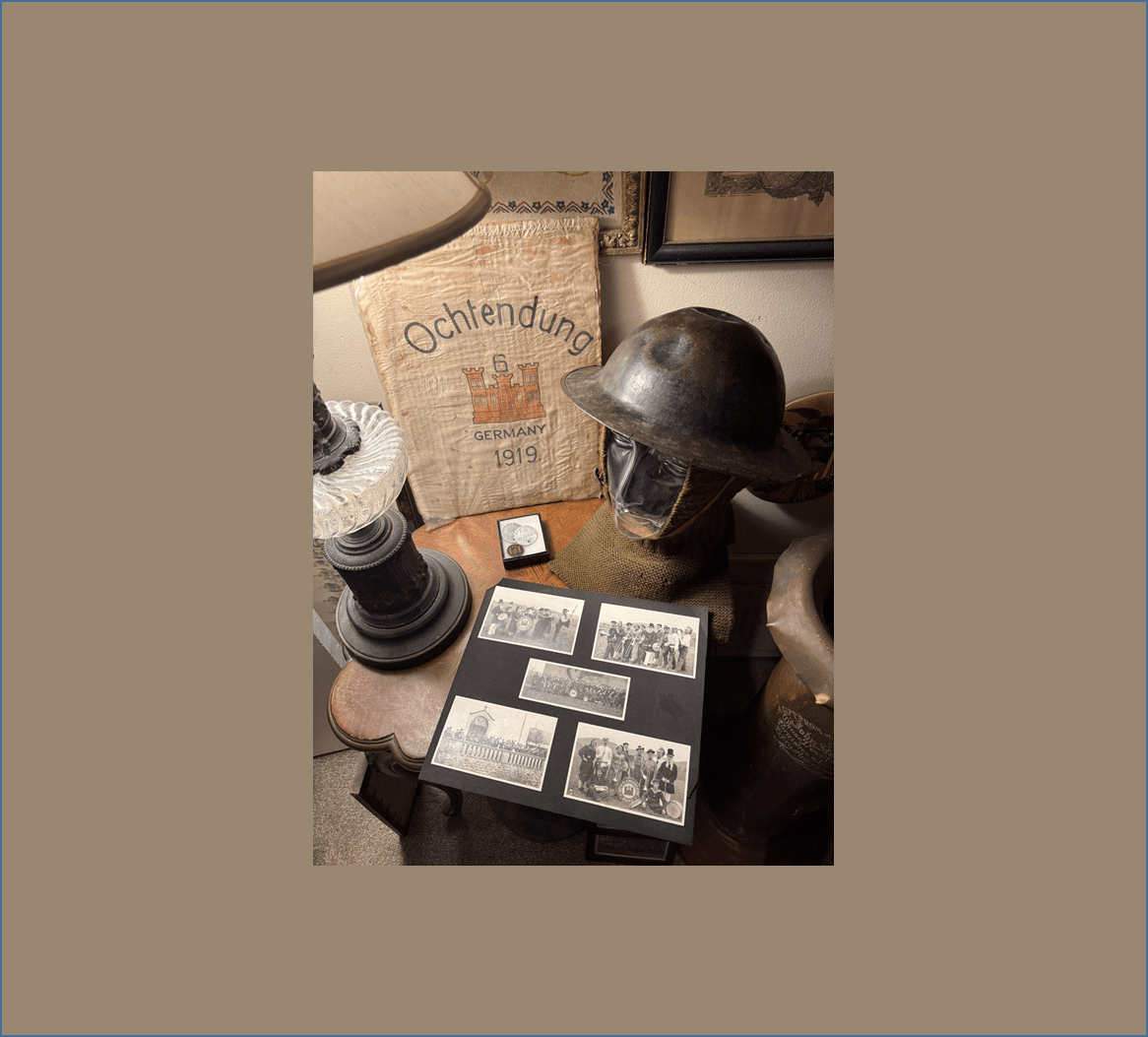
As shown in the opening photo, I have the helmet displayed with some other 6th Engineer items in my collection, including the dog tags & collar disc of David C. Waite, also of Company B and part of “Carey’s Force” in the Somme. Also shown is a silk sign for the 6th Engineers made in Ochtendung where the 6th were stationed in Germany in 1919, and a group of photos showing the band of the 6th Engineer Regiment.
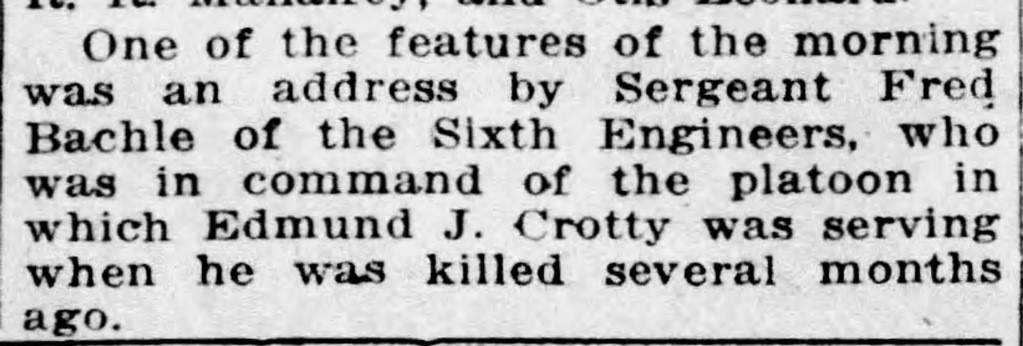
After the war, on April 21st, 1919, Bachle traveled to Edmund J. Crotty’s hometown of Elmira, New York, and gave an address at a Victory Loan Drive meeting, telling the story of Crotty’s bravery. Possibly as a result of this trip, Bachle made the decision to settle in Elmira.
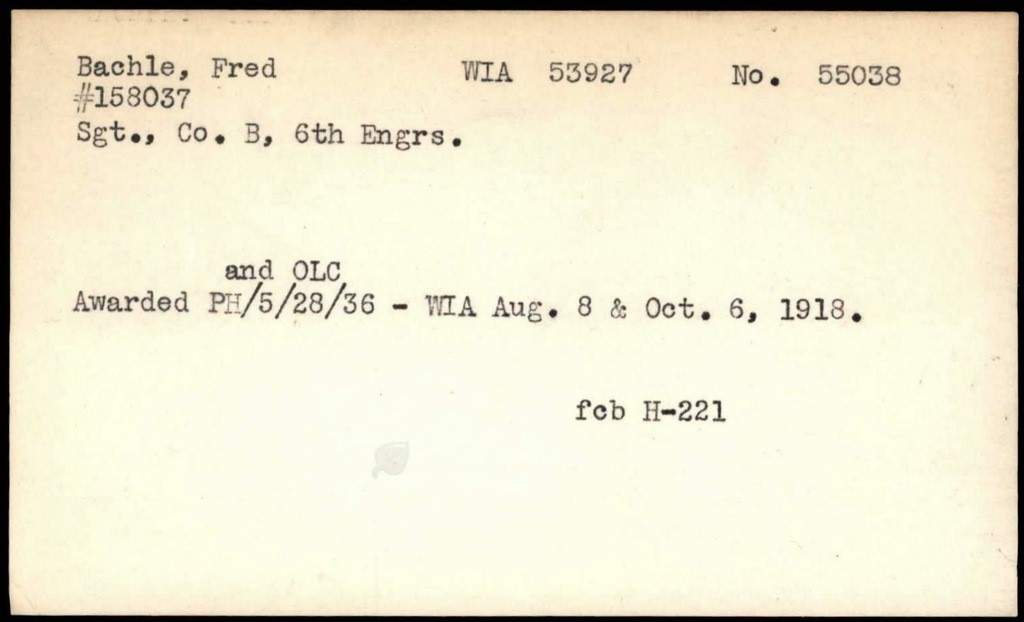
On May 28th, 1936, Bachle was awarded the Purple Heart Medal with an Oak Leaf Cluster, for the wounds he received on August 8th and October 6th, 1918. He passed away in Elmira on June 15th, 1968, at the age of 75.
While most high-end helmets in a collection will be intricately painted or bear some sort of rare insignia, this example remains in the configuration and condition it was in when Bachle wore it through some of the worst military campaigns in history. Each dent carries its own story of life and death that Bachle had to live through, and I am honored to have had the opportunity to share his memory.
 Michael R. Santoro is a historic researcher & antiquarian of the First World War. After finishing his Bachelor’s and Master’s degrees in Architecture & Historic Preservation at the University at Buffalo, New York, he spent a year developing a museum in Gettysburg, Pennsylvania, and another year freelancing research in order to preserve the stories of soldiers long forgotten. He now works full time at International Military Antiques in Gillette, New Jersey as a Historical Research Specialist & Authenticator, preserving countless items & stories across all nations and eras.
External Web Site Notice: This page contains information directly presented from an external source. The terms and conditions of this page may not be the same as those of this website. Click here to read the full disclaimer notice for external web sites. Thank you.