Brighter Days Ahead: The Actions of Harry F. Kelly During the First World War
Published: 10 August 2026
By Katherine Haun
Special to the Dougboy Foundation website
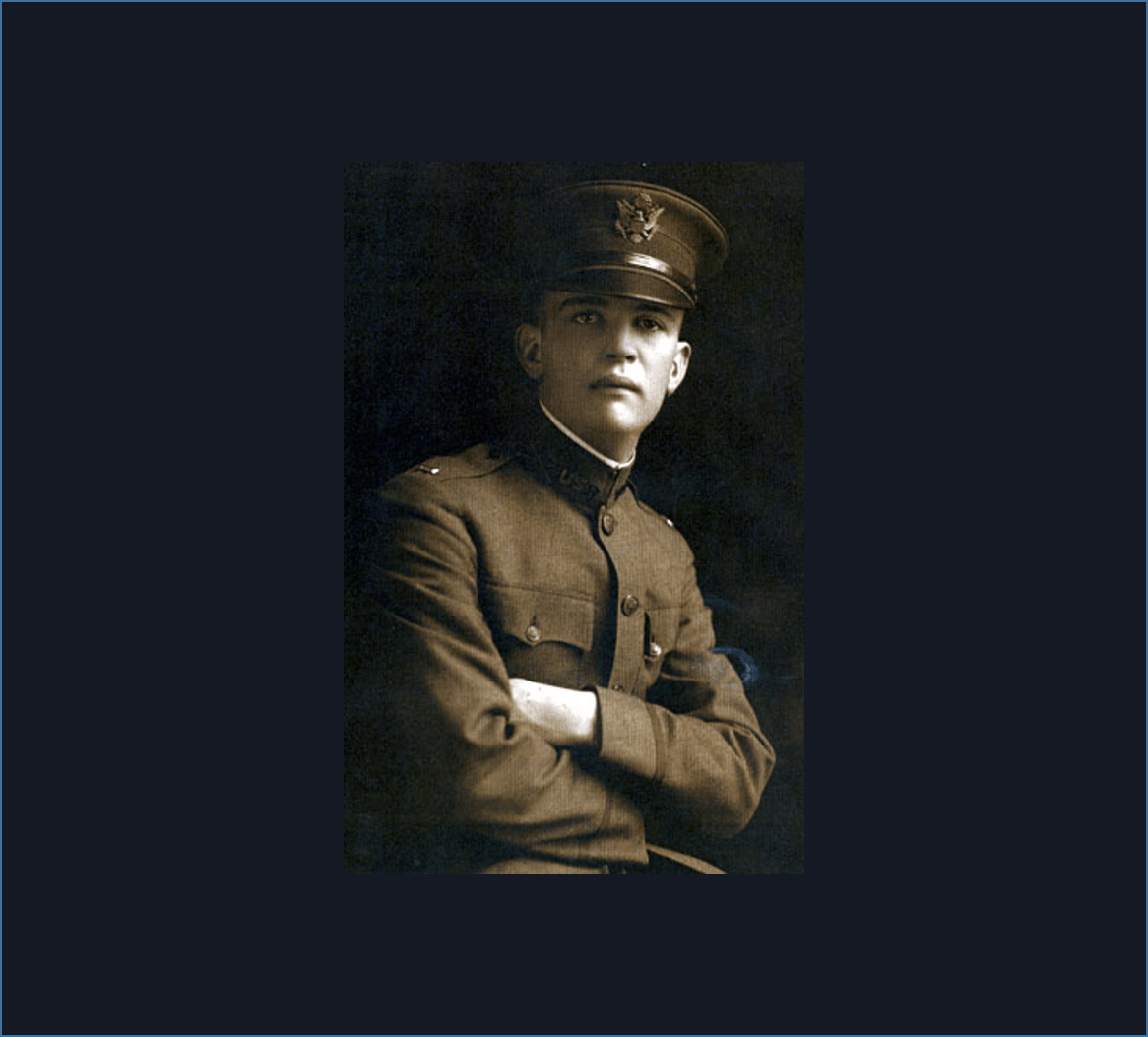
Harry F. Kelly WWI Picture framed
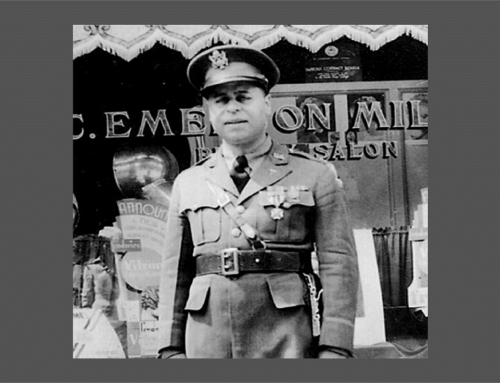
Harry F. Kelly pictured in his World War I uniform in 1917. Kelly went on to become the 39th governor of Michigan during World War II, and an associate justice of the Michigan Supreme Court, but his service during WWI, though heavily reported on during the conflict, has largely been left behind with the passage of time
On April 29th, 1918, the Morris Herald News reported that Mary and Henry Kelly had officially been notified in a telegram that their eldest son, Harry F. Kelly, had been seriously wounded in France. Kelly himself sent a cable to his parents after the incident that reportedly read, “Slight wound in leg. No danger.” In the same issue of the Herald News, Kelly’s father reported that, “…he fears that his son may have sent the cable for the purpose of trying to prevent his family from becoming alarmed, and minimized the extent of his injuries.” By the time the Herald News reported on the incident, Harry Kelly had already lost a portion of his left leg.
On April 19th, 1895, Harry F. Kelly, was born in Ottawa, Illinois, to Mary and Henry Kelly, one of nine children. After graduating from high school, Kelly worked in his father’s law office for one year before enrolling at the University of Notre Dame, from which he graduated with a law degree in 1917, while training at Fort Sheridan’s officer training camp in Northern Illinois. Kelly is best remembered for his political career, the seeds of which were planted during the First World War. Kelly went on to become the 39th governor of Michigan, during the Second World War, and an associate justice of the Michigan Supreme Court. His actions during the First World War were heavily reported on at the time but have largely been left behind with the passage of time.
In June 1917, Kelly began training to join the U.S. Army at Fort Sheridan. In November of the same year, Kelly earned a commission as Second Lieutenant of the 9th Infantry Division. The information surrounding Kelly’s regiment is confusing. The 9th Division was organized in July 1918 at Camp Sheridan, in Alabama, and did not see service overseas. Kelly undoubtedly saw service overseas. By his own reporting, in a letter to his father, Kelly rose to the rank of Lieutenant Commander of the Second Platoon, Company L, of the 9th Division. Due to this misreporting of Kelly’s regiment, not much is known of his service in France prior to his injury.
On either April 17th or 21st, Kelly led an assault on an entrenched German machine-gun position near Chateau-Thierry or Seicheprey. The Free-Trader Journal and Ottawa Fair Dealer reported on May 9th, 1918, that “Lieut. Kelly and three companions…were surrounded and fought themselves free despite terrible wounds suffered during the assaults at Seicheprey on April 21…Kelly fought off the Germans until weakened by wounds, he was captured. He revived and broke away from the five men holding him and escaped to the end of a trench where they left him…he lay in the trench all night under the barrage fire. When he was found in the morning it was necessary to amputate his [left] leg. Sixteen pieces of shell were taken out of his right leg.” For his efforts, Kelly was awarded, alongside four other wounded Americans, the Croix de Guerre with palm leaves by the French government.
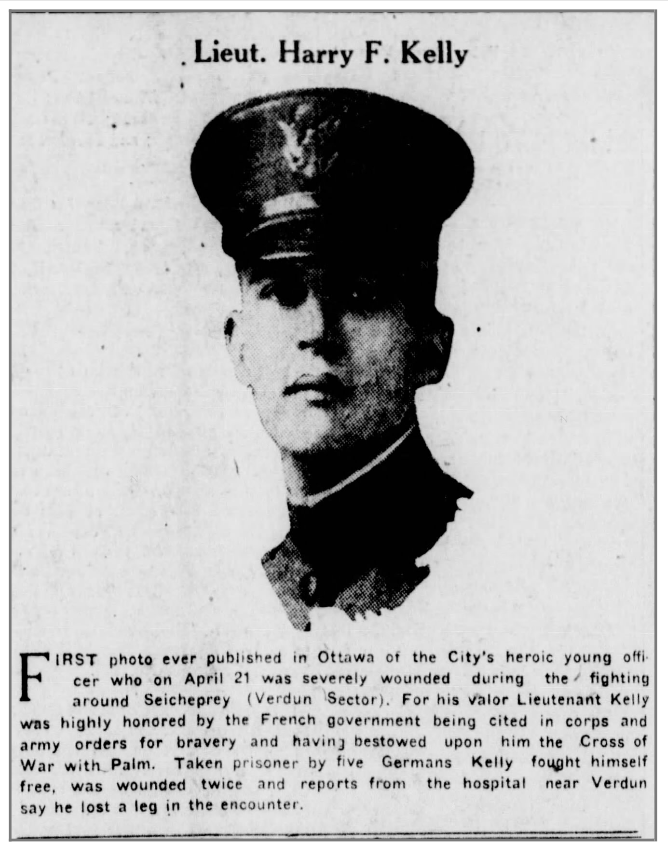
Article and photo about Harry F. Kelly in the Free Trader-Journal and Ottawa Fair Dealer, May 8th, 1918.
The Battle of Seicheprey, where Kelly was likely wounded, took place on April 20th and 21st, 1918. The American losses included eighty-one dead, four-hundred and twenty-four wounded, and one hundred and thirty captured, including six officers. The German army lost over six hundred men, with one-hundred and fifty being confirmed dead. The American units involved were the 26th Infantry Division and the 102nd Infantry Regiment, both regiments hailing from New England. Kelly’s regiment was also present, as reported in a published letter written by Kelly’s friend, Lieut. John Cassidy, but the extent of their involvement is unknown and, so far, unverifiable.
Kelly’s letters remain mostly optimistic, likely an effort to not frighten his family, but there is within them a trace of personal experience and deep sadness that has since categorized the supposed, Great War. On May 24th, 1918, the Morris Herald News published a letter from Kelly to his father, in which he recounts much of his current condition and his future expectations within the Army. Most notably he writes, “I used to think I would never want to return in any other condition than in which I left, preferring death instead. But things appear altogether different to me now and have never seemed dearer.”
On June 26th, 1918, the Free Trader-Journal and Ottawa Fair Dealer published two letters concerning Kelly. The first was a letter written by his friend, and fellow soldier, John Cassidy recounting his visit to the hospital in which Kelly stayed. The letter was written to Kelly’s sister, Marie, and described Kelly’s health, good attitude, and “popularity” within the hospital. The second letter was written by Kelly himself, to his parents, on Memorial Day 1918. In the letter Kelly describes his homesickness, sadness surrounding the holiday, and what was being done at the hospital to honor it, “It was as lonesome a sight as I ever care to see, those little white crosses resting on the end of the graves thousands of miles from home on foreign soil. One of my best friends, a young lieutenant, who I bunked with ever since joining the Ninth regiment, lies in one of those graves over here. He was killed a few days before I was wounded. I was only a few yards from him when a high explosive broke and blew him to pieces. It was my first awful taste of war. A sight that I will never be able to forget and it seemed that I felt his loss as though I had known him all my lifetime.” Kelly ends the letter by writing, “I know there are brighter days ahead for all of us.”
In August 1918, Kelly reported, in a letter to his parents, that he was officially enroute to the United States and was sure to be home soon. After disembarking at Ellis Island, Kelly was taken to Walter Reed Military Hospital, where he resided until September. On September 5th, the Senator Daily Times reported that Henry Kelly was visiting his son at Walter Reed. By September 17th, Kelly was back in Ottawa, Illinois, to the joy of both his family and the greater-Ottawa community. On September 20th, the Free Trader-Journal and Ottawa Fair Dealer reported that the Kelly family held a public reception in their home, in honor of Harry’s return. The event was attended by two-hundred and fifty people, the most unexpected of which was Kelly’s younger brother Emmett, who had recently received his own commission in the U.S. Army from Fort Sheridan, and had not yet seen his brother.
The remarkable paper trail attached to Harry Kelly during the First World War is undoubtedly thanks to the deep concern and love his family held for him. After his return to the United States, the trail turns towards speeches made by Kelly, instead of letters. From August until October 1918, Kelly worked with the Fourth Liberty-bond sale and gave a speech, published in the Free-Trader on October 3rd, aimed at selling more bonds. On October 23rd, the Morris Herald-News reported that Kelly had returned to Walter Reed for treatment and was awaiting further instructions from the Army.
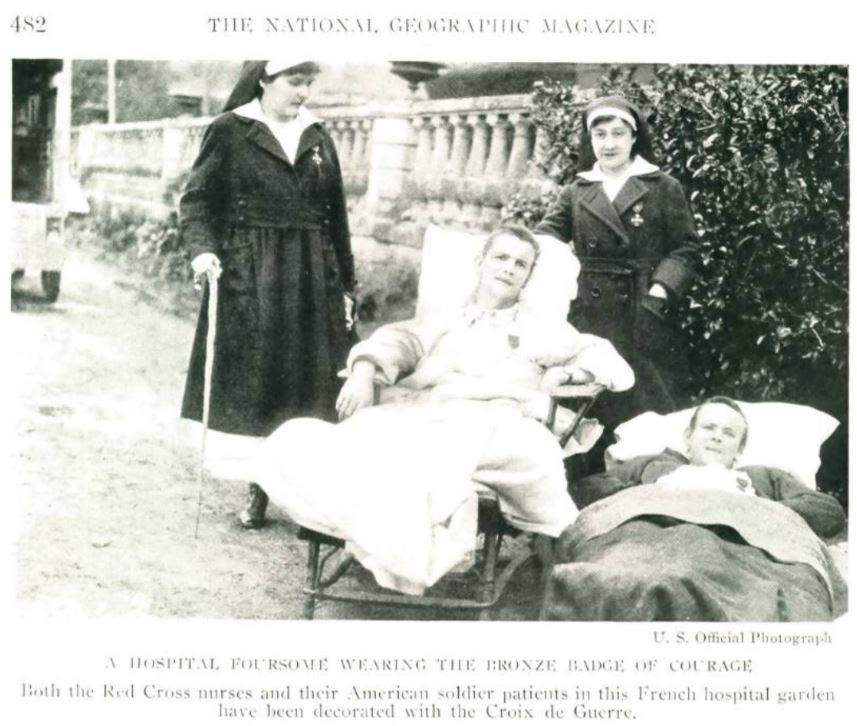
Harry Kelly, left, in The National Geographic Magazine, December 1919, pictured in an article titled “The Romance of Military Insignia” by Col. Robert E. Wyllie.
After this point, Kelly’s whereabouts and experiences become less reported on in newspapers, likely due to the war’s near conclusion. On November 30th, 1918, the Free-Trader published a speech Kelly gave at the Knights of Columbus’s military memorial service. On May 24th, 1919, the Free-Trader published a paraphrased speech of Kelly’s that stated, “…he preferred not to speak of cooties, barbed wire, rats, trenches, and launched into a stirring patriotic address on the three celebrations Ottawa is going to have in the near future.” On July 26th, 1919, the Free-Trader published another speech of Kelly’s, the first of a political nature, in which he discusses the experiences of American soldiers abroad and makes mention, towards the end, of the October Revolution of 1917 and “bolshevism.” On December 8th, 1919, the Senator Daily Times reported that a photo of Kelly taken while he was hospitalized in France was to be published in the most recent National Geographic issue. Kelly’s picture was included in an article titled “The Romance of Military Insignia,” in which he is pictured with two nurses and a fellow solider wearing their Croix de Guerre awards. In 1920, Kelly was elected LaSalle County, Illinois’s state attorney, marking the beginning of his long and successful political career.

Katherine Haun
Katherine Haun is a rising senior at the University of Illinois-Urbana Champaign, majoring in history and minoring in creative writing. Currently, she works as an intern at the Michigan Supreme Court Historical Society, working with their extensive portrait collection and writing in various capacities for the organization.
Katherine resides in the Greater Lansing area, but grew up in Detroit, Michigan. Her personal historical interest is in British History spanning from the medieval era to the 19th century, along with the Italian Renaissance
External Web Site Notice: This page contains information directly presented from an external source. The terms and conditions of this page may not be the same as those of this website. Click here to read the full disclaimer notice for external web sites. Thank you.