Who were the American mothers to France’s orphaned children during the First World War?
Published: 27 May 2026
By Emmanuel Destenay
via The Conversation website
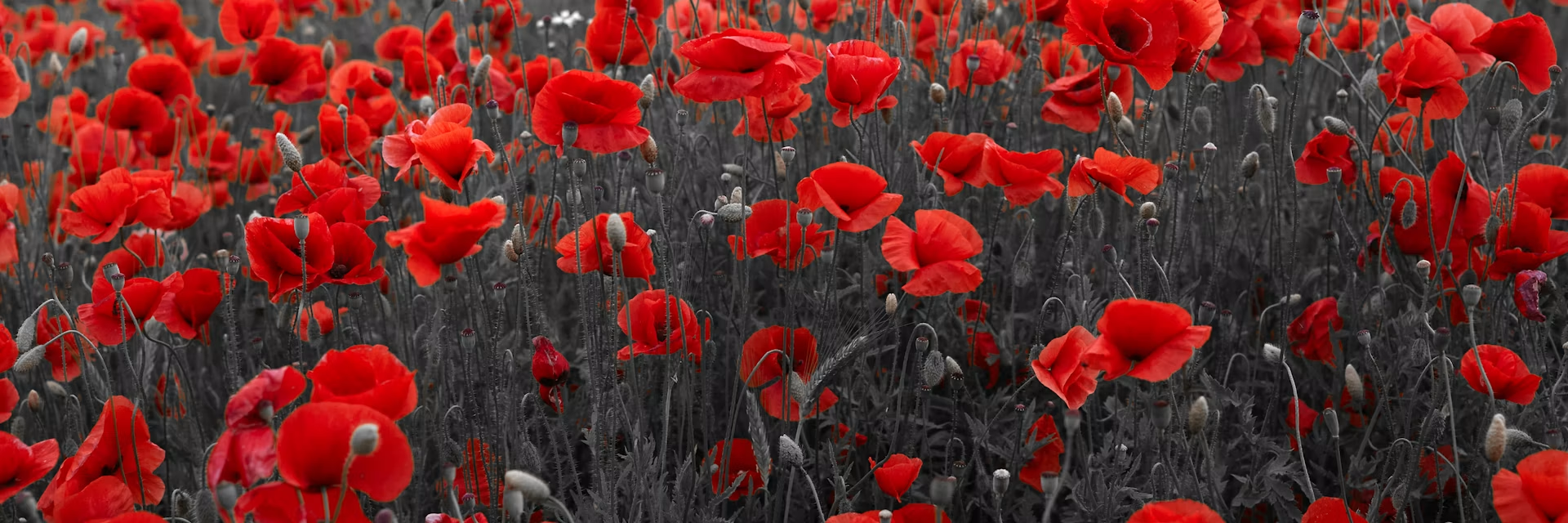
Poppies
Inspired by the war poem In Flanders Fields by John McCrae (1915), poppies, as pictured here, were first used near the end of WWI to commemorate British Empire and United States military casualties. Anna Guérin known by then as the “Poppy Lady of France”, established the first fundraising initiatives for veterans, widows, orphans and liberty bonds, as well as charities such as the Red Cross. (Vetre/Shutterstock)
During the entire course of World War I, approximately 25,000 American women crossed the Atlantic Ocean to attend to the needs of wounded soldiers and civilian communities in Europe. Women traditionally operated in medical units and helped care for wounded soldiers. Following US entry in the conflict, the newly established Women’s Overseas Hospitals and the American Women’s Hospitals in France drew hundreds of trained nurses to get involved in the war effort. Women’s participation, however, was not limited to the medical field. Female physicians and stenographers brought valuable skills to the front and helped the US military in a variety of domains. In 1918, for instance, the US Army Signal Corps sent 223 trained telephone operators to France to take over from inexperienced soldiers who were struggling to keep general headquarters connected with the troops who were under fire.
At a time when women experienced domestic confinement within their homes, taking part in relief organisations and being actively involved on the Western Front gradually reinforced their quest for equal rights, furthered their political agenda, and strengthened their claim for full citizenship.
Many American women seeking meaningful wartime jobs in France came from a very specific background, and many “hoped that the war would prove the forcing house in which long-standing feminine aspirations for the vote and economic equality would finally mature”.
Considerations for telling the story of the mothers to ‘America’s French orphans’
Any course focusing on American women in World War I should acknowledge the social backgrounds of the American wealthy expatriates, businessmen’s daughters, leisured wives of diplomats, and middle-class professionals who served as doctors, nurses, ambulance drivers, stenographers, and radio operators.
When teaching World War I in relation to 20th century American history to high school pupils and undergraduate students, educators traditionally focus on the neutrality of the United States and then expand on the reasons why Woodrow Wilson gradually dragged his country into the global conflict (Editorial note – For further reference: The Path to War: How the First World War Created Modern America by Michael S. Neiberg, Oxford, 2016; Neutrals, Belligerents and the Transformation of the First World War by Abbenhuis Maartje and Ismee Tames, London: Bloomsbury Academic, 2022).
Military historians linger on battles, strategies, and the decision-making process; cultural history gravitates around cultural encounters, war atrocities, and public reaction to the outbreak of the conflict; and scholars specialised in diplomacy dig into government archives, private papers, and conference proceedings to determine the responsibility of each country. But historians of women, childhood, and philanthropy have much to add to the understanding of WWI.
Presenting the big picture fatally necessitates omitting important details, but in the case of World War I studies, some entire facets of the conflict have been overlooked.
Out of interest in humanitarian organisations that operated in my home country, France, between 1914 and 1921, I have recently shifted the focus of my teaching to the plight of children during World War I. Cultural historians have long demonstrated that the French school system mobilised its youth to perpetuate a sense of national belonging in wartime and how state propaganda shaped children’s worldview. Yet I find that the various pictures of the conflict remain ethnocentric and neglect the silent but vital action of American women in rescuing France’s children.
In 1915, a group of American philanthropists envisioned the creation of Franco-American colonies to rescue youngest war victims from starvation and misery.
Twenty-eight colonies were established by the Committee Franco-American for the Protection of the Children of the Frontier (CFAPCF) to shelter displaced orphans from France and Belgium. All the colonies were managed and staffed by French nuns, but heavily depended on American donations and volunteers – American women. Among them were Alma A. Clarke, a former student at Bryn Mawr College, and Erica Thorp de Berry, the granddaughter of Henry Wadsworth Longfellow, a Harvard University professor and a towering figure in 19th century American literature.
American women helped to feed, educate, and nurse the orphaned and traumatised children who were moved to the colonies to recover and prepare for life on their own after the war. They tucked little orphans into bed, kissed them goodnight, told them stories of the gigantic country across the Atlantic Ocean, and even sang songs when they could not sleep.
Colonies operated as “humanitarian wombs” and though the survival of approximately 800 children from France and Belgium could look relatively insignificant, they carried out the first humanitarian actions toward children.
Read the entire article on The Conversation website.
External Web Site Notice: This page contains information directly presented from an external source. The terms and conditions of this page may not be the same as those of this website. Click here to read the full disclaimer notice for external web sites. Thank you.