Finding the Hello Girls: Pacific Northwest Connections
Published: 22 May 2026
By Lisa Oberg, M.Libr.
Director and History of Science and Medicine Curator
Special Collections, University of Washington Libraries
Special to the Doughboy Foundation website
Oberg header
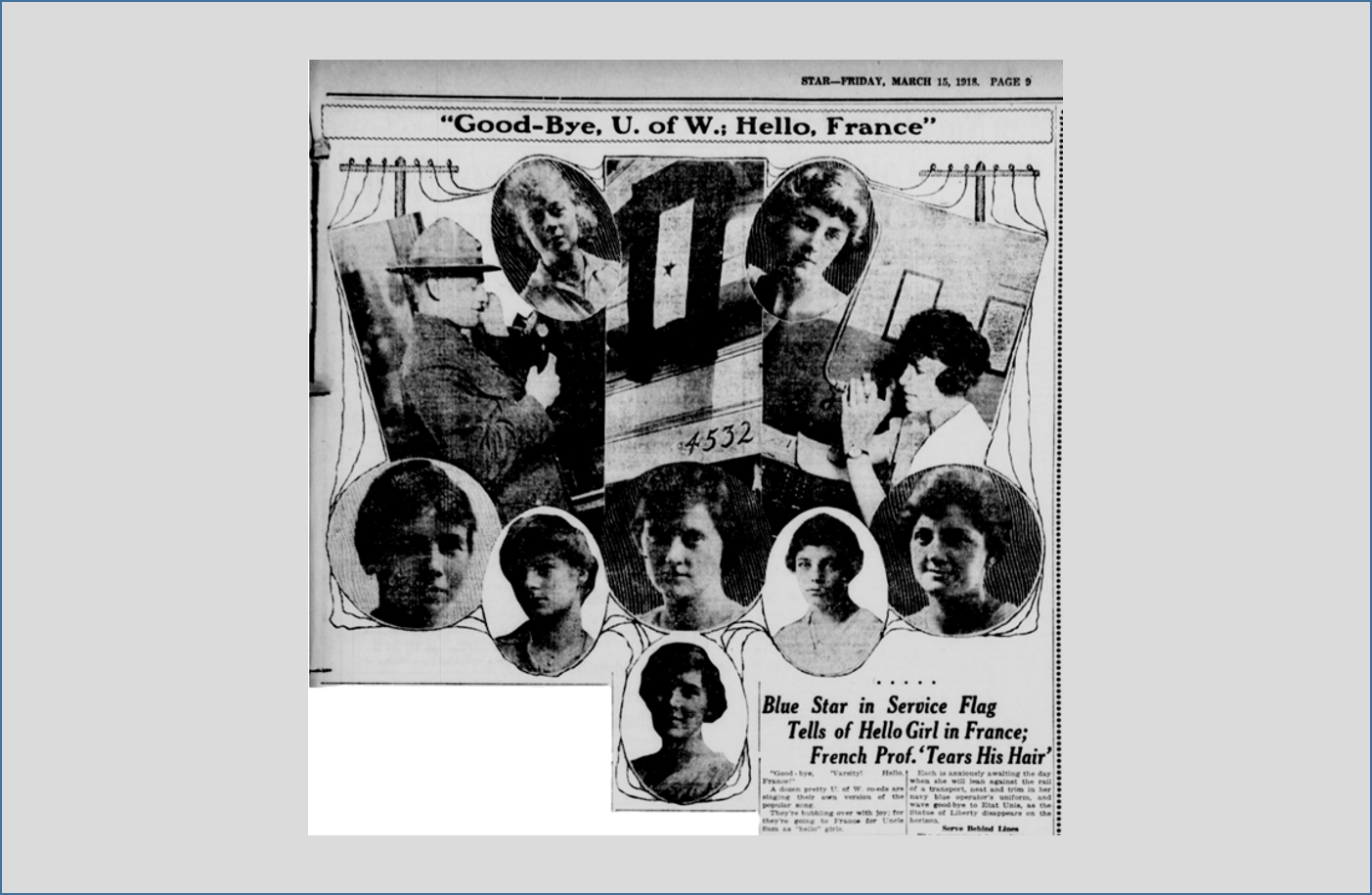
“Good-Bye, U. of W.; Hello France.” The Seattle Star (Seattle, Washington), March 15, 1918, page 9.
”Goodbye U. of W.; Hello France” was the headline in a Seattle-area newspaper I came across while researching the University of Washington’s response to World War I. It has led me on a decade-long pursuit of the women featured in the article who had enlisted in the U.S. Army Signal Corps as telephone operators – AKA “Hello Girls” – and their compatriots. (Seattle Star, (Seattle, Washington), March 15, 1918, page 9.) But how did I get here? In 2016, as we headed into the centennial of the Armistice that ended the Great War, I decided to curate an exhibit in Special Collections at the University of Washington Libraries. It was an ambitious undertaking, as up to that point, my knowledge of World War I was limited to it being one data point on the timeline of 20th-century events leading to World War II.
The resulting exhibit, Washington on the Western Front, which involved more than a year of research, highlighted a variety of ways the University of Washington (UW) contributed to the war effort and the war’s effect on the campus. In 1917, when the U.S. joined the war, the UW had been in its current location for only 12 years and was still a relatively young school, founded in 1861. Then-President Henry Suzzallo supported numerous war efforts, as Army, Navy, and Marine training overtook the campus, and Red Cross volunteer work overtook the classroom.
The centerpiece of the exhibit was a gallery featuring the UW’s Gold Stars, the fifty-eight students and alumni who lost their lives in the war. While researching the lives of the fifty-seven men and one woman, I discovered that the full arc of the war could be told through their stories. Students who went to Canada to enlist before the U.S. entered the war, those who served with the 91st “Wild West” Division, the Coast Artillery Corps, and the Spruce Production Division, those killed in action, killed in U-boat sinkings, and the many who died of influenza during the 1918 pandemic.
Following the war, a monument was erected on the campus to the UW’s war dead. One of the main streets was renamed Memorial Way and planted with 58 London Plane sycamore trees, one for each life lost. Each tree was accompanied by a certificate documenting a Gold Star. Later, the number of trees was doubled to reflect the losses from later conflicts.
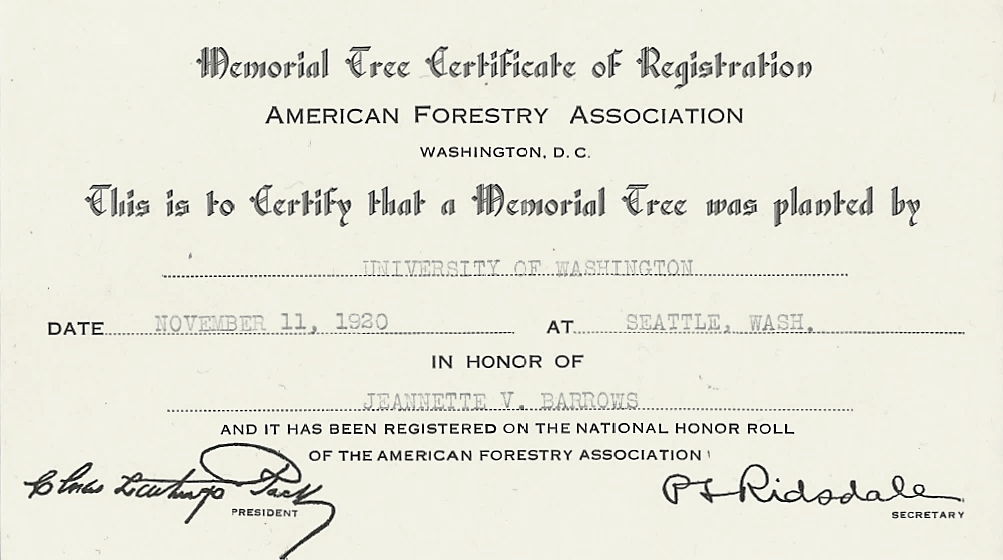
University of Washington Office of the President records, 1854-2019. Acc. 71-034, box 128/folder 4. University of Washington Libraries, Special Collections.
In addition to documenting the UW’s Gold Stars, I was also very drawn to the detailed accounting in the UW’s yearbook, the Tyee, of the myriad ways women had contributed to the war effort. In particular, its coverage of “What Our Women Did” prominently featured the work of ten students who served in France as telephone operators with the Signal Corps: Helen Hill, Adele Hoppock, Eleanor Hoppock, Frances Laney, Marjorie McKillop, Helen Naismith, Doris Summers, Mary Story, Ellen Turner, and Jessie Young. An additional four UW students, Gwendolyn Green, Margaret Jones, Enid Mack, and Thelma Miller, had been attached to Group 7, but the Armistice was declared before they deployed. Perhaps it was the patriotic fervor that swept the campus, or the opportunity to serve alongside classmates, but in the end, the University of Washington contributed more Hello Girls to the Signal Corps than any other higher education institution in the United States.
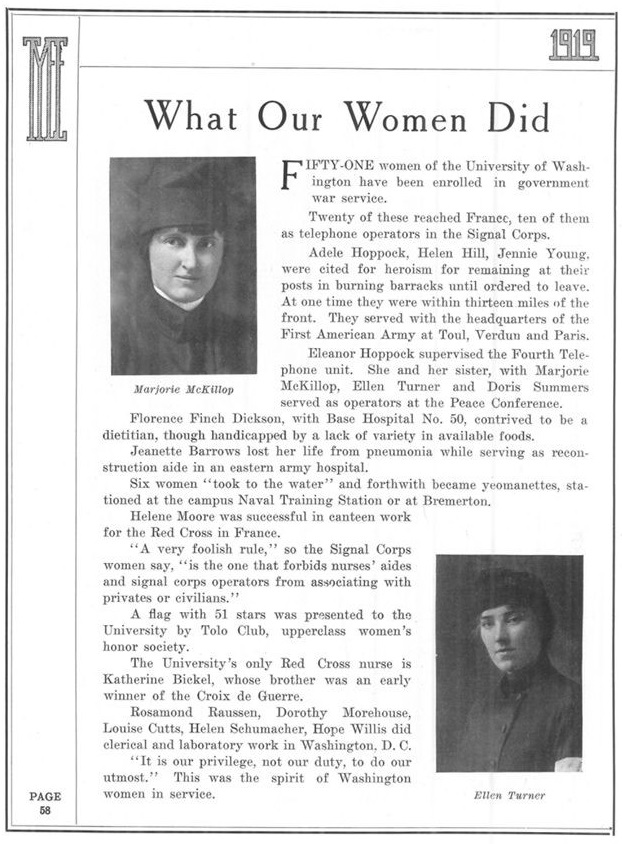
“What Our Women Did.” University of Washington Tyee Yearbook. 1919. Page 58.
At the time the article was published in The Seattle Star, featuring eight of the ten who served in France, the exodus from campus to Palo Alto for switchboard training was in full swing. So much so that Professor Pierre Frein, head of the French department, lamented the loss of his finest students and nearly all the senior class’s French majors. Frein administered the language proficiency exam for applicants to be telephone operators, so he played an active role in his students’ loss! Following the war, most of the women who had interrupted their college education to enlist returned to the UW to finish their degrees, forming a new campus organization in the process, the Ex-Service Women’s Club.
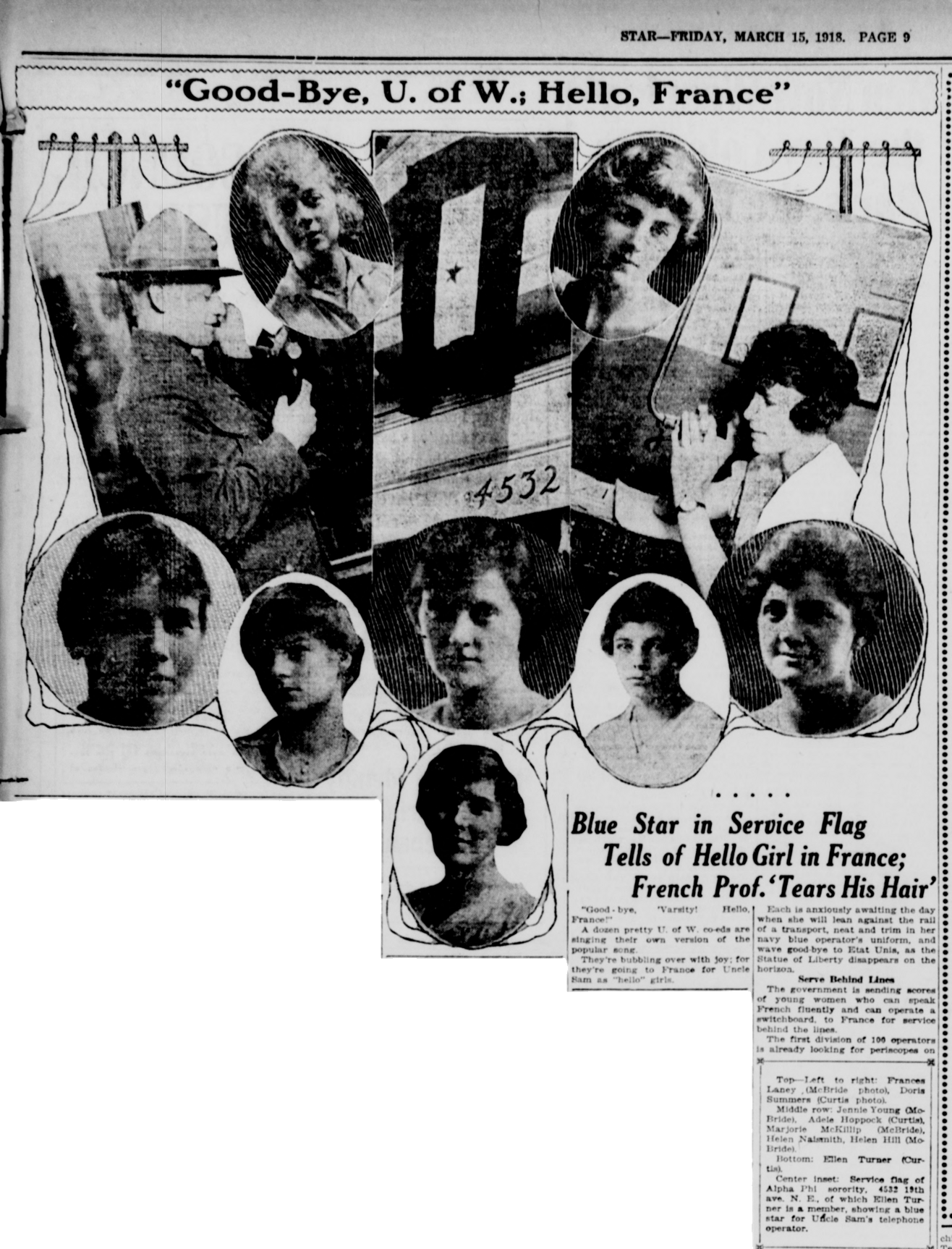
“Good-Bye, U. of W.; Hello France.” The Seattle Star (Seattle, Washington), March 15, 1918, page 9.
In 2020, the Seattle Genealogical Society sponsored a writing contest in conjunction with the centennial of the passage of the 19th Amendment, which granted women the vote. Having learned of the many Washington Hello Girls, I challenged myself to use the opportunity to enter one of their stories. UW Senior Marjorie McKillop was one of those Hello Girls whose service was featured in the UW yearbook. At random, I set out to research Marjorie’s life story, a lucky choice, as she led a fascinating, peripatetic life. Although I did not know it when I initially began researching her story, Marjorie, who served with Group 4, was one of the few operators whose longevity enabled her to receive her official Army discharge in 1979. Canadian-born, Marjorie learned French as a child living in Montreal. Her family migrated to Seattle when she was young and, as a UW student, she became entwined with the war effort. Through her later association with the Women’s Overseas Service League, Marjorie remained in contact with many of her fellow operators throughout her life.
I was surprised and delighted that my entry was chosen as the winner of the contest. Having done a deep dive into one operator’s story, I found I could not stop there and continued to research the women of the Signal Corps, particularly those with a connection to the Pacific Northwest (PNW), which I defined as Oregon, Washington, Idaho, and Montana. In all, thirty-eight women were born in the PNW, enlisted from the region, or died or were buried here.
Among them was refined Eglantine Moussu, the daughter of French immigrants, who grew up in Pendleton, Oregon, a town best-known for its annual rodeo. Sadly, due to ill health, Eglantine would take her own life at the age of sixty-four. And, the Keyser sisters, Ethel and Florence, born to Jewish parents, whose father emigrated to the U.S. from the Netherlands. Both sisters continued to work in Paris in embassy posts after the war ended, and Ethel remained there for the rest of her life. She married a well-known French opera singer, Claude Got, who was killed in the early days of the war, and was a diplomatic prisoner pf war during World War II.
Eleanore Brown led me on a merry chase because of the many name changes she adopted throughout her life. A resident of Spokane, Washington, at the time of her enlistment, Eleanore settled in New York City after the war and became active in the American Legion, coordinating national memorial poppy sales. She later married a prominent Army officer, Colonel John Putnam Loomis, who served in both WWI and WWII, and the couple is buried at Arlington National Cemetery. Like many women whose husbands were also veterans, Eleanore’s headstone reads “His wife,” making no mention of her wartime contributions.
Mary Caroline Story’s appointment with the Signal Corps received nationwide newspaper coverage. The daughter of a British Vice Admiral commanding a Naval Yard in British Columbia, there had been a lingering question of whether Mary was eligible to serve as a British subject. While enrolled at the UW, Mary boarded at a nearby convent, and the sisters were required to provide proof of her residence when Mary applied for a bonus after the war.
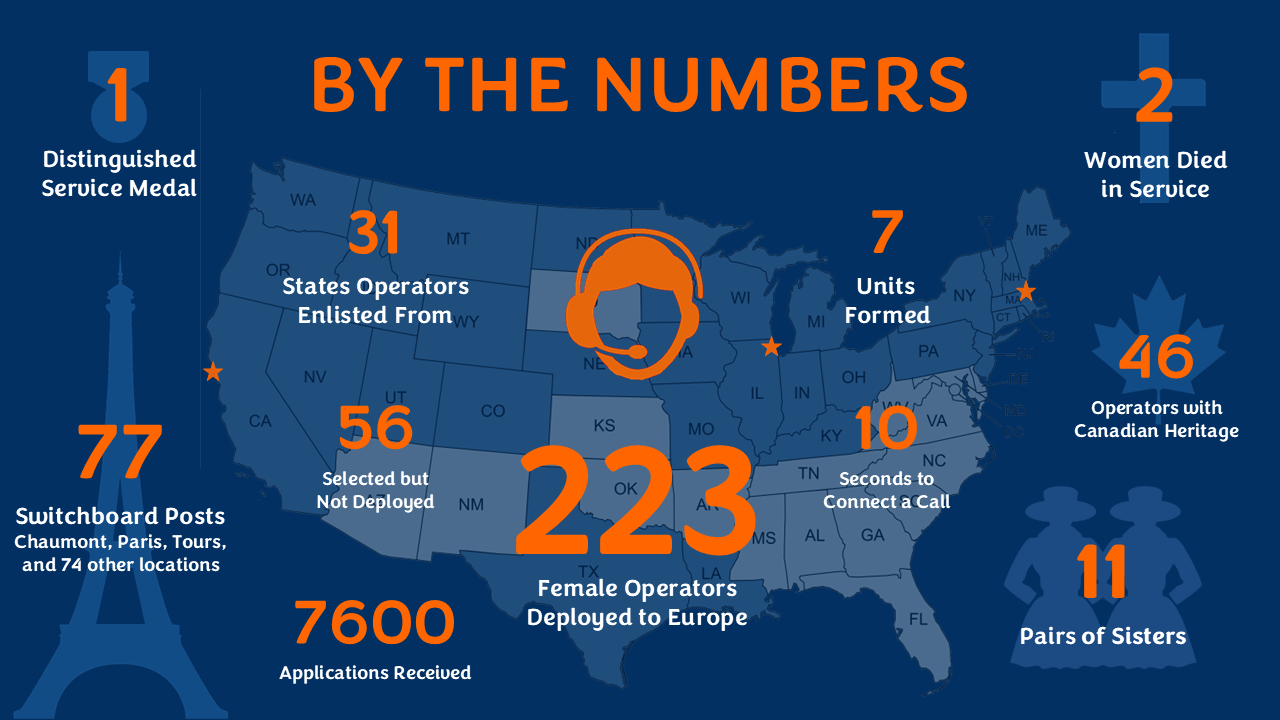
Hello Girls Infographic. © Lisa Oberg, 2025.
But where was I going with all this research? It was a question I frequently asked myself. In 2024, I began following the effort underway to secure recognition for the Hello Girls with a Congressional Gold Medal. I wrote to my state’s senators as suggested on the Doughboy Foundation’s website and continued to watch their activities. (Washington’s senators are both women, so I felt confident of their support!)
In March 2025, the organizers posted about their success in obtaining the Congressional Gold Medal for the Hello Girls in a Facebook message, and outlined their long-term projects, including discovering more descendants of the Hello Girls, ensuring all Hello Girls have a grave marker or one that reflects their WW1 military service, and creating a database for all Hello Girls’ information in one easy-to-use place. I quickly wrote to them, offering to help in any way I could with their research. To my delight, they added me to their ranks!
One of the women who played a pivotal role in fighting for veteran status for the Hello Girls was Merle Egan Anderson. Merle was a professional telephone operator from Montana who served with Group 5 after the bilingual requirement was dropped. Merle and her husband moved to the Seattle area after their marriage, when they were reunited following the war. Merle spearheaded a nearly 60-year “siege” – as one newspaper put it –against the U.S. Army to secure veterans’ recognition.
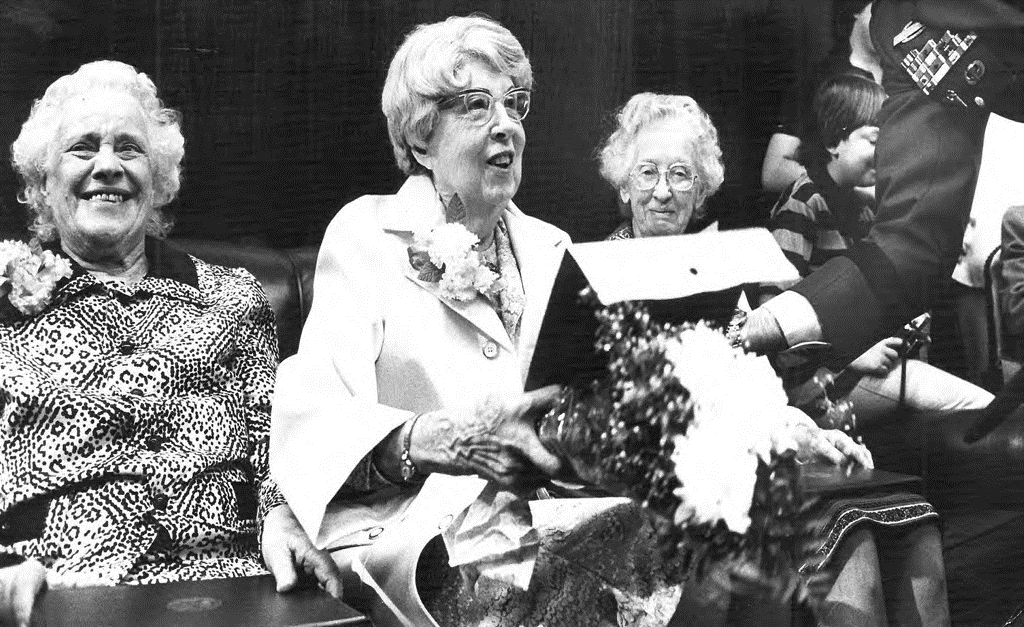
In 1979, three WWI military telephone operators, known as “Hello Girls,” received honorable discharges as war veterans after a 60-year wait and a long struggle to obtain recognition for their efforts on behalf of the nation. From left, they are Marjorie McKillop, 81; Merle Egan Anderson, 91; and Alma H. Hawkins, 89; all of the Seattle area. (AP photo)
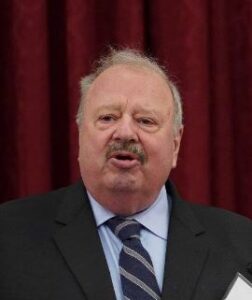
Attorney Mark Hough speaks after receiving his Special Recognition Award from the U.S. Army Women’s Foundation in 2019 for his work in getting recognition for the Hello Girls’ military service, nearly fifty years after their return from WWI.
By the mid-1970s, the operator ranks were dwindling, and the operators’ repeated efforts to get legislation over the finish line were running out of options. In 1975, a Seattle-area newspaper featured an article about Merle and her long-running effort. Seattle Attorney Mark Hough was one of those who read the article and connected with Merle with an idea for a new approach. Carolyn Timbie, granddaughter of Chief Operator Grace Banker Paddock, connected me with Mark, who still lives in the Seattle area. Mark’s recollections of working with Merle are still sharp after more than 50 years. We shared a wonderful lunch, reminiscing about his experiences working with Merle and about her steadfast belief that the surviving operators could receive their Army discharge before they were all gone. Mark and I also discovered that our WWI interests overlapped in numerous ways, including Mark’s longtime interest in Base Hospital 50, organized under the auspices of the UW, another focus of my 2016 WWI exhibit. The opportunity to speak with Mark, a living legend in the saga of the Hello Girls, was a dream come true, as I have long admired his pro bono work on behalf of the operators and the pivotal role Seattle played.
In 1979, when the surviving Hello Girls received their discharges, five of the original 14 UW students were still living, but only Marjorie McKillop was living in Washington, classmate Enid Mack having died just days before their scheduled recognition ceremony. When she received her Army discharge, Marjorie was quoted as saying, “I’m so excited, I’ll never be the same again.”
I feel the same way. It has truly been a wonderful experience working with the Hello Girls team. I am grateful for the opportunity to be part of The Hello Girls Military Honors and Remembrance Project (M-HARP), dedicated to preserving the history of the Hello Girls and ensuring that their descendants and future generations understand the significance of their service.
A virtual cemetery that brings together thirty-three of the thirty-eight operators with PNW connections is available on Find A Grave. The final resting places for five of the PNW operators are still unknown: Ruth Clarke, Hazel Hammond Morton, Helen Hill Verdi, Margaret Jones, and Lena Anderson Roy. The M-HARP team would love to hear from anyone with information about these operators or any of the women who served as Hello Girls.
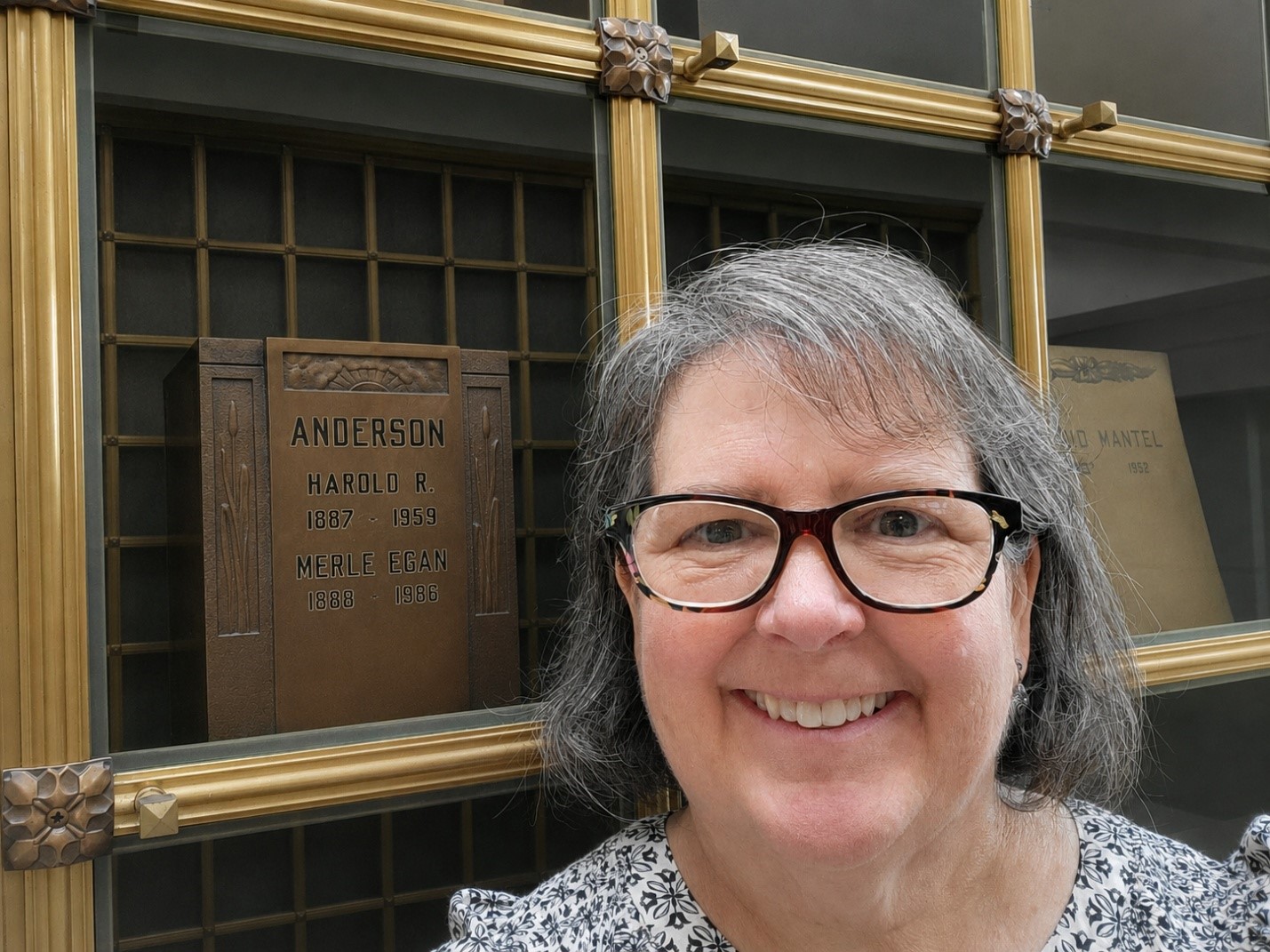
Lisa Oberg and Merle Egan Anderson, Forest Lawn Columbarium, Seattle, Washington.
Beyond my UW connections, one reason I focused my initial efforts on researching Hello Girls with Pacific Northwest connections was the opportunity to visit their grave sites, including Merle Egan Anderson’s. Merle’s response to receiving her WWI Victory Medal was much tarter than Marjorie’s had been, “I deserve this medal not just for serving in France, but for fighting the U.S. Army for 60 years and winning.” (Spokesman-Review (Spokane, Washington), 30 August 1979, pg. 5.) Merle, we’re so glad you never gave up. Researching your story and those of your fellow operators has been a privilege for the M-HARP team and me.
Lisa Oberg is the History of Science and Medicine Curator and Director of Special Collections within the University of Washington Libraries. In 2016, Lisa became interested in the UW campus response to World War I, which led her to uncover many examples of women’s contributions to the war effort. The often-hidden roles women played became a particular topic of interest and one she continues to research. In addition to the Hello Girls, Lisa also researches the personnel attached to the UW’s WWI hospital unit, whose stories she shares on her blog, Base Hospital 50 (basehospital50.blogspot.com).
External Web Site Notice: This page contains information directly presented from an external source. The terms and conditions of this page may not be the same as those of this website. Click here to read the full disclaimer notice for external web sites. Thank you.