A Primer on Iran’s (Persia’s) Rather Unpleasant World War I Experience
Published: 22 April 2026
via the Roads to the Great War website
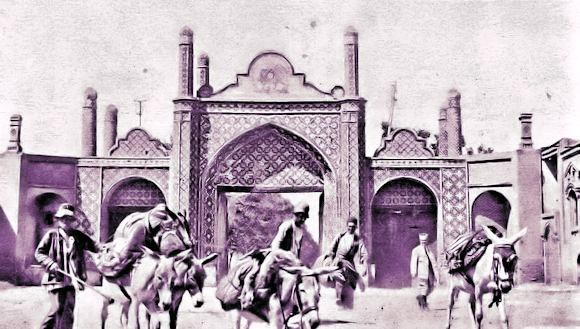
The Teheran Gate, Persia
The Teheran Gate, Persia
Persia (now Iran) is little known as a theatre of the First World War, but events there influenced global politics in the years following the war. Although Persia declared its neutrality in 1914, it was too important strategically for Britain, Russia, the Ottoman Empire and Germany to leave it alone and as a British diplomat wrote, “Persia, during the war, had been exposed to violations and sufferings not endured by any other neutral country.” Persia and Iran are use interchangeably in this article.
1905–1909 Constitutional Revolution
The Persian constitutional revolution sought to replace arbitrary power with law, parliamentary democracy and justice. When Naṣer-e-Din Shah Qajar was assassinated in 1896, the crown passed to his son Moẓaffar-e-Din Shah Qajar, who reigned until 1907. He was forced in 1906 to grant a constitution that called for some curtailment of monarchical power. He was succeeded by his son Mohammad Ali Shah Qajar, who with the aid of Russia, attempted to rescind the constitution and abolish parliamentary government. He aroused opposition and was deposed in 1909, the throne being taken by his son, Aḥmad Shah Qajar, who reigned until 1925. The occupation of Iran during the First World War by Russian, British, and Ottoman troops was a blow from which Aḥmad Shah Qajar never effectively recovered.
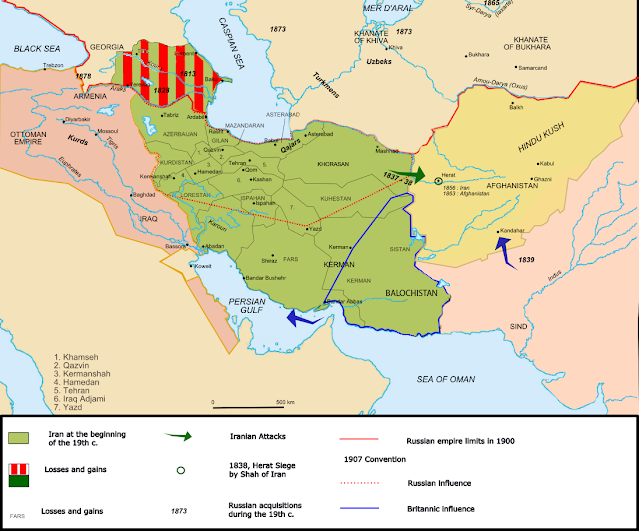
Map of southwest Asia, showing British and Russian areas of rule or influence.
1907 The Anglo-Russian Convention
This convention was signed on 31 August 1907. It made a neutral buffer of Tibet, recognized Britain’s interest in Afghanistan and partitioned Persia into spheres of influence: a Russian zone in the north, a British zone in the south and a neutral “buffer” zone in the rest of the country, in which both the British and the Russians shared power. [Read our article on how this resulted in the expansion of the Entente Cordiale to the Triple Entente, HERE.]
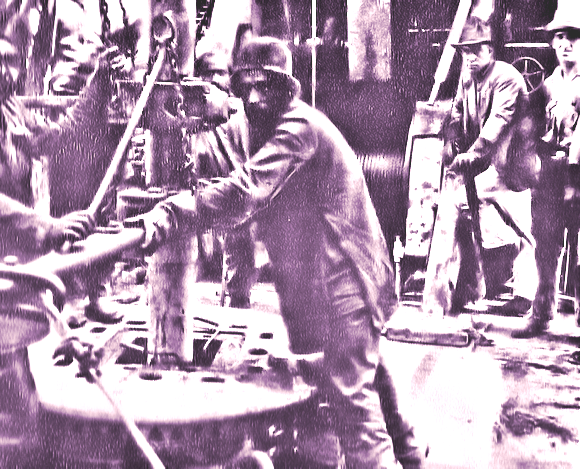
First oil drilling Masjed Soleyman, 1908.
1908 Discovery of oil in Persia
The Anglo-Persian oil company struck oil at Masjid-e-Suleiman in the southwest of modern-day Iran. The British Navy started to switch to oil combustion in 1910, thereby increasing its operating distance and speed.
1911 Occupation of Iran by Russia
A rebellion had broken out in Tabriz in north-western Iran on 23 June 1908, and in response to the siege situation there, Britain and Russia agreed that a Russian force should be sent to occupy the city. The Russians occupied Tabriz on 30 April 1909. Negotiations for its withdrawal soon began but dragged on into 1911. On 29 November 1911, the Russian government presented the Persian government with an ultimatum. There were several demands, but the most significant was to fire an American lawyer Morgan Shuster, who had been hired by the Majlis (parliament) to organize the country’s financial affairs. Upon the Persian parliament’s refusal, the Shah dissolved parliament and agreed to the Russian ultimatum. The ultimatum created unrest in Tabriz and on 21 December 1911, militants attacked the Russian troops, inflicting high casualties. In response, a brigade of the Russian Imperial Army was dispatched to Tabriz. Its aim was to occupy three major cities – Tabriz, Anzali and Rasht. The fiercest battle of the Russian invasion occurred in Tabriz, where the constitutionalists resisted. After about three days, the defense of the city broke, the Russians shelled Tabriz with artillery and entered the city on 31 December 1911. The Russians executed the constitutional revolutionaries of Tabriz, their families and many civilians of Tabriz as well. The Russians also destroyed part of the Arg of Tabriz by shelling, and a fire broke out there while it was held by Russian troops. The Russian forces remained in the city until 1917.
Read the entire article on the Roads to the Great War website here:
External Web Site Notice: This page contains information directly presented from an external source. The terms and conditions of this page may not be the same as those of this website. Click here to read the full disclaimer notice for external web sites. Thank you.