WWI Soldier’s Postcard from Home Helps Unite His Family After a Century
Published: 10 June 2026
By Sam McNeil
via the Military.com website
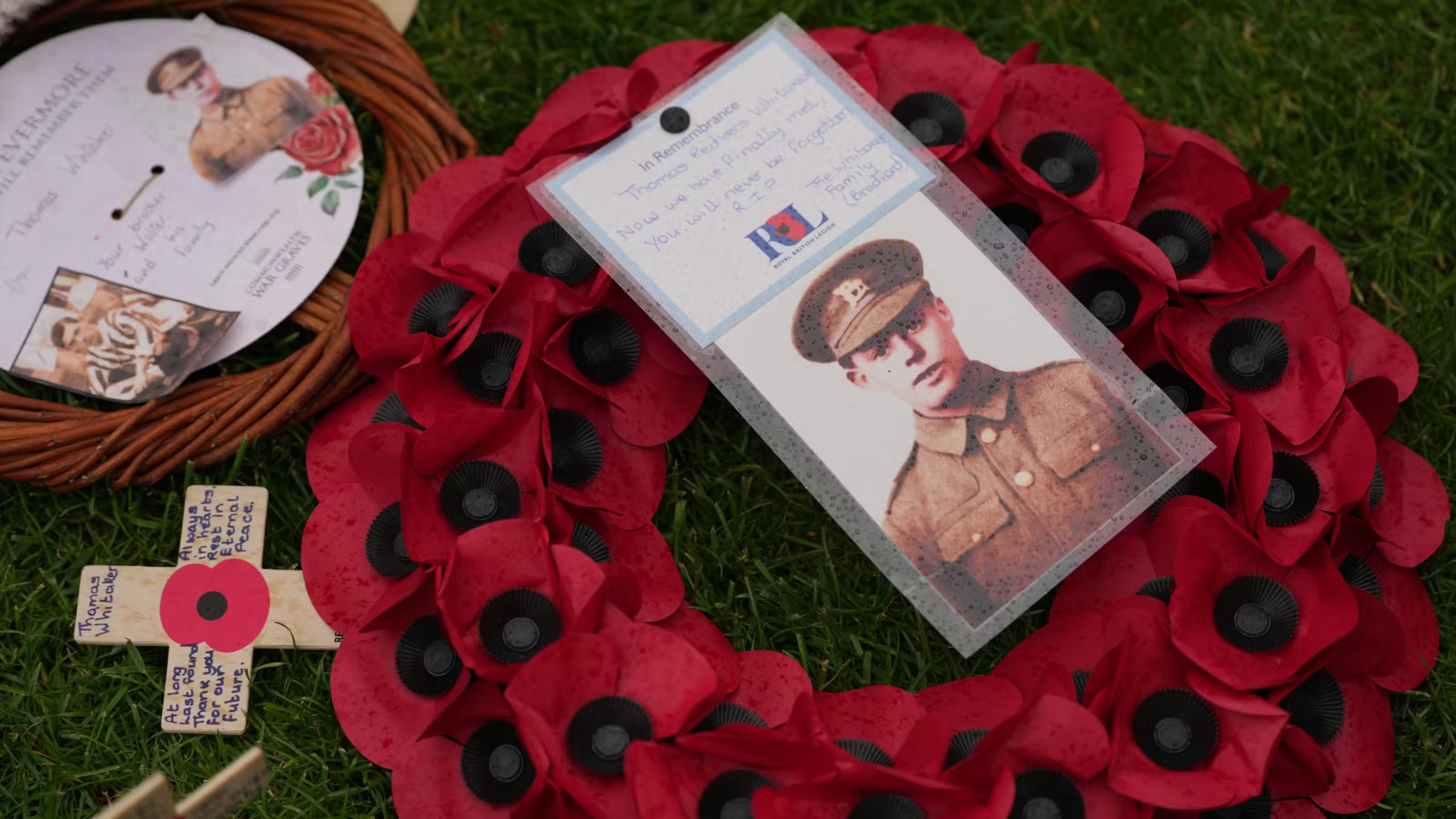
Private Thomas Redvers Whitaker burial ceremony
A poppy wreath and a photo next to the grave of Private Thomas Redvers Whitaker during a burial ceremony for six British soldiers of World War I, at the CWGC's Tyne Cot Cemetery in Zonnebeke, Belgium, Wednesday, June 10, 2026. (AP Photo/Virginia Mayo)
Dozens of mourners attended a memorial service in western Belgium.
ZONNEBEKE, Belgium (AP) — A postcard belonging to a World War I soldier whose body was found with five comrades during an excavation has helped reunite distant descendants more than a century after his death on the Western Front.
Dozens of mourners attended a memorial service in western Belgium on Wednesday during which six new white marble headstones were dedicated to the British soldiers whose remains were recently identified through the use of archival research and DNA analysis.
The six burials at the Tyne Cot Cemetery included that of Pvt. Thomas Whitaker, who died in the trenches carrying a postcard from Bradford, in north east England, where some of his relations still live.
At the ceremony were three members of the Whitaker family. Under sunshine piercing the gray drizzle, Joe Whitaker, 22, read aloud a poem written in honor of his great-great-uncle: “At peace in foreign hills, he finally drifts away to sleep, his mind on Bradford mills.”
The soldier’s postcard proved to be a crucial piece of evidence that helped British government researchers establish his identity and ultimately linked Joe’s family with another, estranged, branch of the Whitaker family.
Joe said: “The thought that (Thomas) might have been thinking of home, comforted by this postcard that he kept on him from Bradford — we were all quite taken aback by that.”
He said writing a poem “felt like the right thing to do.”
Alexia Clark, a commemorations case worker at the U.K. Ministry of Defence’s Joint Casualty and Compassionate Centre (JCCC), said the six soldiers were found during an excavation in western Belgium. But the discovery of the postcard on one of them proved to be a crucial “hint.”
She added: “And then actually when we looked at the missing list and went, ‘Oh we have got one from Bradford! Great, there’s a strong chance that he is going to be one of them.‘”
By matching the postcard with other found artifacts, including a Lewis Gun and uniforms, the JCCC researchers — known as “the war detectives” — were able to zero in on a likely group of men from the more than half a million British soldiers still missing from World War I.
The team contacted potential relatives for DNA samples, and the analysis confirmed the identity not only of Thomas Whitaker, but also privates Horace Frederick Cook, Frederick Martin, Charles Richard Russels, Courtney Darvill Hart and Joseph Turnley — all members of 2/4 Battalion Queen’s Royal West Surrey Regiment.
Paul Turnley was presented with a British flag folded into a triangle given by the military in honor of the sacrifice of his relation, Pvt. Joseph Turnley.
“Just a privileged to be laying a relative of ours to rest, to watch, to be present and then to be passed the flag… it was the greatest treasure actually,” said Paul, in tribute to his grandfather’s cousin.
Read the entire article on the Military.com website.
External Web Site Notice: This page contains information directly presented from an external source. The terms and conditions of this page may not be the same as those of this website. Click here to read the full disclaimer notice for external web sites. Thank you.