WWI Army Pilot Proved Airplanes Could Sink Battleships and Predicted Pearl Harbor — He Was Fired For It
Published: 22 November 2025
By Allen Frazier
via the Military.com website
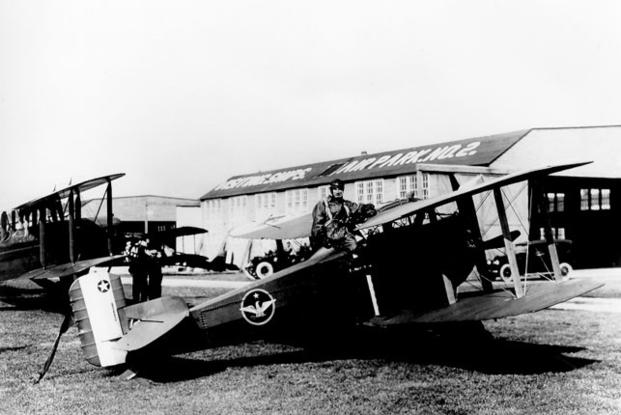
mitchellplane
Army Brig. Gen. Billy Mitchell with an MB-3 pursuit aircraft. Mitchell commanded the 1921 bombing tests that sank the battleship Ostfriesland and wrote a 1924 report predicting Japan would attack Pearl Harbor at dawn. (U.S. Air Force photo)
In 1921, Army Brig. Gen. Billy Mitchell proved airplanes could sink battleships. Three years later, he predicted Japan would launch a surprise air attack on Pearl Harbor at dawn. Navy and Army brass dismissed him. They court-martialed him, forced him out, then spent the next two decades building more battleships.
On Dec. 7, 1941, Mitchell’s predictions were proven right, but it was too late.
The Navy’s Rigged Test
Mitchell was a veteran of the Spanish-American War and World War I. He spent the late 1910s vocalizing how airpower could dominate the seas. The Navy was not amused by his assertions, and instead hoped to continue massing its battleship fleet.
Chief of Naval Operations Adm. William S. Benson summed up the Navy’s view during this time: “I cannot conceive of any use that the fleet will ever have for aircraft. Aviation is just a lot of noise.”
In late 1920, the Navy hoped to silence the WWI hero as he continued to argue battleships were obsolete. So, they conducted their own anti-naval test using airplanes on the USS Indiana, an old battleship from the Spanish-American War.
Navy aircraft dropped dummy bombs filled with sand to mark where they hit on the ship, then crews detonated massive explosives at those spots to simulate an aerial attack. The damage was devastating and the ship sank in shallow water.
When the test ended, the Navy drew a different conclusion. Capt. William D. Leahy released a report asserting that “the entire experiment pointed to the improbability of a modern battleship being either destroyed or completely put out of action by aerial bombs.”
The Navy hoped this would silence Mitchell, who’d been telling Congress the Air Service could sink any battleship and that funding should shift to modernizing Army aircraft.
However, in December 1920, two dramatic photos showing massive bomb damage from the tests appeared in London Illustrated News. Seven more surfaced in The New York Tribune. Congress and the press erupted as the test was shown to be rigged.
Secretary of the Navy Josephus Daniels scrambled to release Leahy’s report publicly, hoping it would calm the storm. It didn’t. Details emerged that challenged the Navy’s conclusions: no live bombs had been dropped at all.
The Indiana test had proven nothing.
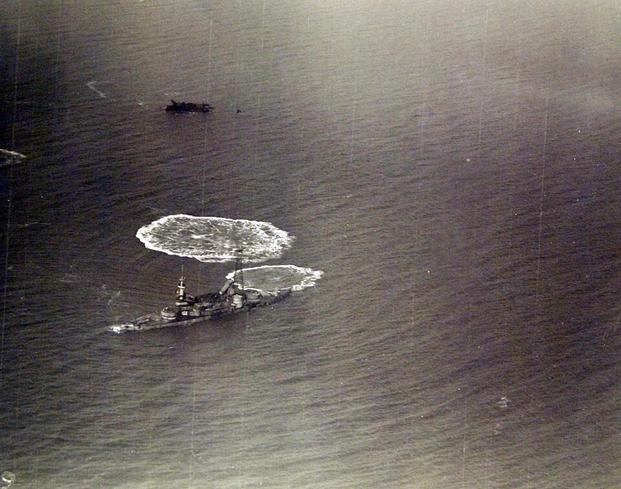
USS Indiana after the Navy’s rigged 1920 bombing tests. The Navy dropped dummy bombs filled with sand, then detonated explosives to sink the ship—claiming it proved battleships couldn’t be destroyed by aircraft. When the scandal leaked, Congress demanded real tests, leading to Gen. Billy Mitchell’s successful 1921 demonstrations. (U.S. Navy photo)
Mitchell Gets His Shot
After the Indiana scandal, Secretary of War Newton Baker and Secretary of the Navy Josephus Daniels agreed in February 1921 to joint Army-Navy exercises. Daniels couldn’t afford another embarrassment. The exercises, nicknamed Project B, would test to see if Air Service bombers could attack and sink several obsolete ships.
Mitchell, who had commanded nearly 1,500 Allied aircraft at the Battle of St. Mihiel in WWI, formed the First Provisional Air Brigade at Langley Field, Virginia — 150 aircraft and 1,000 Air Service personnel from across the country. He brought in Alexander de Seversky, a Russian Imperial Naval Service veteran who had attacked German destroyers during WWI. Seversky taught American pilots the “near miss” technique: dropping a bomb close enough to a warship to generate an underwater pressure wave that rips hull plates apart.
Meanwhile, Army ordnance engineers developed a 2,000-pound bomb specifically designed to kill battleships.
The tests began in June 1921 off the Virginia coast. As Mitchell flew overhead to observe, Navy aircraft went first, attacking a German submarine and the old battleship USS Iowa with more dummy bombs. The Navy refused to use live-ordnance as the Army had demanded. Instead, the ship was crewed and allowed to maneuver. Only two of 80 bombs hit the Iowa. The battleship advocates that witnessed the test were reaffirmed in their beliefs.
Then came Mitchell’s turn.
⇒ Read the entire article on the Military.com website.
External Web Site Notice: This page contains information directly presented from an external source. The terms and conditions of this page may not be the same as those of this website. Click here to read the full disclaimer notice for external web sites. Thank you.