World War I created the close relationship between the USDA’s dietary recommendations and the American agricultural industry
Published: 21 November 2025
By Dave Roos
via the History.com website

2232972761_digzjc
How Should Americans Eat? A Timeline of USDA Advice
The United States Department of Agriculture (USDA) was founded in 1862 under Abraham Lincoln. For more than a century, nutritionists at the USDA have issued dietary guidelines aimed at helping Americans eat healthier.
Why does the U.S. government care what people eat? Because there’s a clear link between unhealthy diets and higher risks for chronic diseases like heart disease, diabetes and certain cancers.
“Chronic disease costs the country billions,” says Lisa Jahns, a nutrition research consultant who worked for the USDA. “That comes from lost productivity, insurance costs and lost years of healthy aging.”
USDA dietary guidelines attempt to translate the science of food and nutrition into practical recommendations for everyday eating. Here’s a look at how those recommendations have evolved over more than 130 years.
1894: The First USDA Recommendations
At the turn of the 20th century, the most pressing dietary concern for American policymakers was malnourishment. Wilbur Atwater, a USDA chemist, issued the first federal dietary guidelines in 1894, based on his belief that “the best food is that which is both most healthful and cheapest.”
“Everything was based upon scarcity,” says Jahns. “How do you feed a family with nutritious food for a specific dollar amount?”
Atwater’s landmark study, called Food and Diet, included detailed tables listing the nutritional value of dozens of foods, their prices and how many calories each ingredient packed per pound. Other sections explored “dietary standards for men at muscular work” and even “food waste.”

USDA employees sit on the stairs outside a building, 1890s. (Corbis/VCG via Getty Images)
1916: Food Groups
The first person to categorize food into different “groups” was nutritionist Caroline Hunt, who worked with Atwater in the USDA’s Bureau of Home Economics. In her 1916 guide Food for Young Children, Hunt organized a child’s recommended diet into five food groups:
-
milk products, meat, fish, poultry and eggs
-
bread and other cereals
-
butter and other “wholesome fats”
-
fruits and vegetables
-
simple sweets
Over time, the USDA expanded and contracted the number of food groups as its nutritional recommendations evolved.
1917: WWI Fighters and Farmers
From the beginning, the USDA was given two responsibilities: 1) ensuring a reliable and healthy food supply and 2) supporting American farmers. That dual mandate took on a new urgency when the U.S. entered World War I.
“The government realized that a lot of America’s fighting-age men were undernourished,” says Jahns. At the same time, the war was disrupting agricultural production and export markets. “So the USDA started thinking, we’re going to help the farmers by getting more of their agricultural products to consumers, which will also improve the health of our fighting boys.”
The wartime Food Administration, led by Herbert Hoover, coordinated with the USDA to encourage changes in public eating habits.
That was the beginning of a close relationship (a “marriage,” Jahns calls it) between the USDA’s dietary recommendations and the American agricultural industry. It’s a relationship that would spark controversies in later decades.
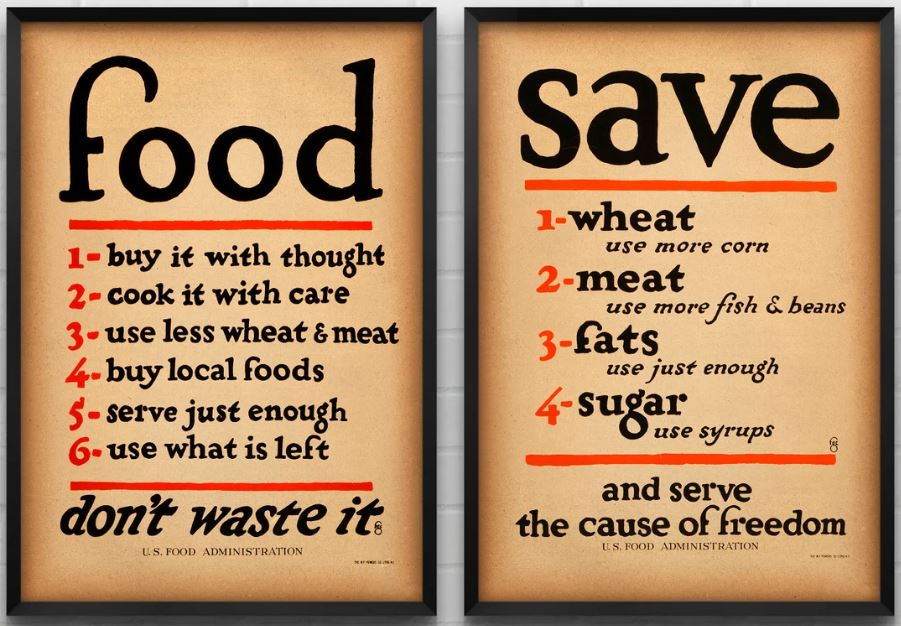
World War I Save Food Posters, US Food Administration, 1917.
⇒ Read the entire article on the History.com website.
External Web Site Notice: This page contains information directly presented from an external source. The terms and conditions of this page may not be the same as those of this website. Click here to read the full disclaimer notice for external web sites. Thank you.