William Jutras, a Manchester soldier’s journey from the Mexican border to World War I
Published: 25 October 2026
By Gary Ledoux
via the Ink Link News website

in-service-to-america Lieutenant William Hilair Jutras
In Service to America
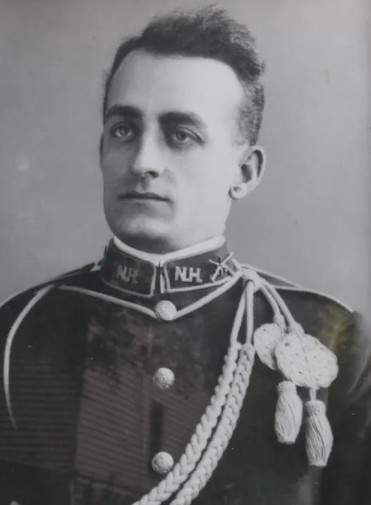
U.S. Army Lt. William Hilair Jutras
William Hilair Jutras, son of Alfred & Mattie/Martha (Barbeau) Jutras, was born on September 19, 1891, in Peterborough, NH. By 1900, the Jutras family had moved and were living in Manchester, at 377 Carter Street. William’s father was a roofer by trade (as was his own grandfather). William probably attended the local schools.
There is indication that he joined the NH National Guard as early as 1909 when he was 19 years old, although some sources claim he lied about his age and entered the Guard sooner. His job as a civilian was that of a cobbler, operating a shoe repair business.
By 1916, there was trouble on the U.S. – Mexican border. The Mexican government had become very unstable with a growing revolution. This was bad for the U.S. with interests in oil and minerals in the troubled country. Tensions ratcheted up when, on March 9, 1916, Mexican revolutionary Pancho Villa attacked the American border town of Columbus, New Mexico resulting in 24 American casualties—14 military and 10 civilians, drawing a strong military response from the U.S. Government.
President Woodrow Wilson ordered a punitive attack led by General John Pershing to capture Villa. The expedition involved sending about 10,000 troops into a sovereign country drawing Mexico’s ire. Despite engaging with Villa’s band, he was not captured or killed.
As the situation escalated, Wilson mobilized the National Guard units from Texas, Arizona, and New Mexico to secure the border. Other states deployed National Guard units as well, New Hampshire, deploying one infantry regiment (1st NH Regiment, Company A) to Laredo, Texas. William H. Jutras was with them. By June, 1916, over 110,000 National Guard troops were engaged along the Mexican border.
Mobilization along the hot, dry, dusty Mexican border was quite a shock for NH Guardsmen, used to much cooler climes, and much more rain. Soldiers complained that they “ate dust, drank dust, and slept on dust,” and violent sandstorms frequently disrupted the encampment. Guardsmen trained with regular Army soldiers, learning the nuances of combat. They marched on 10-mile exercises to get used to hard work in the heat and dust. By late 1916, the men of the 1st New Hampshire were no longer merely a local militia; they were soldiers who had been “toughened” by the climate and “honed” by the standards of the Regular Army
This mobilization was the first significant test of the National Defense Act of 1916, which sought to integrate the National Guard more closely with the Regular Army, establishing a mechanism for federal pay and standardized training. The act was passed amidst the “preparedness controversy”, after Pancho Villa’s cross-border raid on Columbus, New Mexico, and prior to U.S. entry into World War I. The “Preparedness Movement” was at first opposed by President Woodrow Wilson, who believed the United States should be in a position of neutrality in order to broker a compromise peace in Europe. Several organizations were formed around the Preparedness Movement and held parades and organized opposition to Wilson’s policies. After the Lusitania was sunk by German U-boats on May 7, 1915, and Pancho Villa launched his raid against Columbus, New Mexico, Wilson’s attitude changed.
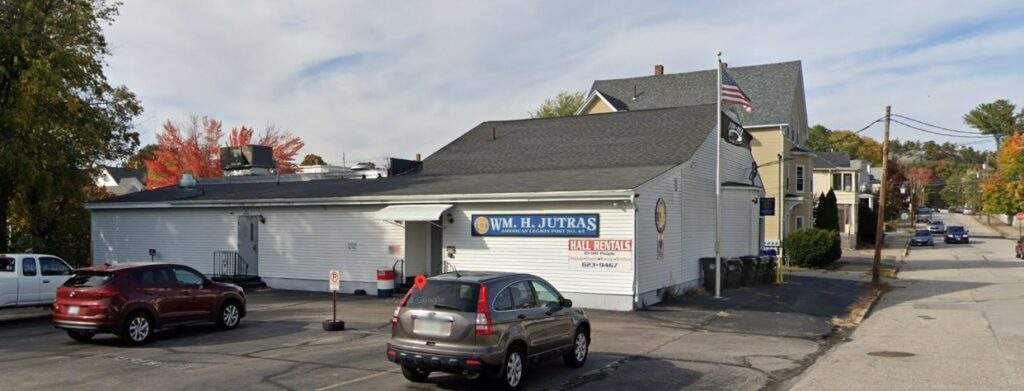
William Jutras American legion Post in Manchester, NH
Meanwhile… back in Washington, diplomatic efforts continued to try to avoid a full-scale war. US troops finally withdrew in 1917 failing to achieve its primary mission – to capture Pancho Villa.
On February 20, 1917, the 1st NH Infantry was mustered out of service at the Mexican border, where they had been stationed since 1916. The time spent by the 1st NH Infantry on the Mexican border was said to be, “a transformative crucible that converted a disparate collection of local militias into a battle-hardened, federally-integrated military force just weeks before the United States entered World War I.” William Jutras had served on the Mexican border from September 1916 to February 1917.
The 1st New Hampshire Infantry arrived back in Concord at 12:40 a.m. on February 9, 1917, just as the demobilization orders were being finalized. They were met with a heavy, wet snow, a physical reminder of the transition they were making back to their civilian lives. Despite the blizzard-like conditions, they marched up the hill for a few hours of sleep at the Green Street Armory before parading through the city the next morning to the cheers of thousands. They left NH, as “slouchy and inattentive” recruits and returned from the Mexican border, “a formidable military force.”
America entered WWI on April 6, 1917 and the 1st NH Infantry finished their Mexican tour just in time. The mobilization order reached New Hampshire on June 19, 1916. The scene in Concord was one of sudden, jarring transition. In the days before the internet, the ringing of the city fire-bells could signal any number of different things from a general alarm fire to “no school day.” On June 19, 1916, the bells rang the militia call “3-1-2,” a signal that sent “khaki-clad soldiers hurrying through the streets amid a growing excitement”. Within days, the 12 companies of the 1st New Hampshire Infantry Regiment, along with an attached machine gun company, converged on Camp Spaulding, situated on “the Plains” (the current site of the Concord Municipal Airport).
The composition of the 1st New Hampshire was a microcosm of the state’s industrial and ethnic diversity. Notable among the units were the “Sheridan Guards” of Manchester (Company B), a predominantly Irish-American unit, and the “Lafayette Guards” (Company A), which drew heavily from the city’s French-Canadian population. These men were citizen-soldiers in the truest sense—shoemakers, mill workers, and grocery clerks who were suddenly transformed, into soldiers.
Soon after, the 1st New Hampshire Infantry sailed to France and became the First Army Headquarters Regiment. Most of the rest of the state militia was assigned to the 26th Division and fought in six campaigns in France. Lt. William H. Jutras was assigned to 26th Division, 103d Infantry, Company A, also known as the storied “26th Yankee Division” for its preponderance of the division’s New England origins.
William M. Jutras of Manchester stands as the quintessential representative of the NH Guard’s transformation. A shoemaker/cobbler who had served in the National Guard, Jutras was part of the Company A (Lafayette Guards) deployment to Laredo. After returning in February 1917, he briefly resumed his civilian life before being commissioned as a First Lieutenant for the WWI deployment.
⇒ Read the entire article on the Ink Link News website.
External Web Site Notice: This page contains information directly presented from an external source. The terms and conditions of this page may not be the same as those of this website. Click here to read the full disclaimer notice for external web sites. Thank you.