When Patton met MacArthur in the mud of St. Mihiel
Published: 18 December 2025
By Daniel Tobias Flint
via the We Are The Mighty website
patton-macarthur-rainbow-division-st-mihiel-army
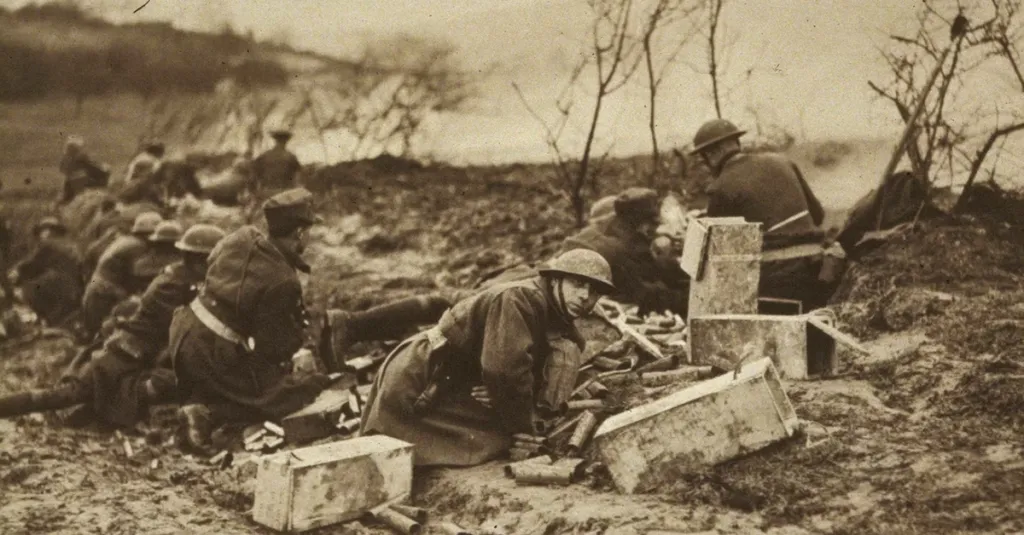
National Guard Soldiers of the 165th Infantry, 42nd “Rainbow” Division during St. Mihiel in September1918. Gen. Douglas MacArthur was assigned to the 42nd Infantry. (U.S. Army)
On Sept. 12, 1918, amid mud, smoke, and the thunder of advancing American forces during the St. Mihiel Offensive, two figures destined for fame crossed paths for the first time. It was fitting that Douglas MacArthur and George S. Patton met not in a briefing room or a quiet rear-area command post, but on an exposed, shell-torn battlefield near the small French village of Essey-et-Maizerais.
Both men already had reputations for leading from the front. Both were known for fearlessness that bordered on recklessness. And both would one day become two of the most celebrated American commanders of World War II. Their encounter under fire hinted at the Army leadership that would be tested again a generation later, albeit on a far larger scale.
America Awakens to Global Conflict
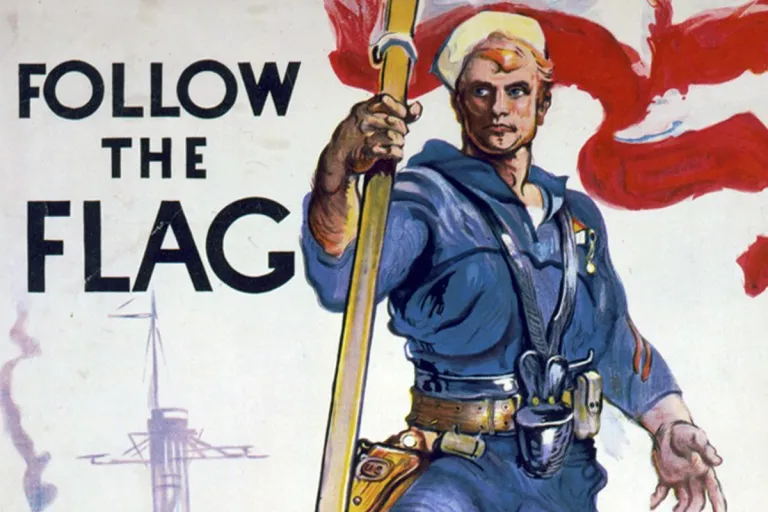
A World War I-era Navy recruiting poster. (Library of Congress)
When the United States entered World War I in 1917, it did so reluctantly but decisively. For three years, Americans had watched Europe tear itself apart. German submarine attacks on American shipping, the Zimmermann Telegram encouraging Mexico to attack the United States, and the widening threat to U.S. interests pushed President Woodrow Wilson to ask Congress for a declaration of war.
The U.S. Army, however, was not prepared for a conflict of this scale. Before 1917, the United States had a relatively small standing army and relied heavily on state militias. Mobilizing millions of soldiers required the Selective Service Act, rapid training camps, and a massive industrial and logistical effort.
General John J. Pershing was tasked with shaping the American Expeditionary Forces (AEF) into an independent, unified fighting force rather than simply feeding replacements into exhausted Allied armies.
By 1918, American troops were flowing into Europe in huge numbers. Their energy, fresh strength, and willingness to attack helped revive the Allied war effort. The St. Mihiel Offensive, in which Patton and MacArthur met, was significant because it was the first major offensive planned and executed under U.S. command by an American field army, with French forces and other Allied support operating alongside it. It was a defining moment when the U.S. proved it could fight and win on the world stage.
Douglas MacArthur in World War I
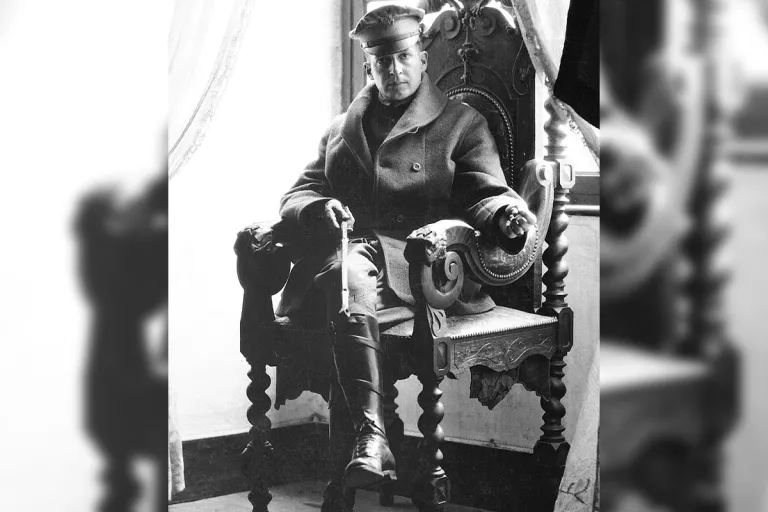
Brig. Gen. Douglas MacArthur holding a riding crop at a French château, September 1918. (U.S. Army)
MacArthur arrived in France already known as an exceptionally intelligent and driven officer. With the 42nd “Rainbow” Division (so named because it included National Guard units from across the country), he quickly developed a reputation as one of the most daring commanders in the AEF. By the time of St. Mihiel, he was no longer just a staff officer. He was a brigade commander who led troops in combat.
MacArthur made it a personal rule never to ask anything of his soldiers that he would not do himself. As a result, he was frequently in the thick of battle, observing enemy movements, encouraging troops, and taking risks few others would dare.
Throughout the war, MacArthur demonstrated a flair for inspiring men under pressure. His courage earned widespread respect. He conducted reconnaissance personally, often under heavy enemy fire. He was also exposed to gas during the fighting, one of the many hazards that made the Western Front brutal even when bullets missed.
By late 1918, MacArthur had become one of the war’s most decorated American officers, recognized repeatedly for gallantry and leadership. The man who stood near Essey-et-Maizerais in September 1918 was already a symbol of American resolve, and he was building the dramatic public persona he would later carry into the Pacific in World War II.
⇒ Read the entire article on the We Are The Mighty website here:
External Web Site Notice: This page contains information directly presented from an external source. The terms and conditions of this page may not be the same as those of this website. Click here to read the full disclaimer notice for external web sites. Thank you.