What’s the Warrior Canine Connection to WW I Hello Girl Edmée LeRoux?
Published: 18 January 2026
By Catherine Bourgin, granddaughter of WWI Hello Girl Edmee LeRoux
Co-authored with Rodger K. Martin, Col. (ret), MS, PhD, and co-parent of Puppy Edmée
Special to the Doughbopy Foundation website
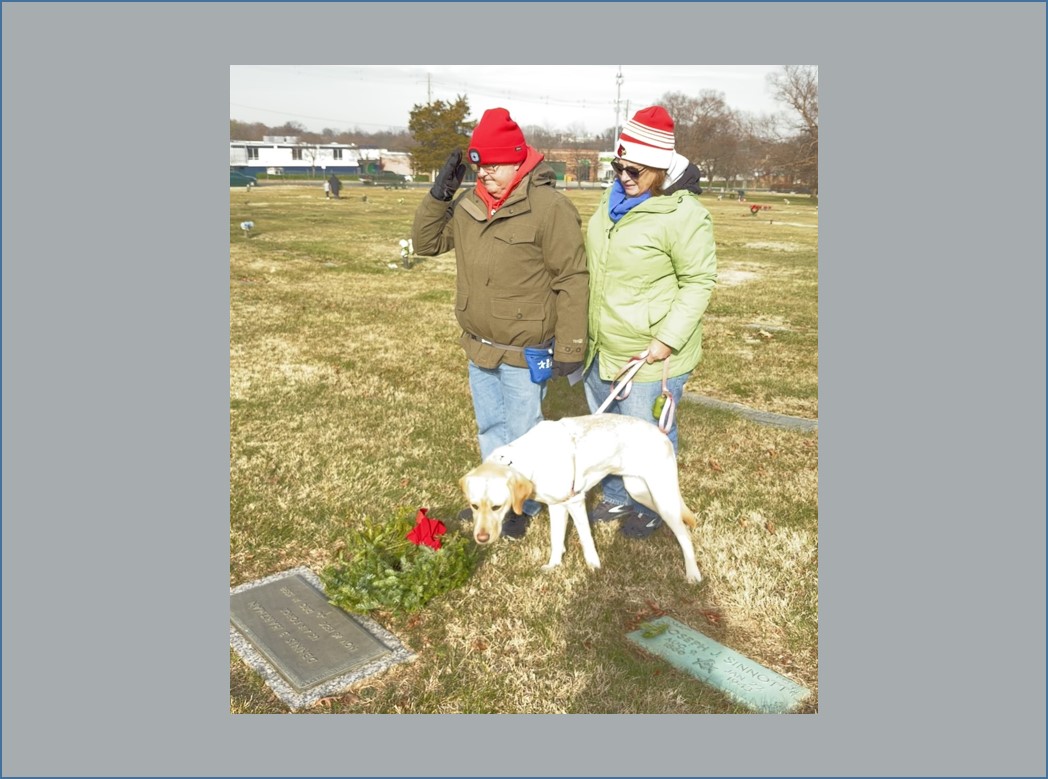
Keith and Mary Gene Martin with Puppy Edmee crop framed
Keith and Mary Gene Martin with Puppy Edmée at the inaugural Wreaths Across America program at Ft Lincoln cemetery in Brentwood, MD December 2025.
Is it puppy love?
Who doesn’t love a puppy? Quite often puppies are gifts for the children in a family. Or they are the first “child” for newlyweds, like the two beagles were for my parents who brought them home in those early honeymoon months of their marriage. The beagles were named Winston and Snoopy. One day both dogs were let out for a run, but only Snoopy returned. I grew up with Snoopy and cherish those memories of him as part of my family.
The evolutionary history of dogs and mankind stretches over fifteen millennia that varies based on the region or country and its culture. In some parts of the world today, dogs are looked down upon or considered an insult or worse, unbelievable, but true. Generally, in Western cultures dogs are known as “man’s best friend” and have been valuable and cherished members of communities, providing a variety of services. Due to their enhanced senses, dogs have been companions in hunting and guardians of homes and flocks of farm animals. Dogs have learned to adjust to human needs, seeing us as their “alpha dog.” This happened through breeding and conditioning over the centuries. Dogs have become more obedient, developed skills to effectively inhibit their impulses, learned different barking habits to aid communication with humans and, of course, somehow developed the technique to give humans the adoring puppy-eyed look that makes us swoon for them.
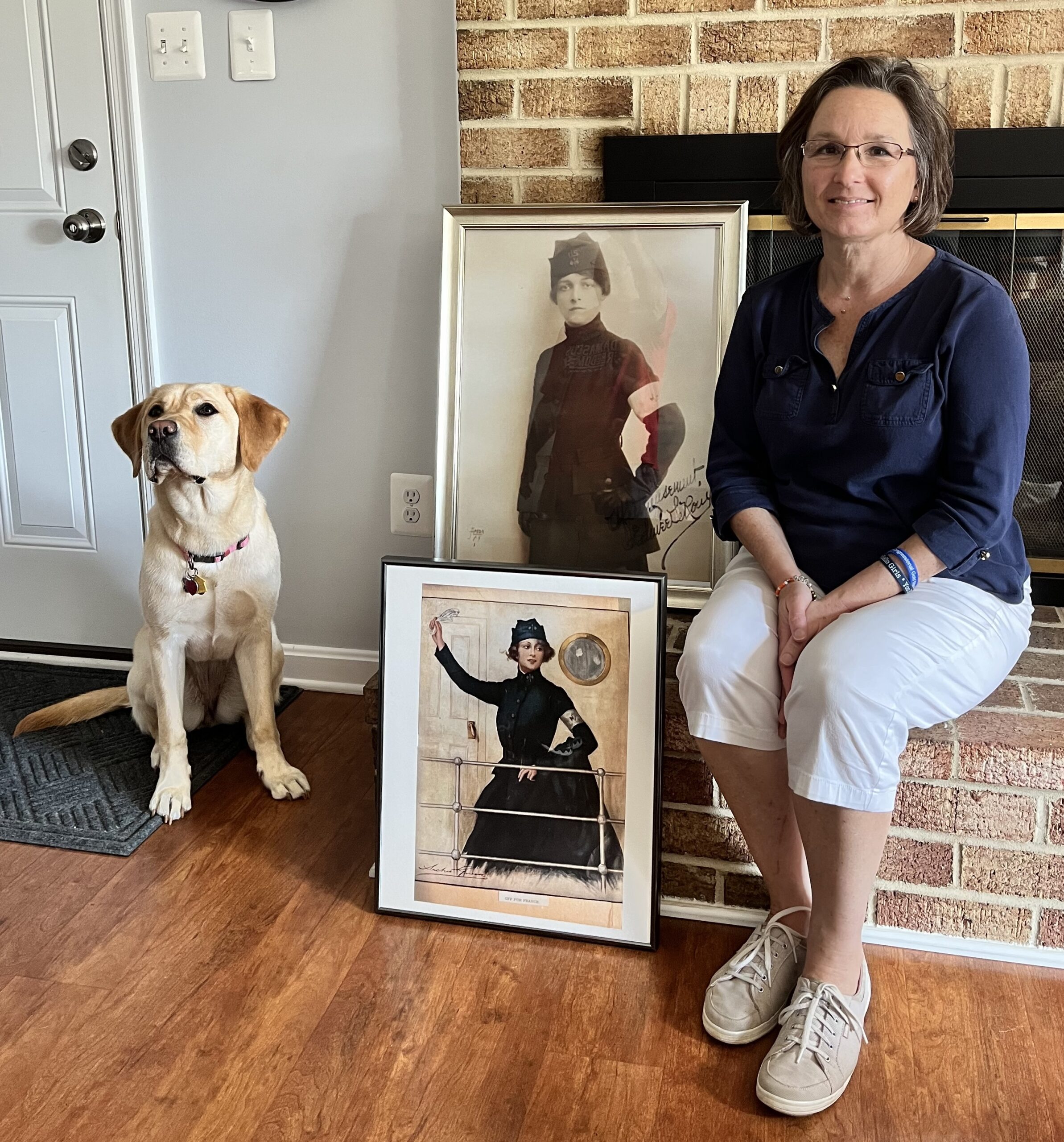
Catherine Bourgin with pictures of her grandmother, WWI Hello Girl Edmée LeRoux, and Yellow Labrador puppy Edmée, selected for the Warrior Canine Connection training program.
So what does all this have to do with WWI Hello Girl Edmée LeRoux? And who was she? What follows is a story of the intersection of delayed recognition, restoration of honor, and of course, a puppy.
Edmée (sounds like Edmay) LeRoux was my grandmother, born in 1895 in Montreal, Quebec, Canada. As a preteen, her family moved to Providence, Rhode Island, where she was raised by her French-Canadian parents. She was passionate about her vocal music studies and studied under a famous French-Canadian tenor, Arthur Plamondon, who opened a music school in Montreal and New York. She won a scholarship to study in France, but when the U.S. entered WWI, all her plans changed. Instead, in 1917, she answered a newspaper advertisement asking for French-English bilingual women to volunteer for the U.S. Army Signal Corps Telephone Unit under General John J. Pershing’s command, the American Expeditionary Forces (AEF), to become telephone operators. My grandmother was in uniform by January 1918. These women were selected, vetted, and trained both by AT&T and the U.S. Army Signal Corps. By June 1918, her Unit 4 shipped out on the USS Lapland from Hoboken, New Jersey, headed for France.
According to a letter my great-grandmother, Blanche-Yvonne, wrote in 1936 on behalf of her daughter, Edmée, in the hopes of finding a way to help her obtain her war bonus, she wrote that “she was sworn into the Army after a most severe mental and physical test, wore the uniform of the Signal Corps, was subject to martial law, and was honorably discharged after two years of service.” She writes further that General Pershing “organized the Signal Corps in order to keep in communication different points of the battlefront with the cities of France, so as to help and to guide the transport of munitions, food and especially the carrying of the wounded to the nearest available hospitals,” in addition to handling all the battlefield tactical communications, using code words and simultaneously translating for the AEF with the French and British Armies under any and all conditions, including mobile communication units at the battle frontlines. My grandmother also served during the Peace talks in Paris as a translator until she was discharged in June 1919. Upon her discharge, Edmée resumed her vocal studies scholarship with Arthur Plamondon, who had relocated to teach in Paris after the war.
In 2013, the World War I Centennial Commission (WW1CC) Act was enacted to celebrate the WWI Centennial. In 2017, Elizabeth Cobbs wrote the book The Hello Girls, and in 2018, the documentary film by Jim Theres, The Hello Girls, was released. The documentary caught the attention of Ed Saunders, a retired Army officer in Montana, during a film festival. Ed introduced Jim to Senator John Tester. Senator Tester became the sponsor for the Hello Girls Congressional Gold Medal bill, and that’s when the Hello Girls Congressional Gold Medal campaign began. It took three sessions of Congress before it finally was signed into law on December 23, 2024, and was awarded posthumously to all women who served as Hello Girls in the U.S. Army Signal Corps Telephone Unit during WWI.
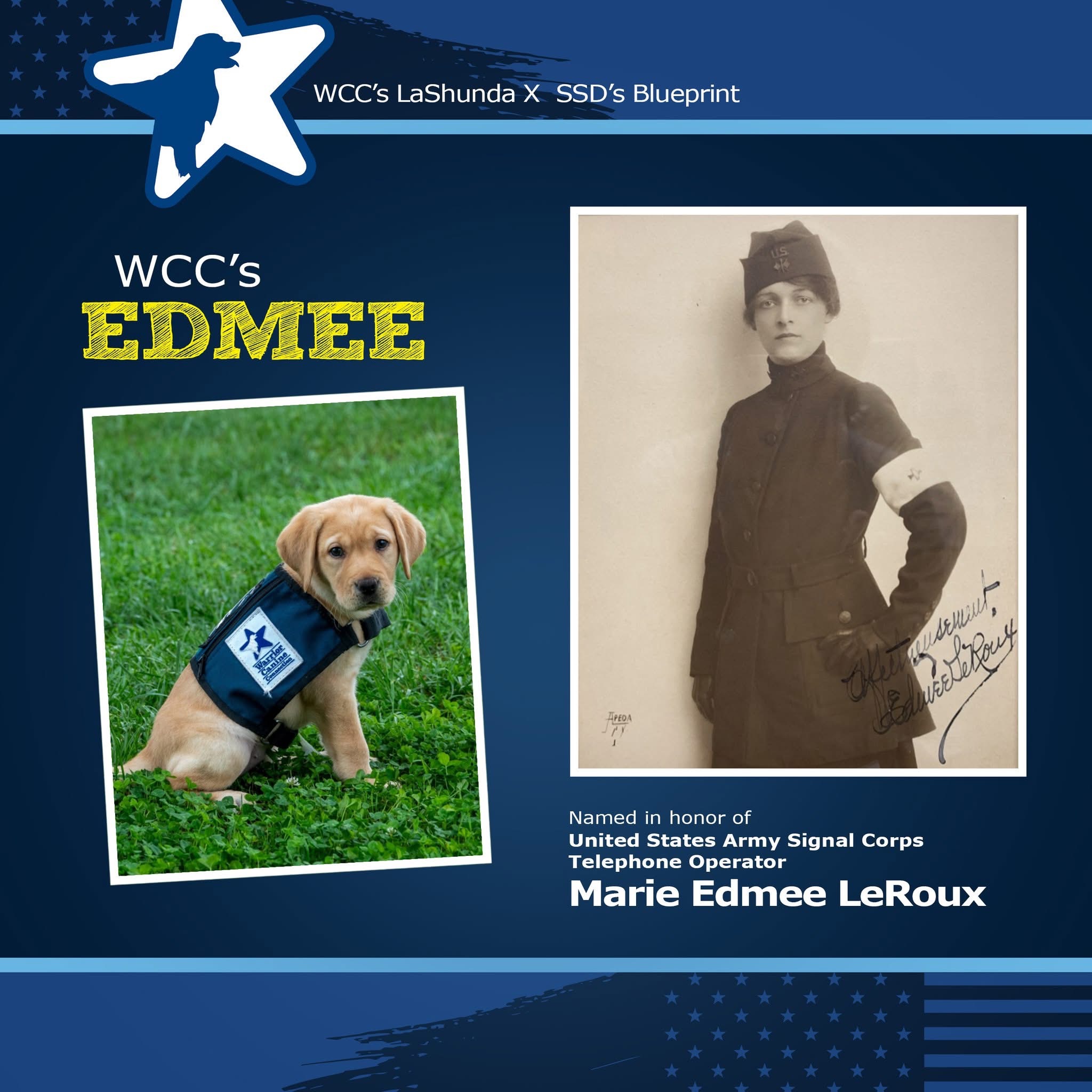
Flyer announcing puppy Edmee’s selection for the Warrior Canine Connection program.
In the spring of 2023, I stumbled across the WWICC during an internet search, and within a few months I was invited to join their campaign efforts by mid-summer of that year. A year later, in the thick of trying to gain cosponsors in the Senate, I was sent an email about the Warrior Canine Connection (WCC) in Boyds, Maryland. WCC breeds, trains, and places dogs to be service animals for veterans at no cost. In keeping with their mission of service to veterans, WCC solicits names of veterans as an honorific for their puppies. Veterans who have been recognized are Jimmy Stewart, Governor Wes Moore, General Jim Mattis, and former NFL star and Army Ranger, Pat Tillman. In their email, WCC was soliciting nominations for additional female veteran names. Honestly, at first, I hesitated. I didn’t know what to make of this unexpected opportunity. The more I learned about it, the more I grew to appreciate their creative approach to keep alive the memory of a past veteran through their namesake (with bio) program Hall of Heroes (Hall of Heroes – Warrior Canine Connection ) while building a connection to a current-day veteran in need of their service dogs. I came around to this idea because through my grandmother’s name and service, she would continue to help a veteran 107-years later. I eagerly completed the paperwork and patiently waited. By October 2024, WCC announced a new Yellow Labrador puppy had been named Edmée, and thus began an odyssey connecting my grandmother’s past with present and future of a potential Service Dog in Training (SDiT). The connection between the two begins with training.
The Hello Girls’ Training:
According to a 1918 Telephone Engineer article, the women were assessed for mental acuity, physical fitness, and ability to conduct simultaneous translations. The focus was on being bilingual. They received inoculations and fingerprinting. Loyalty was paramount. Recruits would be examined by psychologists using methods employed by the Army in judging the qualifications of officers. Oral bilingual translation testing over the telephone followed. Candidates were judged for hesitation, confusion, imprecise translation, and inept pronunciation of either language. A private medical exam was followed by an Army exam which entailed blood pressure, height, weight, diagnostic testing on blood and urine, and questions about digestion, nerves, and general health. Testing of reflexes, teeth, scalp, and ears came next. Army doctors vaccinated them, which was not yet routine for the general public in 1917. Then they were trained by AT&T on PBX systems, magneto boards, and common battery exchanges to learn local and long-distance techniques.*
After being tested, the Army had to decide on rank order within the telephone operator groups and then their placement in Army rank and file. These women were in an in-between status of enlisted and officers. They had to be obedient and responsive to orders.
*”How the Signal Corps Organized 100 Girls: Army Telephone Operators in France Speak Both English and French,” Telephone Engineer, Vol. XX, No. 2 (August 1918), pp. 69-70. Available at GG Archives: https://www.ggarchives.com/Military/WW1/HelloGirls/HowTheSignalCorpsOrganized100Girls-1918.html
The Service Puppies’ Training:
The puppies born into the WCC program have an arduous two-year training program ahead of them before they are ultimately placed with their forever veteran. From birth to placement approximately two-years later, the puppies are under constant supervision, training, and evaluation. Only the most capable SDiT will complete the program. The program continually assesses the future service dogs for their deportment, training, and trainability. Initially, their journey to placement with a veteran begins with a puppy raiser at 8-weeks old until they reach nearly 18 months of age. These volunteers provide an invaluable service ensuring that these future SDiTs receive appropriate socialization, training, and wellness care. The puppies are also evaluated for their temperament, training progress, and overall health before entering advanced training in residence at the WCC Healing Quarters in Boyds, MD.
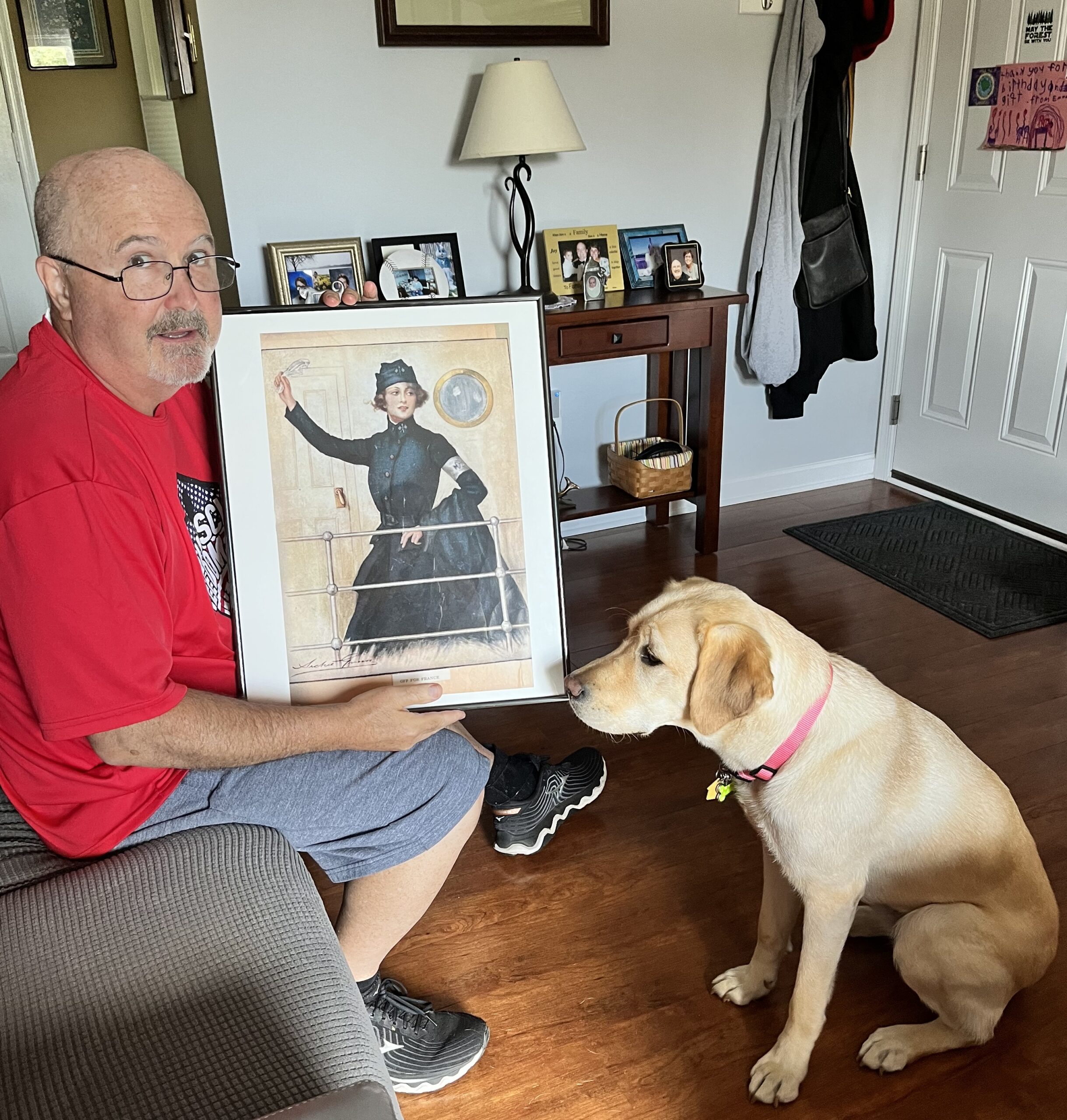
Edmée with her forever owner, Rodger K. Martin, retired U.S. Army Medical Service Corps officer.
My grandmother’s namesake, Puppy Edmée, a female Yellow Labrador Retriever, was born on August 5, 2024. When I inquired about meeting her, she was only three months old, and not yet at that training stage to meet strangers outside of her first puppyraiser. In this early stage, Puppy Edmée was in “boots training,” which consisted of training in different locations and interacting with up to 60 different veterans in different scenarios and at a variety of different locations, including medical facilities. One of the distinguishing hallmarks of WCC’s training program is the inclusion of many veterans in each SDiT’s training. Many of the veteran participants are in their own recovery from the stressors or injuries incurred during their service. These veteran volunteers are enrolled in the Mission Based Trauma & Recovery (MBTR) program and also become adjunct trainers to the WCC full-time trainers. Studies have demonstrated the positive, therapeutic influences of companion animals on the recovery of individuals who suffer from a milieu of health issues. In particular, veterans’ recoveries from physical and psychological injuries were advanced through the physiological bond that develops between dog and human. Another unique and therapeutic benefit of MBTR veterans’ involvement in the SDiT’s training is that their focus is redirected from themselves to assisting other veterans, fulfilling their need to be available for their fellow Servicemembers. By design, however, MBTR veterans would not be placed with these dogs. This is the “force multiplier” effect of this approach. Each SDiT would potentially and positively impact the lives of 60 veterans before completing their training.
Eventually, after rigorous months of various training scenarios, some of these young dogs graduate to become a service dog for a veteran. If for some reason along the training process the dog misses the mark, they could go on to be a different type of service dog. But the requirements are rigorous at each phase, and at any time the dog could be separated from its service training program. When this happens, often the trainers at the various stages, especially at the first stage of normalization and socialization, are offered a chance to adopt the dog. Then the dog will lead a regular dog’s life as a family pet.
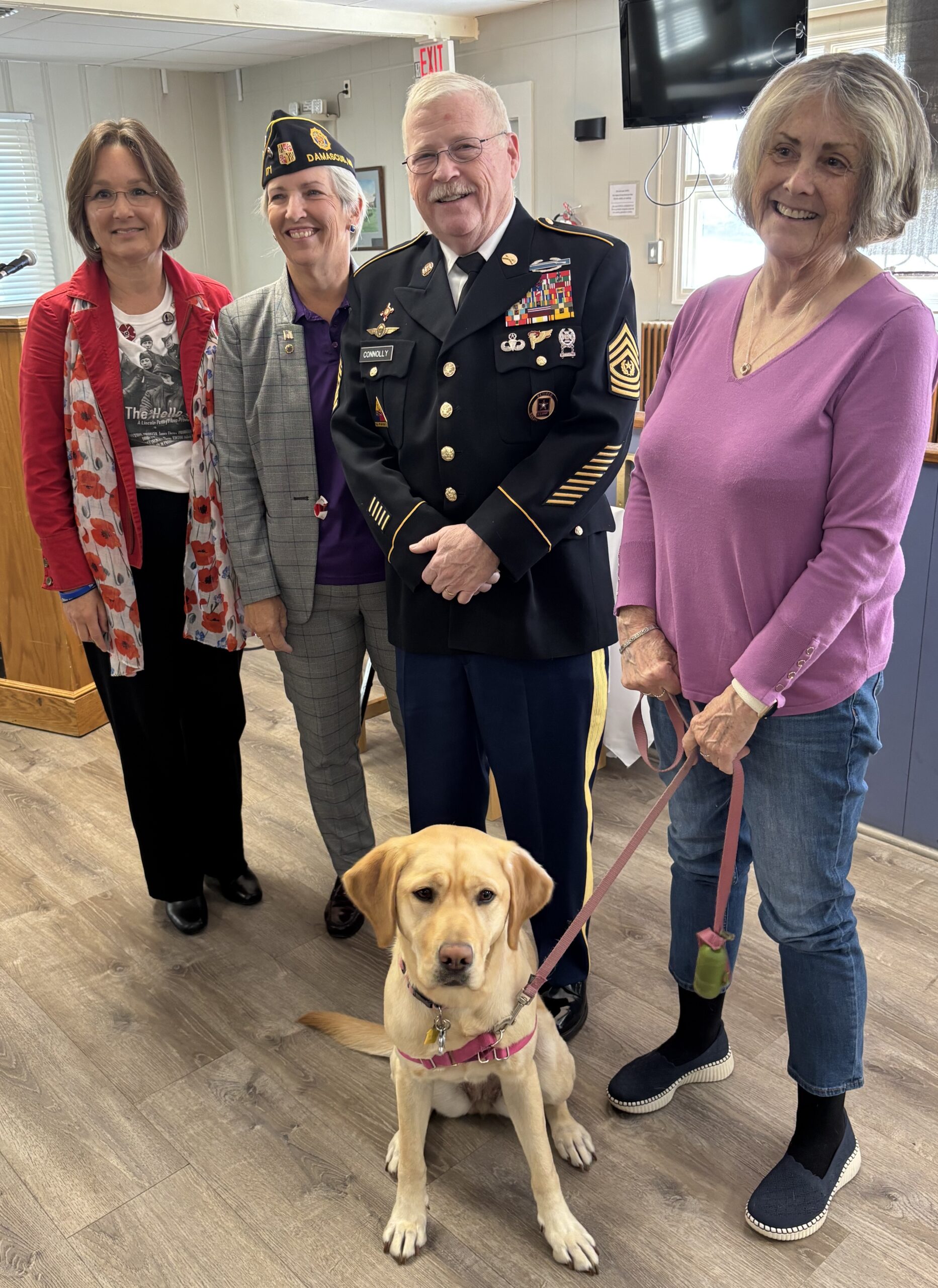
Puppy Edmée serving in an ambassadorial capacity at an informational presentation on the Hello Girls and WCC at the Damascus, MD American Legion Post 171 Veterans Day ceremony on November 11, 2025. Pictured with Edmée (from left): Catherine Bourgin; Post Commander Anita Trotter; Hello Girl grandson Don Connolly; and Puppy Edmée’s WCC first stage puppy raiser.
I had been anticipating a call or an email from WCC letting me know when I could visit Puppy Edmée with her first family trainer in the Spring 2025. After months of waiting, I finally called and left a message saying I would like to meet her. Coincidentally, on May 2, 2025, I received a FaceTime call from Nina Willis at Fort Lincoln Cemetery, where my grandmother is buried. Nina was showing Keith and Mary Gene Martin, long-time volunteers with WCC, my grandmother’s recently placed Veterans Administration (VA) marker. For reasons lost to time and unknown to me, 79 years ago my grandmother was buried in an unmarked grave after she died from cancer. Thanks to the tremendous support and generosity of the National Cemetery Administration (NCA), WWICC, the Doughboy Foundation, and the Military Women’s Memorial, had arranged for a VA grave marker that recognized her WWI military service and held a beautiful and patriotic military honors grave marker dedication ceremony on May 3, 2024. The Martins, who had recently adopted Puppy Edmée, were there to pay homage to their new family member’s namesake.
The FaceTime call was my first live view of Puppy Edmée and my chance to meet her new family. However, it was a bittersweet call to learn that Puppy Edmée had been “honorably discharged” from the SDiT program at WCC because she could be easily distracted and that was sufficient grounds to disenroll her. Although it sounds inconsequential, WCC’s rigorous program standards exist to ensure that only the most qualified will ultimately become a service dog; therefore, she was released from the program and placed on the adoption list. As is custom with WCC, military families are given priority for adoption of released dogs. Coincidently, Keith and Mary Gene, who had recently lost their two Yellow Labrador Retrievers, were looking for a family dog to fill the void. After interviews and meetings, it turns out Puppy Edmée ended up, after all, with an Army family. Both husband and wife served as officers in the U.S. Army: Mary Gene was an Army nurse, and Keith retired as a Medical Service Corps officer. Their son is serving as an officer in the U.S. Army Signal Corps and upon his return from a difficult deployment somewhere in the Middle East, immediately bonded with Puppy Edmée. In an unexpected way, Puppy Edmée will serve three veterans in her new home.
In her role as a family pet, Puppy Edmée also continues to honor and to preserve the legacy and service of the Hello Girls, in particular that of her namesake. Since my encounter with her, she has been invited in an ambassadorial capacity for local informational presentations on the Hello Girls and WCC, including most recently at the Damascus (MD) American Legion Post 171 Veterans Day ceremony. Street encounters and park walks have elicited spontaneous and informal conversations about the Hello Girls and their decades long struggles for veteran recognition and honors. As a consequence, her veteran parents have been willingly recruited as voluntary spokespersons for the Hello Girls. Puppy Edmée’s future service path may not be as once hoped but will nonetheless be equally valuable for the awareness that she promotes of America’s first women Soldiers.
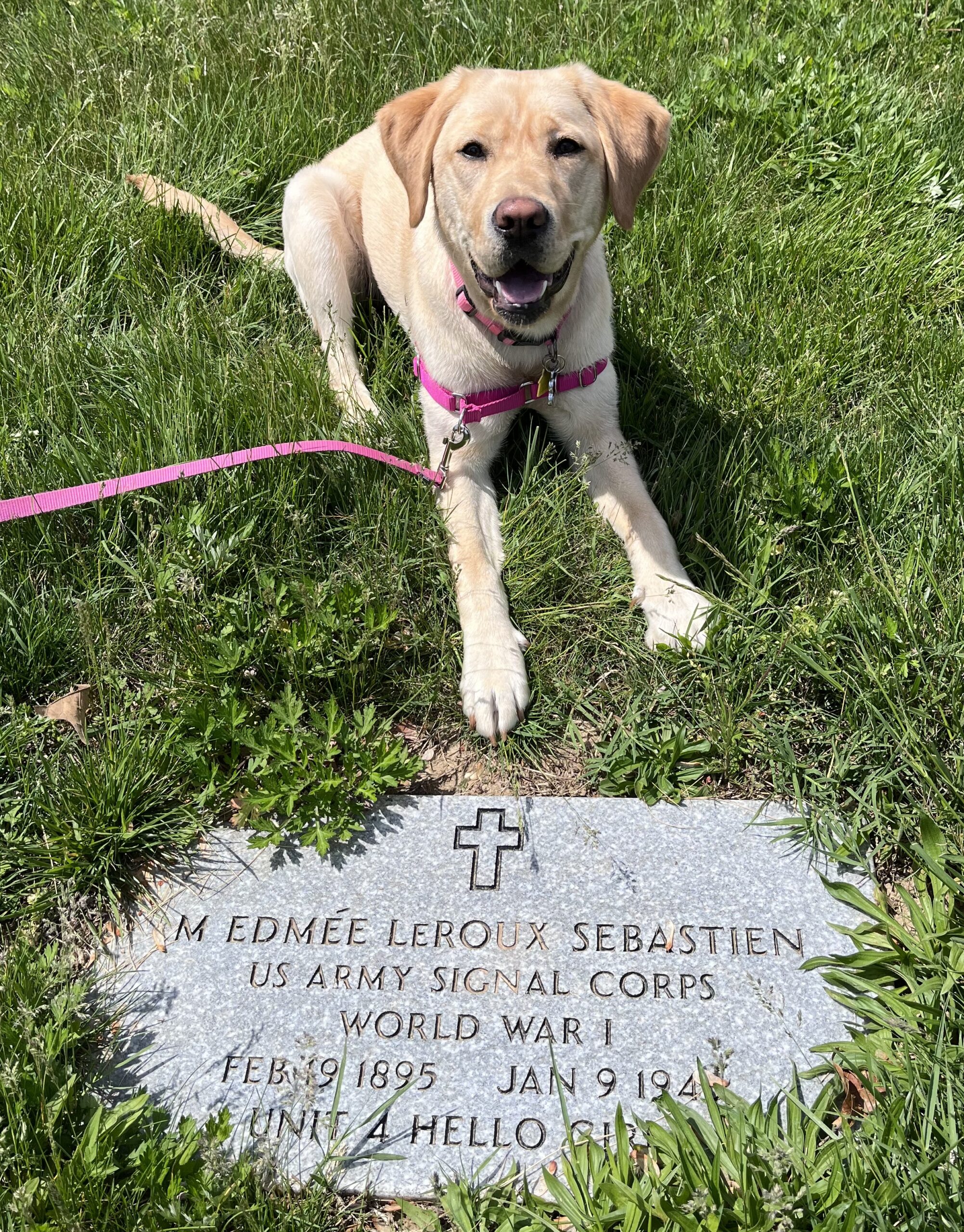
Puppy Edmée visits the grave marker of her namesake, WWI Hello Girl Edmée LeRoux, at Ft. Washington National Cemetery in Brentwood, Maryland on May 2, 2025.
Like my grandmother, who followed an unconventional path for a young, single woman in her lifetime, from vocal studies to volunteering to become a wartime battlefield telephone operator in France to serve her nation, support the Doughboys, and help save Europe, Puppy Edmée will take a different path of service than what she was born into. She will bring joy and happiness to a family who has served and continues to do so, and I don’t doubt there will be plenty of fun adventures ahead for all of them together.
When we are young, dreaming of a goal to aspire to and starting on our path in life, we don’t foresee the changes that may come along and derail our vision. But life has a funny way of doing just that, and often it’s for the better. I believe Puppy Edmée will serve her new family of U.S. Army veterans with many fun adventures and bring happiness from her companionship with them along their path in life. She’s just serving in an unexpected way than how she started in life with the WCC.
I still believe the mission of the WCC is essential and very important, and I love their namesake program of a past veteran helping a current-day veteran through the service dog and its name. Speak their name so they are never forgotten—lest we forget.
“Someone I love has gone away and life is not the same, the greatest gift that you can give is just to speak their name. I need to hear the stories and tales of days gone past, I need for you to understand these memories must last. We’ll never make more memories since they are no longer here, so when you say their name to me it’s music to my ear.” — Unknown author
Here’s how you can donate to WCC: warriorcanineconnection.org
Here’s how you can support the Hello Girls Military Honors and Remembrance Project: doughboy.org/donate-hello-girls
External Web Site Notice: This page contains information directly presented from an external source. The terms and conditions of this page may not be the same as those of this website. Click here to read the full disclaimer notice for external web sites. Thank you.