What are medals and citations compared to be brave in your eyes of your comrades?
Published: 30 December 2025
By Jocke Hallberg
via the Swedes in the Great War 1914-1918 website
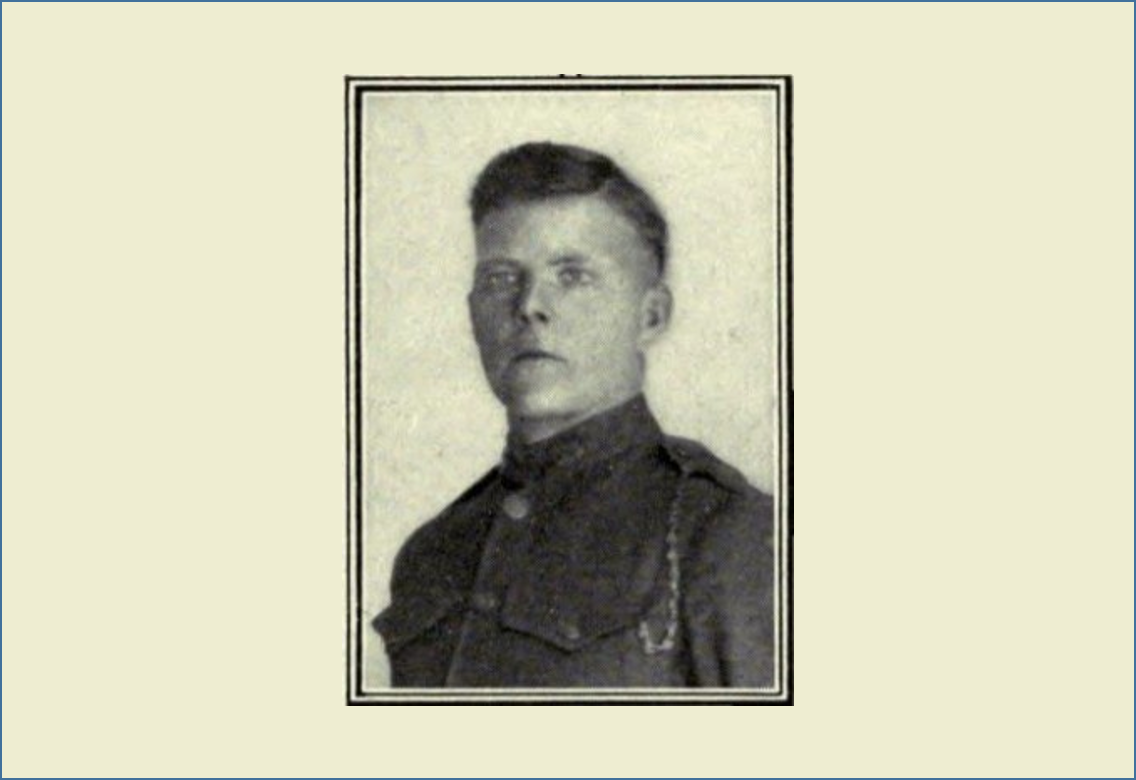
Bravest Men framed
Sergeant Otto S Johnson, Headquarter Company, 39th Infantry Regiment, 4th Division, American Expeditionary Forces.
Today, during their Swedish military education as conscripts, the soldiers use to point out a soldier who has been an exceptional good comrade or a soldier who have done something special worth mentioning. They use to be recognized at specific ceremonies when all personnel are gathered, and it use to be very much appreciated.
It is also very nice to read about Swede who during the Great War was appreciated by his fellow comrades.
Here is the story about Sergeant Otto S Johnson, Headquarter Company, 39th Infantry Regiment, 4th Division, American Expeditionary Forces. (AEF)
Otto S Johnson was born as Otto Sigfrid Johnson on February 8, 1894, in Gårdstånga parish, near Lund in the landscape of Skåne, in the southern part of Sweden.
He was raised by his mother, Kristina Olsdotter and his father, Jöns Nilsson, together with his five siblings. Otto probably got his surname Johnson from his father Jöns, as he was Jöns’s son, Jönsson, which then became Johnson in his new country.
According to the Swedish church books he worked as a farmhand in Sweden, but it seems that he emigrated from Sweden becoming a sailor or similar. I haven’t been able to find a specific year when he left Sweden, but he is noted as an Alien Crew Member on the ship “S.S Thode Fagelund” when the ship arrived California in 1914.
The actual ship was later captured and scuttled by UB.27, 70 miles east of Harwich in March 1917, on a voyage from Shanghai to Rotterdam with a cargo of sesame seed.
Otto is named as Otto Jonsson in the list and seems to have been arrived from his latest destination in Buenos Aires. His profession is stated to be in the Oil lease business, which is an interesting fact later on in the story.
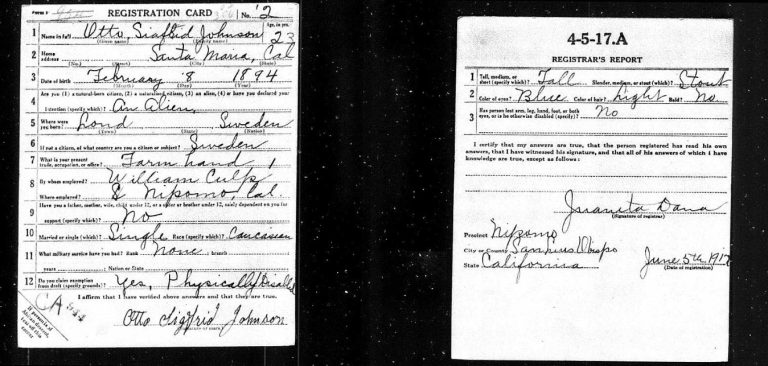
Otto was drafted on June the fifth, 1917, and left for France with his unit on July 10, 1918. As next of kin he mentioned his mother Kristina who at the time lived in Uppåkra, where Otto’s family lived at the time, close to Lund, and that makes me sure that this in the correct Otto.
In the history book of the 39th Infantry Regiment there are stories and rosters of the soldiers who participated in the unit, and nice lists to read about which medals and citations the officers and soldiers have received.
In the end of the book there is a section about how the unit could pointed out a soldier to be among the bravest men in the regiment as chosen by their comrades.
⇒ Read the entire article on the Swedes in the Great War website here:
External Web Site Notice: This page contains information directly presented from an external source. The terms and conditions of this page may not be the same as those of this website. Click here to read the full disclaimer notice for external web sites. Thank you.