War on the Porch: A Doughboy’s Interview
Published: 2 December 2025
By Travis Davis
Special to the Doughboy Foundation website
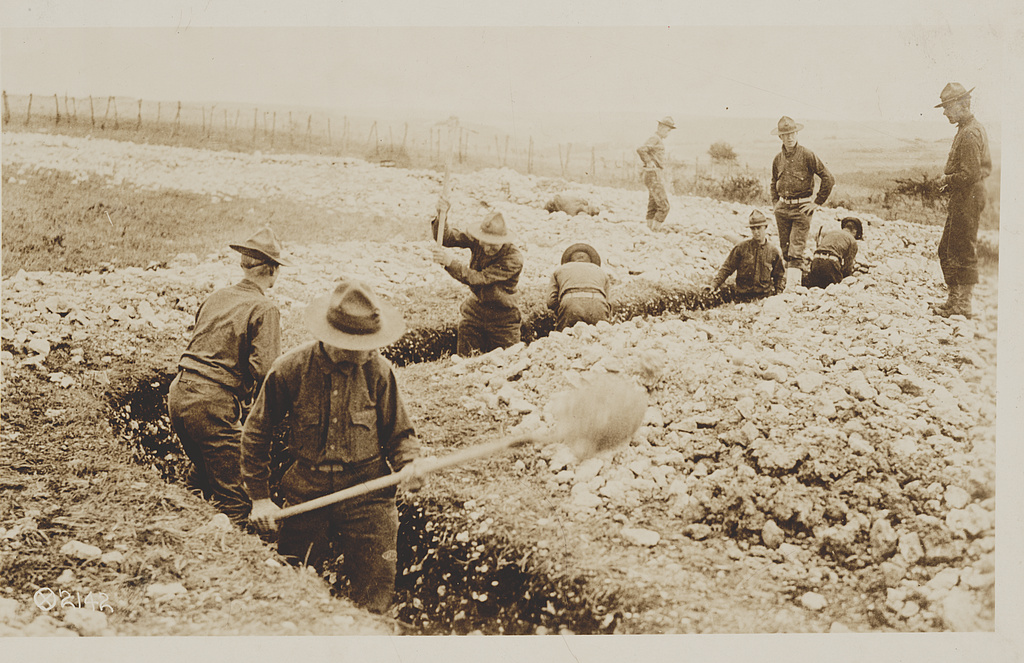
Marines Digging Trenches
U.S. Marines Digging Trenches during World War I. In just eighteen months of war, the United States suffered over 320,000 casualties, including 116,516 deaths and 204,000 injuries.
Remember when you used to sit on your grandparents’ porch and share stories? War on the Porch is a story set on my grandfather’s porch, during the summer of 1968. When a local reporter for the Arkansas Gazette is assigned to write a feature article for the paper for the upcoming 50th anniversary of the end of World War I, he tracks down Patrick King, a veteran who has never been interviewed and has turned down every request until a hot summer day in Central Arkansas. With his wife, Pauline, steadfast by his side, Patrick King is reluctant to be interviewed. However, after some prodding from his wife and learning that the reporter Gordon is a World War II veteran whose father was killed in World War I and whose remains were never recovered, Patrick decides to share the most remarkable story. A story he was told never to tell by General “Blackjack” Pershing because no one would believe him, and he’d be seen as unstable. But Patrick tells it in vivid detail as if the war were happening on his porch. By telling his story, he became unburdened by the past and helped Gordon start his healing process. At its core, War on the Porch isn’t just a war story; it’s a reflection on courage, trauma, and the power of storytelling to bridge generations.
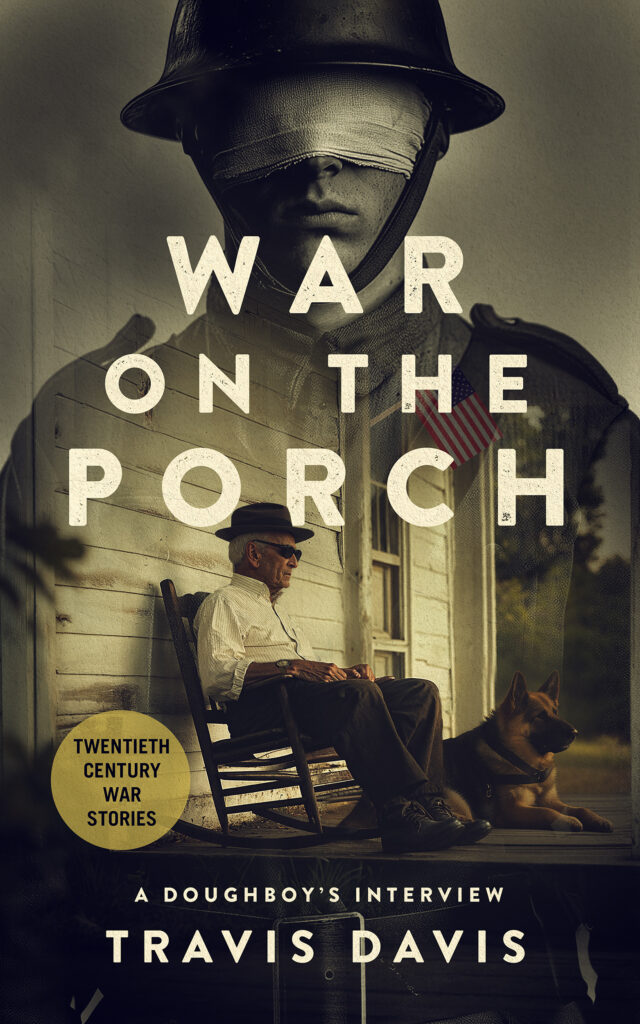 Where did I get the inspiration for War on the Porch? It’s based loosely on the life of a real Doughboy, Thomas “Tommy” Miller, a young American soldier and a farm boy from Kansas. While he was in the trenches during a brutal German artillery barrage in World War I, the deafening roar tore through his senses as shrapnel rained down around him. When the smoke cleared, Tommy was left in the cold silence of blindness, his eyes permanently damaged by the explosion, his once-vibrant world reduced to a chilling darkness. While in a rehabilitation hospital in England, with a dedicated team of healthcare providers and a team of specialists, he learned to cope, navigate, and live with his blindness. Through sound, touch, and smell, he slowly rebuilds his sense of independence.
While in rehabilitation, he discovered a hidden musical talent, as his fingers danced across the piano keys; the melodies became a way to express the emotions he could no longer fully articulate. Using his newfound talent, he dedicated his life to advocating for other blind veterans. Sharing his experiences with fellow soldiers, he helped establish support networks for those who had lost their sight in the war. He eventually found a fulfilling role as a teacher at a school for the blind. He drew on his experience and leadership gained in the trenches of World War I, as well as his rehabilitation efforts in England, to inspire a new generation of students to embrace their potential despite their disabilities.
Tommy’s story is a testament to the resilience of the U.S soldier blinded in the harsh environment of combat of World War I. He turned his disability into a gift that helped his fellow soldiers pursue their dreams and become the fathers of the Greatest Generation.
War on the Porch is my second novel about World War I. In my series, Twentieth Century War Stories. In it, I aimed to convey the true cost of the war, both during the fighting and upon the soldiers’ return home. With the advent of modern warfare, the global human cost of World War I was staggering—over 40 million casualties, with between 15 and 22 million killed. In just eighteen months of war, the United States suffered over 320,000 casualties, including 116,516 deaths and 204,000 injuries. Many soldiers returned home with visible injuries; some were missing arms or legs, while others endured severe head trauma. Some wounds were less obvious, such as blisters from mustard gas or lung damage from poison gas hidden by clothing, soldiers blinded by chlorine gas, and a condition known as “shell shock.” Today, “shell shock” is understood as post-traumatic stress disorder. Many veterans returned with a mix of visible and invisible injuries. The American public was unprepared for the consequences of modern warfare; their family members and friends returned home changed for life. In turn, the soldiers faced the effects awaiting them upon their return home. The available resources, hospitals, and rehabilitation centers were inadequate to support the returning heroes. Many soldiers came from very rural areas of America, with little infrastructure to care for them when they returned after 18 months of the war. Fathers, brothers, and uncles returned home after facing the worst conditions imaginable: filthy, muddy trenches, gas attacks, machine gun fire, accurate long-range artillery, ten-round magazine-fed rifles, and death from above with the introduction of airplanes. There was no place on the battlefield to hide from death.
There was no nationwide organization to assist veterans until the Veterans Administration was created on July 21, 1930, twelve years after the war ended. Before that, a small number of military hospitals, community groups, volunteers, and church groups were responsible for helping veterans readjust to civilian life, as many were eager to return to their pre-war lifestyles.
This is the story of a soldier who became blind due to an artillery attack. He overcame his disability, became an advocate for blinded soldiers, and established support groups for them. Turning his disability into something positive. There are untold stories of veterans helping veterans. This is just one of them. War on the Porch is truly a Doughboy Interview.
 Travis Davis is an Air Force brat who grew up in Arkansas, Spain, New York, and California. He joined the US Army at 17 as an Armored Reconnaissance Specialist and was stationed at various forts in the United States and Germany, where he met his beautiful wife. During his three tours in Germany, he conducted hundreds of border patrols along the East-West German and Czechoslovakia-West German borders, where he saw first-hand communism and its oppression of its citizens. He retired from the US Army, where his last duty assignment was as Assistant Operations Sergeant of the 2nd Armored Cavalry Regiment at Fort Polk, Louisiana. He is a lifetime member of the Sergeant Morales Club. Travis has also received multiple awards, including the Meritorious Service Medal and five Army Commendation Medals.
External Web Site Notice: This page contains information directly presented from an external source. The terms and conditions of this page may not be the same as those of this website. Click here to read the full disclaimer notice for external web sites. Thank you.