The World War I Roots of Modern American Grand Prix Racing
Published: 25 July 2026
By Doughboy Foundation Staff
Freedom 250 Grand Prix
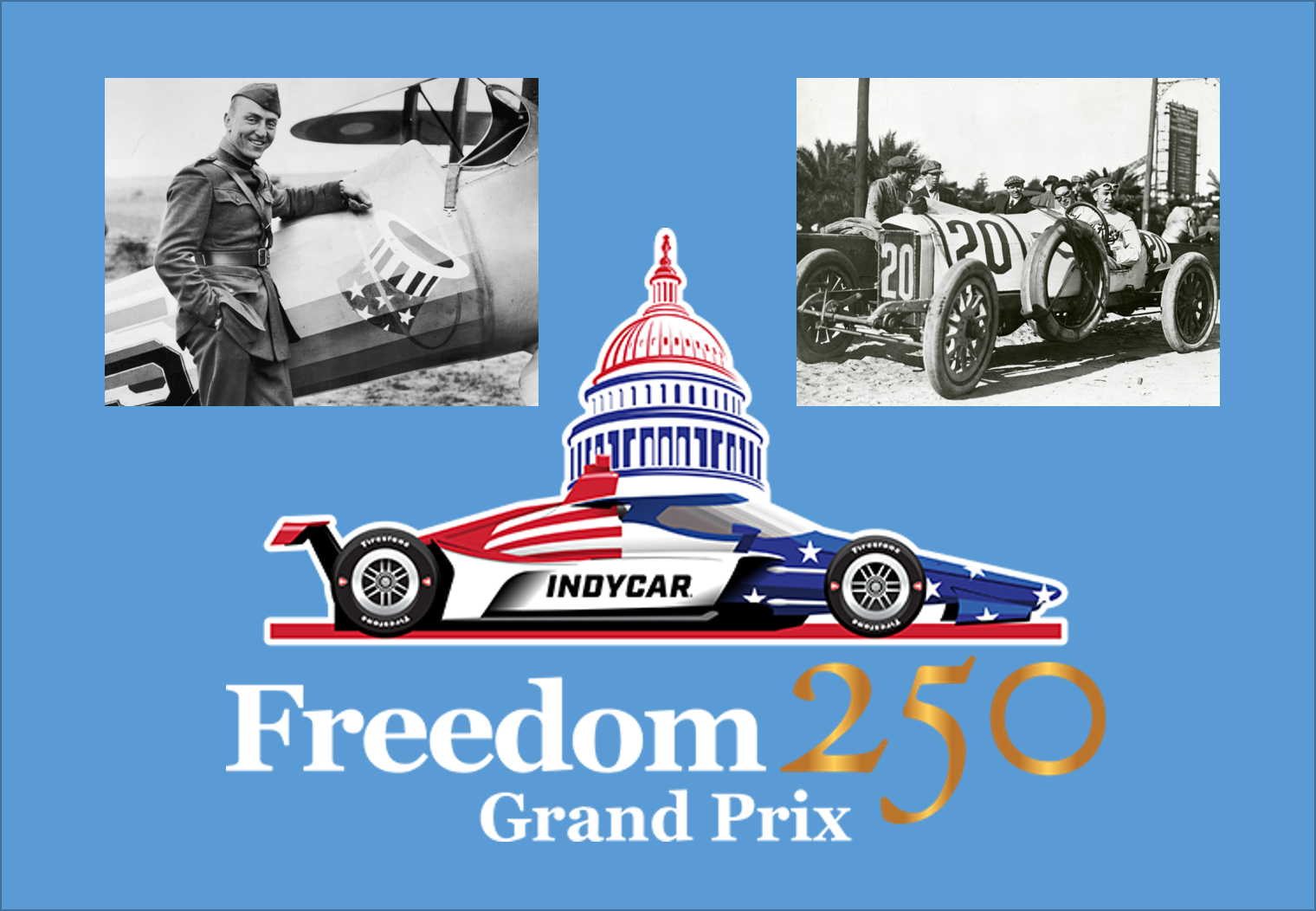
Major Eddie Rickenbacker was America's "Ace of Aces" in World War I (top left) with 26 confirmed aerial victories, earning the Medal of Honor, seven Distinguished Service Crosses , and the French Croix de Guerre. Before the war, Rickenbacker was a renowned auto racer (top right), and after the war he was a formative figure in the development of American Indy 500 auto racing. He will be honored with the sounding of Daily Taps at the National World War I Memorial on August 22 during the Freedom Grand Prix activities.
The key technologies of the race track were pioneered by American individuals and companies in and after World War I
The Freedom 250 Grand Prix of Washington, D.C., will take place Aug. 22-23, 2026, marking the first‑ever NTT INDYCAR SERIES race on the National Mall. The free, two-day motorsports event will celebrate America’s 250th anniversary with world‑class racing set against the backdrop of some of America’s most historic landmarks, including the Washington Monument and the U.S. Capitol.
But most people celebrating our Nation’s 250th birthday with the speed and innovation of INDYCAR at the race in Washington or online may not know that the technological and driving seeds that sprouted into a century of American auto racing were sown in and just after World War I. But since YOU are reading this, YOU’LL know! So here is what to tell all those people around you:
Famous American Racing Drivers & Technologists who served in World War I
Eddie Rickenbacker (October 8, 1890–July 23, 1973)
Born Edward Vernon Rickenbacher in Columbus, Ohio, he was a pioneering race car driver before the war. He competed in the Indianapolis 500 four times (1912 as a relief driver, plus full starts in 1914, 1915, and 1916), with a best finish of 10th in 1914 in a Duesenberg; he also raced in the 1915 American Grand Prize in San Francisco.
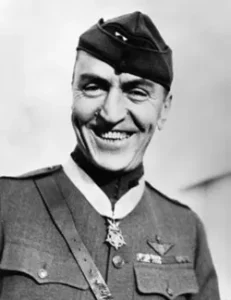
Eddie Rickenbacker
After the U.S. entered World War I, he enlisted in the Army Air Service (then part of the Signal Corps), initially serving as a driver for high-ranking officers in France before becoming a fighter pilot in the 94th Aero Squadron (“Hat-in-the-Ring”). He became America’s “Ace of Aces” with 26 confirmed aerial victories (planes and balloons), earning the Medal of Honor, seven Distinguished Service Crosses (one later upgraded), and the French Croix de Guerre. He was discharged as a major in 1919.
Post-war, Rickenbacker (who changed the spelling of his name during the war amid anti-German sentiment) remained deeply involved in racing as owner of the Indianapolis Motor Speedway (purchased in 1927 and operated until 1945). He also founded the Rickenbacker Motor Company (an automotive venture) and later led Eastern Air Lines. His pre-war driving and post-war promotion tie him directly to the early American racing scene, which overlapped with Grand Prix-style events like the American Grand Prize, the United States’ first “Grand Prix” event, though it never became part of the official European Grand Prix calendar or later Formula One lineage.
The Doughboy Foundation will honor Major Eddie Rickenbacker with the sounding of Daily Taps at the National World War I Memorial at 5:00 p.m. EDT on Saturday, August 22. Racing fans in DC for the Freedom 250 Grand Prix may attend in person at the Memorial. Everyone everywhere can watch Daily Taps online via YouTube every day.
Ralph DePalma (December 19, 1882–March 31, 1956)
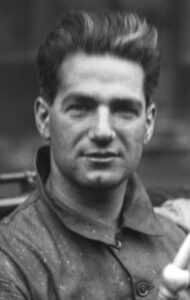
Ralph DePalma
Born Raffaele De Palma in Biccari, Italy, emigrated to the United States as a child around 1893 (settling in Brooklyn) and became a naturalized U.S. citizen. He ranks among the most successful early American drivers and fits the “served in the United States armed forces” category. His racing career spanned nearly three decades, with over 2,500 wins claimed out of roughly 2,900 starts—an astonishing success rate.
He won the 1915 Indianapolis 500 (in a Mercedes Grand Prix car, leading 132 of 200 laps), claimed AAA national championships in 1912 and 1914, and took victories in major events such as the Vanderbilt Cup (1912, 1914), Savannah Grand Prize, and Elgin Grand Prix. He started 10 Indy 500s (leading a record number of laps in the era) and competed internationally, including the 1914 French Grand Prix and a strong 2nd place in the 1921 French Grand Prix at Le Mans.
During World War I, DePalma enlisted in the U.S. Army Air Service and rose to the rank of Captain, serving as Director of Flying at Daytona Beach airport in Florida. He continued racing successfully post-war, including setting a world land speed record of 149.875 mph at Daytona in 1919. He retired in 1936 and is remembered as one of the dominant figures in the transition from dirt tracks and board ovals to Grand Prix-style road racing in America and Europe.
George Mason (May 6, 1890 – September 13, 1918)
One Indy 500 start; U.S. Army lieutenant in the Motor Corps’ experimental department; died of pneumonia in France during WWI). His father, Edward R. Mason, a prominent Des Moines lawyer, was a founder of the Mason Motor Company, an early American automobile manufacturer that produced cars from around 1906 to 1915. The company faced financial difficulties and went into receivership. Chevrolet Motor Company (founded by Louis Chevrolet and William C. Durant in 1911) purchased the Mason facilities and assets on July 14, 1915. Chevrolet itself was absorbed into General Motors (GM) in 1918.
Henry Kohlert (March 8, 1892–December 18, 1939)
Henry Kohlert (full name often listed as Henry Kohlert; Danish-American ancestry) was born March 8, 1892, in St. Charles, Illinois, and died December 18, 1939, in the same town. He served in the U.S. Army Balloon Corps during World War I, operating tethered observation balloons for artillery spotting and reconnaissance on the Western Front. This experience sparked a lifelong interest in aviation (he later owned a Waco biplane and helped develop what became DuPage Airport). After the war, he trained as an automobile mechanic, owned a garage/dealership selling Nash and Ford cars, and even invented an improved oiling system for engines.
Henry Kohlert
Kohlert’s racing career began in the late 1920s. He converted his own street car into a racer and competed as a driver in the Indianapolis 500 twice. In 1927, he ntered as a relief driver (for Fred Lecklider); involved in a spectacular multi-car collision that left him with serious injuries, including a broken neck, five broken ribs, and lacerations. In 1928: he drove the Miller-Elgin Piston Pin Special to a 13th-place finish (completing 180 of 200 laps).
He made additional AAA Championship Car starts and later transitioned to car owner/entrant, fielding entries for others (including Duke Nalon in 1938 and 1939). A bad crash ultimately led him to retire from driving. Kohlert remained connected to the Indianapolis scene as a friend of drivers like Norm Batten and as a garage operator supporting the sport. Kohlert’s story uniquely bridges WWI service with hands-on 1920s open-wheel competition at the Indianapolis Motor Speedway.
The Duesenberg brothers: Frederick “Fred” S. Duesenberg (December 6, 1876 –July 26, 1932) and August “Augie” S. Duesenberg (December 11, 1879 – January 18, 1955).
German immigrants who arrived in the U.S. as children in 1885, settling in Iowa, they were self-taught engineers whose innovative designs bridged early racing success with unparalleled luxury automobiles. Their name has appeared frequently in this conversation because of their pivotal role in pre- and post-WWI American racing (e.g., ties to Mason Motor Company, hydraulic brakes, supercharging, straight-eight engines, and multiple Indianapolis 500 wins), as well as their broader influence on automotive technology.Early Years and Racing
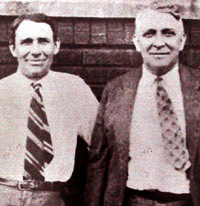
(Augie (left) and Fred Duesenberg in 1925
The brothers started humbly: Fred gained fame racing bicycles in the late 1890s, setting world records, which led them to open a bicycle shop in Rockford, Iowa. By the early 1900s, they shifted to engines and automobiles. Key milestones: 1903–1913: Worked with the Mason Motor Company in Des Moines, Iowa, where they designed innovative racing cars (often called “Mason” racers). Their engines powered early Indy 500 entries, including Eddie Rickenbacker’s 1914 start.
During WWI, they built aircraft and marine engines, gaining precision manufacturing expertise that later benefited their racing and production cars.
In 1920, they relocated to Indianapolis, founding Duesenberg Automobile and Motors Company (for passenger cars) and a separate Duesenberg Brothers entity for racing. Indianapolis offered suppliers, talent, and the Speedway for testing.
Duesenberg dominated early American open-wheel racing, especially at the Indianapolis 500:1921: A Duesenberg (driven by Jimmy Murphy) became the first (and only) American car to win the French Grand Prix, showcasing their engineering superiority internationally.
Indianapolis 500 wins: 1922 (Murphy, with a Duesenberg chassis but Miller engine after a team split), outright wins in 1924 (L.L. Corum), 1925 (Pete DePaolo, first 100 mph average), and 1927 (George Souders). In 1922, Duesenbergs took 8 of the top 10 spots.
The Influence & Effects of WWI on American Auto Racing
World War I profoundly accelerated technological and industrial advancements in aviation and military vehicles, with direct spillovers to civilian automobiles and, crucially, American auto racing (primarily AAA Championship Car and the Indianapolis 500). Unlike WWII (which halted racing), WWI-era racing continued on a reduced scale, allowing rapid postwar adoption of wartime innovations. These changes boosted power, safety, reliability, and speed in open-wheel racing, helping American designs (Duesenberg, Miller) close the pre-war gap with European Grand Prix technology and dominate the 1920s “Golden Age” of Indy/AAA racing.
Here are the most significant effects, focused on those that measurably impacted racing performance, safety, and engineering:
1. Hydraulic Brakes (Aircraft-Origin Safety Revolution)
Malcolm Lougheed (later Lockheed) developed the core hydraulic braking system during WWI specifically for airplanes, where mechanical linkages proved inadequate for high-speed, multi-engine aircraft. Patents and refinements followed immediately postwar.Fred Duesenberg adapted and patented an internal-expanding four-wheel hydraulic system (filed 1920), debuting it on Duesenberg racing cars and the 1921 Model A production car—the first American production automobile with four-wheel hydraulic brakes. The same technology appeared on Duesenberg Indy cars that won in 1921 and 1922.
Racing impact: Pre-WWI cars relied on weak mechanical (cable/rod) brakes, often rear-only, limiting cornering speeds on ovals and road courses. Hydraulic brakes provided even, powerful stopping with far less pedal effort and fade. This enabled higher average speeds, safer passing, and sustained high-speed racing—directly contributing to the jump from ~89 mph winning averages pre-1920 to over 100 mph by the mid-1920s at Indianapolis.
2. Supercharging / Forced Induction (Aviation Power Boost)
Centrifugal superchargers were developed and tested on WWI aircraft engines (including experimental versions for the Liberty V-12) by General Electric and others to maintain power at altitude. Postwar, Duesenberg pioneered their racing use in America: a centrifugal supercharger on a 122-cubic-inch straight-8 powered the 1924 Indianapolis 500 winner—the first supercharged victory at Indy. Harry Miller quickly followed with supercharged engines that dominated the late 1920s.
Racing impact: Superchargers dramatically increased horsepower without enlarging displacement (critical under era rules). This produced the high-output straight-8 and inline engines that defined 1920s–1930s American open-wheel racing, pushing lap records and top speeds higher while influencing later production performance cars (e.g., Duesenberg SJ models).
3. Advanced Engine Technology and Materials (Liberty Engine Legacy & Precision Manufacturing)
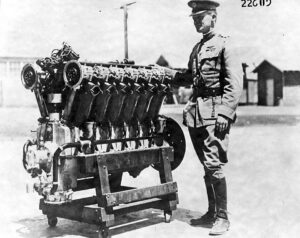
Maj. H.H. Arnold standing beside the first Liberty Engine turned out for war use.
The Liberty V-12 (designed 1917–1918 by Packard and others, mass-produced in the tens of thousands) was America’s signature wartime aircraft engine. Indianapolis firms like Allison Engineering produced components, gaining unmatched precision-machining expertise. The Duesenberg brothers built and tested large aircraft engines (including experimental V-16s) during the war, directly transferring high-strength alloys, aluminum construction, overhead cam/valve designs, and lightweight reciprocating parts to their postwar racing engines.
Surplus Liberty engines powered postwar speedboats and specials; more importantly, the manufacturing scale and metallurgy (better pistons, bearings, valves) enabled reliable high-RPM straight-8 racing powerplants.
Racing impact: Pre-war American engines were often underpowered and fragile compared to European units. Post-WWI Duesenberg/Miller straight-8s (first American production straight-8 in 1921) delivered superior power-to-weight and durability, powering multiple Indy winners and national champions through the 1920s–1930s. Aluminum alloys and precision parts also reduced weight and improved cooling—key for sustained 500-mile races.
4. Tires, Rubber Compounding, and Wheels (Military Demand & Shortage-Driven Innovation)
 WWI created massive demand for military trucks (Ford alone supplied ~390,000), plus rubber shortages from blockades spurred U.S. tire makers (Firestone, Goodyear, U.S. Rubber) to improve cord construction, compounding, and durability. Low-pressure “balloon” tires emerged commercially around 1920–1923 as a direct evolution.
Racing impact: Earlier high-pressure tires were prone to blowouts at racing speeds. Improved postwar tires offered better grip, ride compliance, and longevity on rough board tracks and brick surfaces, enabling higher cornering speeds and fewer mechanical DNFs at events like the Indianapolis 500.
5. Broader Manufacturing & Industrial Scale (Mass Production & Interchangeable Parts)
The auto industry’s shift to war production (trucks, ambulances, aircraft engines) refined Henry Ford-style assembly lines, interchangeable parts, and quality control. This lowered costs and raised reliability of high-performance components.Racing impact: Small racing teams and manufacturers (Duesenberg, Miller) could source better, cheaper parts, accelerating innovation cycles. The postwar economic boom plus returning veterans (including pilots like Eddie Rickenbacker, who later owned Indianapolis Motor Speedway) fueled a racing renaissance with larger fields and faster cars.
Overall WWI Legacy of American Auto Racing Technology
These WWI-derived technologies transformed racing from a relatively primitive, Europe-dominated sport into a high-speed American engineering showcase. Winning Indy 500 speeds rose sharply in the early 1920s, safety improved (fewer brake-related crashes), and homegrown stars/designers (Duesenberg, Miller) achieved sustained dominance. Many innovations quickly trickled to street cars (hydraulic brakes, straight-8 engines), creating a virtuous cycle: better road cars → better racing tech → further road-car improvements.In short, WWI did not invent the automobile or racing, but its urgent demands for power, precision, and reliability provided the technical and industrial foundation that propelled American open-wheel racing into its most innovative and exciting era.
American automobile manufacturers who drove out of WWI
The three major American legacy automobile manufacturers (GM, Ford, Stellantis) all have very strong roots in World War I, supporting the U.S. war effort and the American Expeditionary Forces.
General Motors
B esides the Mason Motor Company (as noted, acquired by Chevrolet in 1915, with Chevrolet itself joining GM in 1918), several predecessor companies and divisions that became core components of General Motors had direct production involvement or technical roots in World War I (U.S. involvement 1917–1918). GM as a whole redirected much of its output to military trucks, engines, and aircraft components, building on the mass-production expertise of its early acquisitions.
Buick Motor Company (1908)
 Buick was the original cornerstone of GM (acquired outright by William C. Durant at GM’s founding). During the war, Buick (along with Cadillac) manufactured more than 2,500 of the critical Liberty V-12 aircraft engines—America’s primary wartime aviation power plant. These 400-hp engines powered U.S.-built DeHaviland DH-4 bombers and other aircraft.
Buick also converted significant production to military trucks and vehicles, contributing to the broader GM effort that redirected over 90% of its truck output to the war.
Cadillac (Acquired by GM in 1909)
 Like Buick, Cadillac was an early GM division. It co-produced Liberty V-12 engines (after initial resistance from Durant’s pacifist leanings, which briefly led former Cadillac head Henry Leland to form Lincoln for the same purpose). Cadillac also delivered America’s first armored car to the military and supplied adapted vehicles, engines, and components. Its precision engineering expertise (already legendary for the Model 30 and electric starters) was directly applied to wartime needs.
Fisher Body Company (1919)
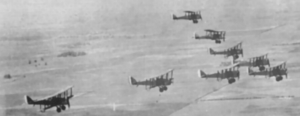 Fisher Body, founded in 1908 as an independent coachbuilder, became a major GM supplier and division. In 1918, its dedicated Aeroplane Division manufactured 1,600 DeHavilland DH-4 aircraft—the only American-built plane to see combat in WWI. Fisher also produced bodies for military ambulances, trucks, and other equipment. This aircraft experience foreshadowed its massive WWII role (tanks, bombers) and solidified its place as GM’s in-house body division (“Body by Fisher”).
Allison Engineering Company (1929)
Originally founded in 1915 as the Speedway Team Company (by Indianapolis 500 co-owner James A. Allison) to support racing, it pivoted fully to war work. Allison produced tools, jigs, and precision parts for the Liberty aircraft engine program and later rebuilt thousands of surplus Liberty engines postwar with advanced steel-shell bearings. This expertise in high-precision aviation work directly led to its acquisition (first by the Fisher brothers, then folded into GM as the Allison Division). It became famous for aircraft engines (e.g., V-1710 in WWII) before the transmission business evolved separately.
Delco (1918)
Founded in 1909 by Charles Kettering (inventor of the electric starter), Delco supplied ignition systems, starters, and electrical components for military vehicles and aircraft during WWI. As part of the United Motors group (acquired by GM in 1918), it supported GM’s broader wartime output of trucks and engines. Delco’s wartime scaling helped establish it as GM’s long-term electrical/ignition division (later ACDelco).These efforts—primarily Liberty engines, military trucks/vehicles, and early aircraft production—demonstrated how GM’s pre-existing and newly acquired companies leveraged automotive assembly lines for rapid wartime output.
Ford Motor Company
 Once the United States entered the war in April 1917, erstwhile pacifist Henry Ford supported the national effort, and Ford Motor Company became a major supplier of military equipment, leveraging its revolutionary assembly-line mass-production techniques to deliver high volumes quickly.
Key Ford automotive-related contributions in WWI included:
Liberty Aircraft Engines
Ford was a key producer of the Liberty V-12 (a standardized 400-hp water-cooled engine designed in 1917 for U.S. warplanes). Ford’s precision manufacturing scaled output dramatically, powering fighters and bombers for the U.S. Army Air Service
Vehicles and Other Equipment
Ford supplied over 38,000 Model T chassis adapted for military use (ambulances, trucks, staff cars, and light utility vehicles). The rugged, affordable Model T proved invaluable on rough terrain in France. The company also produced armored cars, cannons, artillery components, and Fordson tractors for agricultural/military support.
Other Items
Ford factories made helmets, gas masks, and various munitions-related parts, while committing R&D to armor technologies.
Stellantis
The companies that eventually formed Chrysler Corporation (and are now part of Stellantis) played supporting but meaningful roles in U.S. World War I production. Chrysler Corporation itself did not exist during the war—it was created in 1925 when Walter Chrysler reorganized the struggling Maxwell Motor Company (which had absorbed Chalmers Motor Company in 1922). Chrysler later acquired Dodge Brothers in 1928, bringing that firm’s assets and legacy into the fold. Thus, the wartime contributions came from these three predecessor companies: Maxwell, Chalmers, and Dodge Brothers.
Maxwell Motor Company
Maxwell was the direct ancestor of Chrysler Corporation. During U.S. involvement in the war (1917–1918), Maxwell shifted significant production to military needs. In 1917, following America’s declaration of war, Maxwell took over operations of the nearby Chalmers Motor Company plant (Jefferson Avenue, Detroit) specifically to manufacture cars and trucks for the U.S. Government. Maxwell’s Dayton, Ohio plant was selected as the lead facility for a secret U.S. Army program to build the Renault FT light tank (the American version designated the M1917 6-Ton Special Tractor). Like many automakers, Maxwell expanded its female workforce dramatically, hiring women as factory workers, clerical staff, and even machine operators to replace men serving overseas. These efforts helped Maxwell survive the war but left it overextended; the postwar recession of 1920–1921 nearly bankrupted the company, which is why Walter Chrysler was brought in to rescue it.
Chalmers Motor Company
Chalmers (a higher-end automaker founded in 1908) was already in decline by 1917 due to falling sales. Its integration with Maxwell was essentially a wartime consolidation. In 1917, Chalmers’ Detroit plant was placed under Maxwell’s control to boost output of government cars and trucks. The two brands shared dealer networks and production lines for the duration of the war. Full merger occurred in 1922, just before Chrysler’s reorganization. Chalmers did not have independent large-scale military contracts but contributed directly through this combined effort.
Dodge Brothers
Dodge Brothers (founded 1914 by Horace and John Dodge) was a separate company during WWI but became a cornerstone of Chrysler after the 1928 acquisition. It had one of the more visible and successful wartime roles among the future Chrysler family: Dodge quickly pivoted from civilian cars to military vehicles.

The U.S. Army purchased many thousands of Dodge trucks, staff cars, light repair trucks (notably the M1918 light repair truck), and half-ton ambulances. These vehicles were prized for their ruggedness and reliability on the rough roads of France. General John J. Pershing’s forces used them extensively for logistics, troop transport, medical evacuation, and field repairs.
Dodge also produced specialized components such as cannon recuperators and gun recoil systems. The company’s early pickup-truck designs (some dating to 1914 border-patrol use) proved ideal for wartime adaptation, helping establish Dodge’s long-term reputation for tough trucks. Production volumes were substantial for the era (though far smaller than Ford’s), and Dodge vehicles were among the most commonly seen American-made military autos in the American Expeditionary Forces.
Auto part or component manufacturers
Several current American auto parts manufacturers have direct or clearly identifiable legacies tied to World War I (U.S. involvement 1917–1918). The war created urgent demand for military vehicles, aircraft engines, tires, and precision components, accelerating production scale, materials expertise, and innovation that these companies carried forward into civilian automotive applications. While not every supplier’s founding was “because of” the war, the following have well-documented WWI production roles that shaped their early growth, reputation, or technical capabilities—and they remain active U.S.-headquartered manufacturers as of 2026.
Allison Transmission (Indianapolis, Indiana)
Founded in 1915 as the Speedway Team Company by James A. Allison (to support his Indianapolis 500 racing interests), the firm immediately pivoted upon U.S. entry into WWI. It produced tools, jigs, fixtures, and precision parts for the Liberty aircraft engine program (America’s primary wartime aviation power plant, built by companies like Nordyke & Marmon). Post-armistice, Allison Engineering Company (renamed ~1920–1921) won contracts to rebuild thousands of surplus Liberty engines and developed revolutionary steel-shell bearings with lead-bronze linings that improved reliability.
This wartime precision-machining experience directly laid the foundation for Allison’s later dominance in heavy-duty automatic transmissions (spun off from GM in the 1990s; now an independent public company). The firm still produces transmissions for commercial trucks, buses, military vehicles, and off-highway equipment—products whose engineering lineage traces back to the Liberty-era expertise.
The Goodyear Tire & Rubber Company (Akron, Ohio)
Goodyear was founded in 1898, and rapidly expanded during WWI to meet military rubber demands. It manufactured tires for trucks and aircraft, produced airships/blimps for the U.S. military (a capability that continued postwar), and converted much of its production to war-related rubber goods (including gas masks and other items). Over 6,000 Goodyear employees served in the armed forces, and the company’s wartime output helped establish it as a major supplier of durable, high-volume tires.
Today, Goodyear remains a fully independent American company and one of the world’s largest tire manufacturers, supplying original-equipment and replacement tires for passenger cars, trucks, and racing—products whose wartime-proven compounding and construction techniques influenced modern automotive tire technology.
Eaton Corporation (Cleveland, Ohio area)
 Eaton’s predecessor (Torbensen Gear and Axle Company, founded 1911) was already producing gear-driven truck axles when WWI began. By 1916 the company had delivered more than 10,000 axles, many installed in U.S. military trucks (some of which supported Allied efforts, including shipments associated with Japan as an ally). This early military contract work helped scale production and establish Eaton’s reputation in heavy-duty driveline components.
Eaton is still a major U.S.-based public company with a Vehicle Group that produces transmissions, axles, and power-management systems for trucks and off-highway vehicles—directly continuing the driveline heritage accelerated by WWI demand.
The Timken Company (Canton, Ohio)
Founded in 1899 for tapered roller bearings, Timken saw surging demand during WWI due to steel shortages and military vehicle needs. Its bearings were used in trucks, artillery carriages, and other equipment; postwar, their proven performance in WWI military applications opened European markets and solidified Timken’s global reputation. (The company also vertically integrated into steel production in 1915–1916 to meet wartime shortages.)
Timken remains an independent American manufacturer specializing in bearings, wheel-end systems, and power-transmission products used across passenger cars, trucks, and heavy equipment—core components whose durability was battlefield-tested in WWI.
Others
 Other major suppliers (e.g., Dana Incorporated, formerly Spicer) contributed to wartime trucks but have less prominently documented direct WWI legacies compared to the above—their biggest military scaling came in WWII. Brands like Firestone (tires) had similar WWI truck-tire involvement but are now under foreign ownership (Bridgestone). GM’s parts divisions (e.g., AC Delco) also produced ignition and electrical components for wartime aircraft/vehicles, but they are integrated into the larger GM vehicle empire rather than standalone auto-parts manufacturers.
External Web Site Notice: This page contains information directly presented from an external source. The terms and conditions of this page may not be the same as those of this website. Click here to read the full disclaimer notice for external web sites. Thank you.