The U.S. Navy’s Christmas Colliers at the Outset of the Great War
Published: 15 December 2025
By Marvin Barrash
Special to the Doughboy Foundation website
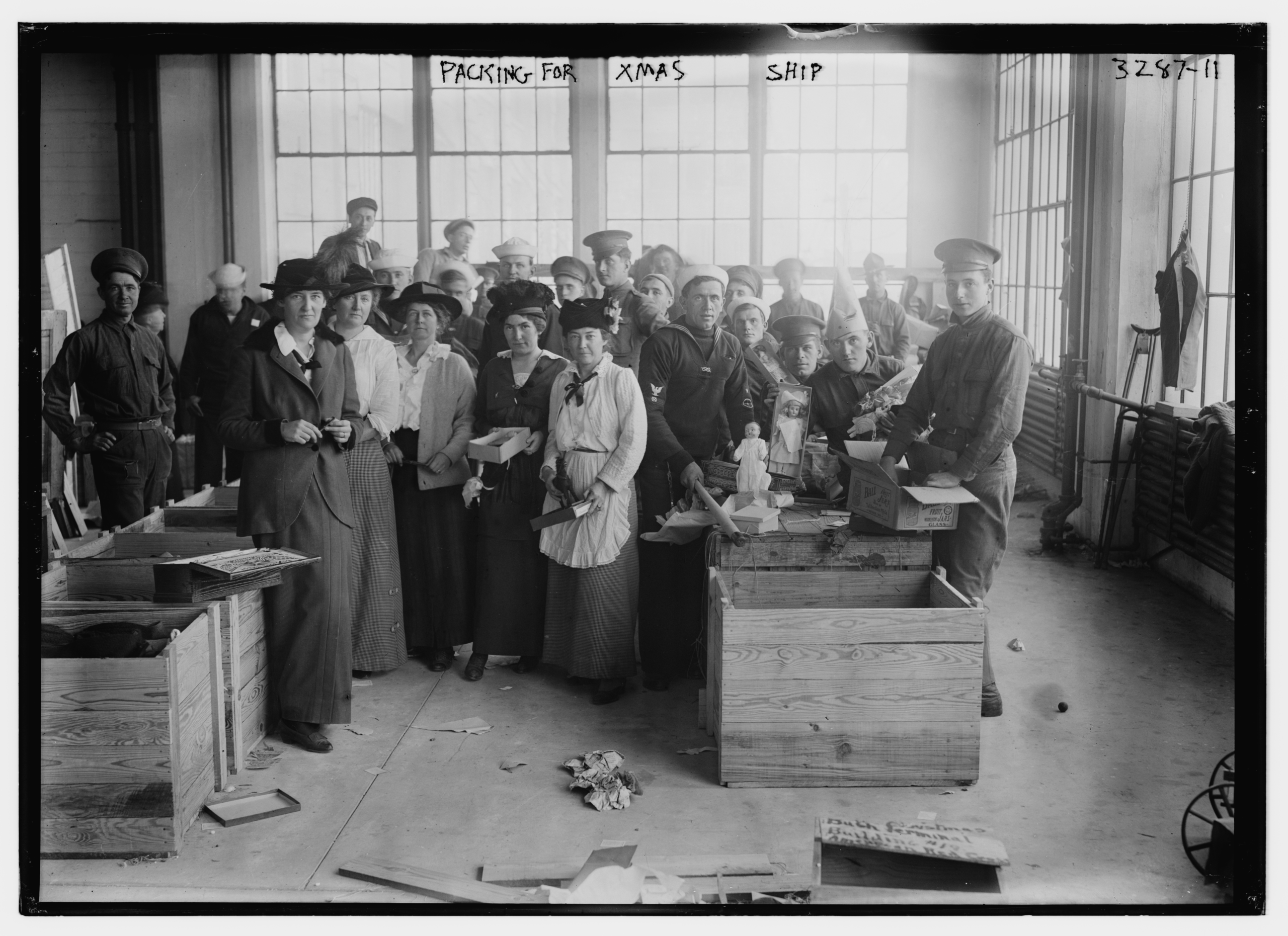
Packing for Christmas Ships header
Photograph shows people packing Christmas gifts for the U.S.S. Jason which sailed from New York on November 14, 1914 carrying about 6 million gifts for the children of Europe who were affected by World War I. (Bain News Service photograph collection, Repository: Library of Congress Prints and Photographs Division. Source: Flickr Commons project, 2011)
In the 1914 edition of the U.S. Navy publication, Ships’ Data, 24 fuel ships were listed. Later that year, three of those ships, massive colliers, ships that would usually transport coal to fuel other ships, would receive unusual tasking from the Navy and garner public attention as Christmas ships. The war in Europe had begun. The United States was not yet involved.
The Ships:
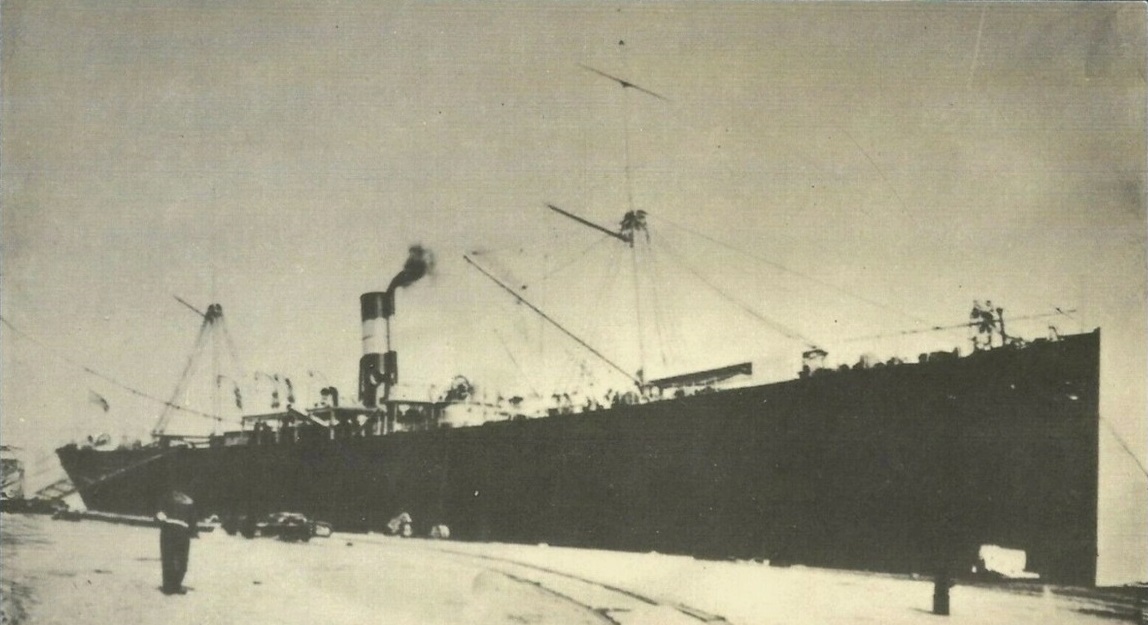
U.S. Naval Auxiliary Brutus (AC-15)
U.S. Naval Auxiliary Brutus (AC-15):
- Commanded by: James D. Smith, Master, U.S. Naval Auxiliary Service
- Fuel Ship/Collier, Length 332’ 6”, Breadth 41’, 6”, Displacement 6,600 tons
- Iron hull, 2 pole masts.
- Constructed by John Readhead & Sons, South Shields, England in 1894 for Bergh & Helland of Bergen, Norway. She traded under the Norwegian flag.
- Original name: S.S. Peter Jebsen
- Purchased by the United States from L. F. Chapman & Co., May 27, 1898.
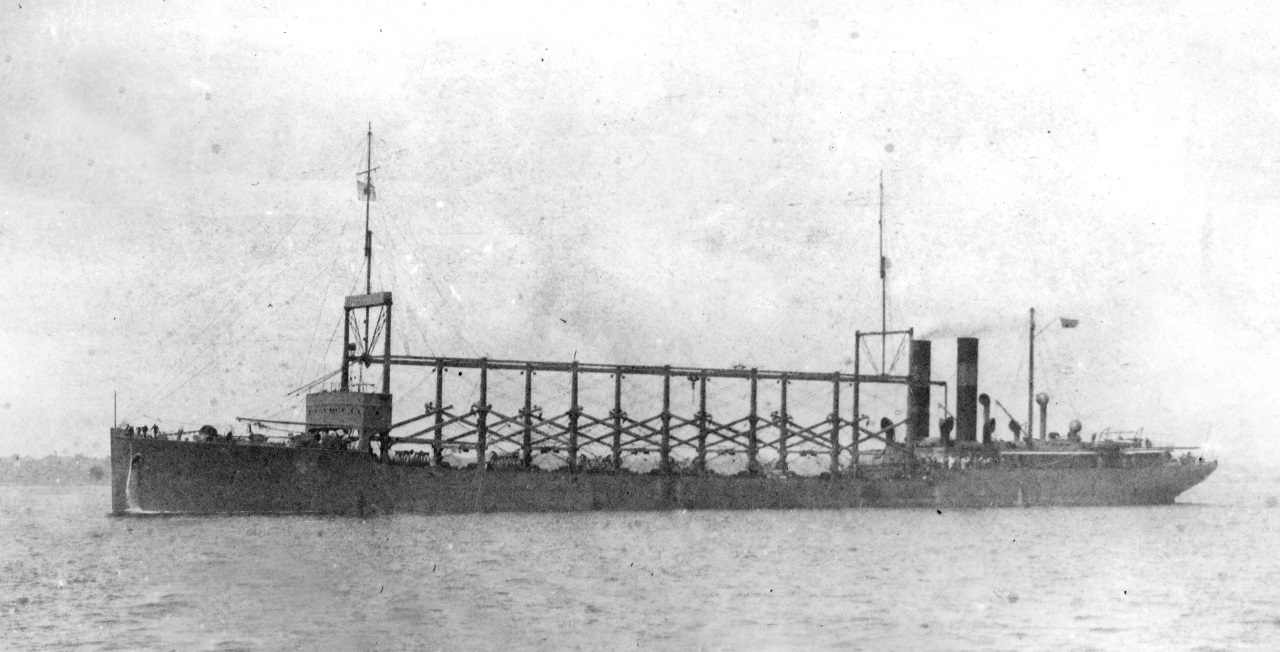
U.S. Naval Auxiliary Cyclops (AC-4) (Collection: Marvin W. Barrash)
U.S. Naval Auxiliary Cyclops (AC-4):
- Commanded by: George Wichmann Worley, Master, U.S. Naval Auxiliary Service
- Fuel Ship/Collier, Length 542’, Breadth 65’, Displacement 19,360 tons
- Steel hull, 4 pole masts
- Constructed by Wm. Cramp & Sons, Ship and Engine Building Co., Philadelphia, Pennsylvania
- Placed in service: November 7, 1910
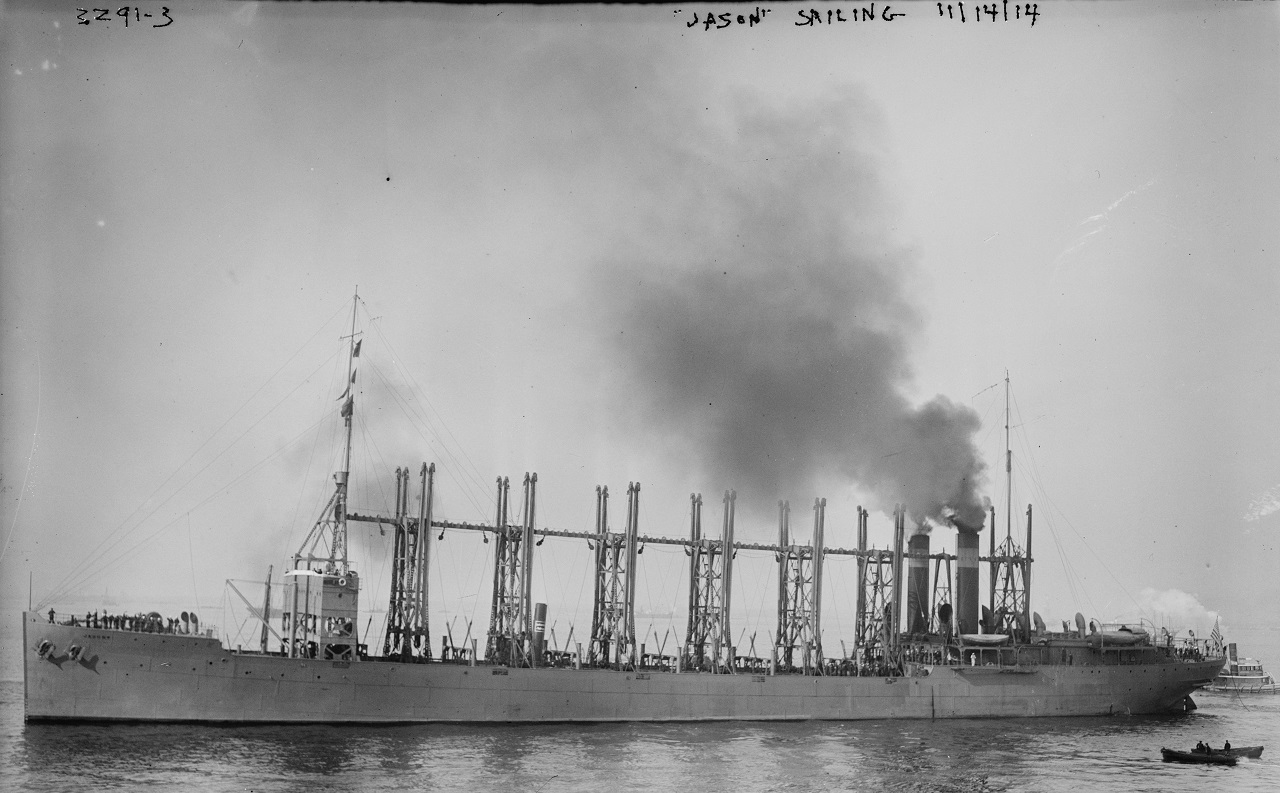
USS Jason (AC-12) (Library of Congress)
USS Jason (AC-12):
- Commanded by: Charles Edward Courtney, Lieutenant Commander, USN
- Fuel Ship/Collier, Length 536’, Breadth 65’, Displacement 19.132 tons
- Steel hull, 2 masts
- Constructed by Maryland Steel Co., Sparrows Point, Maryland
- Commissioned: June 26, 1913
In late April 1914, several colliers, including Brutus, Cyclops and Jason fleet fueled the fleet during the U.S. occupation of Vera Cruz, Mexico. The Cyclops and Jason also transported American refugees from Tuxpan and Tampico, Mexico to Galveston, Texas and to New Orleans, Louisiana. Many were oil workers and their families. Following additional coaling support at Vera Cruz both ships were placed in reserve at Norfolk, Virginia.
Following the outbreak of the war in Europe, author Lilian Bell wrote about how she envisioned a Christmas ship through which, “I could send all Europe a Christmas!” “And Christmas was coming! In a flash which was almost blinding, I saw the desolate Christmas of war-torn Europe! Not a smile on the face of any child in the length and breadth of that devastated land!”
Lilian Bell’s vision soon became a reality through a nationwide movement to raise funds to inspire people to donate clothing, toys and handmade gifts for the children of war-torn Europe. Nearly two hundred newspapers in the United States lent their active support and wired an appeal to President Wilson to persuade him to give the children of America a ship to carry their presents to the sorrowing children of the Old World. To help inspire interest and donations to the cause, a song titled, The Christmas Ship was composed by Henry S. Sawyer.
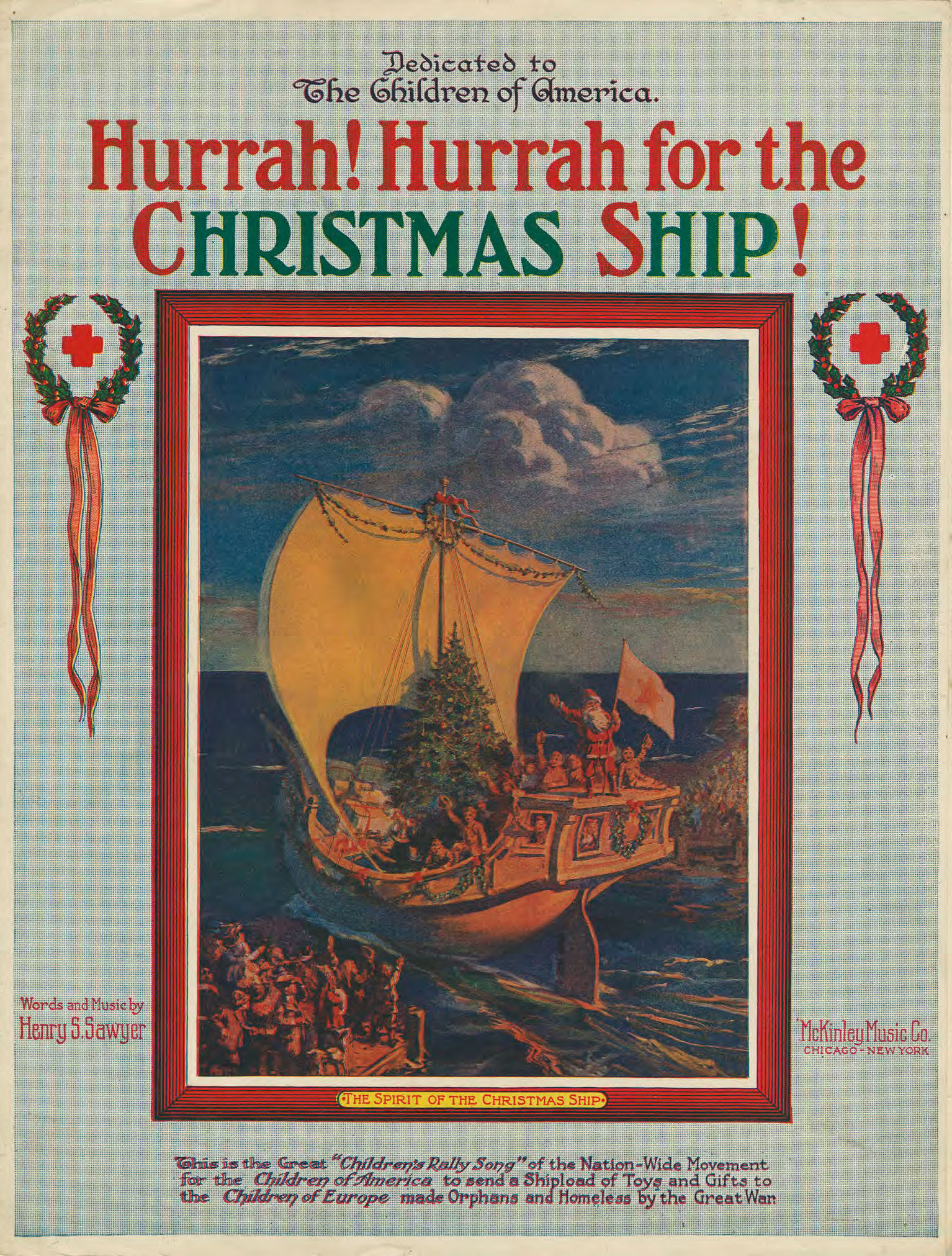
The Christmas Ship song composed by Henry S. Sawyer.
Navy Secretary Daniels sent a message to the Pittsburgh Press newspaper on October 6, 1914:
I take great pleasure in informing you that I have arranged to send an American warship, to be selected later, to European waters during the latter part of November, for the purpose of relieving the North Carolina, and I have further arranged for this ship to carry the Christmas cargo of useful presents, which the 90 odd newspapers of this country, represented by you, are so thoroughly collecting from the generous people of our own country.
It is a beautiful spirit which has prompted this portion of the press of the United States, and the people who have responded to their appeal to lavish upon the distressed little ones of European countries these tokens of liberality. This unselfish enterprise, I feel confident, bespeaks our own gratitude to God for peace, which now prevails within our own boundaries, and at the same time breathes forth the universal prayer from the hearts of our countrymen that the distress of nations across the water may soon be ended.
Again assuring you of my delight that the Navy is able in some measure to further your plans and purposes, believe me,
Cordially Yours,
Josephus Daniels
Secretary of the Navy
On October 19, 1914, it was announced that the collier Jason was selected to serve as the Christmas ship. The presents to be carried by what some called, the Santa Claus Ship, were collected from all parts of the United States through the messages carried by over two hundred daily newspapers. Appeals for funds and articles of clothing, toys and more resulted in an overwhelming response from across the country.
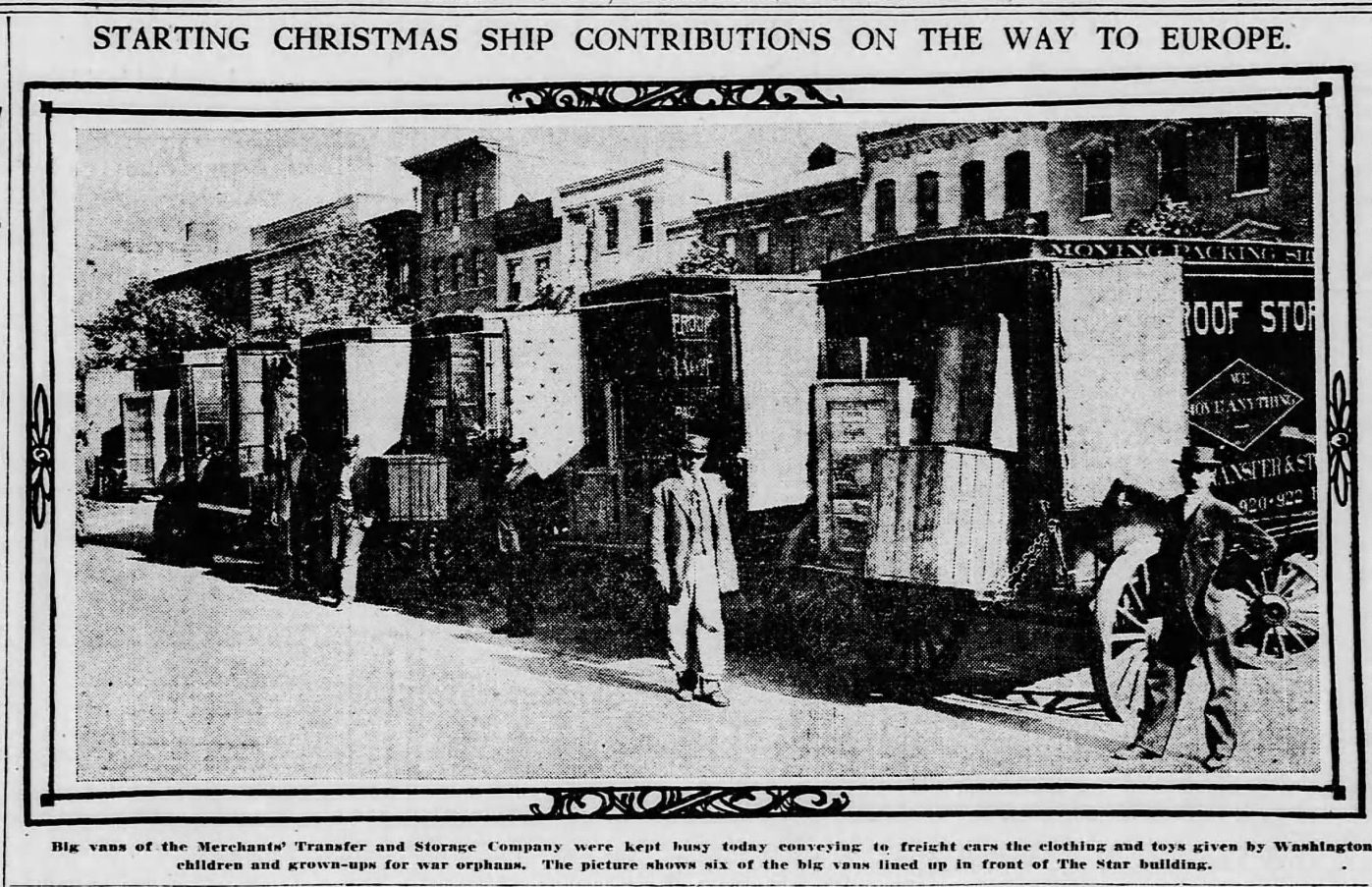
The Evening Star, 1914.
Four train carloads with more than 200,000 articles, came from California alone. Forty-three railroad and all the great express companies provided free transportation to the terminal in Brooklyn, New York. City authorities, religious institutions, letter carriers, department stores, individual firms, all helped by providing services, special prices and donations.
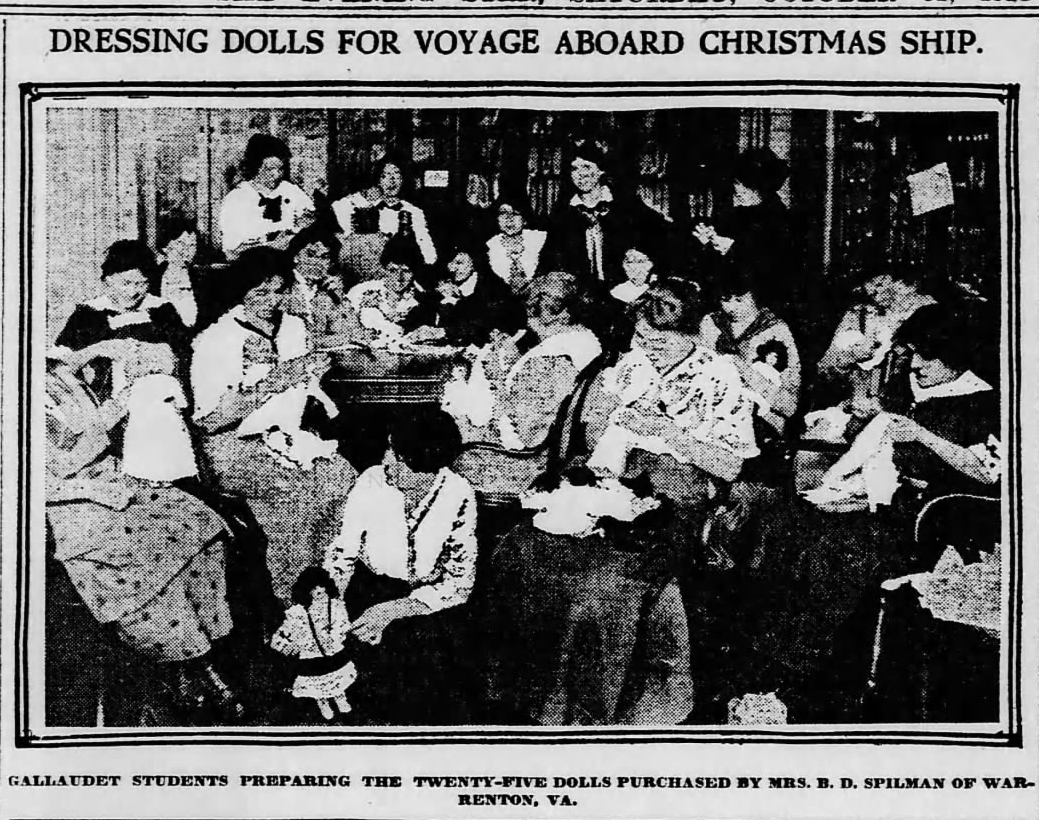
The Evening Star, 1914.
Twenty-five dolls were dressed by students at Gallaudet College in Washington, D.C. These dolls were purchased by a resident of Warrenton, Virginia. Other such donations came from individuals, groups and schools.
On October 30, 1914, Acting Secretary of State, Robert Lansing, issued the following statement:
Arrangements have been made by the Secretary of the Navy to have the gifts carried to Europe on the collier Jason, which will touch at Falmouth, England; Bordeaux or Marseilles, France; Genoa, Italy, and Salonika, Greece. The department is informed that, through an arrangement made by the committee in charge with the British ambassador at Washington, the British government will receive the gifts for Russia and convey them to Bergen, Norway; and the department has authorized the American ministers in Norway and Sweden to apply informally to the Norwegian and Swedish governments respectively on behalf of the committee for the free transportation of the gifts from Bergen to the Finnish border.
This generous and beneficent action on the part of the children of the United States doubtless will being comfort and pleasure to many households, and the department feels confident you will take pleasure in giving your cooperation in the proper way.
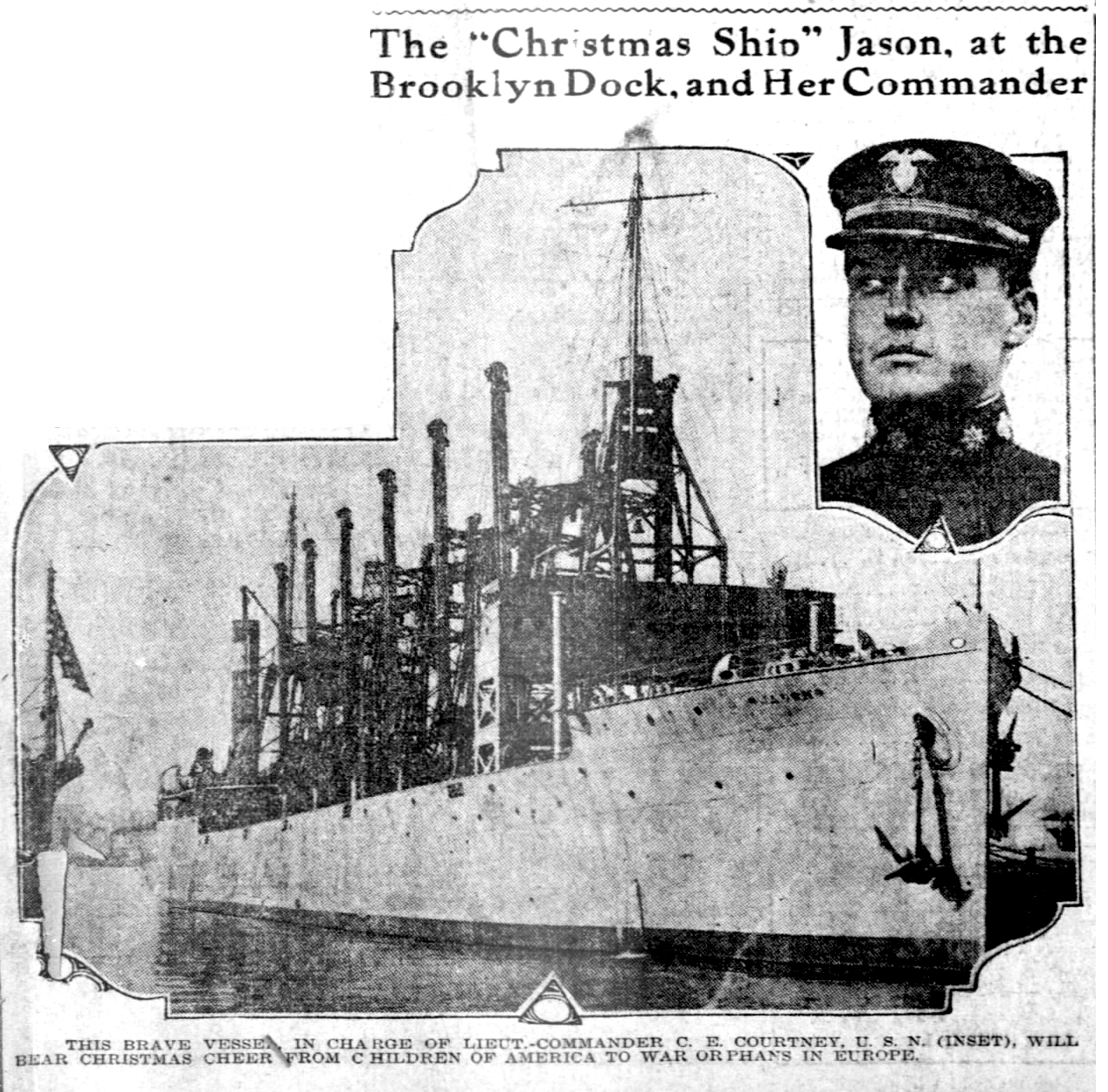
The Pittsburgh Press, 1914.
After some refurbishment to accommodate the cargo of Christmas gifts, the collier Jason departed the Brooklyn Navy Yard on November 14, 1914. Her departure from New York was delayed due to, what was described as, “an avalanche of gifts” for the orphaned, widowed and wounded of the warring nations of Europe. Every square inch in the holds of the collier was filled with Christmas presents contributed by Americans from all parts of the country.
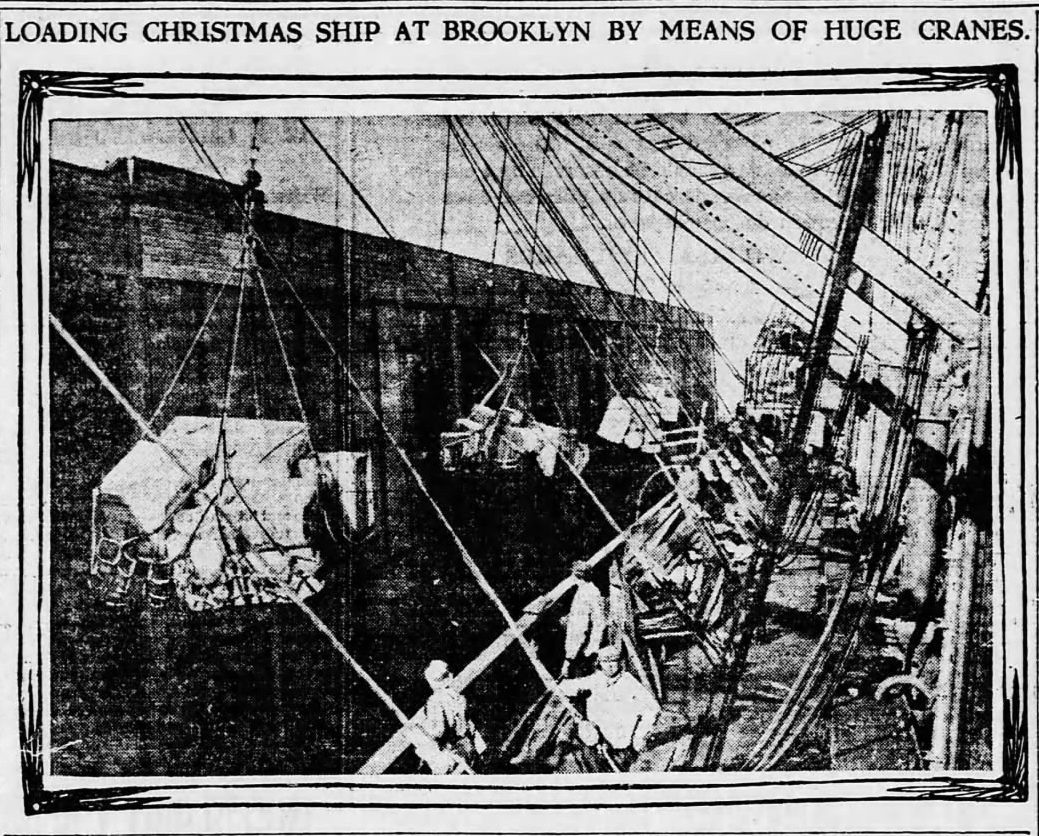
The Evening STar, 1914.
Ships along the riverfront and in Upper New York Bay displayed flags and color bunting. The Jason and her crew were given a grand send off. Many visitors, young and old were aboard the collier prior to her departure to watch the final loading and sheer volume of gifts in the holds.
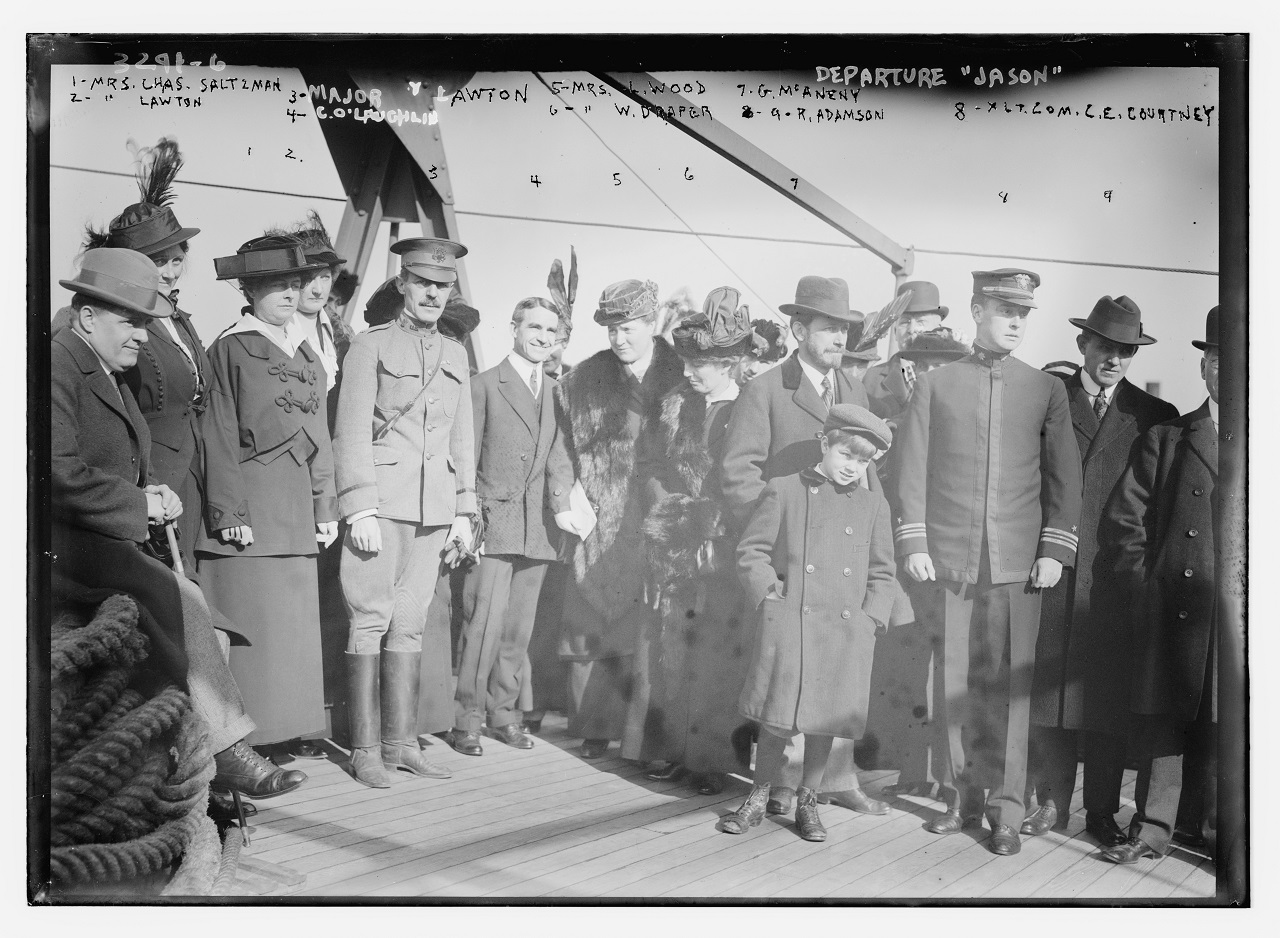
Photograph shows people on the U.S.S. Jason which sailed from New York on November 14, 1914 carrying about 6 million gifts for the children of Europe who were affected by World War I. People depicted include: Mrs. Leonard Wood, wife of the Commander of the Army of the East; Mrs. W.K. Draper (Helen Fidelia Draper), head of the New York Chapter of the Red Cross; George McAneny, President of the New York City Board of Aldermen; John Callan O’Laughlin, journalist for the Chicago Herald and “American Commissioner” on the voyage and Mrs. (Major) Charles McKinley Saltzman (Mary Eskridge Saltzman). (Source: Flickr Commons project, 2011. Names: Bain News Service.)
The presents were in 10,000 large packing cases and 10,000 express packages. There were more than sixty train car loads of assorted merchandise, five carloads of toys for the orphans abroad and fourteen carloads of children’s clothes, five carloads of women’s clothing, one carload of men’s clothing, and many boxes of food, shoes and more. The collier Jason also carried also a supply of coal for the U.S.S. Tennessee and U.S.S. North Carolina.
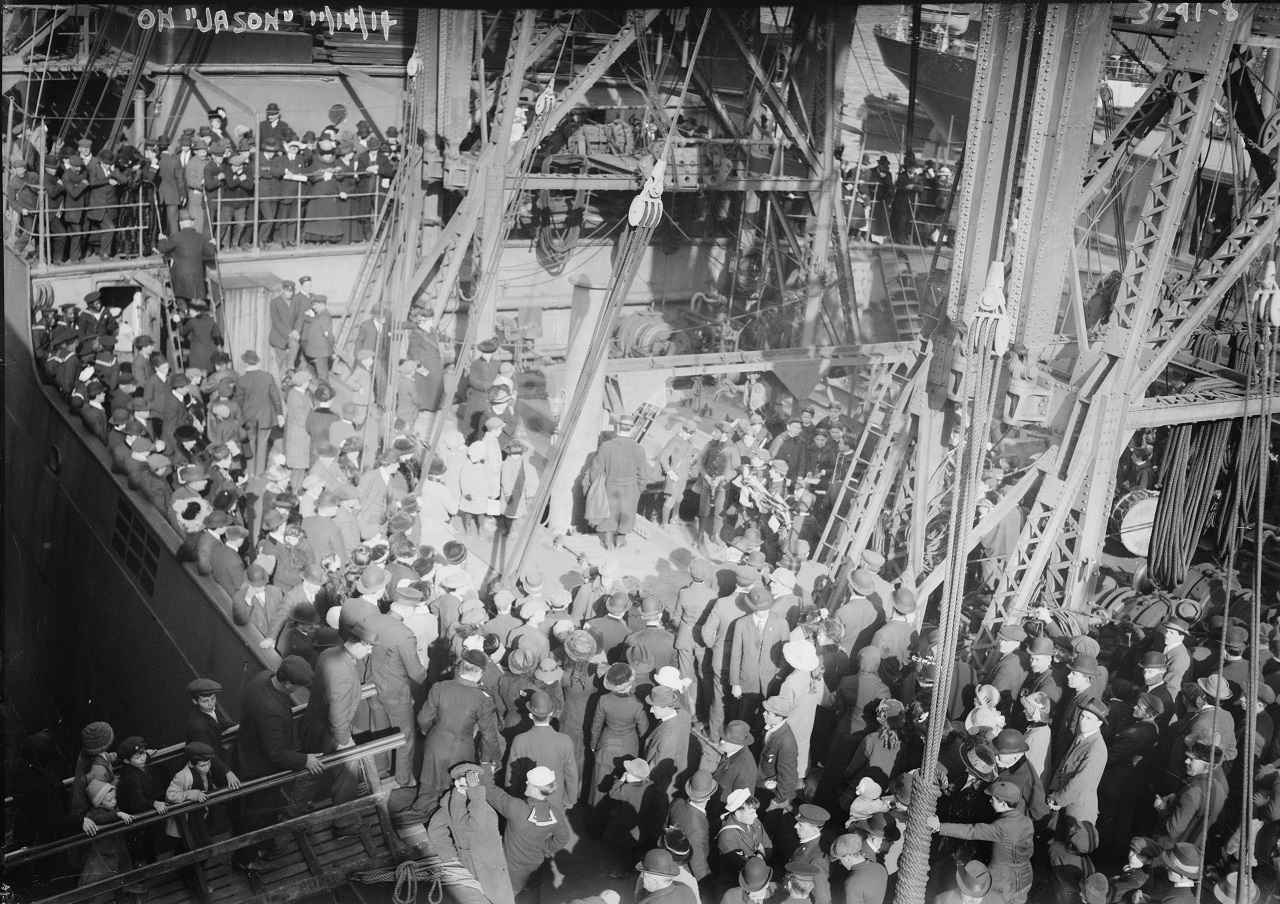
Photograph shows people on the U.S.S. Jason which sailed from New York on November 14, 1914 carrying about 6 million gifts for the children of Europe who were affected by World War I. (Source: Flickr Commons project, 2011. Names: Bain News Service, publisher.)
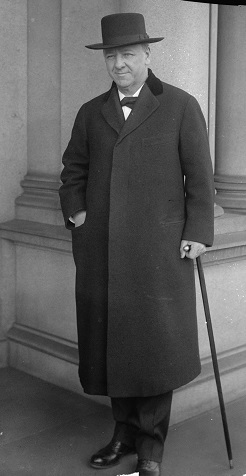
Secretary of the Navy Josephus Daniels
Navy Secretary Josephus Daniels issued the following official statement on November 14, 1914:
The collier, Jason, carrying a double cargo of ‘black diamonds’ for the bunkers of the Tennessee and the North Carolina, which are now in the Mediterranean waters, and of Christmas presents, more valuable than real diamonds because of the spirit which led to their sending, for European children in the war zone, who would otherwise miss the annual visit of Santa Claus, sailed from Bush Terminal, Brooklyn, at eleven o’clock this morning for Falmouth, England.
The Secretary of the Navy sent the following radiogram after the Jason weighed anchor:
Commanding officer, U.S.S. Jason: My hope and prayer is that the Jason may have clear skies and fair winds on her auspicious voyage to Europe, laden, as never ship before, with precious Christmas cargo, prompted by the generosity and hallowed by the sympathy of American childhood. Tiny Tim has his counterpart in thousands of orphaned little ones in the Old World to-day, crippled by ruthless war, not actually, but in present happiness and future opportunity. God bless them, every one, and may the Christmas spirit which actuates American children to send these gifts, help to hasten the day when ‘peace on earth, good will to men’ shall be a blessed reality, and when nations shall go to war no more.
Josephus Daniels
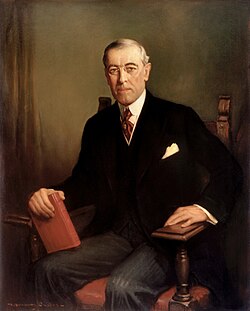
President Woodrow Wilson
The President of the United States sent the following message to the collier Jason, The Children’s Christmas Ship:
My best wishes for a safe voyage. May the good ship carry comfort and relief to the distressed and suffering.
Woodrow Wilson
The White House
Washington, D.C.
November 14,1914
The collier Jason was officially welcomed upon her arrival at Devonport, England on November 25, 1914. She was greeted by British representatives. Nearly 2,000 crates were unloaded full of gifts for British and Belgian children.
Queen Mary of England expressed her appreciation through the wife of the American Ambassador:
I am anxious to express through my warm appreciation of this touching proof of generous sympathy and to ask you to be so kind as to convey my heartfelt thanks to all who have contributed toward presents, which will, I feel sure, be gladly welcomed by the children for whom they are intended, and received with gratitude by their parents.
On November 28, 1914, the collier Jason departed Devonport in England, enroute to France following her delivery of Christmas toys sent from the children of the United States.
On December 8, 1914, the Secretary of the Navy designated the naval collier Cyclops as a Christmas ship to carry gifts to officers and men on duty in Haitian, Dominican and Mexican waters and at Guantanamo, Cuba. The Cyclops will be met by the collier Brutus. “The Christmas boxes sent by relatives and friends to officers in the waters named will be given free transportation from Norfolk, Va.”
The collier Jason arrived at Marseilles, France on December 5, 1914. Fifty wagon loads of gifts were unloaded for children whose parents were killed or wounded. The townspeople gathered to watch the landing and gave the Americans a warm greeting.

The Bridgeport Times and Evening Farmer, 1914.
Also on December 8, 1914, the Christmas ship, USS Jason arrived at Genoa, Italy with gifts for the war orphans of Austria and Germany. Prior to her arrival, her journey was interrupted. ‘‘Three different times during the night the Jason was approached by French warships. The first vessel signaled asking the name, flag, and the destination of the Santa Claus vessel. When the information was given the answer came, ‘Sorry, Godspeed.’
“The second vessel to stop the Jason was a destroyer, which flashed her searchlight from stem to stern of the Jason and then sent a boarding officer. He requested to see the ship’s papers, which were produced. He was informed that the Jason belonged to the American Navy and was bound for Genoa to unload Christmas gifts. He immediately apologized, and wished us a pleasant voyage. The third inquisitor was a converted cruiser, which megaphoned its inquiry and extended best wishes when told of the nature of the mission.”
Commander Courtney and other officials of the Jason were met at their hotel in Genoa by German representatives, designated by the government in Berlin, who officially welcomed them. The Italian government funded the transportation of the gifts to the Austrian border.
The Christmas ship Jason arrived at her final destination on December 22, 1914, Salonika (now Thessaloniki), Greece. Those gifts were distributed to the orphaned and homeless children of Servia, Greece.
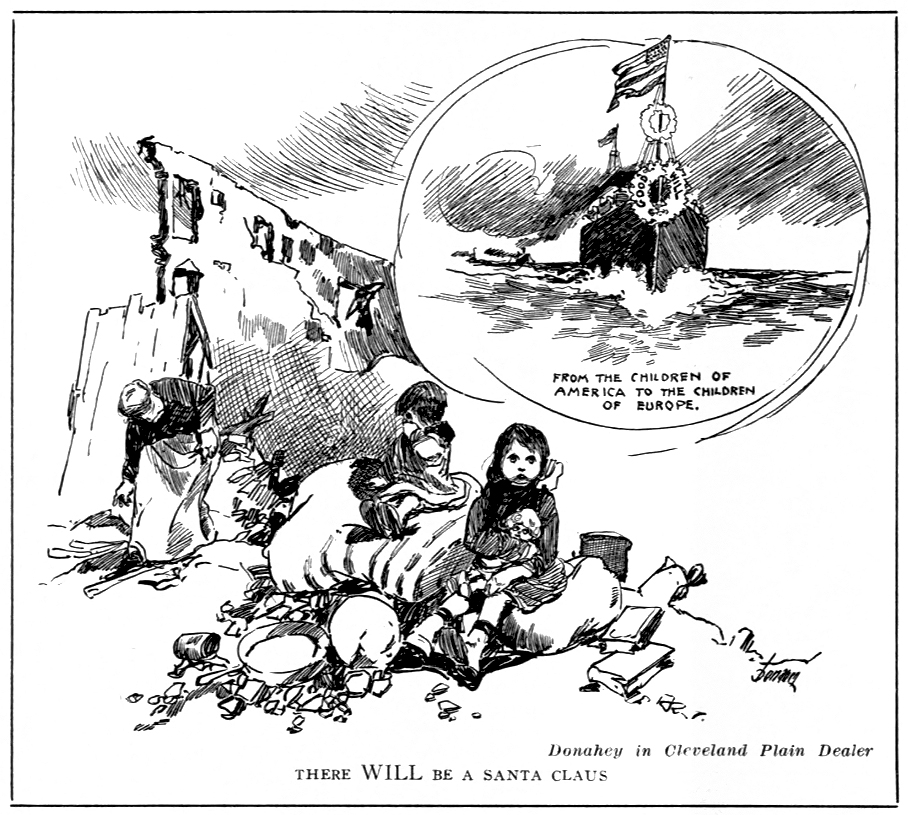
The Cleveland Plain Dealer, 1914.
In his 1914 Annual Report, the Secretary of the Navy summarized the benefit of the Christmas ships in an article titled, Relief Work of the Navy:
It is a matter of gratification that the Navy Department was enabled to be the carrier of the thousands upon thousands of Christmas presents collected by the press of America for the children of the warring countries of Europe. It chanced that it was necessary to send the collier Jason with coal for the Tennessee and North Carolina in the Mediterranean, and its large carrying capacity enabled the department to take to these children of Europe the gifts from the children of America. Their beautiful spirit of generosity touched the people on both continents. The naval officers, marines, and enlisted men entered cheerfully into this noble work, and within a few days these tokens of sympathy will be distributed to many children who have felt the pinch of poverty that follows in the wake of war.
Josephus Daniels
The USS Jason delivered seven million gifts to children across Europe. Each and every present was made in the United States of America. The colliers Cyclops and Brutus transported innumerable gifts to service members assigned to sea and land stations in southern waters. The colliers Brutus and Cyclops delivered their cargos of presents for those serving in southern waters. Few details survive.
Lt. Commander Charles Edward Courtney continued his service in the U.S. Navy. He retired with the rank of Vice Admiral, USN, five months prior to the U.S. entry in WWII. He served forty-six years in the U.S. Navy. He died in 1966.
Master James D. Smith, commander of the U.S. Naval Auxiliary Brutus, began his service as a master in the U.S. Naval Auxiliary Service in 1910. As the United States entered the Great War in 1917, he received his commission as Lt. Commander in the U.S. Naval Reserve Force. He retired from naval service in 1934. He died in 1947.
Master George W. Worley, commander of the USS Cyclops perished with his ship with all hands in 1918 as the ship transported a cargo of war materiel to the U.S. He served seventeen years as an officer in the U.S. Naval Auxiliary Service, and one year as a Lt. Commander in the U.S. Naval Reserve Force.
 Marvin W. Barrash learned about the USS Cyclops as a child in his grandparents’ shop in Baltimore, and has been researching the fate of the vessel since 1997. He is the author of three books on the USS Cyclops mystery: U.S.S. CYCLOPS, Murder on the ABARENDA, and U.S.S. CYCLOPS Volume 2. He has appeared on a number of television programs about the USS Cyclops. His articles about USS Cyclops on the Doughboy Foundation website can be found here, here, and here.
External Web Site Notice: This page contains information directly presented from an external source. The terms and conditions of this page may not be the same as those of this website. Click here to read the full disclaimer notice for external web sites. Thank you.