The Battle of Hamel: Australian Soldiers Taught American Doughboys to Fight Germans in WWI
Published: 7 January 2026
By Allen Frazier
via the Military.com website
hamel_awm_e02690 (1)
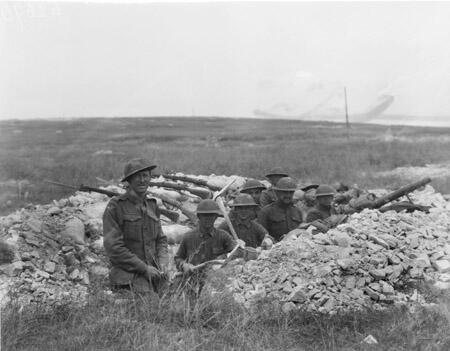
American and Australian troops dug in together during the Battle of Hamel. Hamel was fought in the early morning and by a happy arrangement on what was their National Day, United States troops attacked, at battalion strength, for the first time in the British line. Their part in the operation not only made the day memorable for them, but created a great bond between the Americans and Australians. Left to right: five unidentified; Private Jamieson, 42nd Battalion; Lance Corporal Bellamy, 42nd Battalion. (Wikimedia Commons)
At 3:10 a.m. on July 4, 1918, American soldiers climbed out of their trenches in northern France. Most had never seen combat before. They had arrived in Europe weeks earlier. Now they were attacking German positions alongside battle-hardened Australian troops and were under the command of an Australian general.
For the first time in American history, U.S. soldiers would fight under a foreign command. In 93 minutes, they would help win what military historians call the first modern battle and forge a relationship with Australia that has lasted ever since.
The Battle of Hamel was an important learning curve for the inexperienced American forces and a turning point in World War I tactics. Roughly 1,000 American doughboys from the 33rd Division joined Australian and British troops in a meticulously planned assault that integrated infantry, tanks, artillery and aircraft in ways never before attempted. Together, they proved combined arms warfare could break the deadlock of trench warfare.
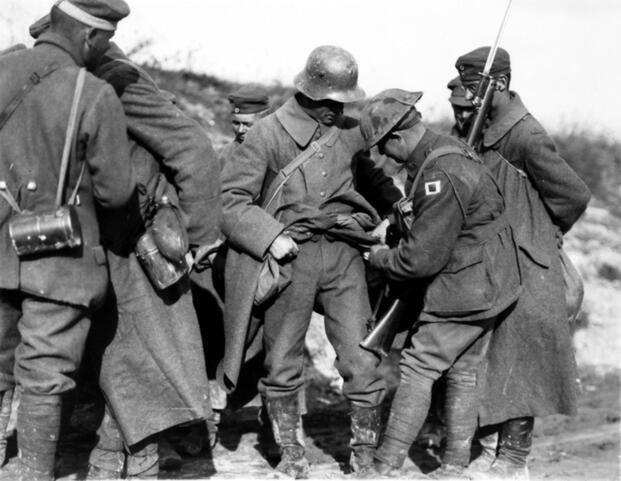
Australian solders searching German prisoners of war for “souvenirs” following their capture during fighting around an outpost of the Hindenburg Line near Hargicourt in France. (Wikimedia Commons)
Americans Under Foreign Command
American Expeditionary Force commander General John J. Pershing had resisted British and French demands to use American troops as replacement units in Allied armies. He wanted the Americans to fight as an independent force under American command. When he learned that ten companies of his soldiers were ordered to join Australian Lieutenant General John Monash at Hamel, he ordered their immediate withdrawal.
On July 3, the day before the scheduled attack, six American companies received orders to pull back. Some obeyed, but many refused. Two Americans in the 42nd Battalion switched into Australian uniforms and stayed. The sudden withdrawal forced Monash to reorganize his battalions. The 16th Battalion’s strength dropped by half. The 11th Brigade shrank from 3,000 men to 2,200.
Pershing later wrote that the battle came as “somewhat of a surprise” and its immediate effect was “to cause me to make the instructions so positive that nothing of the kind could occur again.”
But the Americans who fought at Hamel later praised the experience. Captain Gale spoke for many when he said that “more real good was done by this small operation with the Australians than could have been accomplished in months of training behind the lines.”
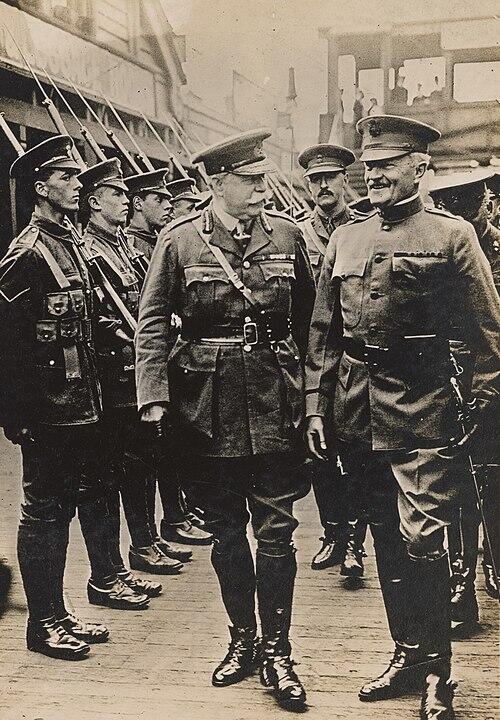
Major General John J. Pershing, the newly appointed Commander-in-Chief (C-in-C) of the American Expeditionary Forces (AEF), pictured here together with Major General Tom Bridges of the British Army, inspecting a Guard of Honor on Pershing’s arrival at Liverpool, June 1917. (Wikimedia Commons)
Planning the Perfect Battle
Monash had planned the Hamel operation with extraordinary precision.
“A perfected modern battle plan is like nothing so much as a score for an orchestral composition,” he wrote, “where the various arms and units are the instruments, and the tasks they perform are their respective musical phrases.”
He calculated the attack would take 90 minutes. On June 30, he held his final planning conference with two hundred fifty of his officers. The agenda included 133 items and lasted four and a half hours. Everyone explained their role. Monash resolved conflicts and doubts immediately. No changes would be permitted after the conference ended.
The German position at Hamel created a bulge in the Allied line south of the Somme River. The high ground gave German observers clear views of Allied rear areas and allowed their artillery to fire on Villers-Bretonneux. Capturing Hamel would straighten the line and provide a springboard for future offensives toward Amiens.
Monash planned to attack on a six-kilometer front with three Australian brigades from the 4th Division, reinforced by the 6th and 11th Brigades. Sixty Mark V and Whippet tanks from the British 5th Tank Brigade would support the infantry. More than 600 guns would provide artillery support. Aircraft would bomb German positions, photograph enemy movements and parachute ammunition to advancing troops.
The attack would begin at dawn to reduce visibility and protect troops from German fire. Secrecy was absolute. Dummy installations deceived German observers. Harassing fire continued during troop movements. No daylight movement was allowed. Aircraft flew constantly over German lines on the night of July 3 to mask the sound of tanks moving into position.
⇒ Read the entire article on the Military.com website.
External Web Site Notice: This page contains information directly presented from an external source. The terms and conditions of this page may not be the same as those of this website. Click here to read the full disclaimer notice for external web sites. Thank you.