The Army’s ‘Hello Girls’ of World War I waited 60 years for veteran status
Published: 12 September 2026
By Bethaney Phillips
via the We Are The Mighty website
hello-girls-world-war-I-poster
When we think of deployments these days, we think of long separations and physical distance. We don’t think of a total lack of communication. Between video calls, internet messages, texts, emails, and care packages, communication can pretty much stay constant using the myriad technologies available to us.
But as we all know, that was not the case in decades past. Military spouses at one time got nothing: no forms of communication at all. Then at some point—likely the American Civil War—letters could be sent to soldiers on a generally reliable basis. Even so, it often took weeks for them to be delivered and little detail could be shared.
But no form of communication could really replace a missing spouse.
By World War I, technology had again advanced, allowing milspouses to hear their loved one’s voice via phone — at least, until they traveled overseas. Transatlantic voice calls simply didn’t exist yet; commercial radiotelephone service between the U.S. and Europe wouldn’t begin until 1927. Once a soldier shipped out, the mail was still the only line home.
There was, however, a bigger problem that arose as telephones became more and more important to war. They were used to call in orders, send messages, and coordinate movement between units—and as the First World War kicked off, the need to make more calls quickly outpaced the ability to field those calls.
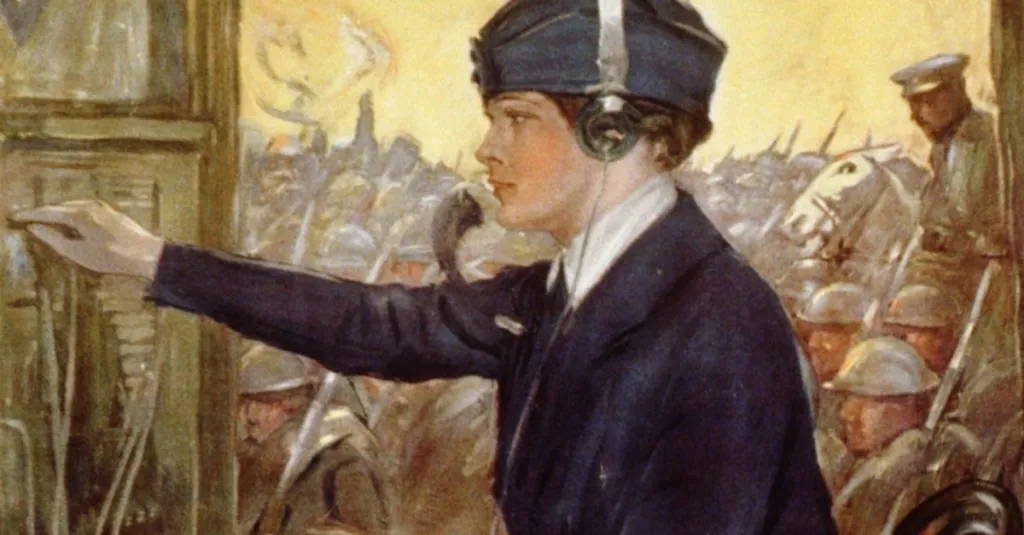
This introduced women to an entirely new career opportunity as telephone operators. Known as the “Hello Girls,” the U.S. Army Signal Corps Female Telephone Operators Unit took the nickname from the standard American telephone greeting and the women who made those greetings. The unit was authorized in late 1917, deployed to France in March 1918, and was demobilized within roughly a year of the armistice, but there was hesitation to employing them at all.
At first, the War Department was against female service members who were not nurses. What changed the calculus was Gen. John J. Pershing. Communications between soldiers in the trenches and accompanying units had begun to deteriorate, and the American Expeditionary Forces required reliable and qualified personnel to handle their communications. A shortage of French telephone operators only made matters worse.
American soldiers put on the switchboards couldn’t do the job because they had no experience with the equipment and spoke no French. Late in 1917, Pershing cabled Washington and asked for bilingual women. Secretary of War Newton Baker relented, and AT&T went to work recruiting and training them.
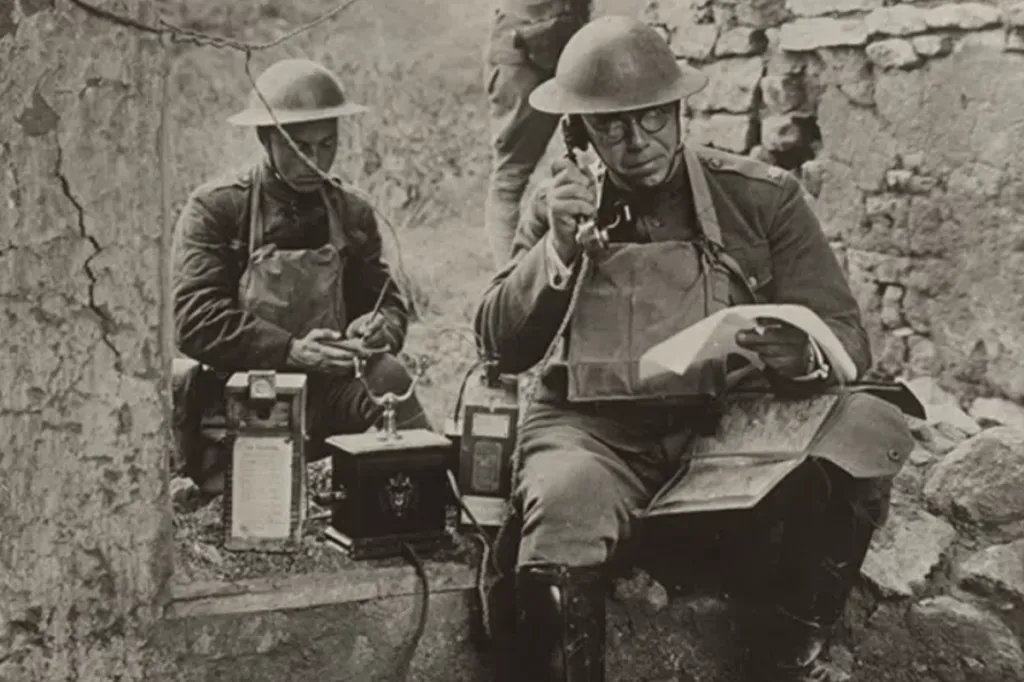
He’s not bad at it, he’s just not as good as a woman. (World War I Centennial Commission)
Some 7,000 women sent in applications, including many switchboard operators from across the United States. Roughly 450 were enrolled and trained; 223 ultimately shipped overseas in six operating units. Getting to the job wasn’t easy for any of them. On top of knowing the switchboard, operators had to speak both English and French to be able to communicate with those calling from the Western Front. They also had to pass physical and psychological exams and a Secret Service loyalty investigation, then train on code procedure and the geography of the front.
It wasn’t an easy life. The War Department required the women to be under constant supervision. They were also expected to dress sharp and provide their own uniforms: navy blue wool coat, skirt, hat, high-top shoes, and bronze insignia. In her book, “The Hello Girls: America’s First Women Soldiers,” author and historian Elizabeth Cobbs estimated the cost of their full kit at between $250 and $350. Either way, the Army never reimbursed a dime of it, and AT&T had to lend some of the women the money.
Pay ran from about $50 to $125 a month depending on rank, comparable to what male soldiers in the Signal Corps earned. For an operator on the base rate of $60, the uniform swallowed half a year’s salary. Some served barely long enough to pay off the debt.
The first 33 operators reached Paris in March 1918, and their workload swelled almost immediately. Before they arrived, American forces were placing around 13,000 calls a day; with the Hello Girls at the controls, that figure rose to roughly 36,000. More soldiers pouring in meant more calls coming through, leading to the need for more switchboards and operators to run them.
The U.S. also added more circuits, placing them under American authority rather than using French switchboards. By war’s end, more than 25 million local calls and 870,000 long-distance calls had moved over the American system, about 26 million connections across the unit’s full tenure.
By September, the Army needed 130 more operators, with another 40 hired every six weeks until 1919.
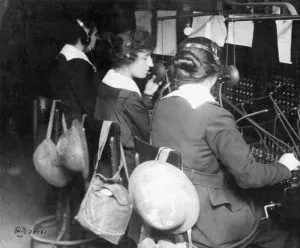
Signal Corps Women supporting the American and French soldiers capturing the St. Mihiel Salient in 1918. (National Archives)
Their speed was essential, and was the whole point of hiring skilled women to work the switchboards. Male operators took as long as a full minute to complete a connection, even when the traffic was an order to advance or cease fire. The Hello Girls cut that time to about 10 seconds, with one captain estimating each operator could handle 300 calls an hour.
They also proved adept at spotting tapped lines and rerouting suspect calls. Without the Hello Girls, phones would have gone unanswered and soldiers’ messages unheard—not to mention an untold number of orders that wouldn’t have been relayed.
⇒ Read the entire article on the We Are The Mighty website here:
External Web Site Notice: This page contains information directly presented from an external source. The terms and conditions of this page may not be the same as those of this website. Click here to read the full disclaimer notice for external web sites. Thank you.