Tennessee soldier played role in American Punitive Expedition into Mexico prior to World War I
Published: 17 July 2026
By James V. Angel
Special to the Doughboy Foundation website
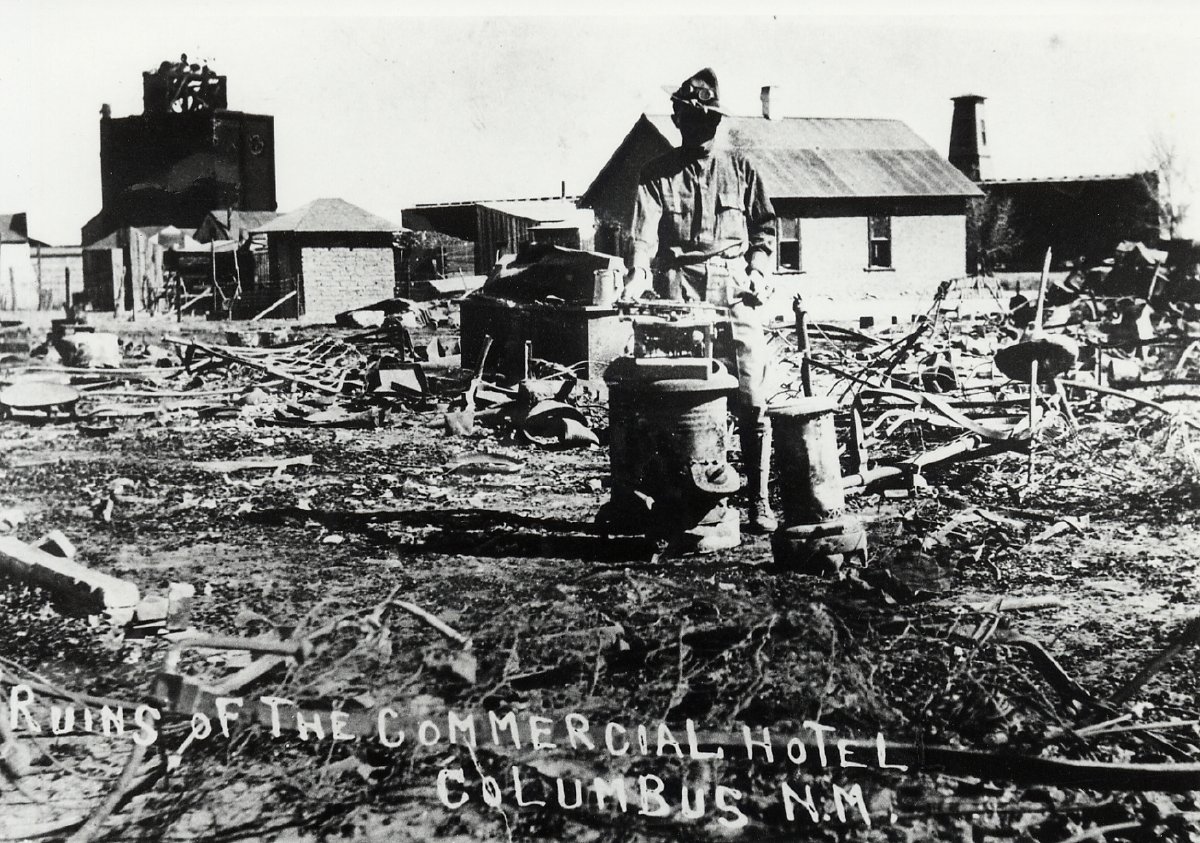
Raid_on_Columbus,_New_Mexico
Aftermath of Pancho Villa's raid on Columbus, NM on March 9, 1916.
In late March 1916, the 5th Cavalry regiment was sent on an expedition across the Mexican Border due to the continuing threat from revolutionary Pancho Villa. Who, at this point, had led several raids in United States territory, resulting in the death of American civilians and soldiers. [1]
The actions along the border are often overshadowed by America’s entry into the First World War the following year. Yet, these actions resulted in the death of U.S. service members and civilians, and their sacrifice remains worthy of research and study.
Andrew J. Watson was born in Scott County, Tennessee, in March of 1888. [2] He was born to the parents Elisha and Nancy Watson. Elisha, who was born in Kentucky and would later move to Scott County when he was a child, where he farmed for most of his life. [3] The young Andrew grew up and worked on the family farm, where he grew accustomed to the hard work that came with it.
In October 1910, Andrew enlisted in the United States Army. [4] He was assigned to various cavalry regiments before finally being assigned to the 5th Cavalry Regiment. In the 5th Cavalry, he was assigned as a wagoner in the supply troop. The regiment prior to the time of the expedition was spread across three posts: one squadron at Fort Leavenworth, Kansas, another at Fort Myer, Virginia, and a third at Fort Sheridan, Illinois.[5]
On March 9th, 1916, Pancho Villa would lead a raid on Columbus. New Mexico. At the time, the town was rather small, with the population being around 300. The town also had an Army camp located near the town limits, known as Camp Furlong. In this raid, several U.S. Soldiers and civilians were killed. [6] The newspaper, Bryan Daily Eagle and Pilot, published an account of the raid
500 Villa bandits attacked this town and held it in their possession for an hour and a half. They were driven off by three troops of the Thirteenth Cavalry at 6 o’clock, leaving part of the town in flames…. The Villa soldiers crossed the border three miles south of here, where the fight began and came to town in the deep ditches paralleling the railroad[7]
In response to this raid, Andrew, with the rest of the 5th Cavalry regiment, was ordered, with other units, for an expedition into Mexico to help aid with suppressing the forces under Pancho Villa.
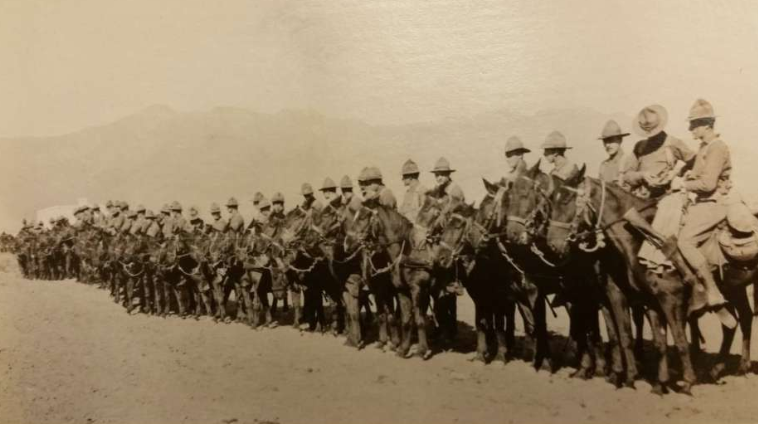
The 5th Cavalry regiment participated in the American Punitive Expedition into Northern Mexico, commanded by Brigadier General John J. Pershing.
During this time, the 5th Cavalry was in multiple engagements and skirmishes as the expeditionary force chased after Pancho Villa. The regiment would aid in capturing eighty revolutionaries, among those a colonel, who was able to identify eight members who were on the Columbus raid. [8]
Watson could keep in his service with the 5th Cavalry regiment. On September 22nd, 1916, Andrew was out drinking at a saloon in El Valle with members from his squadron. When seventeen Carranza soldiers entered the saloon as well. An argument would then ensue between the two parties, and gunfire started. In the crossfire, Andrew Watson was hit and killed. After this, a trooper from Watson’s would take revenge and kill one of the soldiers who was responsible for the shooting. [9]
The exact location of Andrew Watson’s burial remains unknown. Although he has a grave marker in Scott County, Tennessee, it is uncertain whether his remains are buried there. It is also worth noting that the birth year engraved on his marker is incorrect. Military and census records consistently indicate that he was born in 1888
While Andrew Watson’s story is of little note in textbooks, his death is a clear example of the sheer violence that took place along the border at the time due to the Mexican Revolution.
[1] Columbus, NM events commemorate centennial of Pancho Villa raid and US response. https://www.worldwar1centennial.org/index.php/communicate/press-media/wwi-centennial-news/969-events-in-columbus-nm-commemorate-pancho-villa-raid-centennial.html
[2] October 1910 R-Z 1909-1913 Registers of Enlistments in the United States Army, 1798–1914, Records of the Adjutant General’s Office, 1780’s-1917, Record Group 94; The National Archives in Washington, D.C.
[3] 1880; Census Place: Huntsville, Scott, Tennessee; Roll: 1277; Page: 232b; Enumeration District: 128
[4] October 1910 R-Z 1909-1913 Registers of Enlistments in the United States Army, 1798–1914, Records of the Adjutant General’s Office, 1780’s-1917, Record Group 94; The National Archives in Washington, D.C.
[5] Daily Kennebec journal. (Augusta, ME), Mar. 22 1916.
[6] Stout, Joseph Allen. Border Conflict : Villistas, Carrancistas, and the Punitive Expedition, 1915-1920. Texas Christian University Press, 1999. EBSCOhost.
[7] Bryan Daily Eagle and Pilot. (Bryan, TX), Mar. 9 1916.
[8] Evening Public Ledger. (Philadelphia, PA), Jun. 29 1916.
[9] The Montgomery advertiser. (Montgomery, AL), Sep. 26 1916.
James Angel
James Angel is a military historian, focusing his research primarily on Tennesseans in the military and how veterans reintegrated into American society. James currently holds a B. A. in History from Piedmont University and is working on earning an M.S. in Educational Psychology from the University of Tennessee. He is also a U.S. Army veteran and takes part in living history events across the nation.
External Web Site Notice: This page contains information directly presented from an external source. The terms and conditions of this page may not be the same as those of this website. Click here to read the full disclaimer notice for external web sites. Thank you.