Primary Sources from the Interwar Neutrality Debate
Published: 1 July 2026
via the Council on Foreign Relations Education website
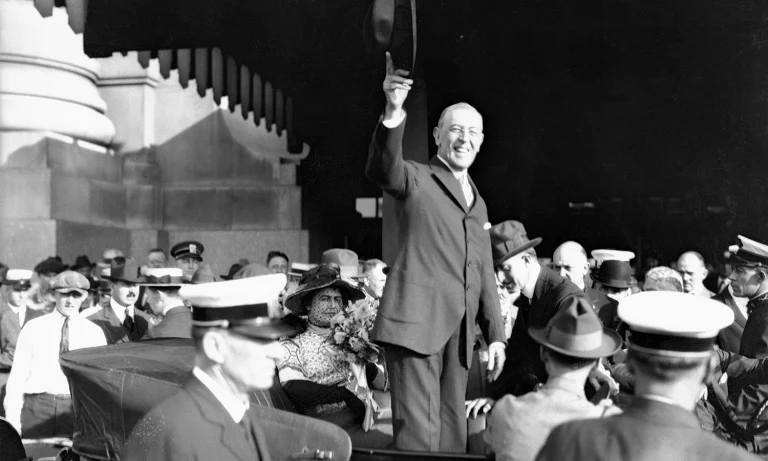
wilson-missouri-GettyImages-515335246-crop_9758964c5
President Woodrow Wilson in St. Louis, Missouri, on a speaking tour to promote the League of Nations on September 6th, 1919. Source: Getty Images.
Analyze debates about neutrality in the leadup to World War I
Overview of Neutrality Acts
This collection of resources facilitates critical analysis of a pivotal moment in U.S. foreign policy history. It contains a brief historical overview, a curated set of primary source documents, a short reading on the aftermath and legacy of the event, and a classroom discussion activity in which learners can synthesize their knowledge.
Should the United States get involved in overseas wars?
In 1917, after Germany began attacking U.S. merchant ships, the United States departed from over a century of neutrality in European conflicts by entering World War I. American military and economic support proved instrumental in securing an Allied victory in 1918.
The war reshaped the international landscape. Nearly ten million soldiers died in combat. Europe’s economies were devastated from years of fighting. Meanwhile, the United States emerged comparatively unscathed. And its economy was supercharged from trading with the belligerents and arming its military. The United States, already the world’s largest economy, was now poised to become a superpower.
As the warring countries negotiated peace terms, policymakers debated what shape the postwar order would take. For Americans, determining what role the United States would play in that order became a crucial foreign policy question in the decades to come.
The Senate Rejects Wilson’s Internationalist Vision
President Woodrow Wilson argued that U.S. participation in World War I would make the world “safe for democracy.” At the end of the war, Wilson saw an opportunity to form an international system defined by cooperation, self-determination, and peaceful resolution of disputes. At the core of Wilson’s vision was a League of Nations that would bring countries together to prevent future conflicts. Wilson negotiated to include the creation of that league into the Treaty of Versailles, which laid out the terms for the settlement of World War I.
But Wilson’s vision met opposition at home. The Senate rejected the Treaty of Versailles, keeping the United States out of the League of Nations. The main point of contention was the concept of collective security embedded in the treaty. It required League members to “respect and preserve” each other’s territorial integrity and sovereignty against external aggression. Many senators argued that provision could force the United States to enter wars against U.S. interests and without congressional approval.
The League of Nations went ahead, but the United States would not be a part of it.
External Web Site Notice: This page contains information directly presented from an external source. The terms and conditions of this page may not be the same as those of this website. Click here to read the full disclaimer notice for external web sites. Thank you.