Home Again in Uniform: A French Immigrant’s Return to Liberate His Homeland
Published: 22 August 2026
By Carl Drake
Special to the Doughboy Foundation website
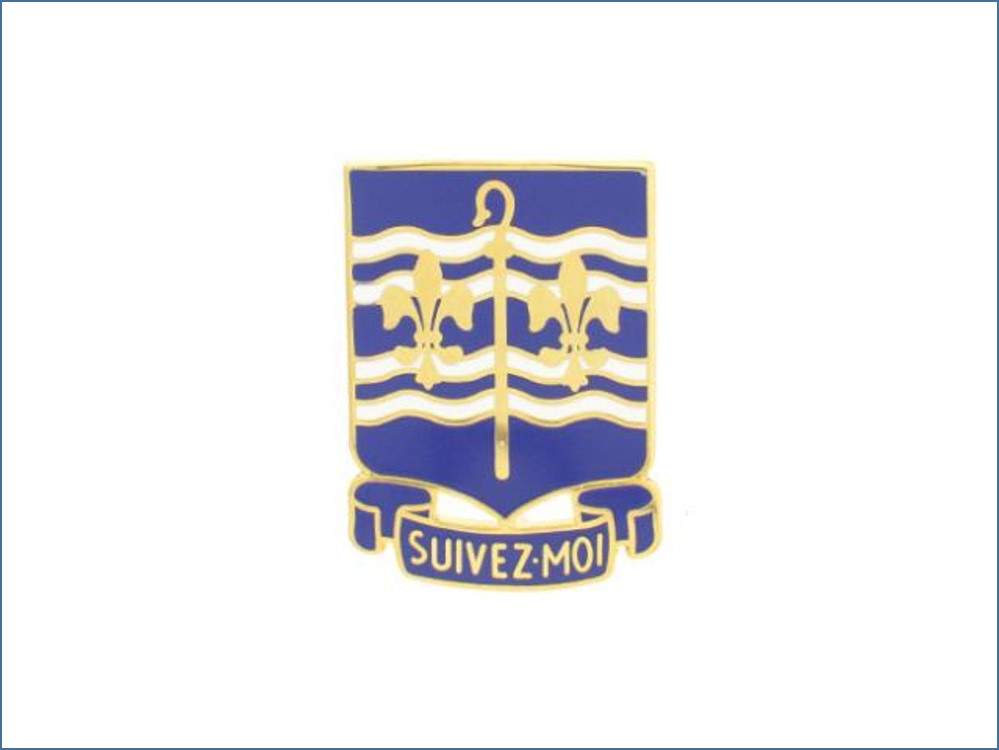
20260711 306th Patch with motto framed
306th Infantry Patch commemorating the liberation of St Juvin, France. Wave lines represent the Aire River crossing, and the shepherd crook of St Juvin.
When Private Marcel Albert Rogissart stepped ashore in France with the American Expeditionary Forces in the spring of 1918, he was returning to a country he knew well. Unlike most of the young Americans around him, France was not a distant ally he had only read about in newspapers—it was home. Born and raised in Charleville, in the Ardennes, Marcel had emigrated to the United States only seven years earlier. Now, wearing the uniform of the United States Army but not yet an American citizen, he had returned to help liberate the homeland he had left as a teenager.
Marcel was born on January 1, 1896, in Charleville, one of the principal industrial cities of northeastern France. Situated just a few miles from the Belgian border, the city prospered through ironworks, railroads, and textile manufacturing. He was the third of eight children born to Joseph Rogissart and Irma Germont, growing up in a close-knit working-class family during a period when relations between France and Germany were increasingly strained. Few could have imagined that the peaceful streets of his childhood would soon lie near one of history’s greatest battlefields.
Seeking greater opportunity, the Rogissart family sailed from Le Havre and arrived at Ellis Island on May 6, 1911. Like thousands of French-speaking immigrants, they settled in Fairhaven and New Bedford, Massachusetts, where thriving textile mills offered steady employment and established French communities eased the transition to American life. Marcel found work in one of the cotton mills, gradually building a new future while learning English and adapting to his adopted country.
On December 7, 1916, Marcel formally declared his intention to become an American citizen. Filing a Declaration of Intention was the first legal step toward naturalization, but it did not immediately change his citizenship. When the United States entered World War I on April 6, 1917, Marcel remained legally a citizen of France.
The Selective Service Act of 1917 required nearly all men between the ages of twenty-one and thirty—including many resident aliens—to register for military service. Citizens of Allied nations that declared intent to pursue citizenship in the United States were subject to the draft, and Marcel answered that call. He registered on June 5th, 1917, and was inducted into the United States Army on February 25th, 1918. Like thousands of immigrants during the war, he pledged his service to the nation he hoped soon to call his own.
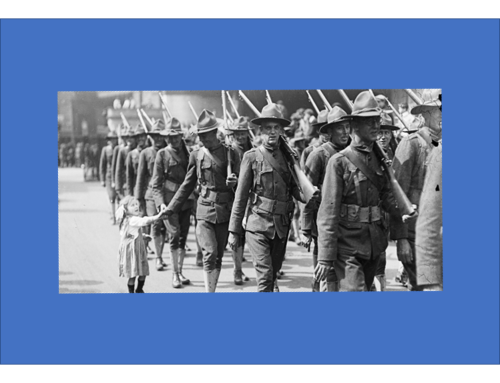
Reporting for duty at Camp Upton on Long Island, Marcel was assigned to Company D, 1st Battalion, 306th Infantry Regiment, part of the famed 77th Division. Known as the “Metropolitan Division,” the 77th was composed largely of New York City draftees whose backgrounds reflected the diversity of America’s immigrant population. Men from dozens of nations served together, united by a common purpose. Marcel’s French birth, once simply part of his identity, now became one thread in the remarkable story of an American division built from immigrants.
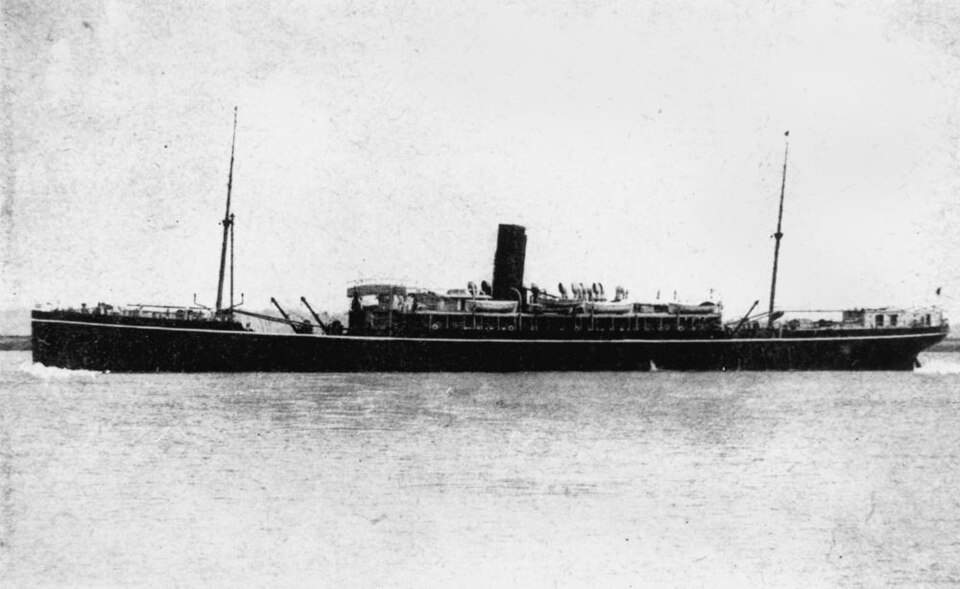
HMS Kashmir, British troop carrier used by the 77th Division in 1918.
The regiment sailed from New York aboard the SS Kashmir in April 1918 and arrived in France later that month. After additional training under experienced British and French instructors, the 306th Infantry entered the trenches in the Lorraine Sector, where its soldiers learned the harsh realities of trench warfare before joining the great Allied offensives of 1918.
For Marcel, returning to France was unlike the experience of any of his American-born comrades. The countryside, language, and customs were already familiar. As the 77th Division advanced across northeastern France during the closing months of the war, Marcel found himself campaigning only a few dozen miles from Charleville, where he had spent his childhood. While there is no surviving evidence that he revisited his hometown or encountered relatives, the geography alone underscores the extraordinary nature of his service. Few Doughboys fought so close to the place where they had been born.
The 306th Infantry’s first combat assignment took it into the Baccarat Sector in the Vosges Mountains, where the regiment relieved the veteran French 42nd Infantry Division in June 1918. For the young American soldiers, many of whom had never before faced an enemy, the experienced French troops offered practical instruction in trench warfare before turning over the line. Marcel’s regiment occupied positions between the villages of Baccarat, Merviller, and Badonviller, a sector often described as relatively “quiet.” That description proved misleading. During the regiment’s first days in the trenches, German forces launched a surprise poison-gas attack that swept across portions of the American line. The attack caused nearly two hundred casualties and gave the men a grim introduction to the realities of modern warfare. Whether Marcel’s company was directly caught in the attack is unknown, but like every man in the regiment, he quickly learned that even a so-called quiet sector offered little safety.
During the weeks that followed, Marcel and his fellow soldiers settled into the relentless routine of trench warfare. Night patrols into no-man’s-land, poison gas alarms, intermittent artillery bombardments, and the constant threat of enemy snipers became part of everyday life. These early experiences transformed the regiment from newly arrived recruits into disciplined combat veterans, providing the hard-earned confidence and battlefield experience they would carry into the larger offensives that followed.
In late August 1918, the 77th Division shifted west to the Vesle River Sector, where the character of the fighting changed dramatically. Around the shattered towns of Fismes and Fismette, the 306th Infantry encountered one of the most fiercely contested fronts on the Western Front. German artillery pounded the American positions relentlessly while machine-gun fire swept the exposed river crossings. Marcel’s company endured these punishing conditions as the regiment fought to maintain its foothold along the Vesle River and press the enemy back toward the Aisne. The costly battles along the Vesle further tested the regiment’s endurance and cohesion, preparing it for the even greater challenges that awaited in the Meuse-Argonne Offensive only weeks later.
Marcel and the 306th Infantry entered the Meuse-Argonne Offensive in late September 1918, participating in one of the largest and bloodiest campaigns in American military history. During the opening week of October, elements of the 308th Infantry Regiment, together with companies of the 307th Infantry and the 306th Machine Gun Battalion, became isolated deep within the Argonne Forest in the action forever remembered as the Lost Battalion. Although Company D was not among the surrounded units, Marcel’s regiment fought continuously on the adjoining front, launching repeated attacks against heavily fortified German positions. These costly assaults fixed German forces in place, prevented reinforcements from concentrating against the isolated battalion, and formed an essential part of the larger operation that ultimately enabled relief forces to reach the survivors on October 7, 1918. Marcel’s service placed him in one of the defining episodes of the American Expeditionary Forces, only about thirty-five miles south of the hometown he had left as a teenager.
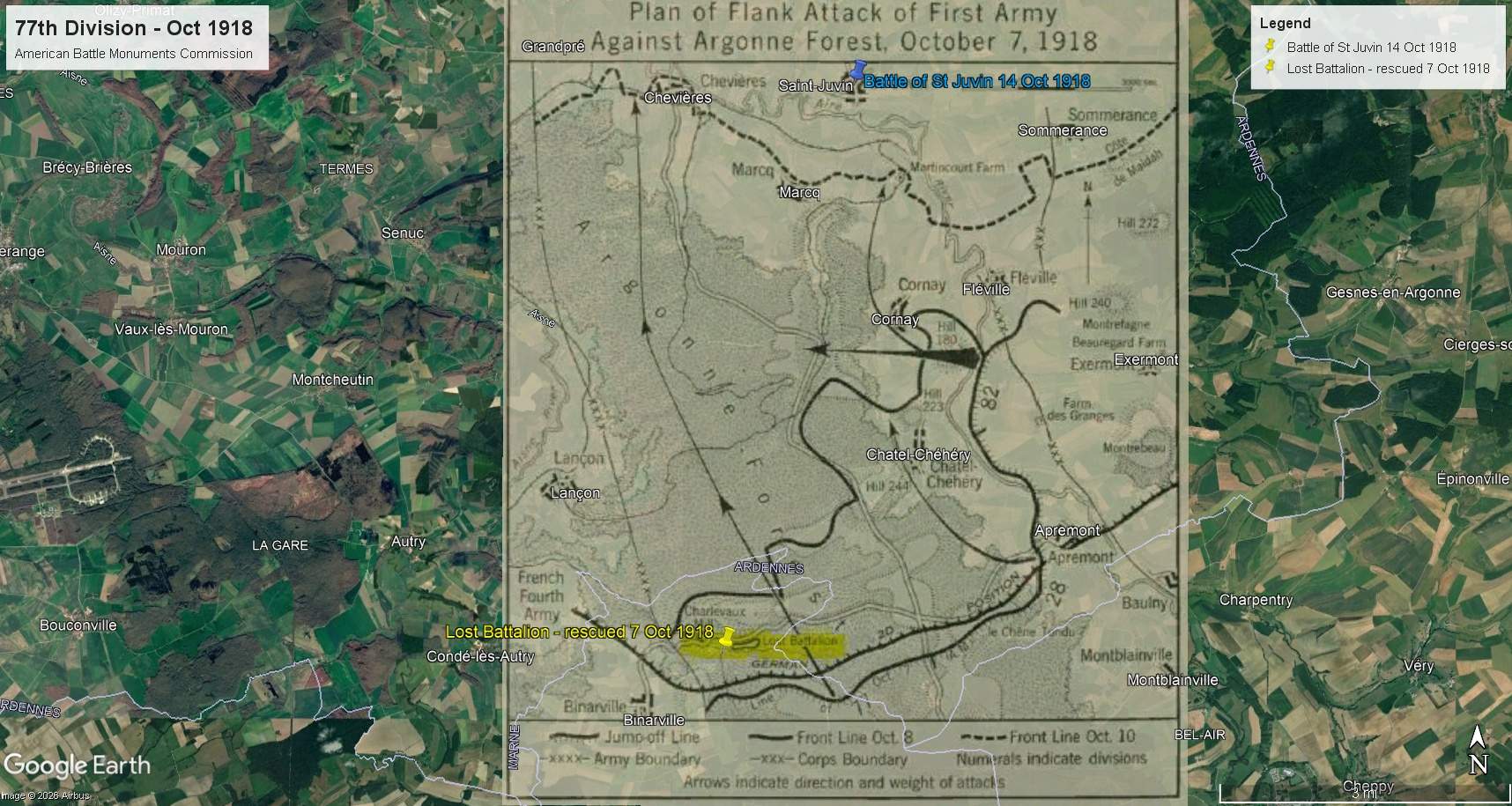
America Battle Monuments Commission map of the 77th Division operations area.
Only a week later, the regiment faced another formidable challenge during the assault on St. Juvin. On October 14, 1918, the 1st Battalion, 306th Infantry led the attack on one of the strongest German defensive positions in the Aire Valley. The battle demanded repeated assaults across the Aire River under intense artillery and machine-gun fire before determined maneuver by neighboring battalions finally secured the village. The victory broke a critical German defensive line and helped open the way for the Allied advance that would end the war less than a month later. Major General Robert Alexander, commanding the 77th Division, praised the courage and endurance of the 153rd Infantry Brigade following the action, recognizing one of the division’s finest battlefield achievements. Marcel’s company was among those whose perseverance contributed to that success.
The victory at St. Juvin remained part of the 306th Infantry Regiment’s identity long after the war ended. When the regiment later adopted its Distinctive Unit Insignia, the design deliberately commemorated the battle. A band of flowing blue water symbolizes the difficult crossing of the Aire River, while the shepherd’s crook—an attribute traditionally associated with Saint Juvin, for whom the village is named—honors the regiment’s capture of the village on October 14, 1918. Together, these elements transformed one of the regiment’s hardest-fought victories into a permanent emblem of its courage and determination. For soldiers like Marcel Rogissart, who crossed the Aire River and fought in the assault, the insignia stands as a lasting reminder of the regiment’s defining achievement during the Meuse-Argonne Offensive.
The guns finally fell silent with the Armistice on November 11, 1918, but Marcel’s military service did not end with the cessation of hostilities. The December 1918 muster roll of the 306th Infantry Regiment records that he became ill and was admitted to a military hospital on December 31, 1918. Although the surviving records do not identify the nature of his illness, his hospitalization extended well beyond the end of the war. Like thousands of American soldiers, Marcel remained overseas as the Army cared for men whose recovery continued after the fighting had ended. Whether his illness resulted from disease, the lingering effects of combat, or the influenza pandemic that swept through military camps during the final months of the war remains unknown. What is certain is that, while many of his comrades were preparing to return home, Marcel’s war continued from a hospital bed.
His prolonged recovery also explains why he did not sail home with the 306th Infantry Regiment. Instead, in May 1919, Marcel returned to the United States aboard the SS Agamemnon as part of a convalescent detachment composed of recovering soldiers from many different units. Even while he traveled separately, the 306th Infantry continued to carry him on its muster rolls until he was formally returned to duty for discharge. He received his honorable discharge on June 11, 1919, and less than six months later, on December 02, 1919, completed the naturalization process he had begun before the war, finally becoming an American citizen. His journey had come full circle—from a French-born immigrant seeking opportunity to an American veteran who had returned to liberate his homeland before officially joining the nation he had served.
The years after the war were spent quietly in Massachusetts, where Marcel resumed work in the textile industry, married, raised a family, and remained active in the community until his death in 1984. His life reflected that of countless veterans who returned from war determined to build peaceful and productive lives, asking for little recognition beyond the opportunity they had fought to preserve.
Today, Marcel Rogissart’s story reminds us that the American Expeditionary Forces were strengthened not only by native-born citizens but also by immigrants who answered the nation’s call before they could legally call themselves Americans. His service represents the intertwined histories of two nations and the enduring ideals of loyalty, sacrifice, and citizenship. Born in the Ardennes, he returned in the uniform of the United States Army to help free the land of his birth. It is a story that deserves to be remembered alongside those of the many Doughboys whose service helped bring the First World War to its close.
Author’s Note:
This article is based on surviving military and civil records. No personal letters, diary, or memoir of Marcel Rogissart is known to exist. Descriptions of the 306th Infantry Regiment’s combat operations are drawn from official histories and are used to provide historical context for his documented service.
The historical research, document collection, source evaluation, and factual analysis for this article were conducted by the author using primary and authoritative historical records. Artificial intelligence (OpenAI’s ChatGPT) was used solely as a writing and editorial assistant to help organize the material into a coherent narrative, improve readability, and refine grammar and style. All historical facts, interpretations, and the final content were reviewed and verified by the author before publication.
Selected Sources:
- 306th Infantry Regiment. History of the 306th Infantry Regiment, 77th Division, A.E.F. (Regimental history).
- 77th Division Association. History of the 77th Division, American Expeditionary Forces.
- United States, World War I Draft Registration Cards, 1917–1918, FamilySearch.
- United States, Enlisted and Officer Muster Rolls and Rosters, 1916–1939, FamilySearch.
- United States Army Transport Service, Passenger Lists, 1918–1919, Fold3.
- United States Veterans Administration Master Index, 1917–1940, FamilySearch.
- Bristol County, Massachusetts, Naturalization Records, FamilySearch.
 Carl Drake is a retired Air Force Major who has worked as a defense contractor in the Washington, DC, region for the past twenty years. An avid amateur genealogist, he has spent nearly thirty years documenting family history for his children, with a special interest in the lives of the veterans who came before him.