“Hello Girls”: Edith Dodson and the forgotten heroes of the Great War
Published: 11 September 2026
By Axel Henning
Commissioner NSB – section Booischot
via the Royal National Veterans’ Association of Belgium magazine
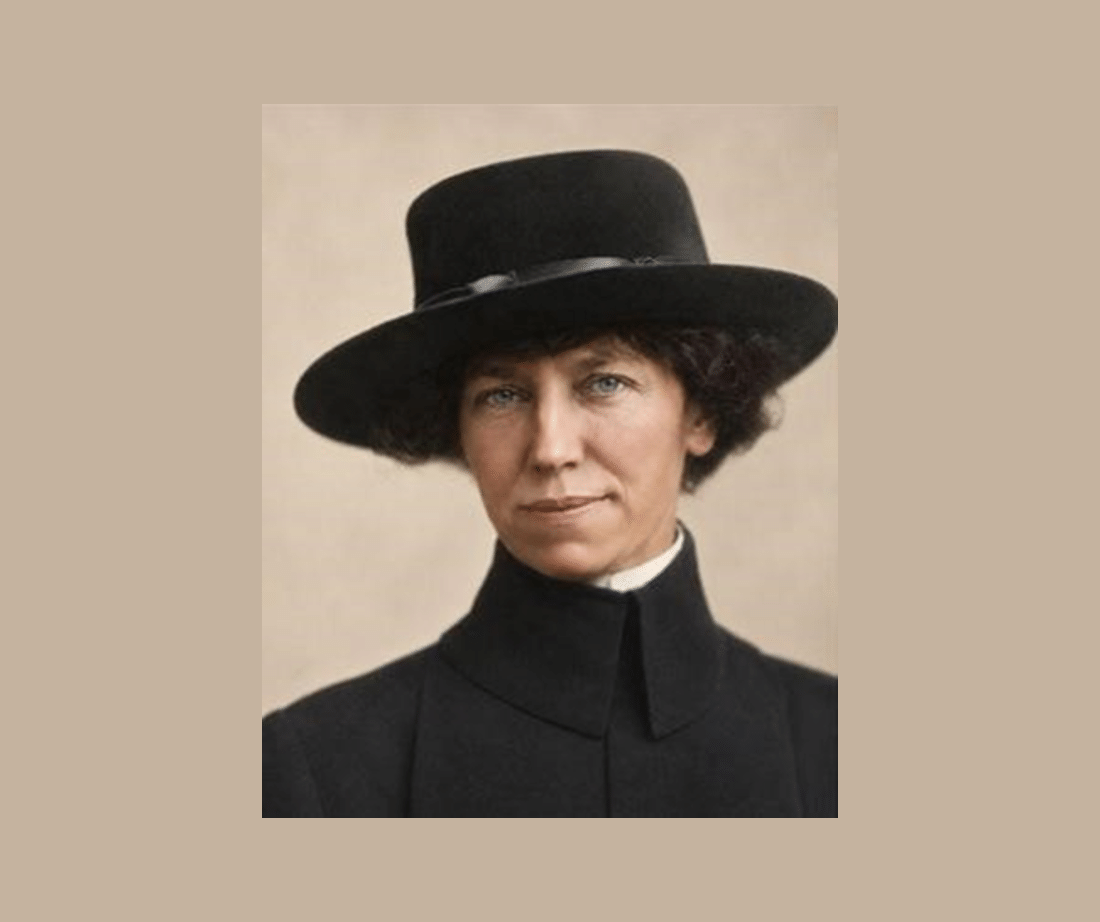
Edith Dodson header image
(Author’s note: With special thanks to Ann Dodson, a second cousin of Edith Dodson, who told me of this fascinating story and provided me with some texts and visual material.)
When we speak of First World War veterans, we instinctively think of soldiers in the trenches, artillerymen at the front or pilots flying over the battlefields. Yet modern warfare was also fought across thousands of kilometers of telephone wire. Behind these communication networks stood men and women who ensured that orders, distress calls and operational instructions reached their destination. One of them was Edith Georgina Annette Dodson, born in Bruges on January 23, 1886. She was my wife’s great-aunt. Edith’s life story takes us from a British family in Bruges to the military headquarters of General John J. Pershing in France, where – as a member of the legendary “Hello Girls” – she made a modest yet vital contribution to the Allied victory. It was not until decades after her death that the world would finally give her and her colleagues the recognition they deserved.
A woman from Bruges with British roots
Edith Georgina Annette Dodson was born on January 23, 1886, in Bruges. Although she was born in Belgium, her parents were British subjects. Her childhood was marked by early loss. When Edith was barely fifteen months old, her mother died shortly after giving birth to her brother. The upbringing of both children subsequently fell to their grandmother, Annette Thorp, who raised them in Bruges within a British family culture.
Edith received a solid education and grew up in a multilingual environment. She spoke fluent English and French and also knew Dutch. At the time, this seemed like nothing more than a practical advantage. Later, that very knowledge of languages would grant her access to a unique position within the U.S. Army.
In 1911, at the age of 25, Edith decided to try her luck in the United States. She left for New York, where her uncle John Townshend – a successful lawyer – lived. Sadly, he passed away while Edith was on her way to America. Despite this setback, she remained in New York and built a life for herself independently. She worked as a secretary for the French Commission and also gave French lessons, making her an independent career woman at a time when such a role was far from the norm.
General Pershing seeks a solution.
When the United States actively entered the war in Europe in 1917, the American army faced a serious communication problem. Military communications at the front in France were in complete disarray. The male American soldiers operating the telephone switchboards were slow and got stressed out when officers shouted at them. Moreover, they did not speak French, which made effective cooperation with their French allies extremely difficult, if not impossible.
When General John J. Pershing, commander of the American Expeditionary Forces (AEF), determined that communication problems were hindering the war effort, he recognized the need for skilled telephone operators. A vital change and an unconventional solution were urgently needed. He explicitly requested bilingual female operators who were fluent in both English and French. After all, women in civilian life already had years of experience operating telephone switchboards. Indeed, women were far faster and more professional at this task: while it took a man an average of one minute to establish a connection, women did so in just 10 seconds. Their speed, precision and discipline made female operators exceptionally wellsuited for this military role.
Thousands of women applied. The selection process was rigorous. Candidates had to be not only bilingual but also technically competent, physically fit and trustworthy enough to handle confidential military communications. Even their backgrounds were thoroughly checked, as they would have access to sensitive operational information.
For Edith Dodson, this was a golden opportunity. With her perfect command of English and French, she fit the exact profile General Pershing was looking for.
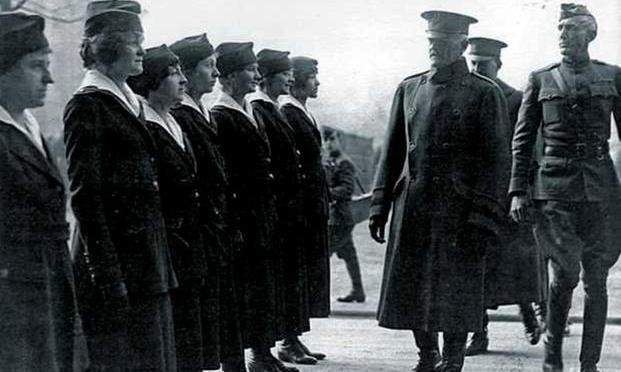
General John J. Pershing inspects the Hello Girls in France. Pershing was in urgent need of skilled telephone operators and called upon the army to recruit these women, despite strong opposition within the ranks (U.S. Department of Defense archives).
An oath to the army
On her thirty-second birthday, January 23, 1918, Edith took the oath of the American Army and joined the U.S. Army Signal Corps as a telephone operator.
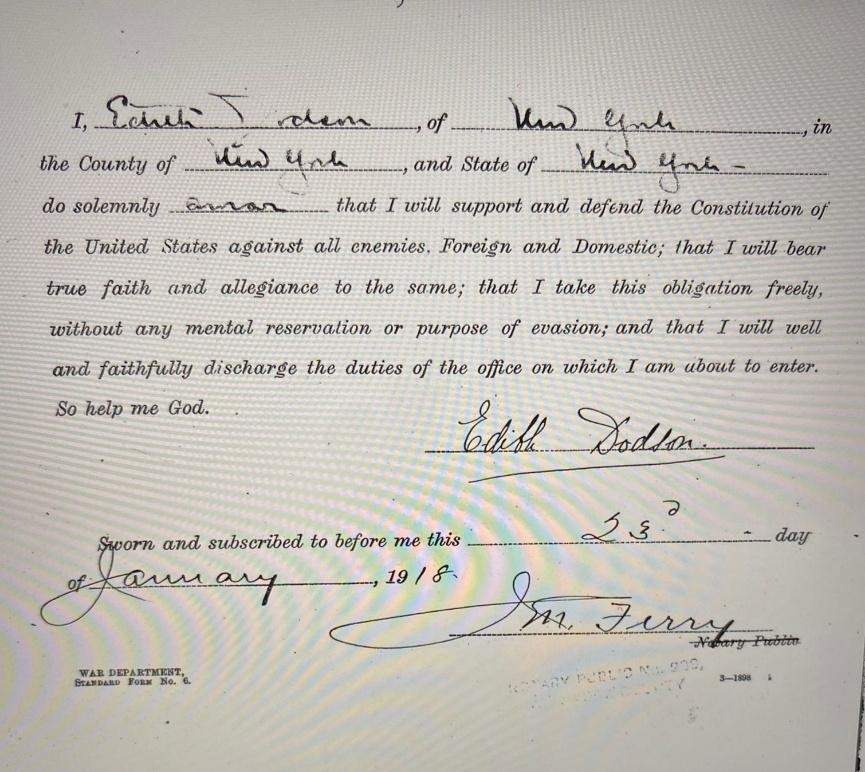
The military oath Edith Dodson took, coincidentally on her birthday (family archive).
She was part of the second group of operators (Group 2) led by Chief Operator Inez Crittenden. On March 29, 1918, her contingent departed for France aboard the RMS Carmania.
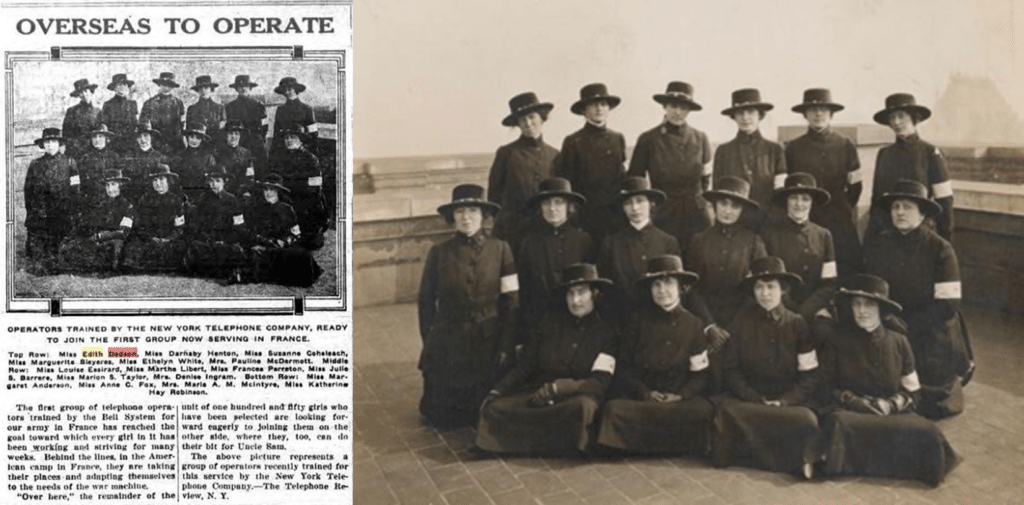
(left) A group of U.S. Army Signal Corps telephone operators trained by the New York Telephone Company shortly before their departure for France in 1918 (National Archives Catalog). (right) Edith Dodson is the first person on the left in the top row.
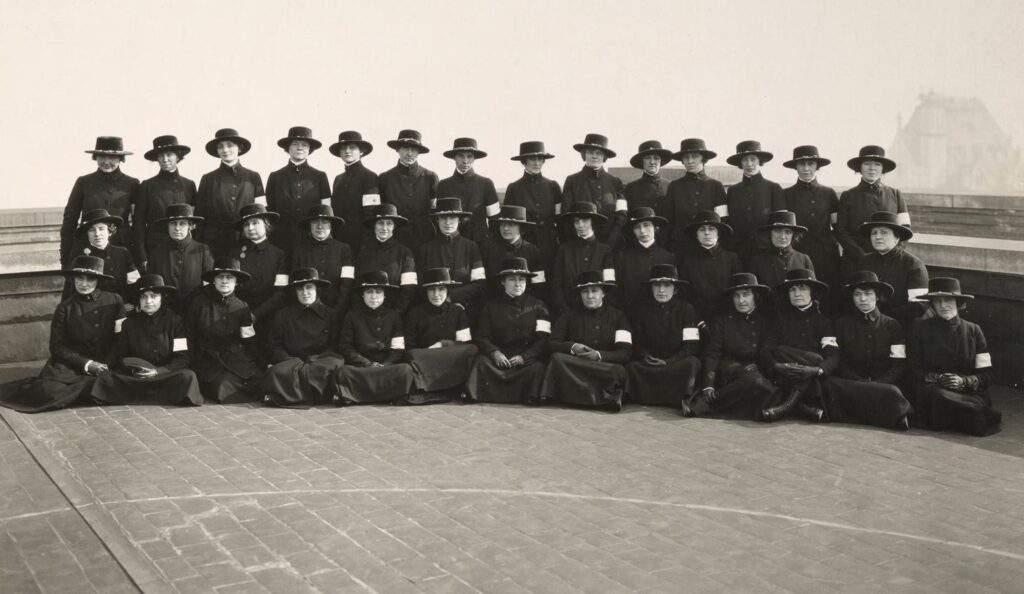
Group photo of Female Telephone Operators Unit 2 of the U.S. Army Signal Corps, also known as the “Hello Girls” (National Archives Catalog). The women had to purchase their own uniforms and were not reimbursed for them by the U.S. Army. Edith Dodson is in the top row, second from the left.
The women were officially incorporated into the military organization, wore uniforms, were subject to military discipline and received assignments within the army’s chain of command. No one doubted that they were part of the war effort. However, the legal reality would later prove to be different.
The nerve center of the American war machine
Edith was stationed in Tours, one of the key logistical hubs of the American Expeditionary Forces. Tours served as the administrative and logistical heart of the U.S. Army in France. This city handled supply lines, troop movements and a vast portion of military communications.
Every day, Edith sat at the switchboards connecting headquarters, depots, railway junctions and operational units. Messages regarding troop movements, supply issues and operational orders passed through her hands. The work demanded constant concentration. A wrong connection could cause delays, result in the transmission of an incorrect message or even cost lives.
Although the Hello Girls were generally not stationed in the front-line trenches, some worked just a few kilometers from the front. The entire group operated under wartime conditions, facing the constant threat of bombardment, gas attacks, disease and extreme workloads. The work was relentless. Long days. Telephone switchboards ringing endlessly. Urgent calls from wounded soldiers, commanders and military personnel navigating the chaos of war.
Some operators handled thousands of calls each day.
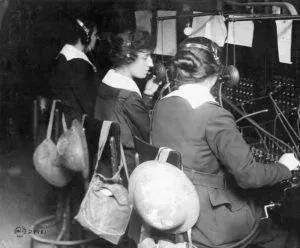
Some “Hello Girls” in a forward sector near the front in France in 1918. The women have helmets and gas masks in bags hanging from the backs of their chairs (National Archives Catalog).
During the major offensives of Saint-Mihiel and the Meuse-Argonne, telephone communications played a crucial role in the coordination of Allied operations.
By the end of the war, the Hello Girls had connected more than 26 million calls in support of the war effort, and they even continued to serve in Europe to help organize the return of American troops following the armistice. More than 30 Hello Girls received individual decorations and two made the ultimate sacrifice for their country during their military service.
Their contribution was so significant that General Pershing later personally expressed his appreciation for the achievements of the female telephone operators.
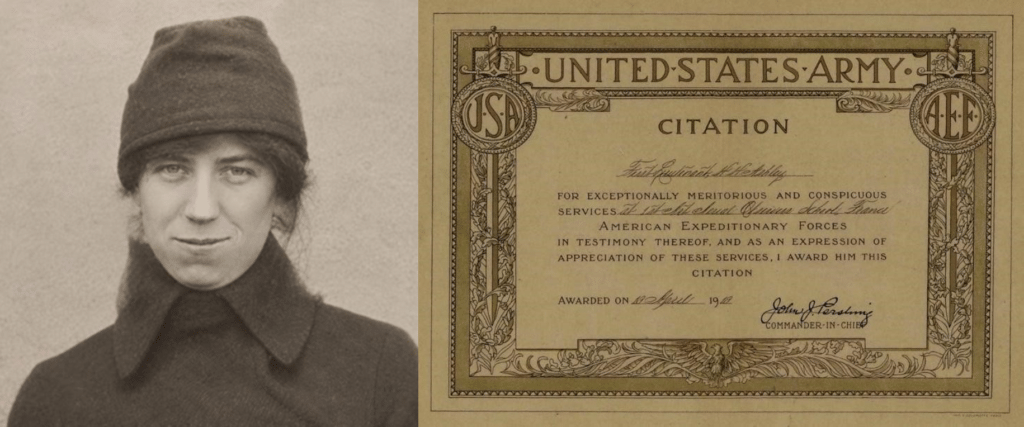
(left) Edith Dodson in her work uniform as a “Hello Girl” (family archive). (right) A formal personal appreciation from General Pershing to one of the “Hello Girls” (National Air and Space Museum, Smithsonian Institution). Note that the pre-printed text of this certificate of appreciation envisaged only male military personnel.
A voice lost, but not her commitment
In August 1918, Edith was forced to give up her job as a telephone operator. The heavy workload had led to a complete loss of voice. For someone who established hundreds of connections daily, this was a particularly serious handicap.
Yet this did not mark the end of her wartime service. Edith remained in France and took a position as Assistant Director of the YWCA residence for female U.S. Army Signal Corps personnel in Tours. There, she supported the women working for the American communications services. Once again, she chose to continue serving where she was needed most.
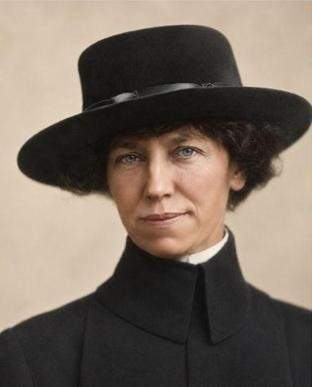
Colorized photograph of Edith Dodson in her formal navy blue military uniform, wearing the characteristic hat (family archive).
A forgotten veteran
After the war, Edith returned to New York. She worked as a French teacher and held various administrative positions to support herself. She became a U.S. citizen in 1938. Her life was that of a hardworking single woman who consistently managed to adapt to changing circumstances.
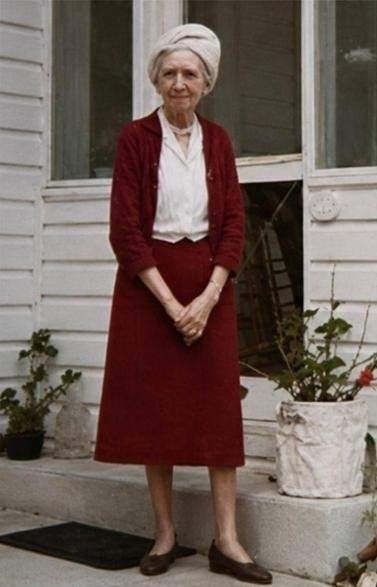
Edith Dodson as a spirited woman over 75 (family archive).
Yet a bitter aftertaste remained. Despite serving within a military hierarchy, taking the military oath, wearing uniforms, being subject to courts-martial and serving in a war zone, the “Hello Girls” were not granted veteran status. The U.S. government classified them as civilian personnel because the legislation of the First World War did not provide for female soldiers. Consequently, they were denied the benefits and recognition that their male counterparts received.
In 1939, Edith herself wrote to the office of the Deputy Commanding General to have her wartime service confirmed. She hoped for recognition and some financial support. Like so many of her colleagues, however, her request was denied.
The years went by. Edith continued working, even into old age. She never married and had no children. In June 1970, she moved to a boarding house in Queens, New York. On September 9 of that same year, she passed away peacefully there at the age of 84. She would never live to see the official recognition she had hoped for.
Sixty years of fight for justice
The former Hello Girls did not accept their exclusion. For nearly sixty years, they campaigned for recognition of their military service. More than fifty bills were introduced in the U.S. Congress before their cause finally succeeded.
It was not until 1977 that President Jimmy Carter signed the law officially recognizing the Hello Girls as U.S. Army veterans. For most, that decision came too late. Only eighteen of the original telephone operators were still alive to witness this historic victory.
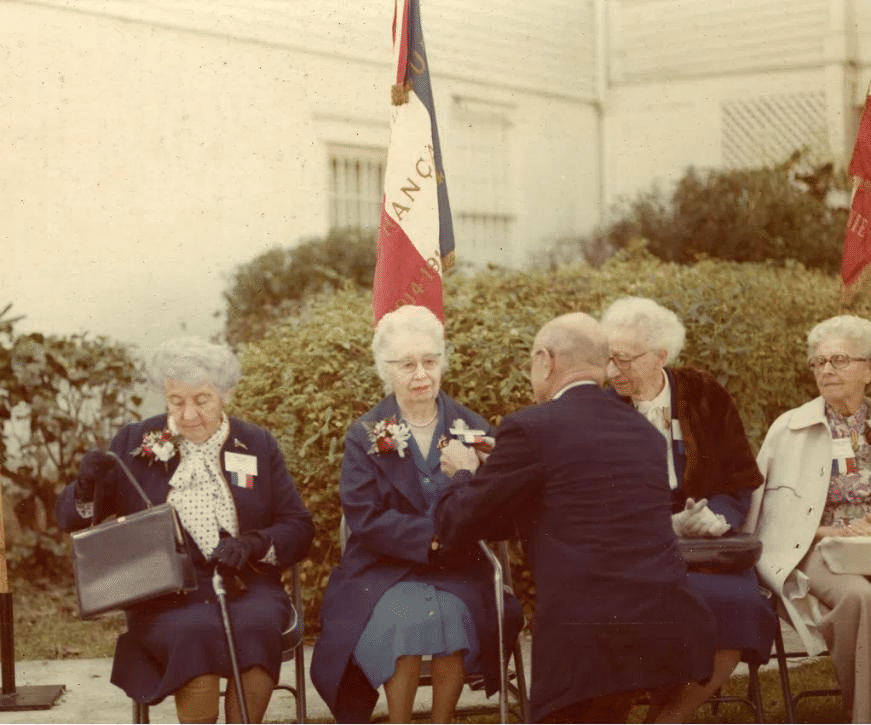
On November 11, 1979, during a ceremony at the Presidio Army Museum in San Francisco, some of the surviving “Hello Girls” received the long-awaited World War I Victory Medal – an official U.S. decoration for military personnel who had served during the First World War (Museum of the American G.I.).
Restoration of reputation after more than a century
It did not stop there. In December 2024, President Joe Biden signed the law awarding the Congressional Gold Medal – one of the highest civilian honors in the United States – to the “Hello Girls.” With this, the 223 female telephone operators finally received national recognition for their exceptional contribution to the Allied victory in World War I.
For Edith Dodson, this tribute came well over half a century after her death. Yet today, she has finally been given the recognition she deserves: that of a pioneer, a military communications specialist and a woman who dedicated her talents to a cause greater than herself.
A gravestone, a name and a lasting memory
Edith Dodson’s story did not end with her death in 1970. Quite the contrary. More than a hundred years after she served her country and more than half a century after her death, her legacy continues to inspire new generations.
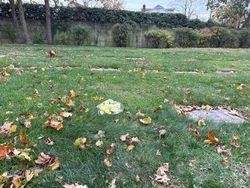
The unmarked grave of Edith Dodson at Maple Grove Cemetery (Find A Grave). A bouquet of flowers lies on the spot.
For a long time, Edith rested in an unmarked grave at the historic Maple Grove Cemetery in Kew Gardens, Queens, New York. Nothing indicated to a casual visitor that a woman was buried there who, during the First World War, had been part of one of the most remarkable military units of her time.
Thanks to research by family members – specifically her second cousin Jean Bearda – Edith’s military service was brought back into the spotlight. That initiative led to a major breakthrough: the U.S. Department of Veterans Affairs approved an official bronze military grave marker for Edith Dodson. This finally grants her the same visible recognition as other American veterans.
An official commemorative ceremony is being prepared for the spring of 2027. The ceremony is being organized in collaboration with Maple Grove Cemetery, the Friends of Maple Grove Cemetery, representatives of the Dodson family, the Department of Veterans Affairs and the Hello Girls Military Honors and Remembrance Project (M-HARP). Veterans, historians, researchers, descendants of the Hello Girls and representatives of heritage organizations will be involved in the event.
The commemoration coincides with a period of rapidly growing interest in the Hello Girls. Not only have they recently been awarded the Congressional Gold Medal, but documentaries, historical publications and even a musical have also brought their story back into the spotlight.
The fact that a woman born in Bruges in 1886 – who served in France in 1918 and died in New York in 1970, virtually forgotten – will finally be officially commemorated with military honors in 2027 is a remarkable illustration of how history sometimes works. Recognition does not always come in time, but ultimately, justice can be done to those who deserve it.
Where Edith rested in anonymity for years, a military memorial plaque will henceforth bear witness to her service, her sense of duty and her contribution to the Allied victory. In doing so, her story literally secures a place in posterity.
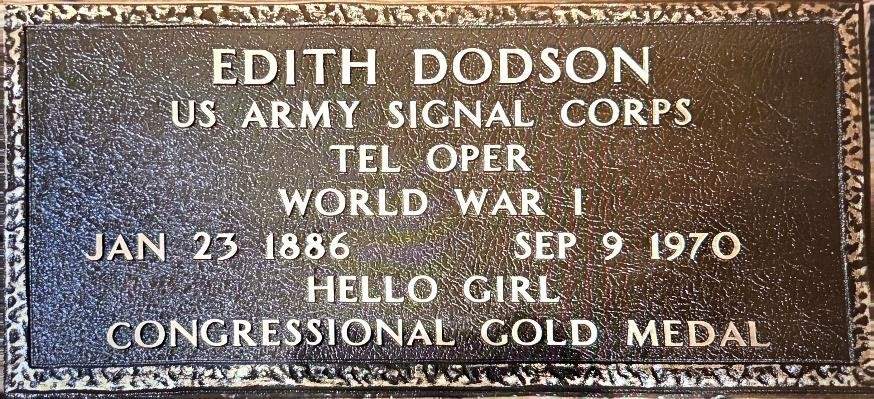
Next year, a bronze military memorial plaque will gratefully mark Edith Dodson’s grave (family archive).
Finally
Edith Dodson’s story is much more than a fascinating family history. It is the story of a woman from Bruges who, thanks to her language skills and perseverance, became a vital link in the U.S. Army’s communication network during the Great War.
She belonged to a generation of women who pushed the boundaries of their time. Without the Hello Girls, orders would have been delayed, operations would have been harder to coordinate and cooperation between the Allied armies would have been less efficient.
For an association like the Royal National Federation of Veterans of Belgium (NSB), which keeps the memory of our veterans alive, Edith Dodson is therefore a particularly valuable figure. She did not carry a rifle or lead a bayonet charge. Her weapon was a telephone switchboard, and her strength lay in her command of languages, discipline and sense of duty. Yet, as is so often the case in wartime, it is precisely those less visible contributions that prove to be of inestimable value.
From Bruges to France, from forgotten switchboard operator to recognized and decorated veteran: Edith Dodson’s life story undoubtedly deserves a place in our military history.
Sources and further reading
Primary and specialized sources
- Hello Girl, Edith Dodson, A Long Life Well Lived As A Strong Independent Women, one page overview, family archive.
- Press release, Maple Grove Cemetery to Honor Forgotten WWI “Hello Girl” Edith “Doddie” Dodson With Military Grave Marker and 2027 Memorial Ceremony, family archive.
- Wikipedia, search term ‘Hello Girls WW1’, https://en.wikipedia.org/wiki/Hello_Girls.
- National Geographic, The ‘Hello Girls’ helped win WWI – why was their service overlooked?, https://www.nationalgeographic.com/history/article/hello–girls–wwitelephone–unit–signal–corps–france.
- The Collector, The Hello Girls of World War I, https://www.thecollector.com/hellogirls–world–war–i/.
- America Comes Alive ! – Great Stories, Simply Told, WWI: U.S. Recruits Women Operators, https://americacomesalive.com/wwi–u–s–recruits–women–operators/.
- Eric Saul, Director/Curator Presidio Army Museum, J’Ecoute: The Story of U.S. Army Signal Corps Telephone Operators in World War I, http://www.easaul.com/jhtml.
- Find A Grave, search terms ‘Edith’, ‘Georgina’, ‘Dodson’, ‘born in 1886’, https://nl.findagrave.com/memorial/287372742/edith–georgina_annette–dodson.
Official and institutional sources
- U.S. Department of Veterans Affairs The Hello Girls’ Quest for Veteran Recognition https://department.va.gov/history/hello–girls/.
- U.S. World War I Centennial Commission, search term ‘Hello Girls’, https://www.worldwar1centennial.org.
- Library of Congress, search term ‘Hello Girls’, https://www.loc.gov/search/?in=&q=Hello+Girls&new=true.
Historical organizations
- Doughboy Foundation, ‘Hello Girls’: The Female Telephone Operators Who Helped Win WWI, https://doughboy.org/hello–girls–the–female–telephone–operators–whohelped–win–wwi/.
- Doughboy Foundation, For 60 Years the Hello Girls Fought for Veterans Status, https://doughboy.org/for–60–years–the–hello–girls–fought–for–veterans–status/.
- Museum of the American G.I., ‘Hello Girls’: The U.S. Signal Corps Women of World War I, https://americangimuseum.org/hello–girls–the–us–signal–corps–women–ofworld–war–i/.
Official recognition Congressional Gold Medal
- U.S. Congress – Congressman Emanuel Cleaver’s Bill to Honor WWI “Hello Girls” Signed Into Law, https://cleaver.house.gov/media–center/pressreleases/congressman–cleavers–bill–honor–wwi–hello–girls–signed–law.
- Senate Bill S.815 – A bill to award a Congressional Gold Medal to the female telephone operators of the Army Signal Corps, https://www.congress.gov/bill/118thcongress/senate–bill/815.
- House of Representatives Bill H.R.1572 – To award a Congressional Gold Medal to the female telephone operators of the Army Signal Corps, https://www.congress.gov/bill/118th–congress/house–bill/1572/text.
Recommended book and other media
- Elizabeth Cobbs, The Hello Girls: America’s First Women Soldiers, Harvard University Press, 2017.
Today, this book is considered the standard work on the Hello Girls and is highly recommended for anyone wishing to take a deeper dive into the story of Edith Dodson and her fellow telephone operators. - MPT Documentary ‘The Hello Girls’, https://www.pbs.org/video/the–hello–girlssmfkeu/.
- A New American Musical, ‘The Hello Girls’, https://www.theatermania.com/news/the–hello–girls–is–a–new–musical–about–areal–female–army–unit–in–world–war–i_87201/.
External Web Site Notice: This page contains information directly presented from an external source. The terms and conditions of this page may not be the same as those of this website. Click here to read the full disclaimer notice for external web sites. Thank you.