Charles Whittlesey and His Ancestors Have Left Lasting Contributions to American Life
Published: 31 August 2026
By Philip R. Devlin
via the Roads to the Great War website
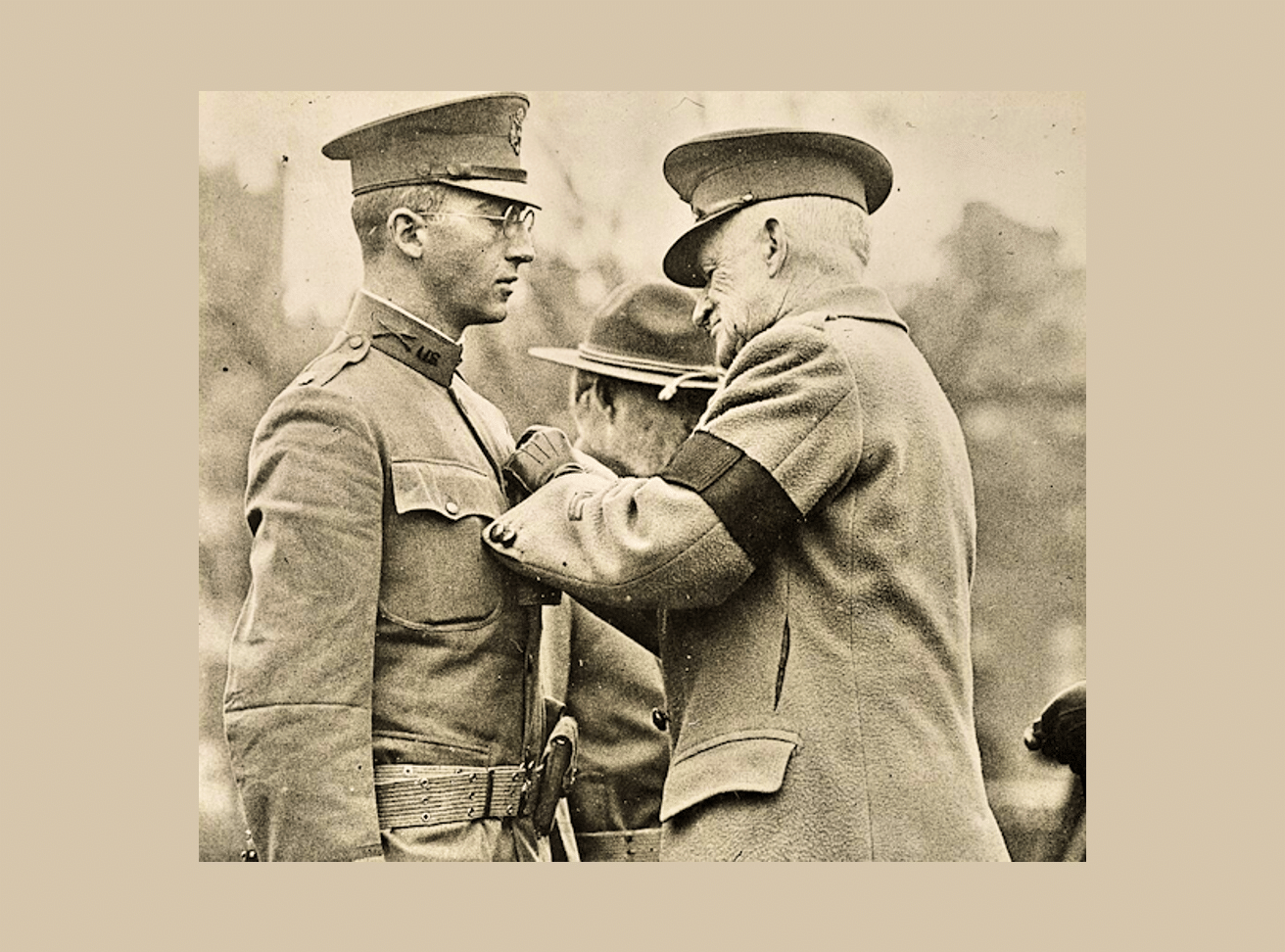
Major General Clarence R. Edwards pinning the Medal of Honor on Lieutenant Colonel Charles W. Whittlesey
Major General Clarence R. Edwards pinning the Medal of Honor on Lieutenant Colonel Charles W. Whittlesey, Boston Common, 24 December 1918
Few stories of World War I are better known than the story of the Lost Battalion, a unit in the 308th Infantry of the 77th Division commanded by Major Charles W. Whittlesey. Numerous books and at least two movies exist to tell the dramatic story of the Lost Battalion. Few people realize, however, the remarkable story of the Connecticut 17th Regiment during the Battle of Long Island on 27 August 1776. Like Major Whittlesey’s World War I unit, the Connecticut 17th, a unit of about 300 men, was cut off from the rest of its army. It was surrounded by thousands of British and Hessian soldiers; nevertheless, the 17th inflicted more casualties on the enemy that day on Battle Hill than any other patriot unit. Most importantly, it guarded the flank of the Maryland 400, enabling that valiant unit’s rearguard action to effect the successful retreat of Washington’s army from Brooklyn.
One member of the Connecticut 17th was Private Duren Whittlesey of Haddam, Connecticut, a third cousin four generations removed from Major Charles W. Whittlesey. It is simply an amazing historical coincidence that these distant cousins, both directly descended from John and Ruth Whittlesey, 17th-century settlers of Old Saybrook, Connecticut, found themselves in desperate, parallel circumstances in their respective wars.
Major Whittlesey’s battalion of 554 men was ordered to attack a heavily fortified German line on 2 October 1918, during the Meuse-Argonne campaign. When French units on either side of the 308th withdrew under heavy fire, Whittlesey’s unit was cut off in the Charlevaux Ravine in the Argonne Forest and surrounded by German attackers. The 308th refused to surrender and withstood withering attacks for five days—including friendly fire—before being rescued. Just 194 men of the battalion were able to walk out of the ravine.
Following his unit’s valiant five-day ordeal, Major Charles W. Whittlesey was promoted to lieutenant colonel and was awarded the Congressional Medal of Honor. Feeling personally responsible for the loss of so many of his men, he was besieged by both survivor guilt and incessant media attention for being a hero. Whittlesey finally died by suicide in 1921, jumping off the stern of a boat bound for Havana, Cuba. The Williams College and Harvard Law School graduate was only 37 years old.
Private Duren Whittlesey (1726-1776) was raised in Old Saybrook, but he spent his adult life in Haddam, Connecticut, raising five sons and contributing to the local community as both a farmer and a tradesman. (Whittlesey is a DAR Patriot Ancestor #A125571.) Duren Whittlesey died as a result of the Battle of Long Island (sometimes also called the Battle of Brooklyn.) The exact circumstances of his death are unknown. He may have died on the battlefield; more likely, he died in captivity as a POW under the brutal circumstances of the notorious British prison ships in New York.
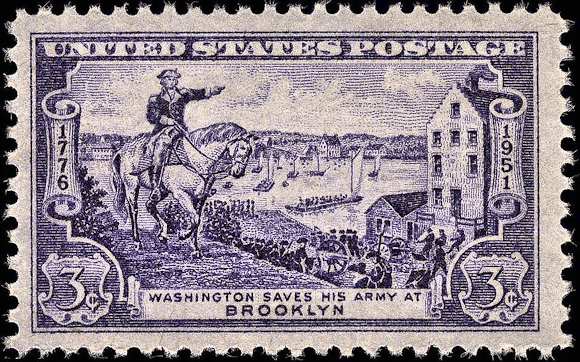
Commemorative Stamp for the Battle of Brooklyn (Long Island)
The small town of Haddam, Connecticut, paid a severe price during the American Revolution, losing 35 of its soldiers. Private Duren Whittlesey was one of 19 men from Haddam who died as a result of the Battle of Long Island, the largest open field battle of the entire American Revolution. It should be noted also that two of Duren’s nephews, John and Stephen Whittlesey, were both killed in action during the Fort Griswold Massacre in Groton on 6 September 1781, an attack that was led by General Benedict Arnold. John was 23 and was bayoneted to death; Stephen, just 16, was shot through the forehead. Duren’s cousin, Captain Asaph Whittlesey, served with the 24th Connecticut Militia Regiment and was killed in Pennsylvania in the infamous Wyoming Valley Massacre on 3 July 1778. Asaph’s brother, Martin, was with Washington in the defense of New York where he suffered a wound so severe that he collected an invalid pension for the rest of his life. Wars have indeed taken a heavy toll on the Whittlesey family.
⇒ Read the entire article on the Roads to the Great War website here:
External Web Site Notice: This page contains information directly presented from an external source. The terms and conditions of this page may not be the same as those of this website. Click here to read the full disclaimer notice for external web sites. Thank you.