America’s Forgotten Doughboys: The 332nd Infantry Destroyed an Empire
Published: 13 January 2026
By Allen Frazier
via the Military.com website
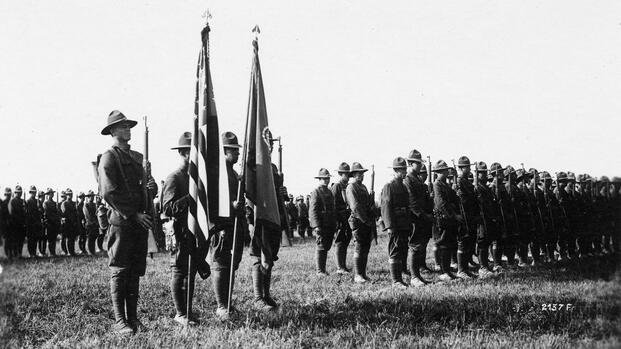
ganfardine_1aug1918_troops.jpeg
The men of the regiment formed up during a formal ceremony in Italy during WWI. (World War I Centennial)
While millions of Americans can name Western Front battles like Belleau Wood or the Meuse-Argonne, almost no one remembers the 332nd Infantry Regiment. These Ohio doughboys were the only American combat unit to fight against the Central Powers in a WWI theater outside of France and helped end the war in Italy.
The regiment formed at Camp Sherman, Ohio, on August 30, 1917. Its ranks filled with men from Cleveland, Akron, and Youngstown. They trained through Ohio’s brutal winter at Camp Perry near Toledo, enduring mud, freezing rain, and even a smallpox scare.
They expected to join the fight in France. Instead, they got orders that would make them one of the most unique units in American military history.
General John Pershing refused to scatter American forces or let them fall under the command of Allied nations. He opposed sending troops anywhere but the Western Front. But Italy was desperate.
The disaster at Caporetto in October 1917 had nearly knocked Italy out of the war. Austrian and German forces had smashed through Italian lines, capturing nearly 300,000 prisoners and pushing the front back to the Piave River. Italian morale collapsed.
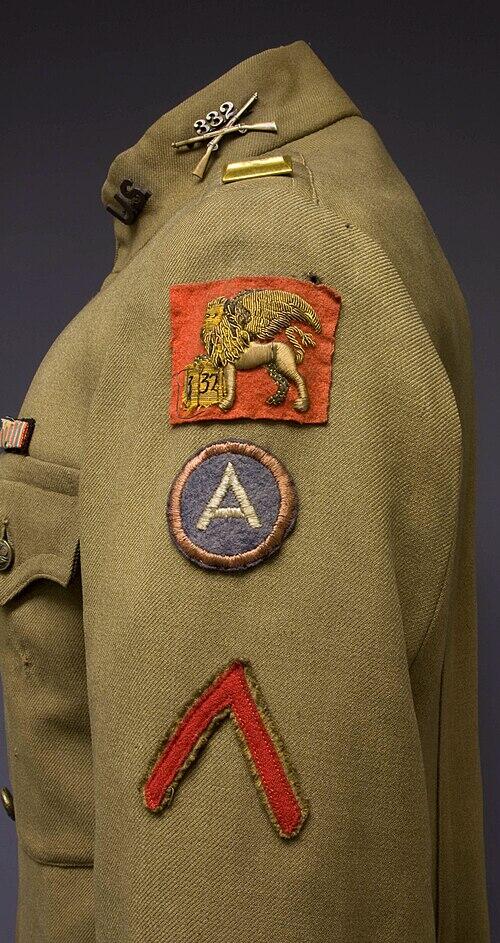
Detail of a Lieutenant’s uniform from the regiment showing the famous 332nd Infantry Regiment Lion of Saint Mark, and Army of Occupation shoulder sleeve insignia. Courtesy United States Army Center of Military History.
Pershing’s “Propaganda Regiment”
At a tense Supreme War Council meeting in May 1918, Italian officials begged for American troops. Not divisions. Just one regiment. Enough to show the Italian people that America stood with them, and enough to make the Austrians worry.
Pershing reluctantly agreed. He selected the 332nd Infantry Regiment, commanded by Colonel William Wallace, a veteran of the Spanish-American War. On June 8, 1918, the regiment boarded the RMS Aquitania in New York. When they reached France, Pershing and French Prime Minister Georges Clemenceau reviewed them. Clemenceau praised their military bearing. Days later, Wallace received his orders.
“Your regiment has been selected to go to Italy,” the chief of staff told him. Wallace later called it a prize coveted by every officer and man in France.
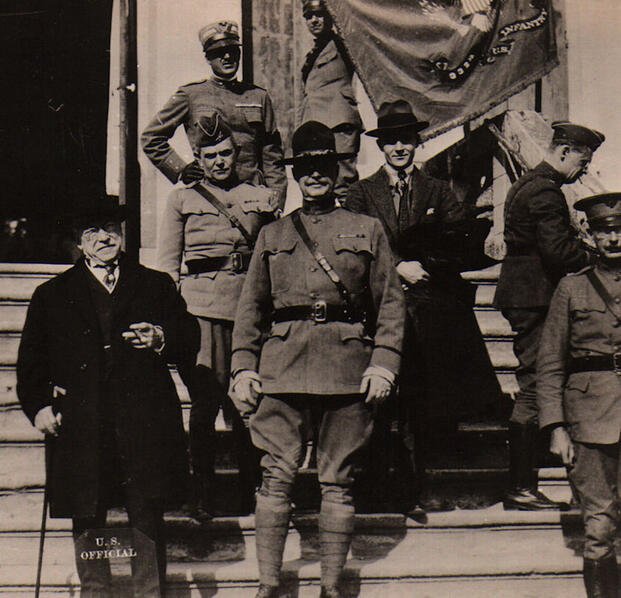
Mr. Samuel Gompers, the famous labor leader, poses for a photograph in front of an Italian villa with Colonel William Wallace, the commander of the 332nd Infantry Regiment, and Brigadier General Charles Treat. Note the 332nd Colors in the background. 12 October 1918. Courtesy National Archives.
The 332nd reached northern Italy in late July 1918. About 4,000 soldiers and 125 officers arrived at Villafranca di Verona. King Victor Emmanuel III personally inspected them on August 1. The Italians welcomed them as saviors. Crowds cheered “Viva l’America!” as they marched through their towns.
Commander of the Italian Army, Gen. Armando Diaz, praised the arrival of the Americans in his order of the day to his forces.
“These strong troops have come today to fight by our side and I, in your name, welcome them with faith in the future, in our brotherly union of arms, and in our mutual successes,” he said.
The Americans were amazed at the reception they received and the scenery surrounding them. One American soldier, Enoch Gunter, expressed his admiration for the land in a letter to his father.
“In the land of song! And it is really the most beautiful place one could imagine,” he said. “Had a fine trip through the Alps and saw some of the most famous resorts in the world. The scenery is so wonderful that one would have to see it to really know how beautiful it is.”
The men soon set up their camps, including Camp Wallace, and prepared for battle. But the 332nd’s main mission wasn’t just fighting. It was grand military deception.
⇒ Read the entire article on the Military.com website.
External Web Site Notice: This page contains information directly presented from an external source. The terms and conditions of this page may not be the same as those of this website. Click here to read the full disclaimer notice for external web sites. Thank you.