WWI Memorial holds hidden history more than 100 years later
Published: 11 November 2026
By Ceara Hunsaker
via the WSAW elevision station (WI) website
WSAW header framed
Storied history of monument honoring veterans for over 100 years in Wausau.
WAUSAU, Wis. (WSAW) – On the busy corner of 5th Street and Forest near downtown Wausau, it’s easy to miss a memorial to the Marathon County residents who died in World War I.
But besides marking a moment in time, the monument to those killed between 1917 and 1918 holds a history of its own.
In fact, it would take many months, multiple twists, and multiple moments of sacrifice before the statue became a reality.
Community fundraising
The story starts in 1922, just a few years after the end of “The Great War”.
Ben Clark, the historian for the Marathon County Historical Society, said the idea for the monument came from the VFW, which back then was a newer organization.
“They put out a call for the public, and they ended up very quickly raising about $20,000, which is, adjusted for inflation, about $400,000 today,” Clark said.
According to Clark, the “Roaring 20’s” were not yet roaring in Marathon County. In 1922, residents were actually experiencing an economic downturn.
“That money that they raised, that didn’t come from people that had a lot to throw at, you know, extravagance,” said Clark. “It was people that were really, you know, struggling.”
Renowned artist steps in
Once the money was raised, the project went full steam ahead.
The designer, Carl Haber, was one of the most renowned public monument artists in the United States at the time.
“Apparently somebody local knew him personally,” said Clark. “[Haber] kind of spent a little time here and then kind of came up with a design that he pitched to the committee.”
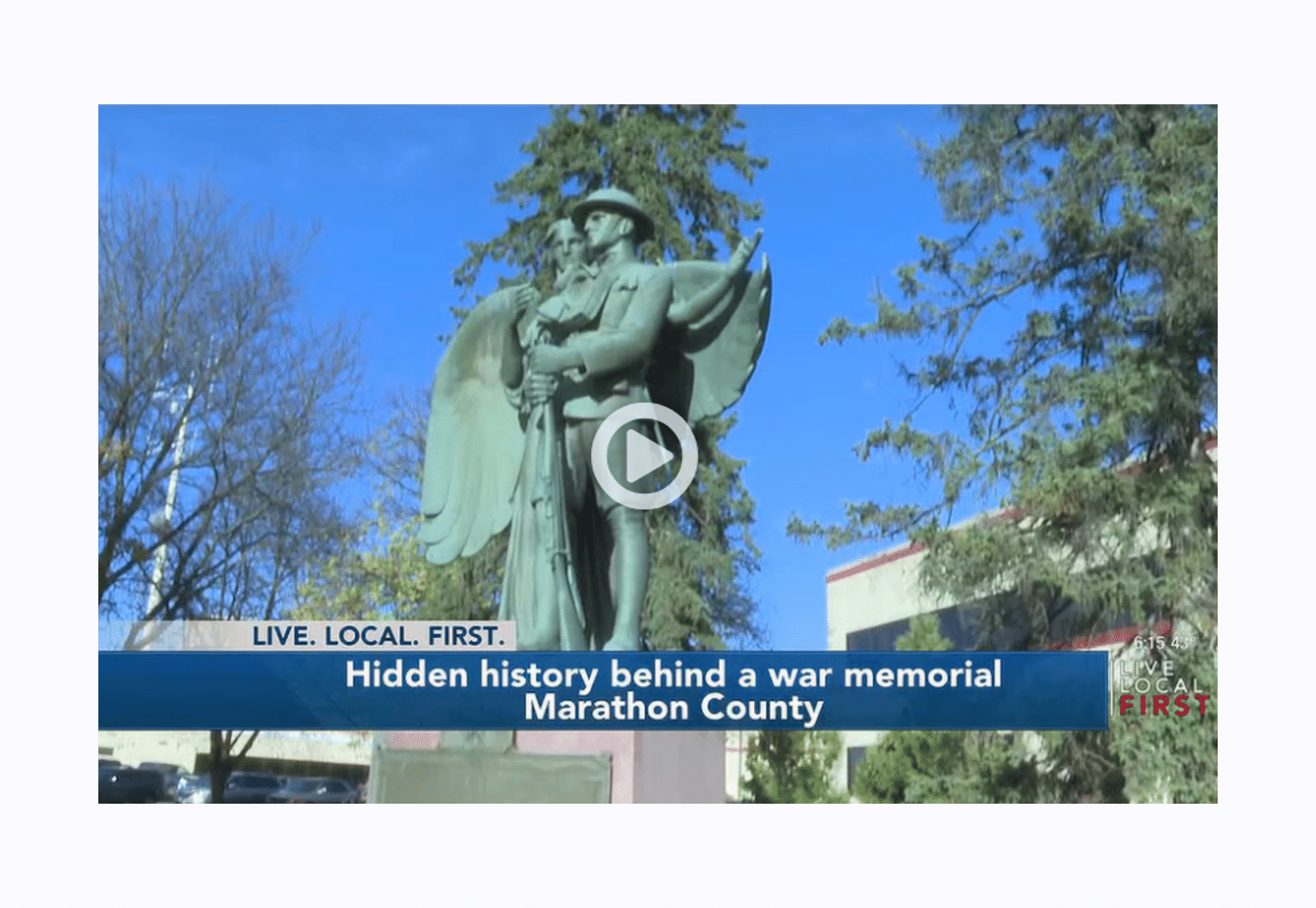
The final design features a soldier in the uniform of the time, complete with a shrapnel helmet and gas mask. His hands rest on his rifle. An angel stands at his side, its arms and wings wrapped around him in protection.
The plaque below is inscribed with the names of 132 Marathon County residents who died during the Great War.
“I think the phrase that they were trying to emulate was valor, patriotism, faith, and hope. And so ultimately [Haber] kind of picked the representation of a sort of generic person,” said Clark.
Clark said the design is intentional.
“[The statue] doesn’t represent any of the 132 people listed on the plaque, but also represents all of them in that same way.”
⇒ Read the entire article and watch the video on the WSAW-TV website here:
External Web Site Notice: This page contains information directly presented from an external source. The terms and conditions of this page may not be the same as those of this website. Click here to read the full disclaimer notice for external web sites. Thank you.