This Veteran’s Day unremembered: American Expeditionary Force Siberia
Published: 9 November 2026
By D. Weisman
via The Escondido Grapevine website
AEF-in-Siberia
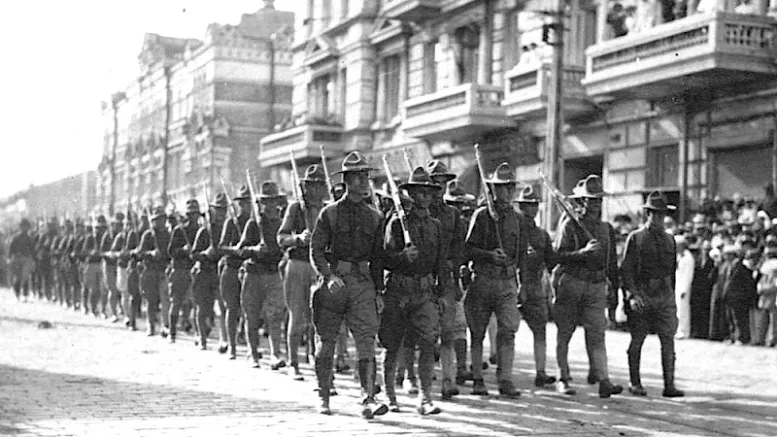
American Expeditionary Force, Siberia (AEF in Siberia) parade through the streets of Vladivostok, Russia on August 15, 1918.
Parades rolled through many American cities on Veterans Day, Nov. 11 honoring the anniversary of the end of World War I on the 11th hour of the 11th day of the 11th month of 1918, what once was known as Armistice Day.
None of those parades, however, featured tributes or remembrance of one of the war’s oddities made all the more poignant by today’s tensions engendered by Vladimir Putin’s invasion of Ukraine. Or resemblde the scene just before the armistice in August 1918 in Russia’s Far East.
Aug. 15, 1918 was that day lost in the sands of time. On that day, almost 3,000 officers and soldiers of the US Army’s 27th and 31st Infantry Regiments plus significant numbers of volunteers from three other regiments of the 8th Division formerly under the command of Major General William S. Graves disembarked at Vladivostok, Russia’s Pacific capital.
Before a throng of Russian citizens, the American Expeditionary Force, Siberia (AEF in Siberia) paraded through the city streets in support of the 40,000 allied soldiers mainly in the Czech Legion, who had fought its way across the country on the Trans-Siberian Railway awaiting evacuation by sea back to Europe.
“’Most Americans don’t realize that early in the existence of the Soviet Union, we actually had American soldiers on the ground killing communists (Bolsheviks back then) in northern Russia and Siberia,” said Col. John House, who wrote a history of the obscured today American Expeditionary Force in Siberia that fought and died in support of efforts to turn back the Bolshevik tide.
The U.S. Far Eastern expeditionary force numbered almost 8,000 troops when the final troops arrived by Aug. 21. They took up positions along the railway from Valdivostok to Nikolsk-Ussuriki about 60 miles north. Another detachment of 5,000 troops were sent at the same time to Archangel in Northern Russia near the Finnish border about 3,500 miles to the west.
President Woodrow Wilson ordered the deployments in the waning months of the great war to free up the Czech force for the Western Front. These troops had been stranded in Russia following the Bolshevik’s March 3, 1918 treaty with the Central Powers ending Russian involvement in the war.
The Legion had been formed early in 1918 from Czech and Slovak prisoners of war in Russia, sympathetic Russian Slavs, and deserters from the Austro-Hungarian army, according to the National Archives.
When the Bolsheviks pulled out of the war, they agreed to let the Czech Legion leave Russia. President Wilson wanted the world to know that the United States supported the safe return of the Czech Legion to its newly formed homeland, said Gibson Bell Smith, an archivist specializing in modern military records, in a 2002 article in the National Archives Prologue Magazine..
Fighting on the railroad
In March 1918, the Legion moved steadily eastward along the Trans-Siberian Railway. When the Bolsheviks tried to disarm the Czechoslovaks, the soldiers of the Legion hid their weapons, and relations between the two groups frayed, Smith said.
Wilson also wanted to promote self-government and self-defense by Russians in the Far East in the face of sporadic Bolshevik attacks and threats of attacks from Japan and Cossack marauders, according to some sources. Not to mention safeguarding American investments.
“President Woodrow Wilson’s motivation for sending troops to Siberia stemmed from the same desires that drove him to try to impose the Paris Peace Treaty on Europe: the promotion of democracy and self-determination,” Bell said.
“But first and foremost,” Smith continued, “he wanted to protect the billion-dollar investment of American guns and equipment along the Trans-Siberian Railway. Vast quantities of supplies had been sent when America believed that Russia was capable of fighting and winning against the Central Powers in the spring of 1917.”
As with much of the historical record, being a contrarian sort, historians debate the intervention.
⇒ Read the entire article on The Escondido Grapevine website here:
External Web Site Notice: This page contains information directly presented from an external source. The terms and conditions of this page may not be the same as those of this website. Click here to read the full disclaimer notice for external web sites. Thank you.