Family treasures World War I diary
Published: 7 November 2026
By Kerri Sandaine
via the Moscow-Pullman Daily News website
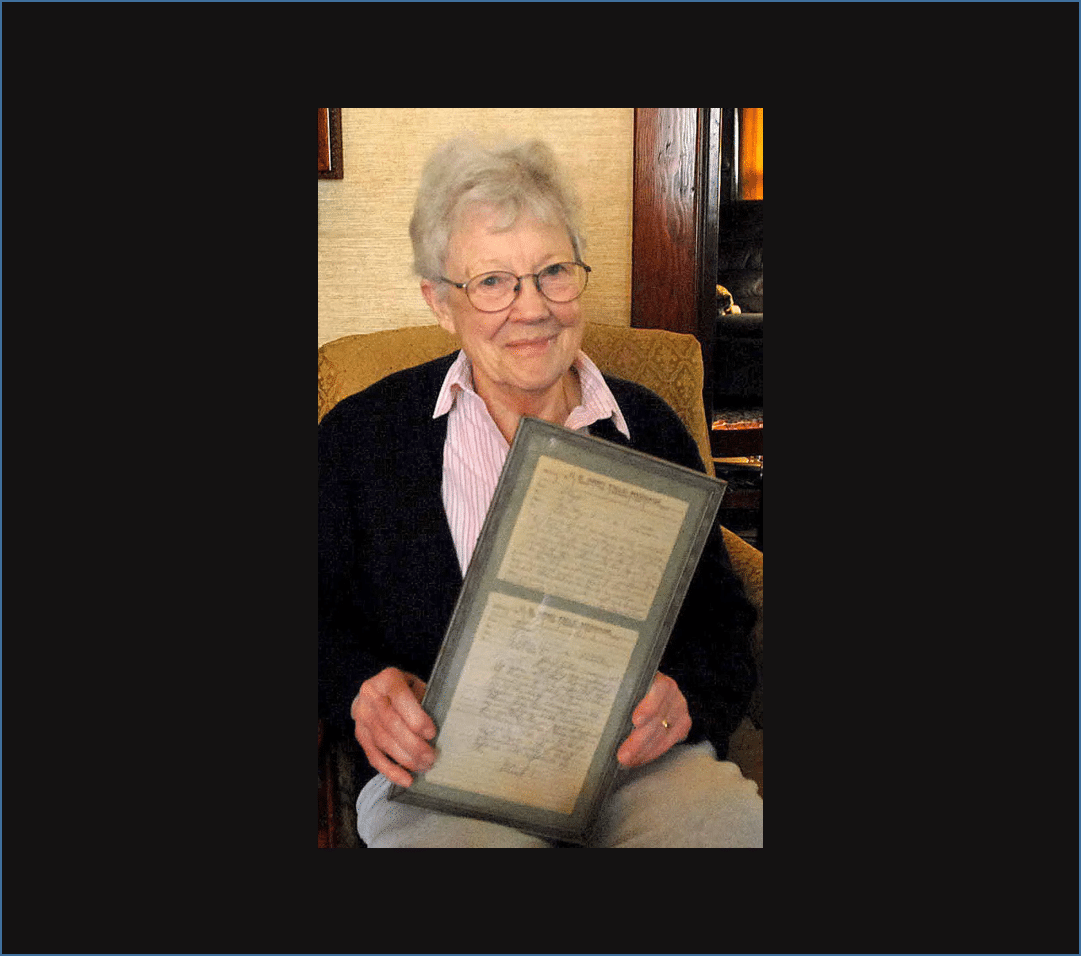
Caroline Collins
Caroline Collins, a Lewiston resident who died in 2011, is shown in 2008 holding a framed note announcing the end of World War I. The message was delivered to the French battlefield where her father, John H. Gibson, was fighting Nov. 11, 1918.Barry Kough/Lewiston Tribune This U.S Army field message, notifying American servicemen that World War I was over, was kept as a memento by the late John H. Gibson, then an Army officer. This U.S Army field message, notifying American servicemen that World War I was over, was kept as a memento by the late John H. Gibson, then an Army officer. (Courtesy of Gibson/Collins family)
This story was originally published in the Lewiston Tribune on Nov. 11, 2008. Caroline Collins died on June 9, 2011.
A runner delivered the handwritten message to a French battlefield where weary American soldiers had been fighting the enemy in muddy trenches.
World War I would end in 1918 on the 11th hour on the 11th day of the 11th month.
And the late John H. Gibson, a veteran of two world wars and Lewiston civic leader, was there when the news arrived.
Gibson, a young Army officer at the time, hung onto the penciled U.S. Army field message, which became a framed family keepsake. “No communication with enemy permitted. Be on guard against trickery. No fighting after 1100 hours,” reads the missive, written at 10:15 a.m. on the original Armistice Day.
“It’s been hanging on a wall at our (Priest Lake) place for years,” Gibson’s daughter, Caroline Collins, 83, of Lewiston said. “People would notice it and comment on it — men, in particular, who had been in the military. My father treasured it.”
Like many veterans, Gibson didn’t discuss his wartime experiences with his family.
“The professionals rarely talk much,” said Collins, whose father went on to become a post commander. “The ones with the most decorations usually don’t.”
That’s what made the recent discovery of a diary he kept in war-torn France so special, Collins said.
The cold, wet conditions and explosive battles are described on several small pieces of paper found in Collins’ Normal Hill home during the past year.
“I was quite struck by it,” Collins said. “It was fairly dramatic to me. It seemed so authentic. He was right on the scene and right in the battle. I was a bit surprised by it, because it surfaced so late in my life, and I didn’t know about it.”
The son of a Methodist minister, Gibson lived all across the state of Washington during his childhood, including Asotin in the 1890s. He graduated from Lewis and Clark High School in Spokane and married a young woman from Lewiston after the war.
He and his future wife, Dorothy Bevis, met while studying journalism at the University of Washington. Collins was their only child.
“As a budding journalist, he joined the Army and was commissioned as a captain and sent off to France,” Collins said. “After the war, he was offered a commission in the regular Army and never looked back. He was in the military for 30 years, before retiring to Lewiston.”
⇒ Read the entire article on the Moscow-Pullman Daily News website.
External Web Site Notice: This page contains information directly presented from an external source. The terms and conditions of this page may not be the same as those of this website. Click here to read the full disclaimer notice for external web sites. Thank you.