Cycling Through History: A Journey Along the Western Front
Published: 23 September 2026
By Colonel (retired) Linda Jantzen, U.S. Army Signal Corps
Special to the Doughboy Foundation website
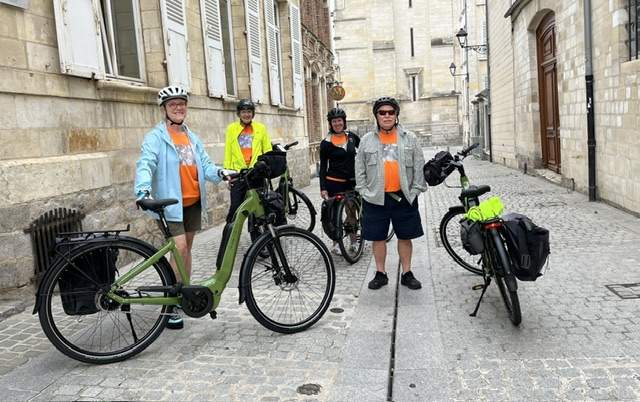
Preparing for our first ride from Amiens to Albert
The team saddling up for the first leg of their ride along the Western Front Way, from Amiens, France to the village of Albert. (left to right) Carolyn Timbie, Linda Jantzen, Julia Donley, Dusty Clampitt.
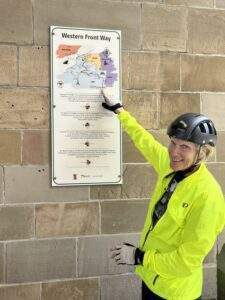
Linda, where’s the Western Front Way?
In late August and early September, 2026, three friends and I set out on an extraordinary cycling journey through northern France and Belgium, following a route known as the Western Front Way. We used a travel service that supplied the e-bikes, made our hotel reservations for seven nights, and arranged taxis to transport our luggage between hotels, freeing us to experience a region that saw some of the most significant battles of the First World War. This article recounts our cycling journey from Amiens, France to Bruges, Belgium.
The four of us share personal and professional ties to World War I. Julie and I served in the U.S. Army Signal Corps, and I have two great uncles who died fighting on the Western Front. Carolyn also has family ties. Her grandmother, Grace Banker, led the first group of telephone operators, known as the “Hello Girls,” in support of American Expeditionary Forces during the war. Six of the Hello Girls were born in Belgium, and one, Melanie Van Gastel, is buried in Aalst, near Brussels. Since our bike journey ended in Bruges, Carolyn arranged for us to meet with a descendant of Hello Girl Edith Dodds there, and to make our way to Aalst to pay our respects at Melanie Van Gastel’s grave site after the bike trip. (More on this in Carolyn’s article).
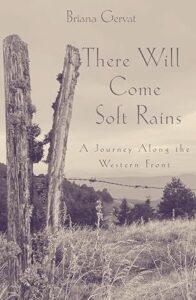
Inspired by author Briana Gervat’s book There Will Come Soft Rains in which she reflects on moving slowly through historic landscapes, we covered roughly 200 miles over seven days. Each day had a goal and its own set of challenges, be that terrain or weather or having enough time to see everything we wanted. We all agreed that the open air and slow pace gave us a perspective that was quite unique and unforgettable.
Following the Somme
The journey began in Amiens, France, home to the magnificent Cathedrale Notre-Dame d’Amiens. After receiving our bikes, navigation and other instructions, we had time to visit the cathedral and have dinner on the Quai Belu which runs alongside the River Somme. Heading back to the cathedral at sunset, we saw the incredible light show on the west façade in which light is projected with such precision that it looks painted on, even from close up.
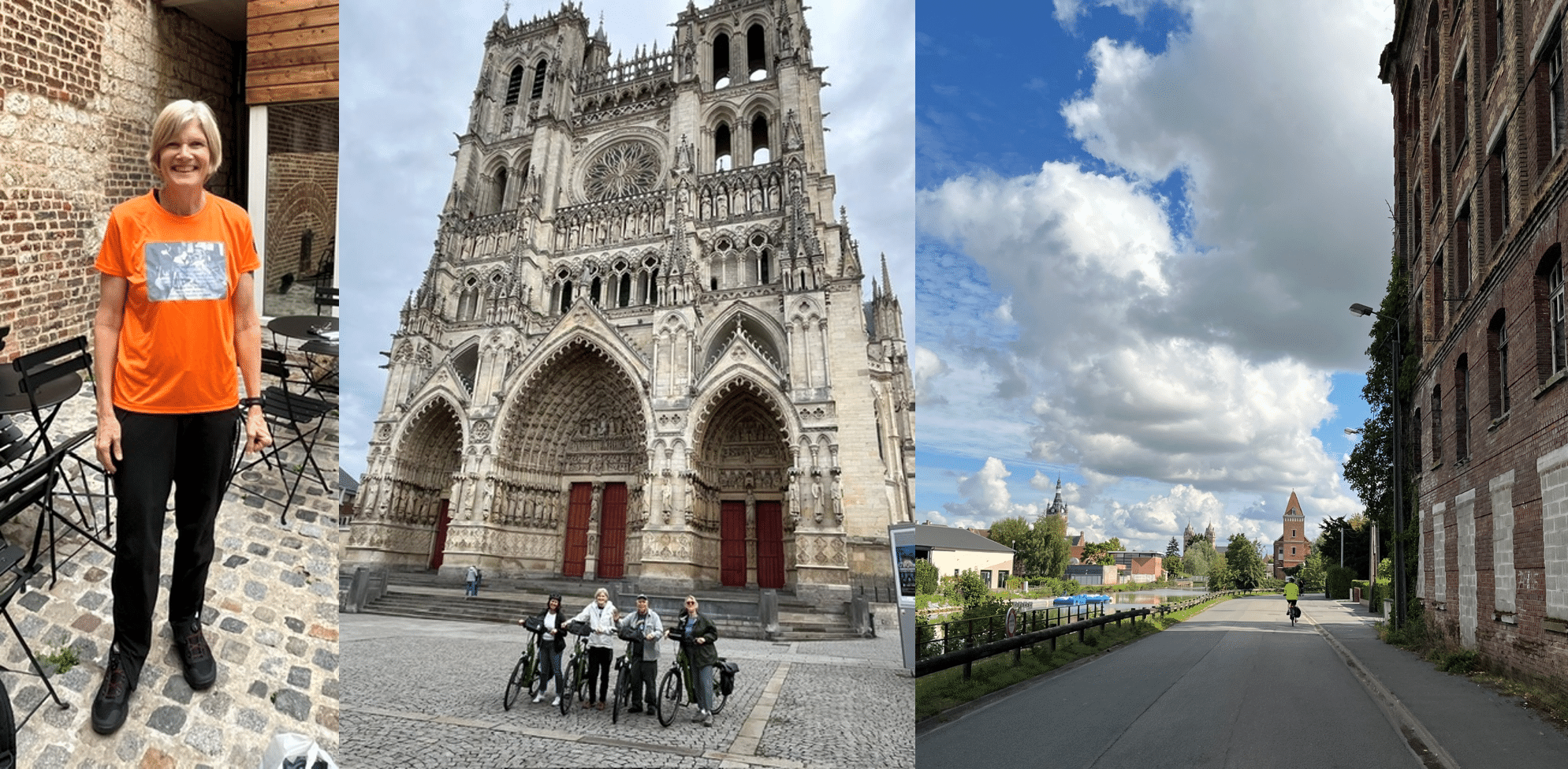
(Left) Linda Jantzen models the special T-shirt she designed for the ride. (Center) First time on the journey’s e-bikes, with backdrop of the beautiful Motre Dame Cathedral of Amiens. (l to r) Julia Donley, Linda Jantzen, Dusty Clampitt, Carolyn Timbie. (Right) They’re off! The team hits the road through the scenic and historic French countryside.
The next day, we headed east out of Amiens along the “Chemin de Halage” that runs along the Somme River toward the battlefields. The first major stop was the Australian National Memorial near Villers-Bretonneux, commemorating the Australian forces that halted the German offensive in 1918. Walking through the cemetery, I was moved by the personal messages of remembrance, some looking quite recent such as the poppy wreath with a note addressed to “Uncle Eddie.”
Its adjacent museum in the Sir John Monash Center uses multimedia exhibits to bring the battlefield experience vividly to life.
Continuing through the countryside, we encountered a recurring feature of the route: military cemeteries. Whether large or small, each was meticulously maintained and the sheer quantity of headstones in some cases outnumbered by the names of those whose remains were never recovered, serve as reminders of the tremendous human cost of the conflict.
Approaching the village of Albert, we could see the Golden Virgin sculpture atop the dome of the Basilique Notre-Dame de Brebières. The dome was hit by shell fire in January 1915, and the sculpture was knocked sideways. It remained in that position and was known as the « Leaning Virgin » until it finally fell in April 1918.
Beneath the cathedral is the Somme 1916 Museum, located in a former bomb shelter. Exhibits on trench warfare, medical care, communications, and daily life helped illustrate the realities faced by soldiers on the front lines. We ended that first day of cycling at the Chateau Martinsart, where the owners of the Chateau greeted us with a glass of wine.
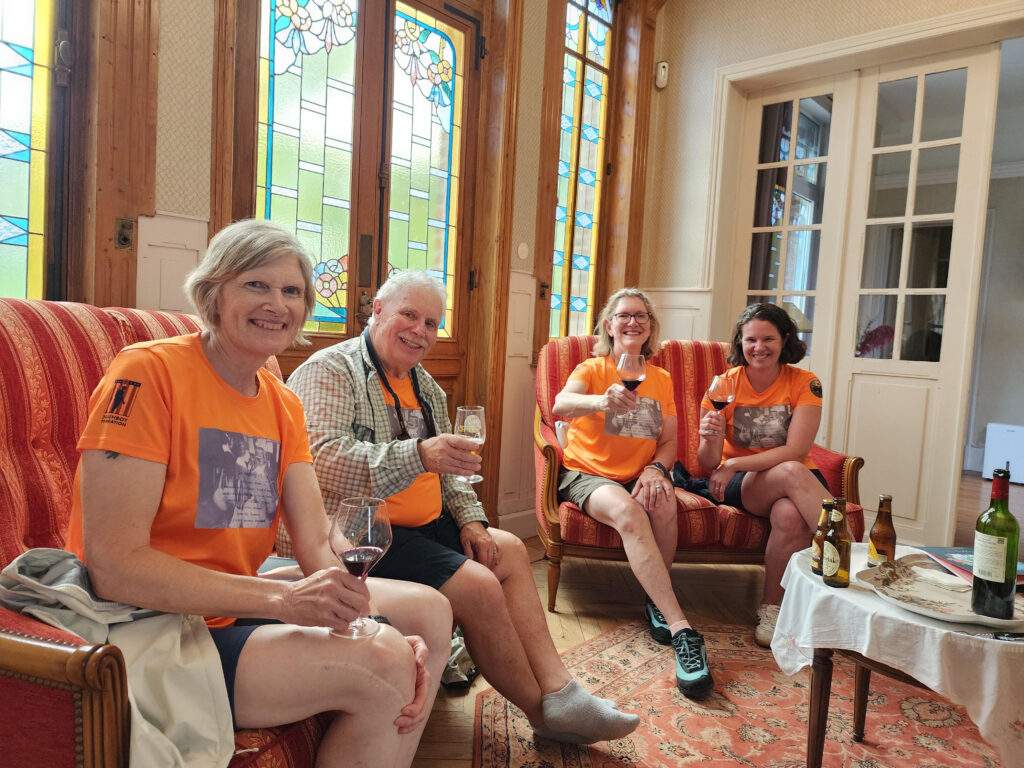
A glass of wine (well, it is France) after the first leg of the journey. (l to r) Linda Jantzen, Dusty Clampitt, Carolyn Timbie, Julia Donley.
The following day brought visits to some of the most iconic sites of the Battle of the Somme. Less than a mile from the Chateau where we had stayed is the Thiepval Memorial, an arch standing 660 feet high, bearing the names of more than 72,000 British and Commonwealth soldiers with no known grave. In the visitor’s center museum is a 24-foot mural by cartoonist Joe Sacco depicting soldiers and their activities before, during, and after the first day of the Battle of the Somme, known as the bloodiest day in British military history.
We stopped for a beverage at a small café on the grounds of the Ulster Tower, erected in memory of the 36th (Ulster) Division and all those from Northern Ireland who served in the war. The tower and café are staffed by members of the Somme Association, based in Belfast. Our host explained that he also leads tours of the nearby woods where the trenches are still visible.
A bit further up the road at the Beaumont-Hamel Newfoundland Memorial we walked among the well preserved trench systems, cemeteries, and monuments commemorating the heavy losses suffered by Newfoundland and Scottish troops on the first day of the Somme offensive. Young Canadian students keep their memory alive by serving as docents at this hallowed site.
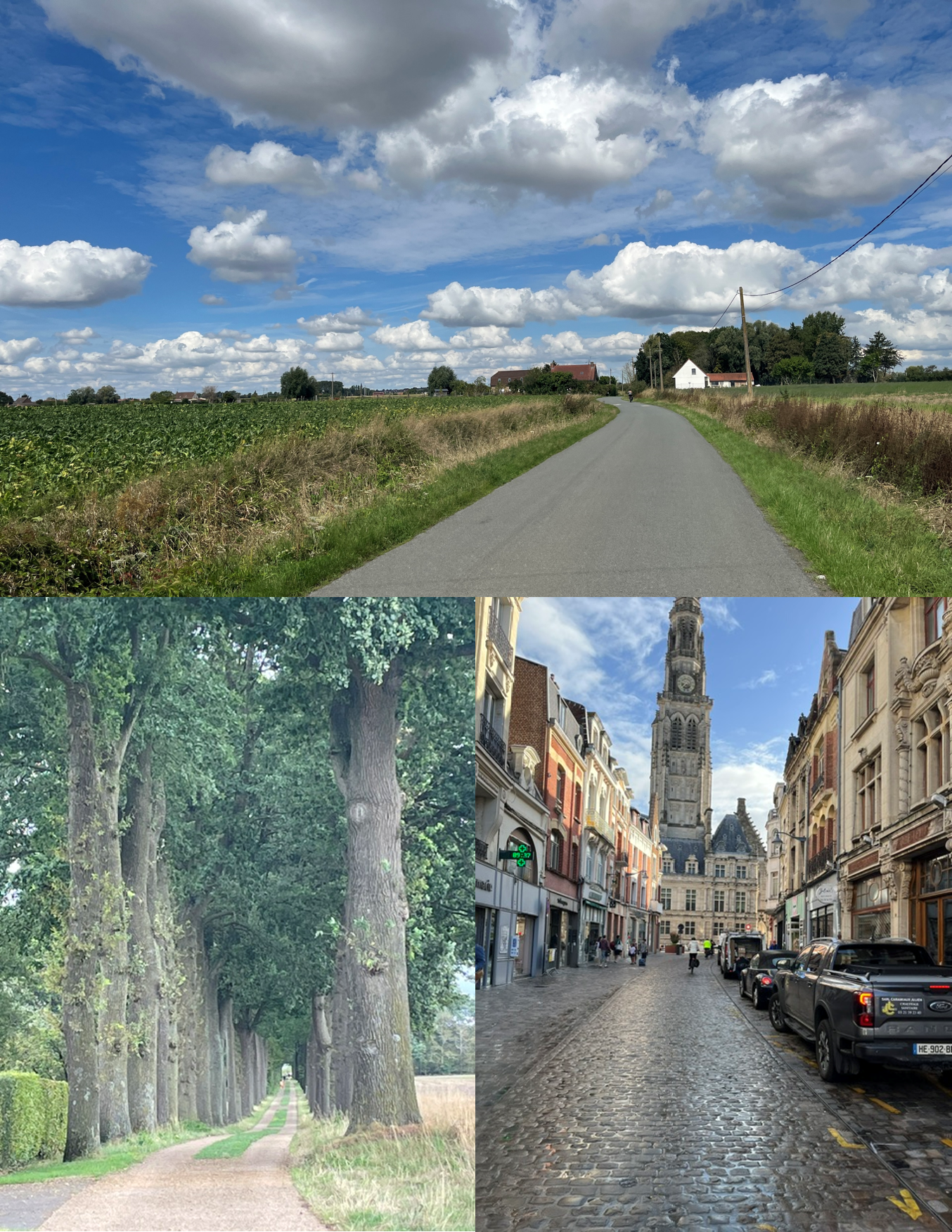
(Top) The team rode through the beautiful French countryside which held so many haunting memorials from World War I. (Bottom) The team visted both nature- and man-made cathedrals on the journey.
Moving north toward Vimy Ridge, we encountered more memorials that reflect different national perspectives on the war. The Canadian National Vimy Memorial honors the Canadian Corps’ capture of Vimy Ridge in 1917, a battle often viewed as a defining moment in Canada’s national history.
The world’s largest French military cemetery is located 550 feet above the city of Arras. After the longest and highest climb of the trip, we came to a site of beauty and reverence, the Notre-Dame de Lorette. The cemetery and ossuary hold the remains of more than 40,000 soldiers, a basilica, and the “lantern tower” with an eternal flame in the upper lantern.
Across from the cemetery stands the Ring of Remembrance, made up of 500 three-meter-tall steel plates forming an ellipsis 345 meters in length. Each panel is engraved with the names of over 580,000 soldiers of all nationalities, including former enemies, who fell in the Great War, creating a powerful statement about the shared tragedy of war.
On the way to our next hotel in Gosnay, we had to negotiate a stretch of flooded road. The route itself underscored the realities of battlefield terrain. It had been a rainy and windy day, yet these challenges only deepened our appreciation for the endurance shown by soldiers who fought in the same region under vastly harsher conditions.
Flanders and the Legacy of War
Crossing into Belgium, we headed for the village of Ieper (Ypres), where we would spend the next two nights. We would soon realize we could have spent the entire week there and not seen everything we wanted. We started at Hill 60, the site of intense fighting, mining operations, poison gas attacks, and repeated battles for control. All these years later, the landscape still bears the scars of war through preserved craters, trenches, and bunkers.
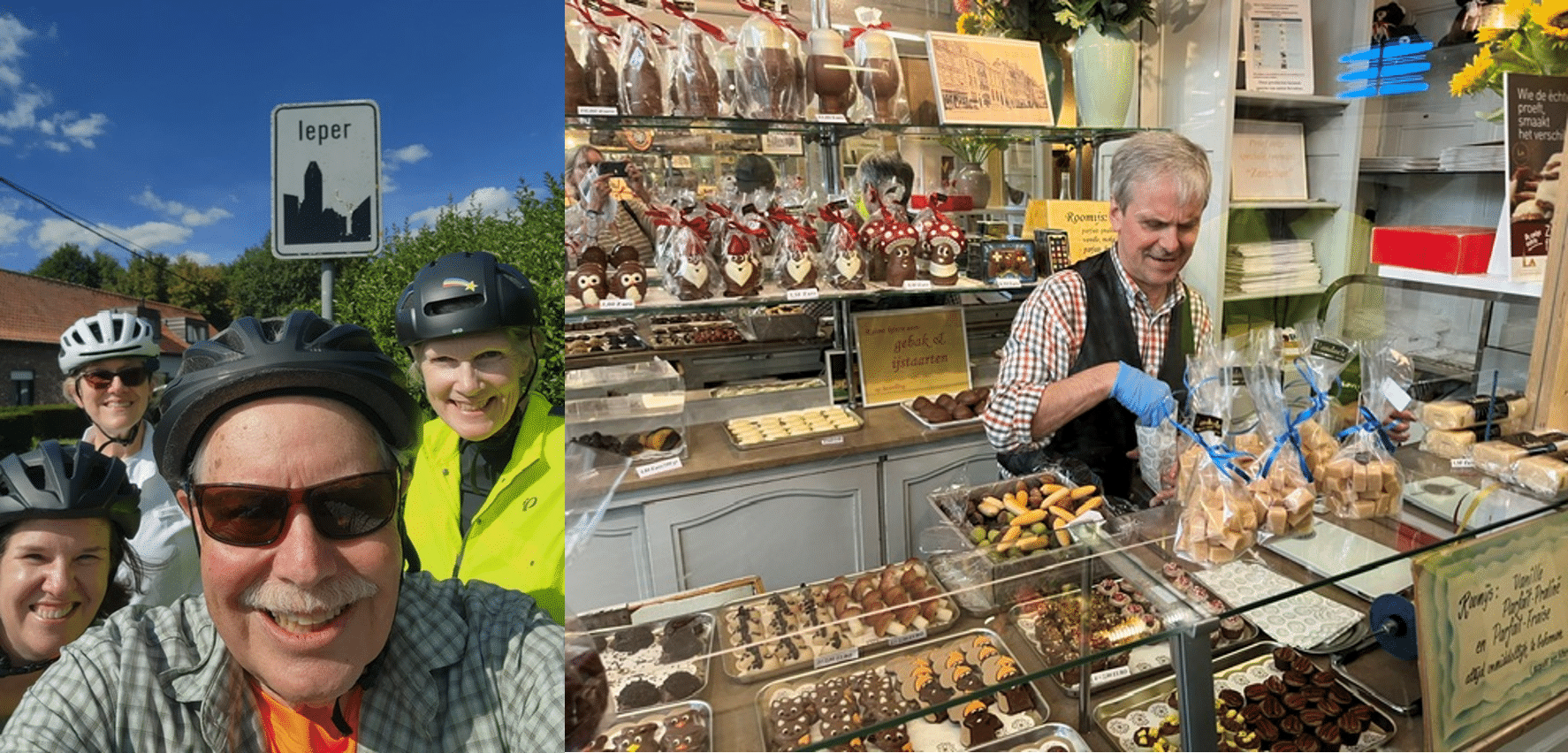
(Left) The team arrives in the village of Ieper (Ypres), first stop in Belgium. (Right) A LOT of chocolate! (Well, it is Belgium.)
The next stop was a new discovery for us. The Brothers-In-Arms Memorial in Zonnebeke pays tribute to brothers who fought together in WWI, where one of the siblings was killed. A statue depicts Australians Jack Hunter in the arms of his brother Jim.
Nearby is the Passchendaele Memorial Museum which includes immersive exhibits explaining one of the war’s most infamous battles. We walked through the dark dugout and emerged into a series of trenches constructed to show the differences between German and British trenches.
We made it back to Ieper in time to visit the In Flanders Fields Museum, where Carolyn had arranged a guided tour for us, led by a museum historian. This museum focuses on individual human experiences through personal stories and multimedia presentations. Two displays at the end were especially meaningful – a cross section of a 200 year old tree trunk showing dark colored “bruises” in spots corresponding to the years 1914 through 1918, and a projection on the wall with the names of soldiers killed each day.
We finished our day at the Menin Gate. Every evening, local musicians perform the Last Post beneath the names of more than 54,000 British Commonwealth soldiers whose bodies were never recovered. After the ceremony we located the name of a relative of one of Carolyn’s acquaintances who lives in Australia, adding a deeply personal dimension to the event.
For the final stage of the journey, Carolyn and Dusty took the direct route to Bruges, while Julie and Linda headed northwest along the Ijzer canal toward the English Channel coast. Approaching the village of Diksmuide, we were drawn in by the sight of the Ijzer Tower, a memorial and museum with 22 floors of exhibits exploring themes of war and peace while overlooking land that had been deliberately flooded in 1914 to halt the German advance. In Nieuwpoort, we stopped at the monument to Albert I, the King of the Belgians during WWI, next to the sluice gates, a series of locks and spillways that to this day control the water level in the Ijzer plain. We then made our way to the white sands of the English Channel coast, the end of the Western Front.
We then took the mostly peaceful ride along canals and coastal landscapes to Bruges, the journey’s endpoint.
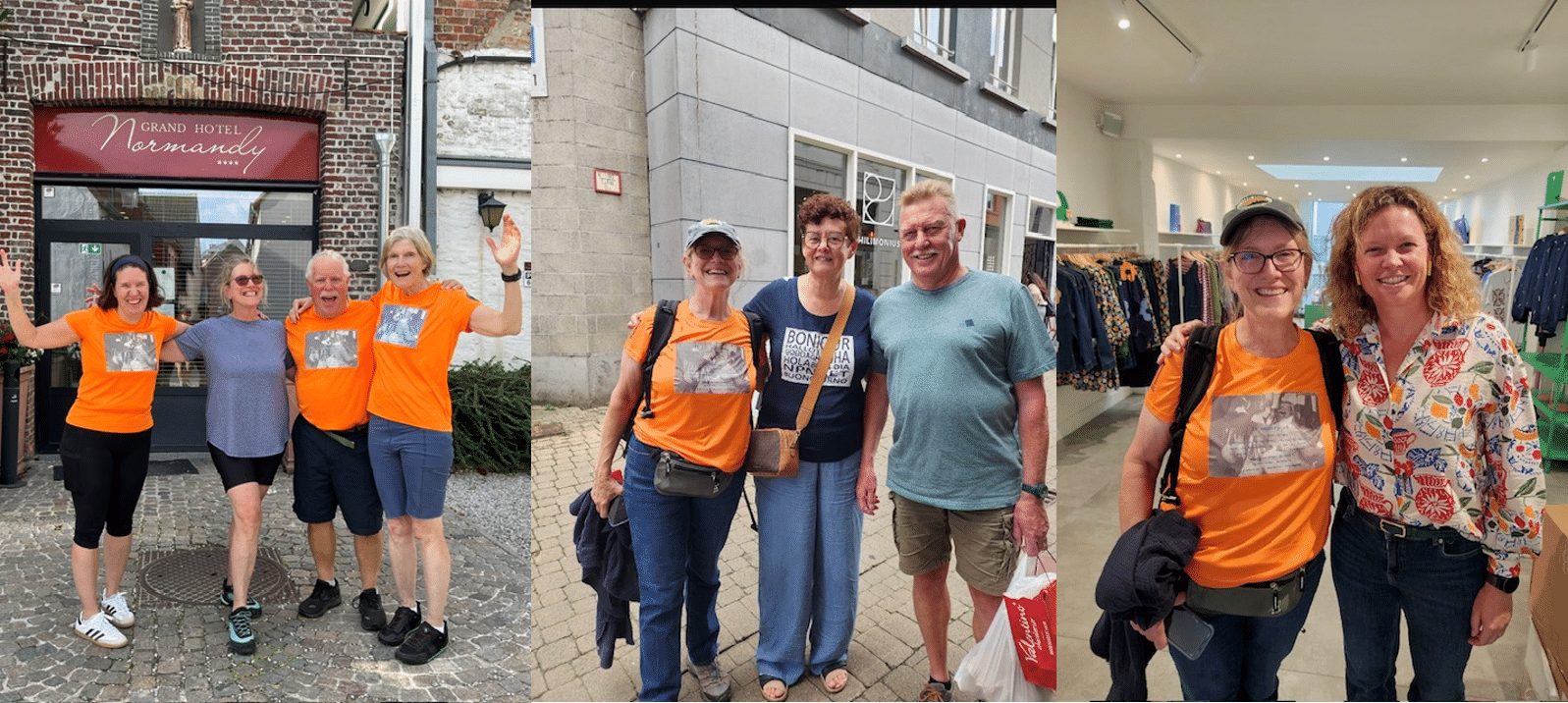
(Left) We did it! Finished our bike trip in Bruges, home of Hello Girl Edith Dodson. (Center) Random supporters see our Hello Girls t-shirts, hear our story, and send us to their daughter Sophia, who is an Aalst tour guide. (Right) Sophia is interested in the Hello Girls and Melanie Van Gastel, and would like to pass along their story with her tours.
A Journey Worth Taking
This trip was all that we had hoped for, and more. Cycling allowed us to experience historical landscapes at a human pace, revealing details that are often missed when traveling by car. Above all, it created opportunities for reflection.
For the four of us, the Western Front was not merely a collection of monuments and museums. It was a living landscape shaped by memory, sacrifice, and resilience. Our ride became both an exploration of history and a tribute to those whose stories continue to echo across the fields of France and Belgium.
You can read the group’s day-by-day diary of the bicycle journey Along the Western Way on CycleBlaze Journal here.
External Web Site Notice: This page contains information directly presented from an external source. The terms and conditions of this page may not be the same as those of this website. Click here to read the full disclaimer notice for external web sites. Thank you.