Unusual burial record leads Netherlands father, son on international search for info on WWI soldier from Lilly
Published: 1 August 2026
By Joshua Byers
The Tribune-Democrat, Johnstown, Pa.
via the Yahoo! News website
Screenshot 2026-08-25 at 9.25.27 AM
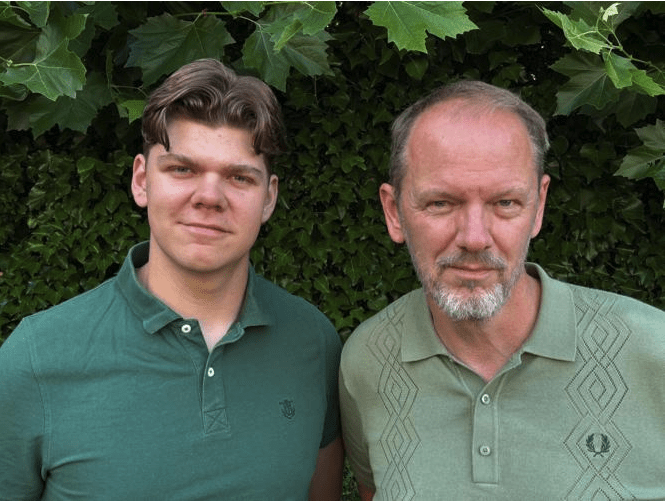
Haye and Peter Wever's discovery of a World War I grave marker at the former U.S> Military Cemetery No. 6,Bazoilles-Sur-Meuse, France, unraveled a story nearly lost to time about Lilly native Pvt. John J. Andrews.
LILLY, Pa. – A partial grave marker from a former World War I cemetery in France led a Netherlands father and son down a rabbit hole of unusual circumstances regarding the burial of Lilly native Pvt. John J. Andrews.
Dr. Peter Wever and his son, Haye Wever, were searching the grounds of the former U.S. Military Cemetery No. 6 at Bazoilles-sur-Meuse, France, in August 2022 when they stumbled upon the story of Andrews and his marker for Grave 1021.
“All the bodies had been removed already in 1921, so all we could find is what was considered waste in 1921,” Peter Wever said. “We first went out there on Aug. 3 and Aug. 4, 2022, when my son found the partial grave strip that started this story on the second day.”
Through that search, the pair found more than 180 partial grave strips, many of which could be linked to U.S. military members formerly interred there.
That area of France was also home to the Bazoilles Hospital Center, the first U.S. hospital center in operation during World War I.
Those buried in the adjacent plots were exhumed in 1921, following a 1919 order by President Woodrow Wilson offering next-of-kin for U.S. service members the option to have their family members transported to the U.S. for final interment.
The Wevers turned to the U.S. National Archives and Records Administration, which had started digitizing burial files of service members who died in France during World War I around the same time they searched the former cemetery.
They discovered that Andrews served with U.S. Army Company G, 2nd Battalion, 39th Infantry Regiment, and died Sept. 29, 1918, at the center’s Base Hospital No. 116 in Bazoilles-sur-Meuse, France. His official cause of death is lobar pneumonia, but his service record shows he was wounded in action.
Wever suspects Andrews was likely injured in the initial phase of the Meuse- Argonne Offensive, which started Sept. 26, 1918, and included Andrews’ regiment on the front line. He may have died from complications of the Spanish flu, Wever said.
What made Andrews’ death unusual was more than just his lack of Purple Heart despite being wounded in action – degree undetermined. He was also buried in the wrong grave for years before the error was corrected.
⇒ Read the entire article on the Yahoo! News website.
External Web Site Notice: This page contains information directly presented from an external source. The terms and conditions of this page may not be the same as those of this website. Click here to read the full disclaimer notice for external web sites. Thank you.