Profiles Of Valor: GySgt Charles Hoffman and Cpl Henry Pruitt (USMC)
Published: 31 July 2026
By Mark Caldwell
via the Chattanoogan.com website
Chattanoogan header
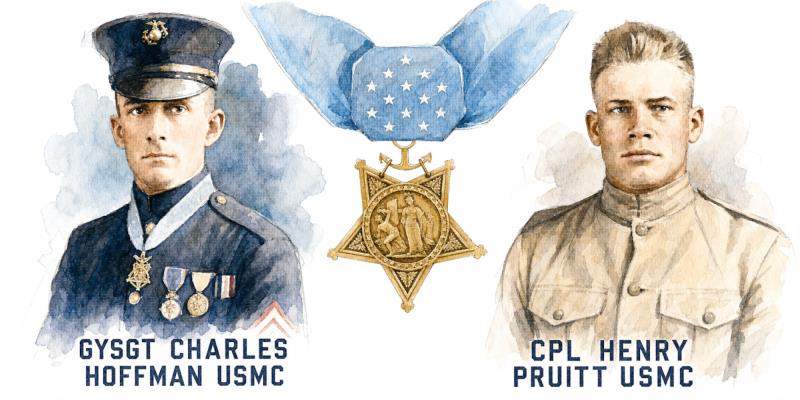
This is the last in my series on double Medal of Honor recipients; in both of these cases, two Medals for the same action. The recipients were both World War I Marines, GySgt Charles Hoffman and Cpl Henry Pruitt.
Of the 3,536 military recipients of our nation’s highest award for valor (65 living today), there are 19 U.S. service members who have received two Medals of Honor. Among them, amazingly, 14 received two Medals for separate actions of valor, while five WWI Marines received both the Army and Navy Medals of Honor for the same action because they were deployed with Army units.
(Following WWI, regulations were changed so that two different service branch Medals of Honor would not be awarded for a single action.)
The three most notable 20th-century double recipients for different actions were Marine MajGen Smedley Butler, Marine SgtMaj Daniel Daly, and Navy LCDR John McCloy.
I have previously profiled the three additional World War I Marine double recipients for the same action: Pvt John Kelley, Sgt Matej Kocak, and Maj Louis Cukela.
GySgt Charles Hoffman was born Ernest August Janson in New York City in 1878.
For reasons unknown, his enlistment in the Marine Corps in 1910 was under the name Charles Hoffman, though he had already served 10 years in the Army as Ernest Janson before his Marine enlistment. This was most likely a clerical error — fog of war. It was only after the conclusion of World War I that Janson requested that official records note his name correctly. However, his Medal of Honor was awarded as Hoffman, and the citation notes Hoffman to this day.
During his years in the Army, he took part in the Nicaraguan Campaign and was honorably discharged in June 1914.
Reenlisting that same month in the Marine Corps, Janson was promoted to corporal and then to sergeant in August 1914. He served aboard Navy ships until 1916, and he was then stationed at Norfolk, Virginia, until May 1917. A month later, he was deployed to St. Nazaire, France, and appointed a gunnery sergeant.
On 6 June 1918, during the historic Battle of Belleau Wood, Janson, then 39 years old, was serving under Army Gen. John “Black Jack” Pershing in the 2nd Division, which was assigned to Marine regiments.
GySgt Janson was severely wounded that day, and his Medal of Honor would be the first awarded in the American Expeditionary Forces.
According to his Medal of Honor citations:
“Army — Immediately after the company to which he belonged had reached its objective on Hill 142, several hostile counterattacks were launched against the line before the new position had been consolidated. GSgt. Hoffman was attempting to organize a position on the north slope of the hill when he saw 12 of the enemy, armed with five light machine guns, crawling toward his group. Giving the alarm, he rushed the hostile detachment, bayoneted the two leaders, and forced the others to flee, abandoning their guns. His quick action, initiative, and courage drove the enemy from a position from which they could have swept the hill with machine-gun fire and forced the withdrawal of our troops.”“Navy — For conspicuous gallantry and intrepidity above and beyond the call of duty in action with the enemy near Chateau-Thierry, France, 6 June 1918. Immediately after the company to which GSgt. Janson belonged had reached its objective on Hill 142, several hostile counterattacks were launched against the line before the new position had been consolidated. GSgt. Janson was attempting to organize a position on the north slope of the hill when he saw 12 of the enemy, armed with five light machine guns, crawling toward his group. Giving the alarm, he rushed the hostile detachment, bayoneted the two leaders, and forced the others to flee, abandoning their guns. His quick action, initiative, and courage drove the enemy from a position from which they could have swept the hill with machine-gun fire and forced the withdrawal of our troops.”
Janson was also awarded a Silver Star for service prior to Belleau Wood.
He returned to the United States, where he convalesced at the Naval Hospital in New York. When his enlistment ended in April 1919, he reenlisted and served as a recruiter in New York City.
Notably, on Armistice Day 1921 (observed since 1954 as Veterans Day), Janson was the Marine pallbearer for the interment of the World War I Unknown Soldier at the Tomb of the Unknowns.
He continued as a Marine Recruiter until 1926, when he was transferred to the Marine Barracks at Quantico and promoted to sergeant major prior to his retirement.
He is buried in Brooklyn’s Evergreen Cemetery, where his tombstone notes, “AKA Charles E. Hoffman.”
⇒ Read the entire article on the Chattanoogan.com website.
External Web Site Notice: This page contains information directly presented from an external source. The terms and conditions of this page may not be the same as those of this website. Click here to read the full disclaimer notice for external web sites. Thank you.