Alloways Creek ship graveyard holds hidden WWI history
Published: 16 August 2026
By Gretchen F. Coyle and Theodore E. Ferris
via the Asbury Park Press website
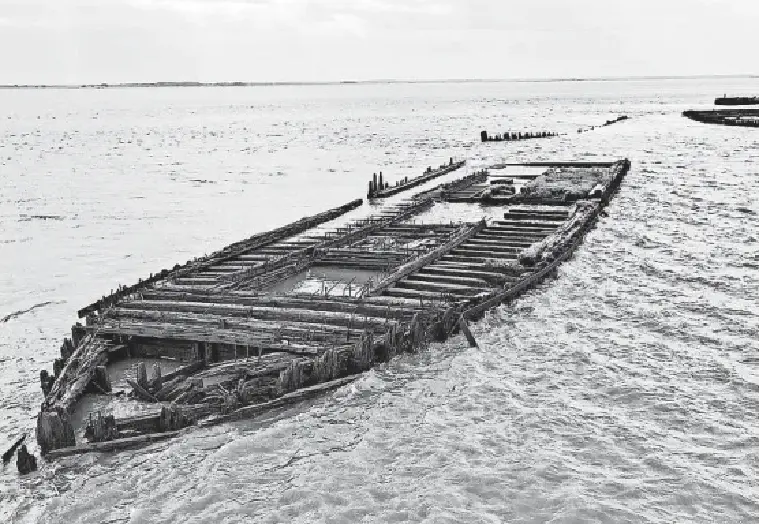
Wooden World War I schooners form a breakwater to protect Alloways Creek
Wooden World War I schooners form a breakwater to protect Alloways Creek
Alloways Creek ship graveyard is a line of 18 World War I wooden steamships.
Located in Salem County, southwestern New Jersey, and flowing into the Delaware River, Alloways Creek meanders for 23.2 miles.
The mouth of Lower Alloways Creek is the site of barely visible ships built by the Emergency Fleet Corporation when Germany had sunk many of our country’s supply ships. After the war, the ships were not of much use. Consequently, they were stripped of all metal fittings, filled with rocks and dirt, and sunk in a formation to act as a breakwater. This rural area is also full of rarely heard American and Revolutionary history.
These ships have remained in place for over a century now, though can hardly be seen from either the Delaware River or the protected marshes except at extremely low tides. They have sunk a bit over the years, and few people know of their existence. They lie north of the Salem Nuclear Power Plant, where nautical regulations keep ships and pleasure boats far offshore.
Water management areas have strange names such as Mad Horse Creek and Abbott’s Meadow. The area is still mainly marsh land with large black flies filling the air and fond of human flesh during warm months. There are also other identified and unidentified wrecks along the Delaware Bay and River shoreline.
Emergency Fleet Corporation
To increase the number of merchant marine ships, the U.S. Shipping Board, or War Shipping Board, was formed.
From this government department, the Emergency Fleet Corporation was formed only 10 days after the U.S. declared war on Germany. Allied merchant marine fleets had been almost destroyed by the Germans, so the EFC oversaw increasing the number of ships built, quickly finishing those under construction, and maintaining and repairing those in need.
Admiral Capps was the general manager of EFC. Given a list of U.S. requirements, he set about to have the 431 ships in the process of being built, finished as soon as possible. Production was to be standardized. Ships that had been seized were to be rebuilt for U.S. use. The EFC coordinated ship ownership and vessel operators.
Great Lakes shipping was almost completely moved to the Atlantic, Pacific and Gulf of Mexico. Ship building capacity was enlarged, while coordination with the U.S. Navy was a top priority. There were problems here as the Navy had many ships ordered before the war that were not what the EFC were ordered to construct.
EFC’s largest new shipyards were along the East Coast: Bristol, Conn.; Hog Island, Delaware River, Philadelphia; Newark Submarine Boat Corporation; and Wilmington, N.C. Shipbuilding Company. Most of the shipbuilding used steel hulls.
The building of wooden ships was controversial, with many notable sources declaring they were old-fashioned, out of style, and would easily sink or burn to the waterline.
Edward Hurley, chairman of the U.S. Shipping Board, defended the wooden ship program in speeches and in his 1927 book “The Bridge to France,” where he wrote:
“I am convinced that we were amply justified in building the wooden ships, although no one wished to assume the responsibility of then because of the criticism and ridicule which they had received.”
⇒ Read the entire article on the Asbury Park Press website here:
External Web Site Notice: This page contains information directly presented from an external source. The terms and conditions of this page may not be the same as those of this website. Click here to read the full disclaimer notice for external web sites. Thank you.